
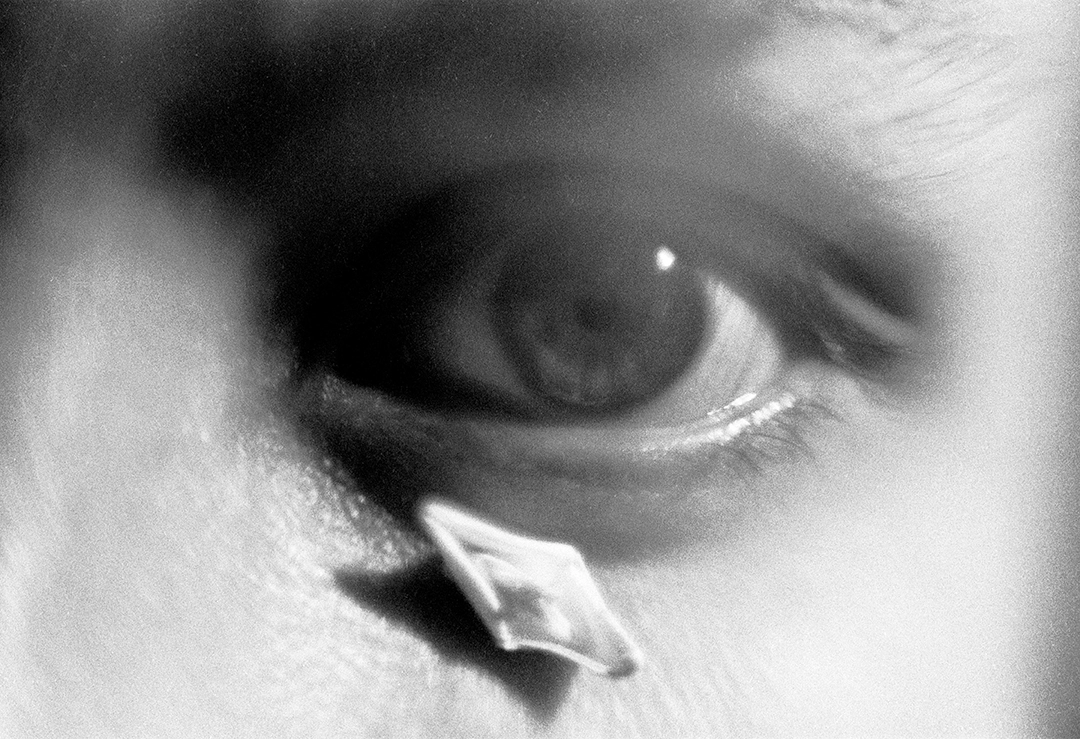
Although I am an avowed admirer of her solo work and have known her for nearly twenty-five years, I do not remember ever having spoken in person with Liudmila Velasco. About her work, about the weather, about how unbearable this or that artist can become. When I left the island, Liudmila was already practically an institution within Cuban women’s photography. For a long time, and until then, I associated her with her legendary binomial with Nelson Ramírez de Arellano.
As a duo, their work insisted on the crossing between the documentary, history as fiction, and visual prophecy. They generated a vast visual archive of the unfolding of the calamitous Cuban project, which swept away the nation’s physical and symbolic heritage. They also created images of prosperity that they superimposed onto the ruins of the city, onto its promises and official iconography, recreating the fantasies and the desire of their generation for better futures.
In my perception —apart from its natural exceptions— that body of work looked mainly outward. It was also a testimony to the frustration of an entire era. It was not sufficiently translucent to direct the gaze toward the other side, toward its own nature as a collective project, toward its affective and mental configurations, or toward its aesthetic and ideological architecture.
When I left Cuba and, through an extravagant pirouette of existence, was hired as Executive Director and Chief Curator of the newly inaugurated Museum of Contemporary Art of the Americas, in Kendall, Miami, I began paying attention to the works that hundreds of artists were sharing on social media. I knew practically all of them, so there were no great surprises. Liudmila’s photographs, however, did catch my attention because, in my opinion, very little —almost nothing— in them had anything in common with the narrative poetics I had assumed were hers.
Liudmila had turned all the way around, one hundred and eighty degrees, and was entering without fear the always swampy terrain of her own subjectivity. She began confronting herself, paying attention to far smaller details, much less transcendental and tremendous ones. Revolution, my foot. The question was rather this one: how does one keep a flame alive when it has been battered by every kind of existential gust?
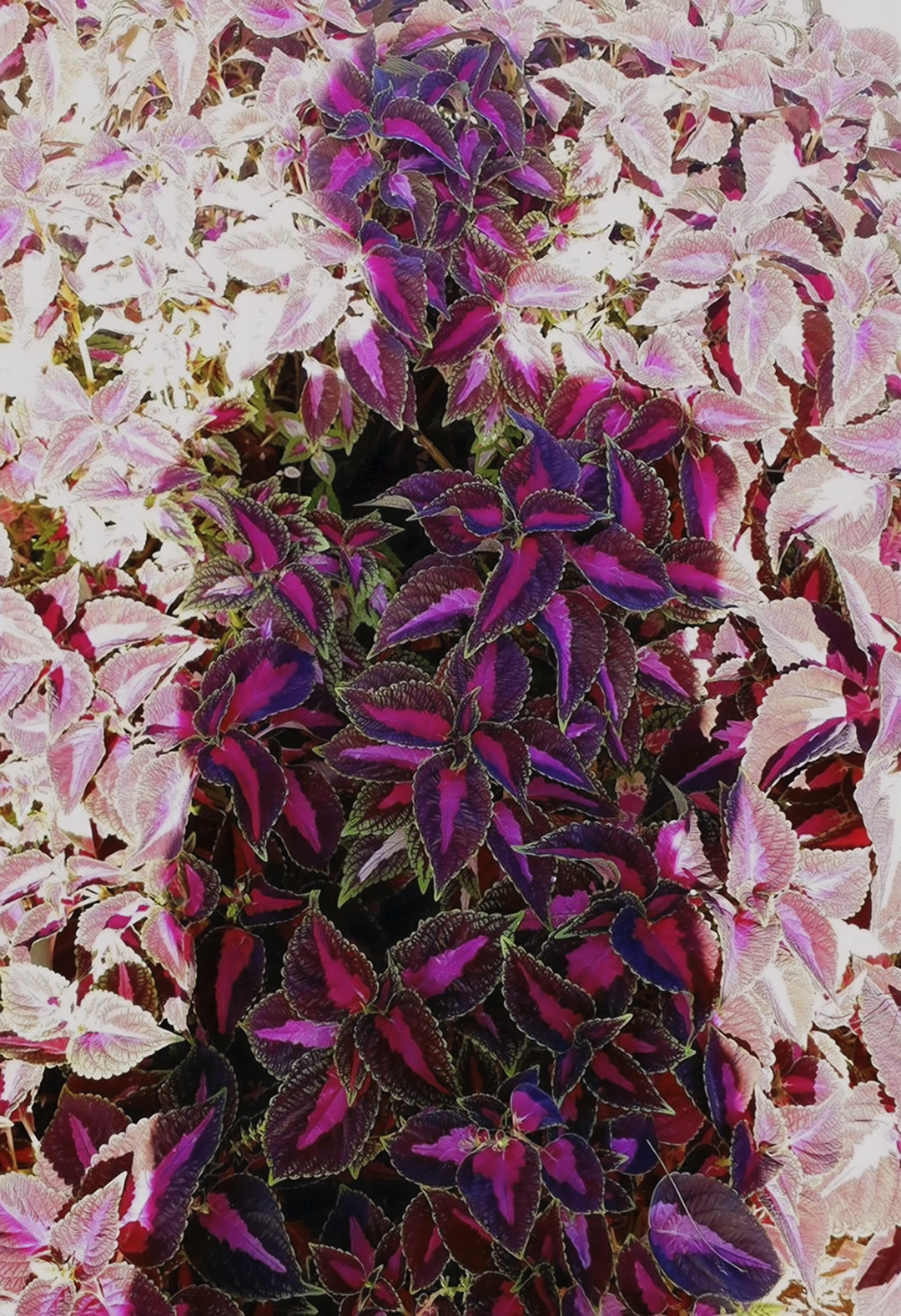
It was no accident that it became my first acquisition for the MoCA–Americas collection. A beautiful piece from the Phantasmagorias series. Warm and, at the same time, cold enough to stretch a protective barbed wire around its shadow. The piece was included in the museum’s first photography exhibition under my care.
This series, along with Déjà-vu and My Self-Portrait and I, places her unequivocally at the epicenter, both of the composition and of her own interest. Perhaps there was a thematic exhaustion there. A moment comes when we grow tired of living —beyond the inconceivable miseries of the everyday— inside a sustained political bombardment. We look elsewhere. Liudmila seems to begin, perhaps to return, to looking toward herself.
Considering her more than twenty years of work, her solid trajectory, and an already validated and established poetics, could one have expected a shift toward her existentiality, toward the more than bearable lightness of her being? Everything is in the biography. One only has to look.
Velasco enters the Cuban scene in 1995 with Silences, her first solo exhibition, at the Fayad Jamís Gallery in Alamar. She shares the space with Chilean photographer Gonzalo Vidal. Both work with emigration: she through the paper boat; he through the documentary record of the exodus. From that point onward, her work advances along two parallel paths. With Nelson Ramírez de Arellano, over more than two decades, she builds a conceptual photography concerned with the public sphere —Project 384, Absolut Revolution, Hotel Habana— through ironic and provocative gazes. At the same time, she sustains an individual, intimate, and symbolic practice, which the exhibition Thresholds. The Long Road Home, at The Annex Gallery, seeks to bring to the foreground.
Liudmila has acknowledged how difficult it was for her to work in the shadow of the solid project she shared with Arellano. This solo exhibition is another act of authorial affirmation, and another invitation to read her as part of a process of detachment from a collective signature. Her training was self-taught. I have read that she regrets not having studied photography formally and that she attributes her craft to a creative compulsion. Her professional arc moves through three moments: the nineties, marked by the crisis of the Special Period and by a personal crisis she states without euphemism; motherhood, which reorganizes her gaze, her archive, and her priorities; and the confinement of the pandemic, which takes her toward landscape and contemplative withdrawal.
Her compositional inheritance does not seem mysterious either. Ana Mendieta, Marta María Pérez Bravo, René Peña, and José Manuel Fors. Frontality and centered framing. The way of constructing the image, formally and conceptually. A single poetic nucleus sustains much of her individual work: one element placed on the axis of the frame, bearing the responsibility of meaning. The paper boats in Silences, the fragments of her body in the mirror, her silhouette in the foliage. In each series there is a central body that stands in for the face.
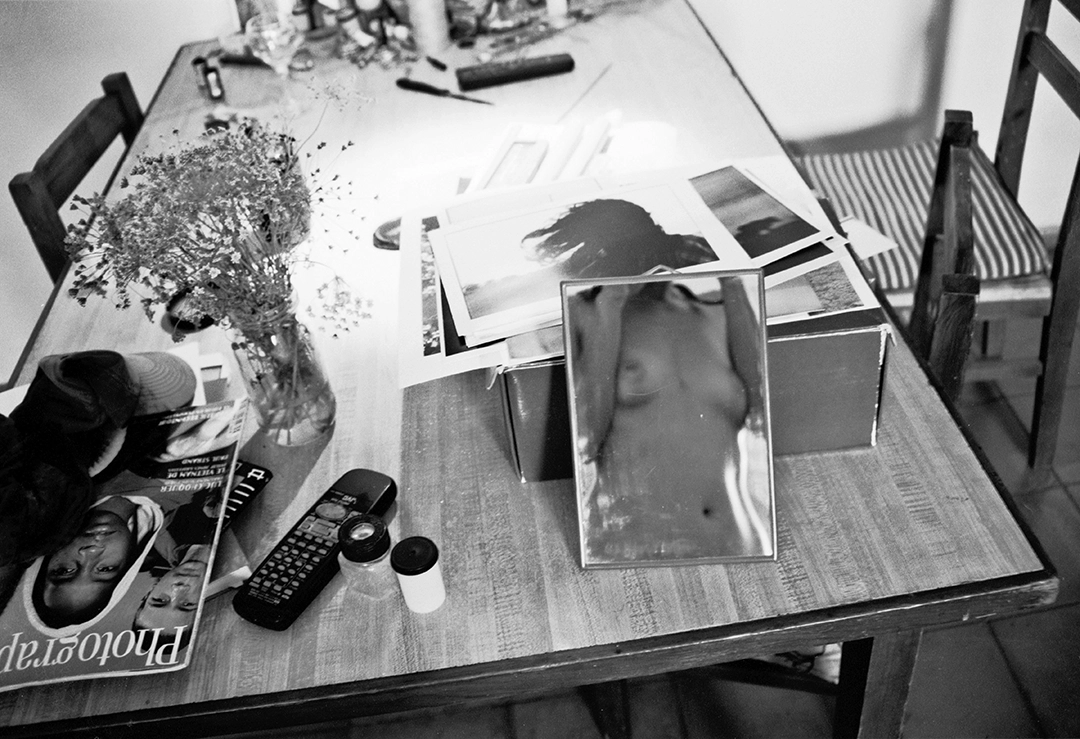
Her early work begins by ignoring color. In Through the Looking Glass, Liudmila links that decision to a state of consciousness, to an intention of rawness and stripping away. The absence of color removes the anecdotal and pushes the reading toward the psychological. Fragmentation reinforces the effect. She photographs herself in pieces, sometimes too small or too large for the frame, and that alteration of scale can be read as a feeling of maladjustment with space.
We find, then, a mirror that functions as an instrument of visual composition and as proof of life. It allows her to construct images otherwise impossible. It doubles the domestic space so she can look at herself through another’s eyes. I also pay attention to her material relationship with the negative. In those from Silences, humidity, fungi, and the passage of time have left marks that she preserves and incorporates into the image. They are witnesses, dark presences that become part of the content. Deterioration becomes an aesthetic affirmation. During her years in the analog laboratory, she worked with photograms of flowers and leaves, collages, and chemical alterations that displaced the image toward unstable zones of color, matter, and apparition. A delicate manual labor on vegetal matter, which returns, transformed, in much of her recent work.
The Phantasmagoria series confirms her persistent negotiation between light, shadow, and surface. The shadow lies, with inexplicable timidity, over the grass, the puddles, and the leaves, trying to camouflage itself just enough, to merge with the background, without renouncing the disclosure of a soft but audible voice. Compositionally, the figure ceases to stand cut out against its surroundings and begins to integrate itself: the contrast lowers, the edge dissolves, the artist appears as a faint presence within the material. It is an accumulative series, open across time, bringing together images gathered over years and seasons. A body of work in permanent configuration that does not close itself in a single piece.
At one point I thought of titling this text The Girl Who Came in a Little Boat. It was only a moment of delirium, a controllable abandonment. Yet Liudmila did arrive in Cuba in a little boat. That may be why the paper boat can likely be chosen by critics as her sign par excellence. Perhaps because it gathers her childhood and loss, her fragility and the fragility of the handmade object. The rafts of 1994 and her own crossing. Paper over water anticipates the dissolution of the person as a whole constituted up to that point. That boat does not return; it fixes migration as a journey without return, a destiny to be reconfigured, the blank sheet, beginning from zero. She has used it in installations, sometimes suspended, sometimes floating, always with the threatening idea of shipwreck.
Displacement is her basic structure. She describes herself as an immigrant formed in transit, with an uprooting learned in childhood and a nostalgia she always carries with her. That condition explains the procedure that runs through her entire work: self-portraiture by delegation. She places herself at the center of the frame, yet rarely frontally or directly. She appears in a partial reflection, a shadow, or a mannequin. That mediated presence can be read as a way of appearing and sheltering herself at once, proper to a subjectivity that experiences itself as fragmented or dissolved.
The nineties concentrate much of the conflict. She confesses to a deep existential crisis, a feeling of collision with the known world, and the experience of the house as a place that oppresses her. The fragmentation of the body and the alteration of scale give form to that inability to fit within one’s own space.
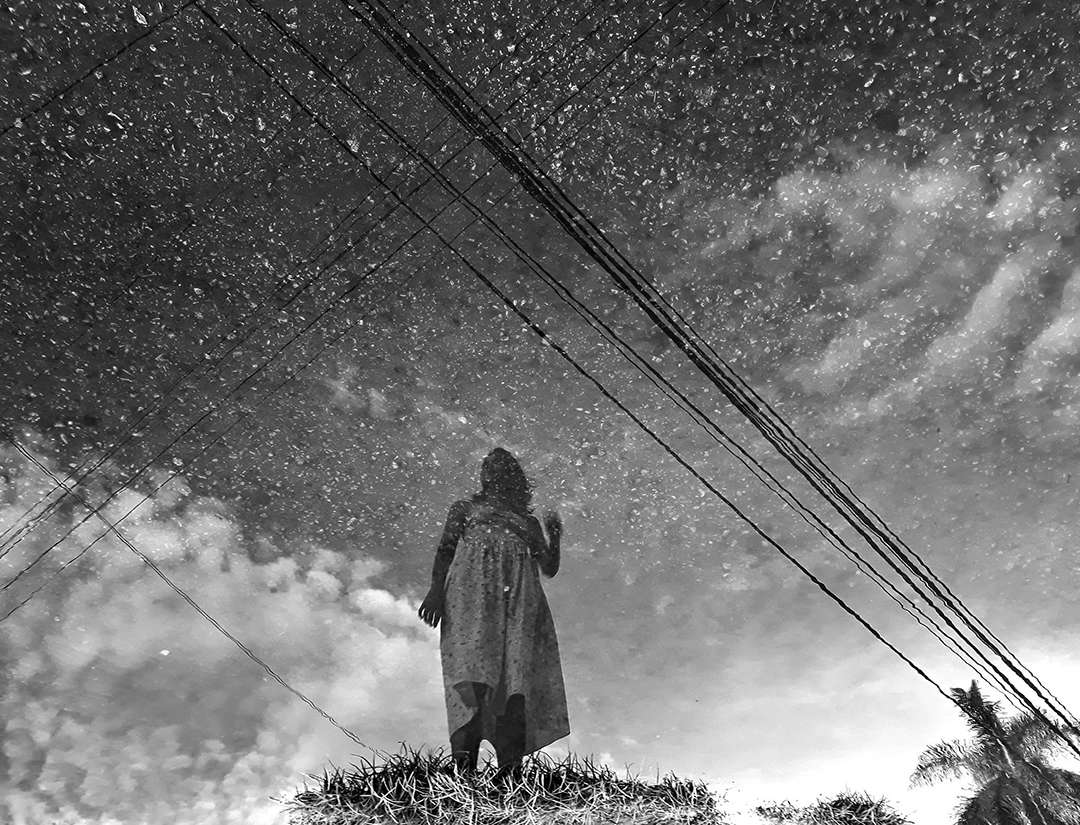
Motherhood introduces a turn. Her daughter becomes the center of her universe, and the camera becomes the instrument for retaining her growth against the passage of time. The gesture of meticulously recording each stage reveals a relationship between photography and loss that Liudmila has declared since childhood, when she thought of the photograph as a way of saving the instant from oblivion. The arrival of the digital changes the scale of production. It allows her to accumulate thousands of records of her daughter’s growth, an archive that today sustains her series Adolescence.
The pandemic opens the third moment. Nature becomes a refuge from fear, and contemplation becomes a practice that restores calm, balance, and silence. Here we can observe the most significant affective shift in her trajectory. The early work resists loss and fixes it in the rawness of the sinking boat or the body in crisis; the recent work reconciles itself with loss, and the silhouette merging with the foliage admits its own fugacity without anguish. The whole traces a movement from conflict toward a serene acceptance of the transitory.
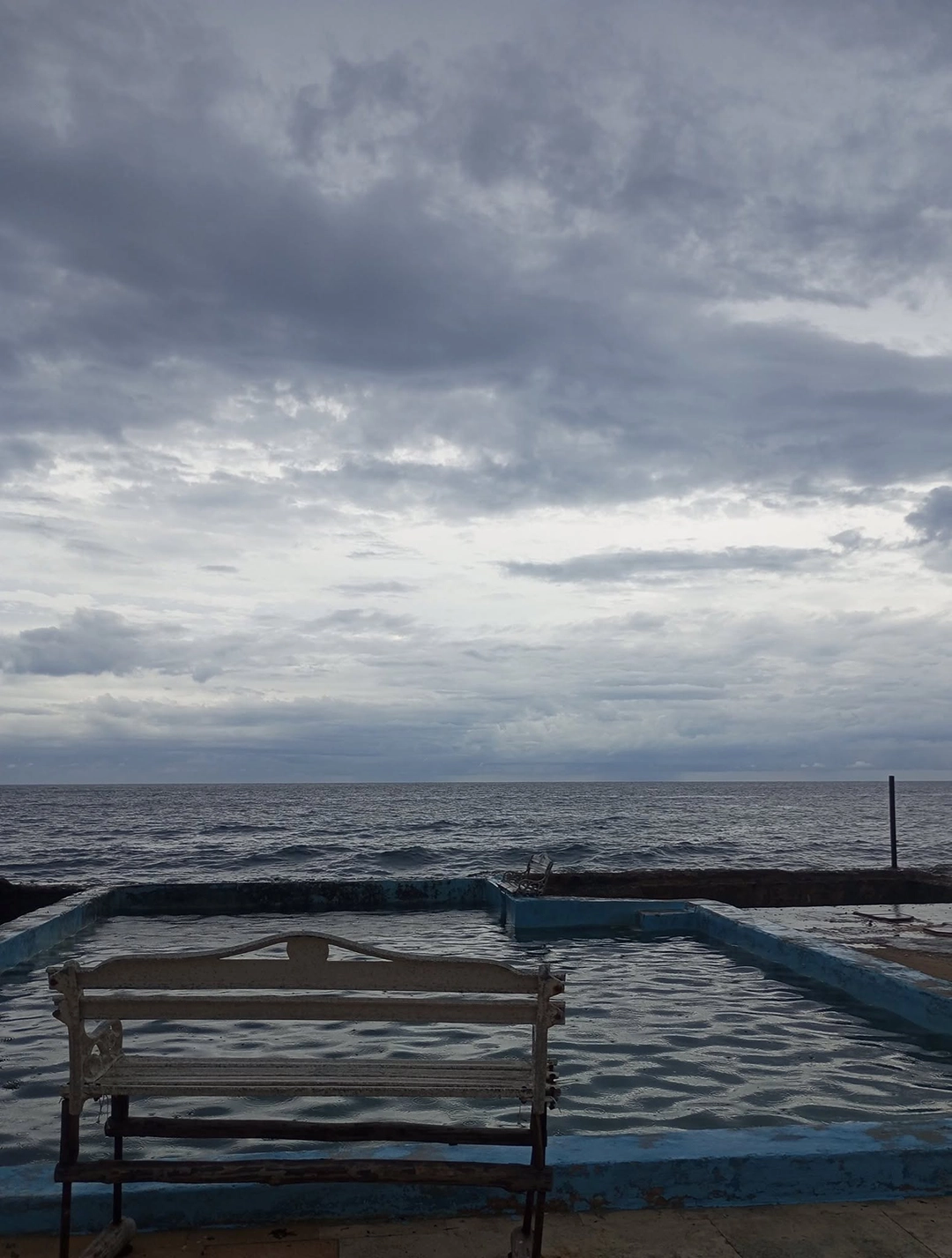
In my personal archive, Liudmila insists again and again —especially in the works she shares only as visual findings on her social media— on the sea as an imaginary. She has described it as a geographical condition and, at the same time, a subjective one. Promise and space for offering, prayers, farewells, and baptisms. I sense a purifying rite of depuration and murmur. This enumeration could bring her sea close to that of the Afro-Cuban tradition, as sacred space and threshold, although she herself has never clarified this explicitly.
Although Borges said that “mirrors and copulation are abominable, because they multiply the number of men,” to me they are fortunate because, in some way, they duplicate the Liudmilas that inhabit them. They also introduce the motifs of the double and the threshold. Through the Looking Glass refers to Carroll and to the passage into another dimension. In her self-portraits, the quicksilver produces some recognition and a great deal of estrangement, and opens the enclosed space of the domestic toward an extensive psychological beyond.
In recent times, shadows seem to be the central sign of her narrative. I do not know whether as figures of the unconscious, of the intuitive and the unfathomable, in keeping with a long symbolic tradition. The very title Phantasmagoria inscribes the spectral. The shadow becomes apparition, trace, elusive presence. At the beginning, her naked body —in Through the Looking Glass— functions as a symbolic territory urged toward transformation; nudity operates as a guarantee of honesty and, ultimately, as a final confession of vulnerability. In her house, her discreet presence forms a delicate microcosm. A personal world on a domestic scale, her own miniature island, a known space that protects her and, at the same time, encloses her.
I want to share with our audience the impression that, with her most recent work, Liudmila seems to have expanded her intimacy until it becomes landscape. The sea, the trees, the rain, the sun in the puddles, and the fallen leaves now inhabit, with unsettling naturalness, the very center of her emotional territory.
Thresholds. Liudmila Velasco’s Long Road Home will open at The Annex Gallery on June 17, 2026, beginning at 11:00 a.m.






If you’re a regular reader of this blog and enjoy its content, you might consider contributing to its upkeep. Any amount, no matter how small, will be warmly appreciated
Founded in 2021, Echoes (Notes of Visual Narrative) invites everyone to explore together the visual codes that shape our world—art, photography, design, and advertising in dialogue with society.

Copyright © 2026 r10studio.com. All Rights Reserved. Website Powered by r10studio.com
Cincinnati, Ohio


Comments powered by Talkyard.