
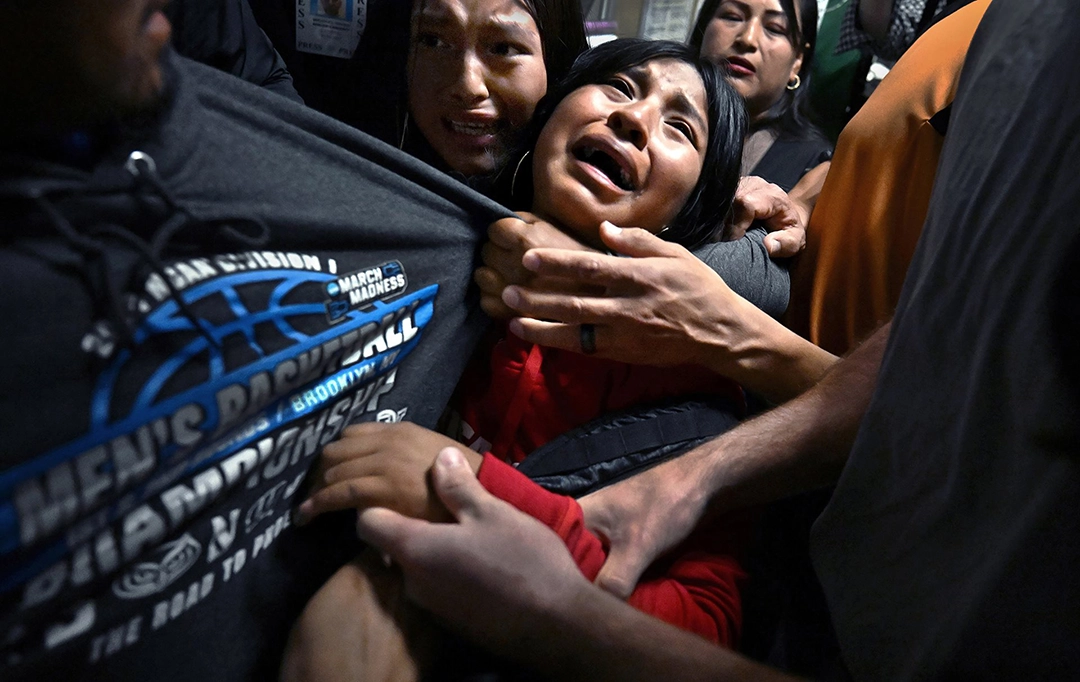
The World Press Photo of the Year is Separated by ICE by Carol Guzy, ZUMA Press, iWitness, for Miami Herald
Though it isn't always evident, behind every prize-winning photograph several images coexist. The one captured by the photographer, perfectly visible, and the ones the system of recognition produces over time, deciding what that image will end up meaning.
The winning photograph of the World Press Photo 2026, Separated by ICE by Carol Guzy, documents an immigration arrest in a New York courthouse, but it also produces — through its author's formal decisions and through the multitude of texts that surround it: caption, jury statement, declarations from the director of World Press Photo, press coverage — a specific reading of what is legitimate to see and what falls outside the sign. And I find that reading entirely accurate.
Within the visual field, which is what concerns this column, the central sign of the image is the figure of the detained father and the daughters clinging to his clothing. That gesture — the desperate grip, small bodies pressed against the adult body — operates as an icon of helplessness in the most classical tradition of Western humanist photojournalism. There is nothing new about it. Its rhetorical efficacy rests precisely on the fact that the viewer already knows how to read it. The child as symbol of absolute innocence, the father as figure of protection that the State deconstructs. The image confirms a prior schema. That doesn't make it any less true, but it does make it, in semiotic terms, highly conventional.
Guzy's photograph concentrates its force in four formal decisions that operate simultaneously. First, the light. Within the even, functional illumination of a federal building, there is a zone where it spills onto the faces and bodies surrounding the father with a concentration the rest of the frame lacks. That zone turns pain into visible texture and theatrically prioritises what the viewer is meant to see before any text explains it.
Then the hands clutching the father's shirt and the fold of fabric pulled taut by the grip trace a line that gathers nearly all the kinetic energy of the image, but that line ends at a point outside the frame. This deliberate draining of an essential signifier prevents the eye from closing the story and leaves the viewer suspended in a tension without resolution.
Here I pause. The father, absent, functions as narrative centre and as a structure of faith. We "perceive" him through his effect on the other bodies. It is a visual operation the Western religious tradition has used for centuries to represent the presence of that in which one must believe without seeing. Read politically, the absence is the abduction itself. The State removes the father from legal and familial space; the image removes him from visible space. The frame formally repeats the disappearance it denounces. Light, diagonal, absence and repetition: four formal operations working on the same plane, producing an image that exceeds itself.
The photograph also fails to show — and this is another telling blind spot — the institutional context that made it possible. Access to the Javits Building was granted exceptionally and selectively. Guzy and other photographers were admitted into one of the few federal spaces where such documentation was tolerated. The frame, therefore, answers to an aesthetic decision by the photographer and, at the same time, to an access negotiation administered by the State itself. The image that denounces a policy is simultaneously an image that policy permitted. None of this appears in the photograph, yet much of what we see in it is structured by it.
Outside the image, the texts that surround it — captions, jury statements, the words of the director of World Press Photo — are no neutral supplements. They are co-producers of the sign. When the jury writes that what Guzy documented "is not an isolated case but a policy applied systematically," it is closing down an open interpretation and fixing the correct reading of the image. A photograph, which on its own might admit several approaches, becomes anchored — in the sense Roland Barthes gave the term — to a single direction of meaning: the denunciation of a State policy. It is an ideological operation as significant as the framing itself, and one that almost always passes unnoticed. This goes without saying, viewed from an emotionally inert vantage. I find no second readings free of the fanaticism that contaminates every discourse in circulation.
There is one final level of sign production: the contest itself. The World Press Photo is no mirror of global photojournalism; it is a mechanism of selection with its own historical, cultural and geopolitical criteria. That an image about American immigration policy should win the top prize in 2026 says a great deal about which kinds of suffering are legible and worth rewarding for a global jury based in Amsterdam. This in no way invalidates Guzy's photograph, but it does situate its consecration within a symbolic economy that also deserves to be read critically. An image wins a prize for being timely, because at that moment it articulates, in recognisable form, what certain cultural circuits are prepared to see.
The other two finalists are Saber Nuraldin (@saber.nuraldin), @epa_images with Aid Emergency in Gaza and Victor J. Blue with The Trials of the Achi Women. I share below the texts World Press Photo dedicated to each of them.
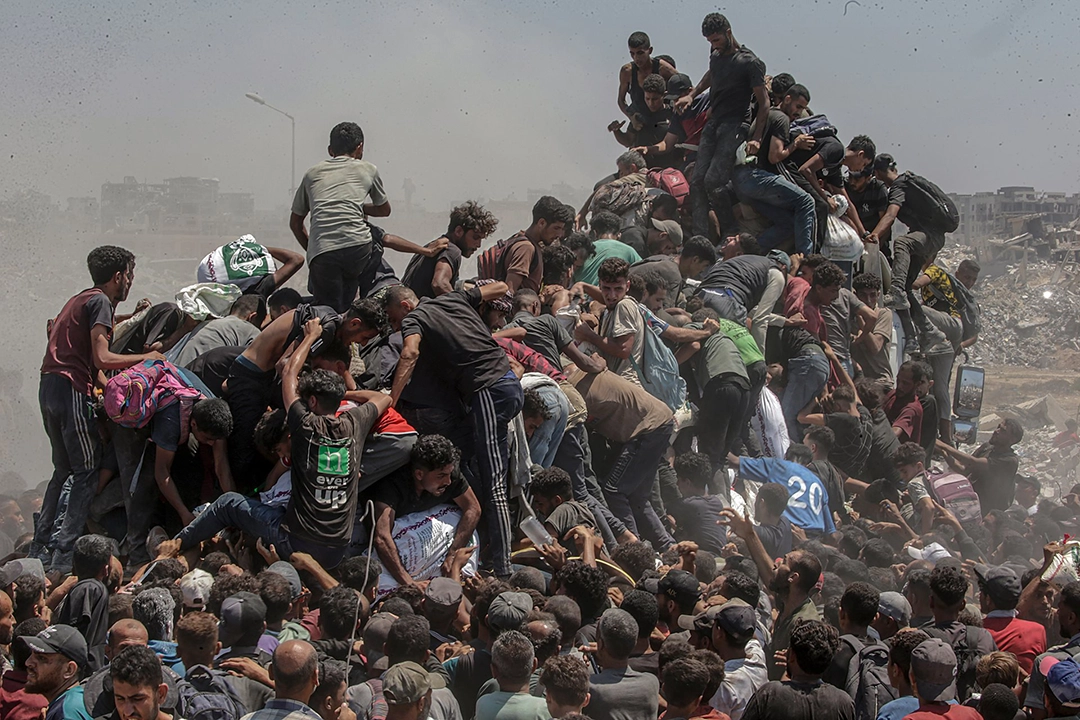
'Aid Emergency in Gaza' by Saber Nuraldin (@saber.nuraldin), @epa_images. World Press Photo 2026.
Aid Emergency in Gaza
Palestinians clamber onto a humanitarian aid lorry as it enters the Gaza Strip through the Zikim Crossing, attempting to reach flour, on 27 July 2025, during what the Israeli military described as a "tactical suspension" of operations to allow humanitarian aid through. In 2025, famine took hold amid what an independent inquiry by the UN Human Rights Commission has concluded constitutes a genocide in Gaza. Israel disputes this finding. Israeli authorities imposed a complete aid blockade in March, a tactic humanitarian organisations described as the weaponisation of starvation. When international pressure led to a partial reopening of crossings in May, most deliveries passed into the hands of the Gaza Humanitarian Foundation (GHF), set up by the United States and Israel to bypass the UN-led aid system. Its operation, run by military personnel, was widely condemned by global human rights and international law organisations as unethical and in violation of international law. The UN reports that between late May and early October, at least 2,435 Palestinians were killed seeking food at or near GHF distribution points. The GHF ceased operations when a fragile ceasefire took effect in October. Despite some aid entering Gaza, more than 75% of the population still faced hunger and malnutrition in December. The photographer was born in Gaza and has documented life there since 1997.
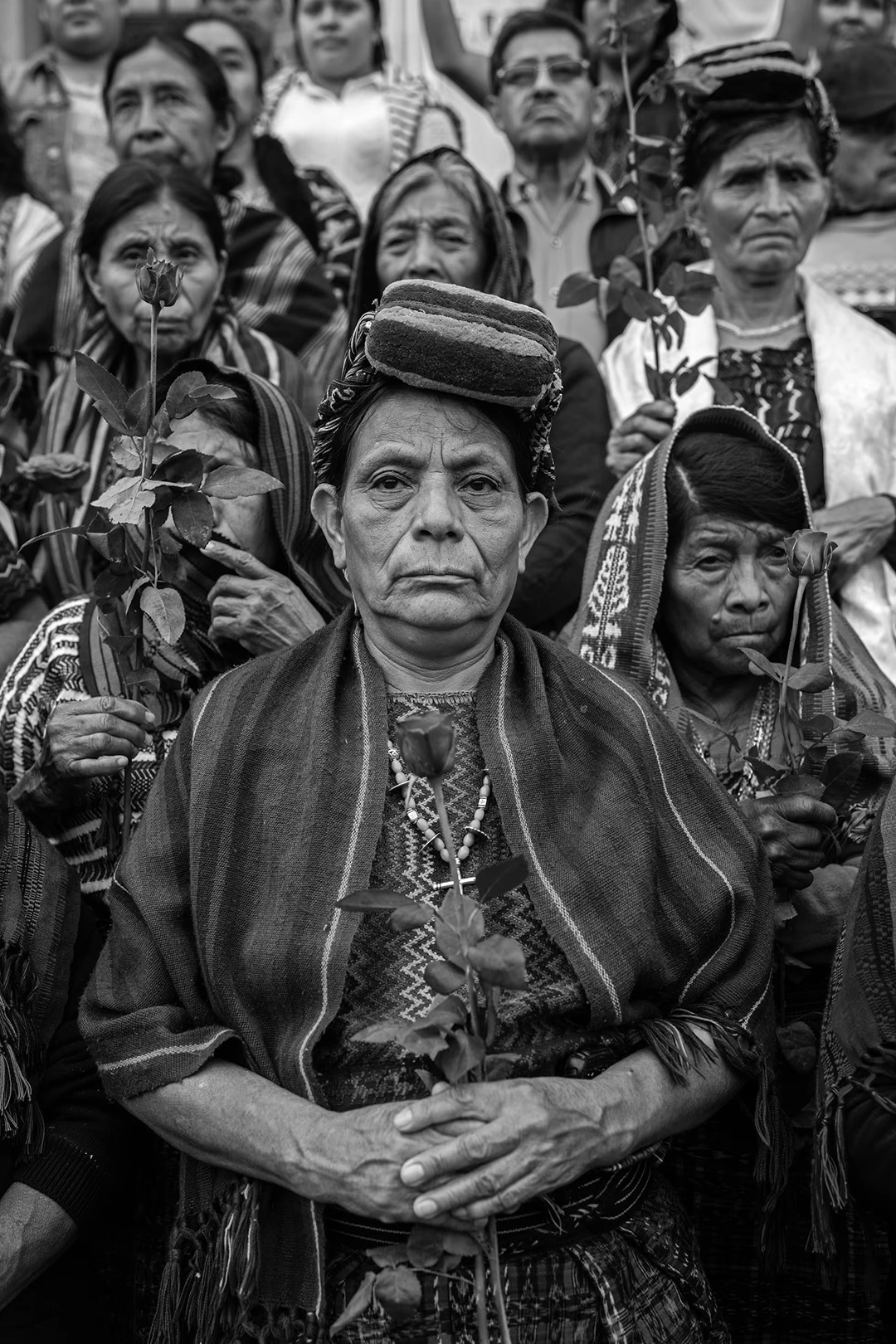
The Trials of the Achi Women' by Victor J. Blue (@victorblue), @nytmag. World Press Photo 2026.
The Trials of the Achi Women
The photograph by Victor J. Blue, published in The New York Times Magazine, operates in the opposite register to the other two. There is a sober, almost classical portrait of Doña Paulina Ixpatá Alvarado and a group of Maya Achi women outside a courthouse in Guatemala City on 30 May 2025, the day three former civil-defence patrollers were sentenced to forty years in prison for rape and crimes against humanity committed during the civil war. The image is static, frontal, built with the formal dignity of portrait painting. That decision is deliberate and semiotically very precise: it corrects a long visual tradition that depicts survivors of sexual violence as vulnerable or broken subjects, and instead inscribes them within an iconography of authority. They stand before the institution that finally vindicated them after fourteen years of litigation. The photograph documents the closing of a battle, not its urgency. And that difference in time — the long arc set against the instant of the other finalists — is part of what the prize recognises.
In conclusion, I think the winning photograph is excellent. The context, the cultural circuit that awards it, the ideology behind it — none of it matters to me. I applaud it because what it denounces is plainly denounceable. From the point of view of millions of people. Other millions will disagree. That, too, is legitimate. It falls to them to find the photograph that shows their reasons.






If you’re a regular reader of this blog and enjoy its content, you might consider contributing to its upkeep. Any amount, no matter how small, will be warmly appreciated
Founded in 2021, Echoes (Notes of Visual Narrative) invites everyone to explore together the visual codes that shape our world—art, photography, design, and advertising in dialogue with society.

Copyright © 2026 r10studio.com. All Rights Reserved. Website Powered by r10studio.com
Cincinnati, Ohio


Comments powered by Talkyard.