
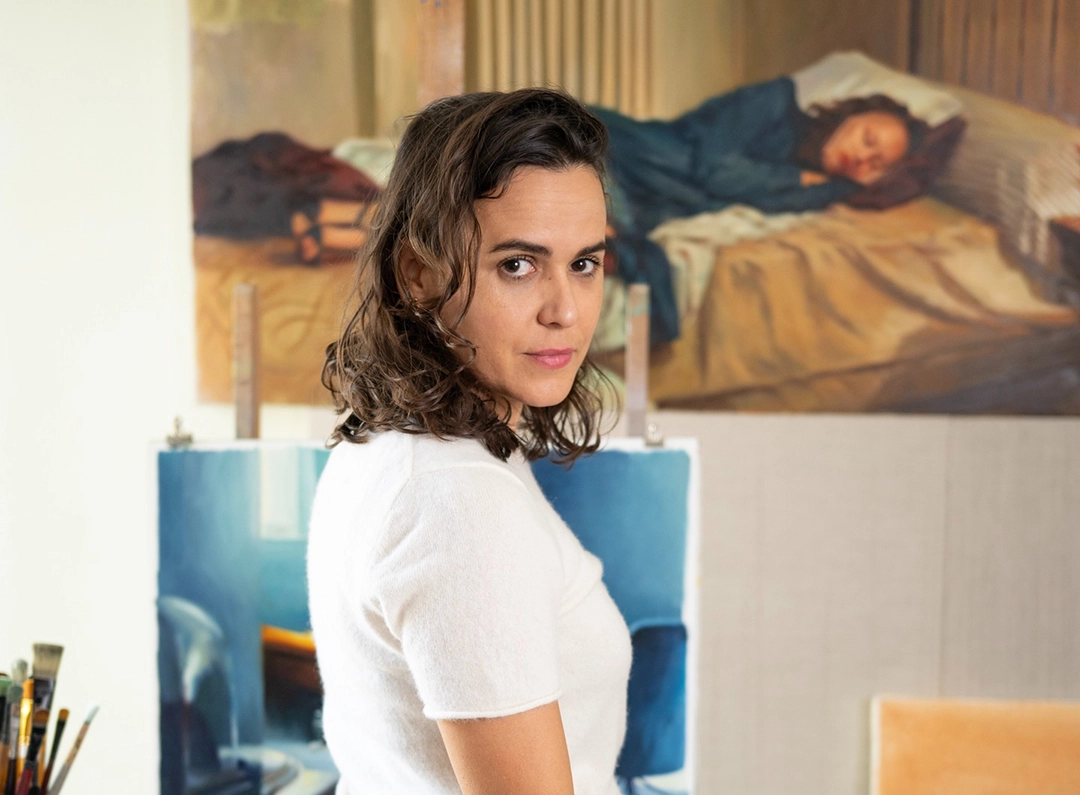
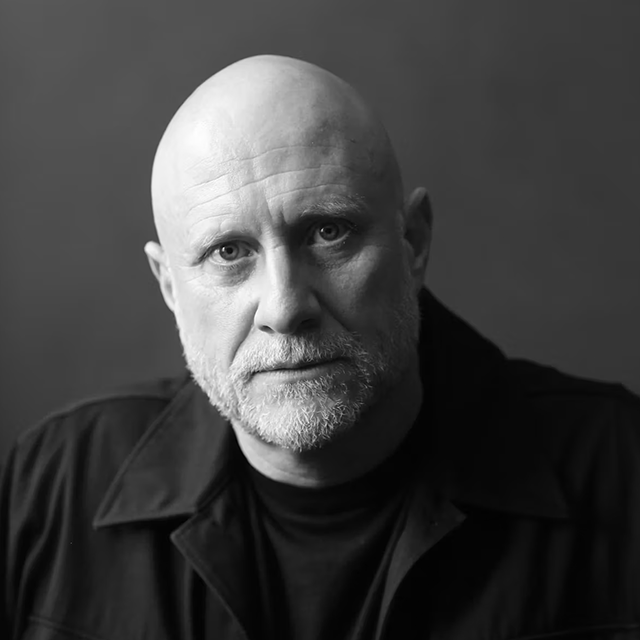
Detail of a photograph by Lisbet Corcova
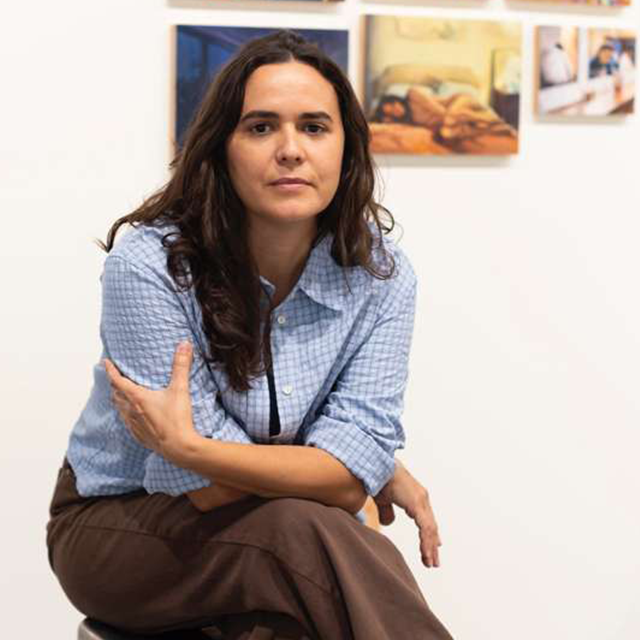
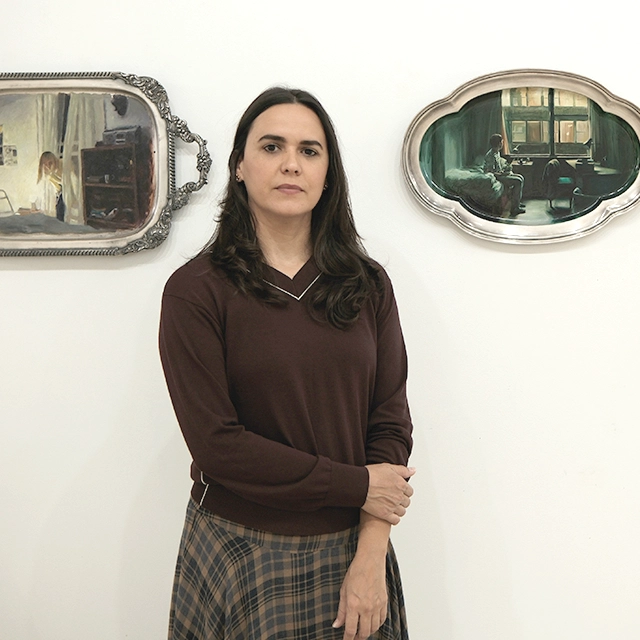
A few weeks ago I met Leticia Sánchez Toledo (Cabaiguán, Cuba, 1985). The friend of a friend who is turning into a friend. We are somewhere inside that passage.
The first time I saw her work was in her living room. Some paintings hung on the walls. Others rested on the floor, leaning against pieces of furniture, as though they had not quite finished deciding where to be. On a table, tubes of paint, some of them open, lay in no apparent order, used only moments before I arrived.
I found the sensation slightly unsettling. The activity had not stopped. This was not a studio at rest. It felt like a suspended gesture. Painting seemed to have kept happening and merely made room for me. As though stopping, waiting for me, and continuing all belonged to one continuous impulse, more attentive to time than to courtesy.
That day we talked about many things, had something to drink, ate, and in one of those moments of solitude-in-company I began to look at the paintings. I looked at them and thought of Edward Hopper, that taciturn giant who learned how to paint silence after spending years illustrating advertisements. The colors, the tones, the places brought him to mind. Yet the sensation Leticia’s painting left me was not that of a scene I could describe. It was the sensation of a duration I could not name. I spent several days turning it over before arriving at a phrase that seemed acceptable to me: Leticia paints time as experience. When I leave a Hopper painting, I remember what I saw. When I leave one of Leticia’s, I carry the more troubling sensation that I am still there.
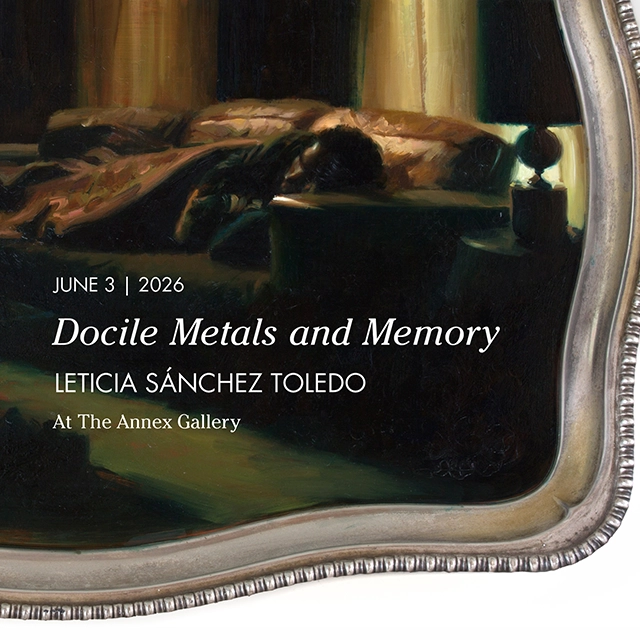
I saw her oils, her works on paper, rummaged through the catalogue on her website, only to confirm that her works do not represent scenes. They suspend them.
The figures are not caught halfway through an action. They are caught halfway through an interval. Someone has already arrived, or is about to leave, or has been waiting so long that the difference no longer matters. Beds appear less as places of rest than as containers for unfinished thoughts. Doors are questions. Hospitals, laundromats, subway stations become architectures of waiting rather than settings.
Painting behaves here the way memory does. The edges blur out of honesty, not indecision. Light does not reveal. It lingers. The brush does not insist. It listens. The figures are neither idealized nor degraded. They are simply allowed to remain unfinished. What emerges, then, is less a realism of events than a realism of waiting. The issue lies beyond how these paintings are made. It lies in the kind of relation they propose. By refusing to seal the gesture, complete the scene, or resolve the image, the painting relinquishes one of art’s most reassuring promises: the promise of offering something finished. In its place it assumes a more uncomfortable responsibility. It does not explain. It does not conclude. It does not occupy the place of a time that has yet to pass. Here, the unfinished ceases to be a lack and becomes an ethical position. Remaining unfinished is not negligence. It is respect for what is still taking place, for what does not belong entirely to us. These paintings, rather than showing me something, keep me company, which struck me as a very beautiful gesture, honestly. A quiet, insistent gesture, one in which waiting ceases to be a theme and becomes a way of being in the world, under a kind of ethics of the unfinished.
The second time I returned to Leticia’s house, I no longer looked at the paintings in the same way. The works had not changed. Something in my own way of standing before them had shifted. Familiarity did not make them clearer. It made them more insistent. I was no longer looking at them as scattered pieces across different contexts — the house, the gallery, the screen — but as variations of one and the same experience beginning to recognize itself.
This was not repetition. It was persistence. The images did not adapt to the place where they appeared. The place ended up adjusting itself to them. The house, the gallery, the website ceased to be settings and became layers within the same duration. Something remained intact from one space to the next, as though the paintings carried their own time with them, indifferent to their surroundings. That was when I began to notice that I was not facing works that asked to be seen only once. They demanded return. And with each return, the thing that changed was not the image. It was the listening. Because looking at those paintings, I realized then, had become for me a way of hearing.
Each painting seemed to drag along its own tempo. Not an atmosphere — something sonic, recognizable to me. I do not mean that the painting literally “sounded,” nor that there was some obvious correspondence among image, music, and lyrics. It was subtler than that. If I remained before each painting for as long as it required, an inner listening would appear: a rhythm, a cadence, a way of moving forward or lingering that found, somewhere in my auditory memory, an equivalent. A song, not as illustration, but as company.
It then occurred to me to pair each painting with a song as a personal, intimate exercise, almost a domestic one. A private gesture, fully aware of its arbitrariness. I am certain someone else would see no absolute relation between the painting and the music, or would arrive at a completely different soundtrack, equally legitimate. There is no correct music here, and no reading that imposes itself. There is only my shared experience: that of a suspended time activating in me — or in other possible viewers — a different way of listening.
I would not call it some overblown synesthetic tangle of the senses. I was not hearing colors or seeing sounds. Something stranger and more precise was taking place: a temporal coincidence. Seeing and hearing occurring at once, without ever fully translating into one another. The painting holds me. The music accompanies me. Both insist within that same interval where nothing is resolved and everything remains. That was when I understood that what I had begun to perceive as listening was neither metaphor nor embellishment. It was the appearance of an object that refuses exhaustion, that insists, that repeats itself without repeating itself. Not a soundtrack imposed afterward, but a natural consequence of that time Leticia paints and that, once I enter it, I never entirely leave.
So I set to work. If the paintings were asking me for time, and if that time was beginning to feel like a form of listening, the logical thing was to accept the invitation and see how far it went. Not in order to fix a meaning, nor to translate painting into music — that would diminish it — but to accompany one duration with another possible duration. That is how I began putting together my own soundtrack for some of Leticia’s paintings. Not as curatorship. Not as an interpretive key. As a personal exercise, almost a domestic one. A way of remaining a little longer inside each painting. A way of listening to it without demanding that it speak. I am convinced that someone else would assemble a completely different list, equally valid, perhaps better. This one does not seek closure. It merely traces one possible path.
What follows, then, is not the music of these paintings. It is the music I heard while looking at them. Songs that do not explain the images yet accept their time; songs that do not illustrate them yet allow themselves to be affected by them. A provisional soundtrack for an object that, by definition, resists being held still.
I firmly believe these works never close because they were not made to end. They stay. They wait. And while one looks at them, something, inevitably, begins to sound.
Paint tracks
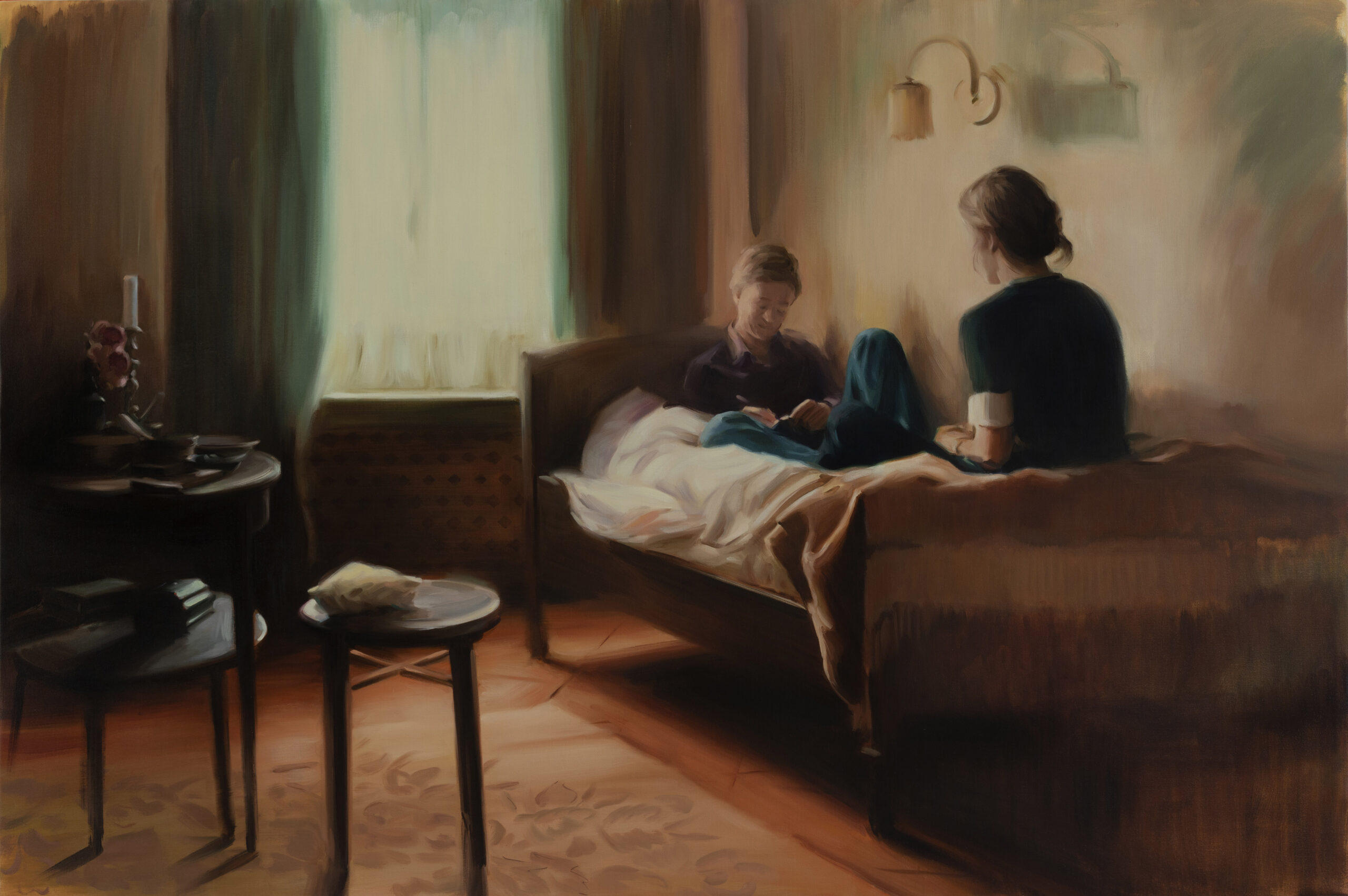

A Shared Chapter, 2023
Oil on linen | 72 x 48 inches
Amelia | By Joni Mitchell
This painting is about closeness without convergence. Amelia is not a love song. It is a problem of geometry. The people occupy the same sky and remain on different trajectories. The room in the painting behaves like Mitchell’s horizon: wide, luminous, emotionally misaligned. Everyone is present. No one arrives.
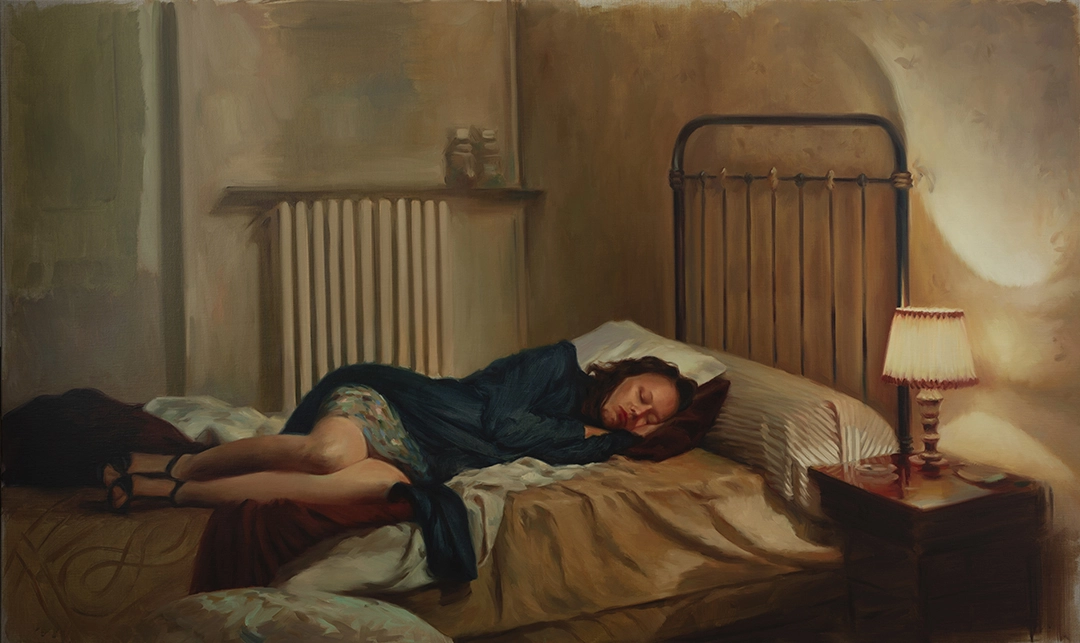
I’m Coming Back to You I, 2025
Oil on canvas | 36 x 60 in
River Man | By Nick Drake
The gathered body, the bed, the faint domestic glow — this is exactly Drake’s tempo. River Man moves forward without ever resolving its own sadness. The painting does the same. The figure is not asleep. She is listening inward. Both song and image feel like promises whispered to oneself, never spoken aloud.
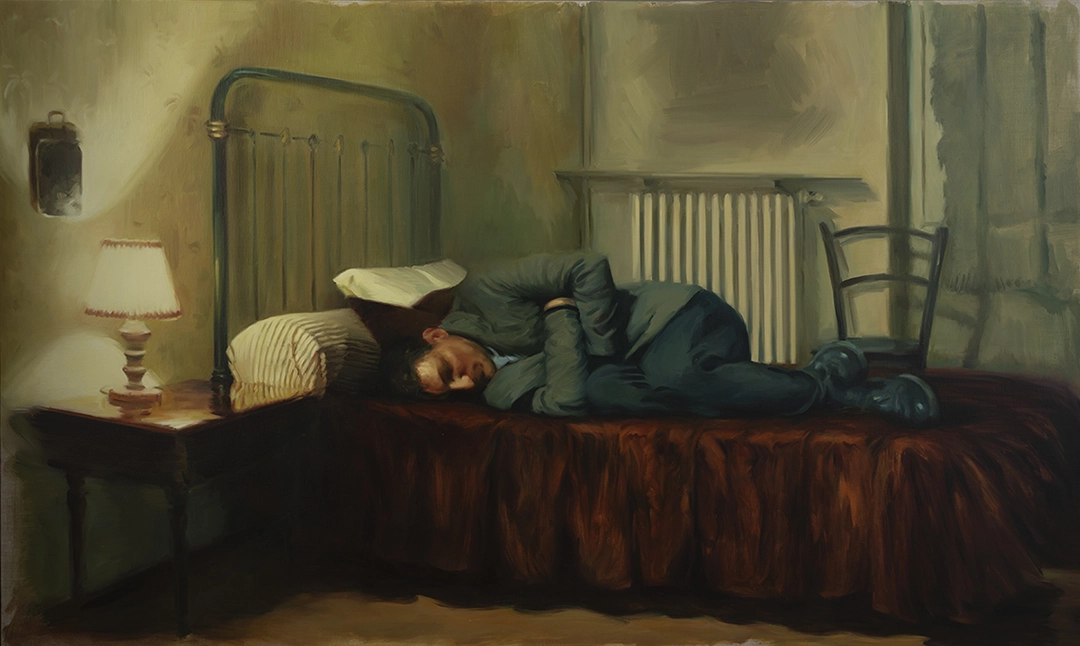
I’m Coming Back to You II, 2025
Oil on canvas | 36 x 60 in
Day Is Done | By Nick Drake
If the first painting is anticipation, the second is consequence. Day Is Done holds exhaustion without bitterness. The body lies on its side before the world, resigned yet undefeated. The song asks for no comfort. The painting does not ask for it either.
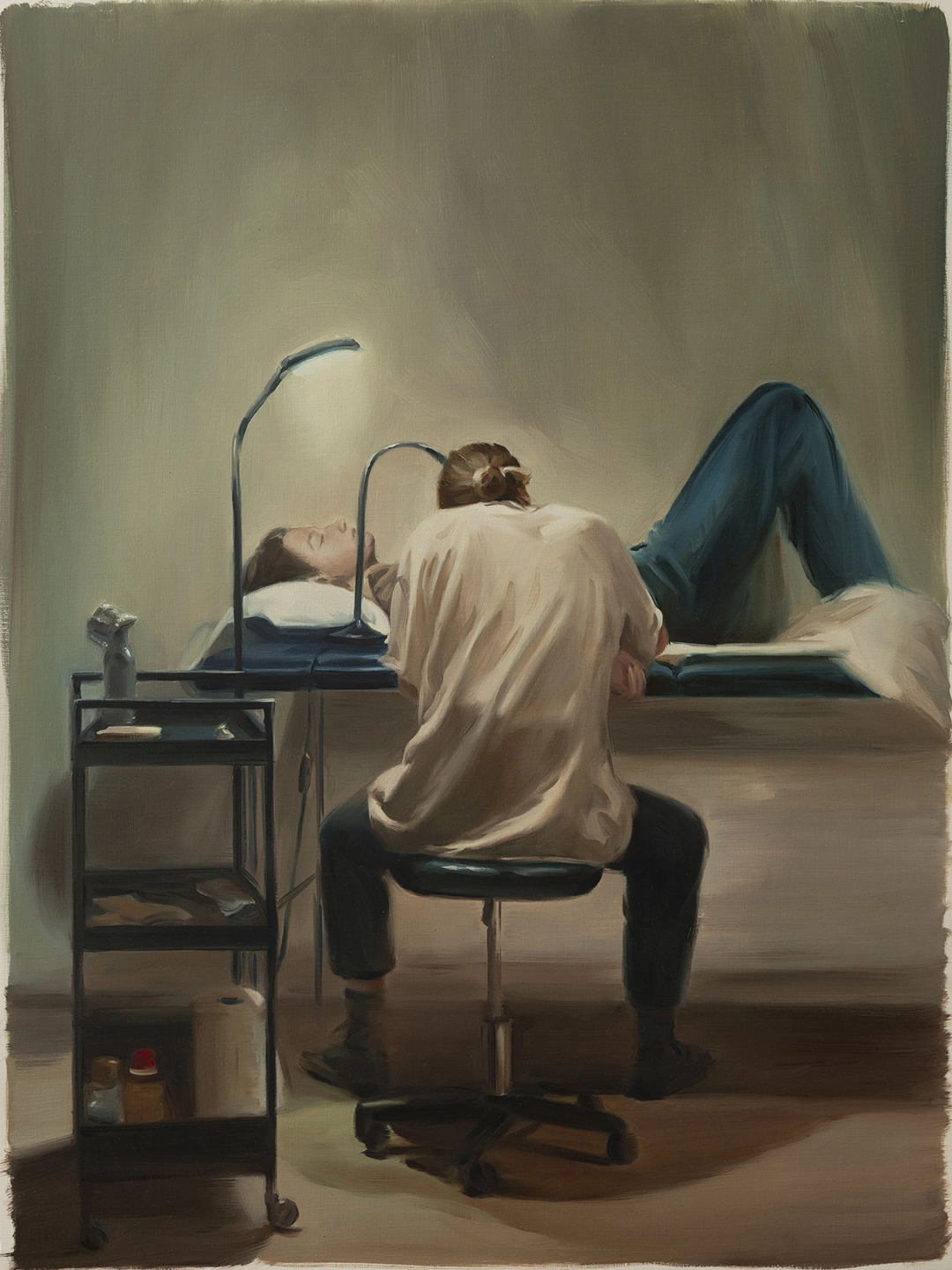
Study for First Date, 2024
Oil on paper | 18 x 24 in
Andata | By Ryuichi Sakamoto
Andata moves like a breath under tension. It understands illness as duration rather than drama. The painting shows care as a posture that ends up deforming the caregiver’s body. The song listens to that deformation with restraint. Nothing grows. Nothing breaks. Everything holds.
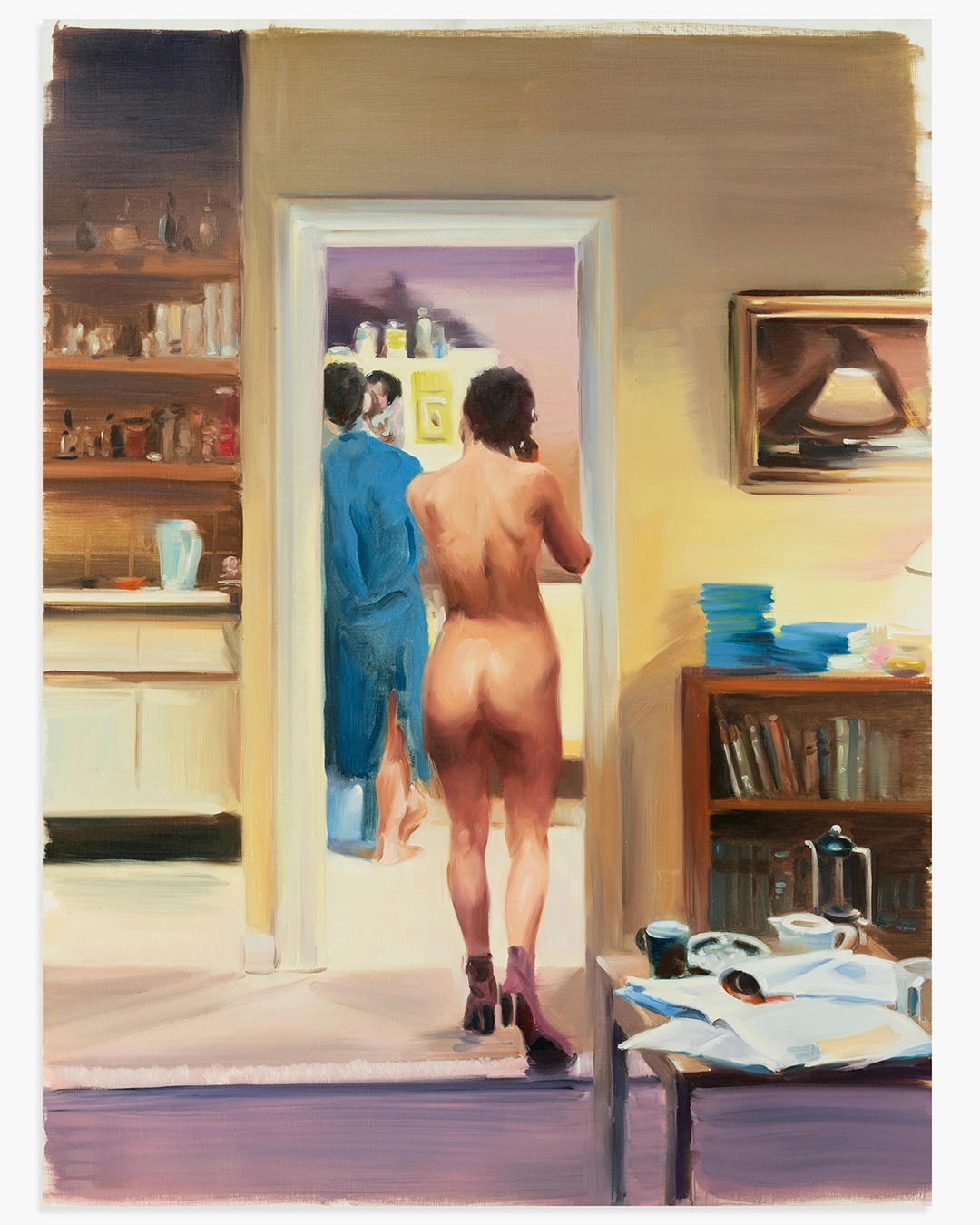
Study for Alice, 2023
Oil on paper | 24 x 18 in
Famous Blue Raincoat | By Leonard Cohen
This has nothing to do with eroticism. It belongs to departure. Cohen’s song is written after intimacy, once desire has already become entangled with memory and guilt. The painting captures that exact moment. The body is fully visible and emotionally inaccessible. We arrive late — and Cohen knows that lateness intimately.
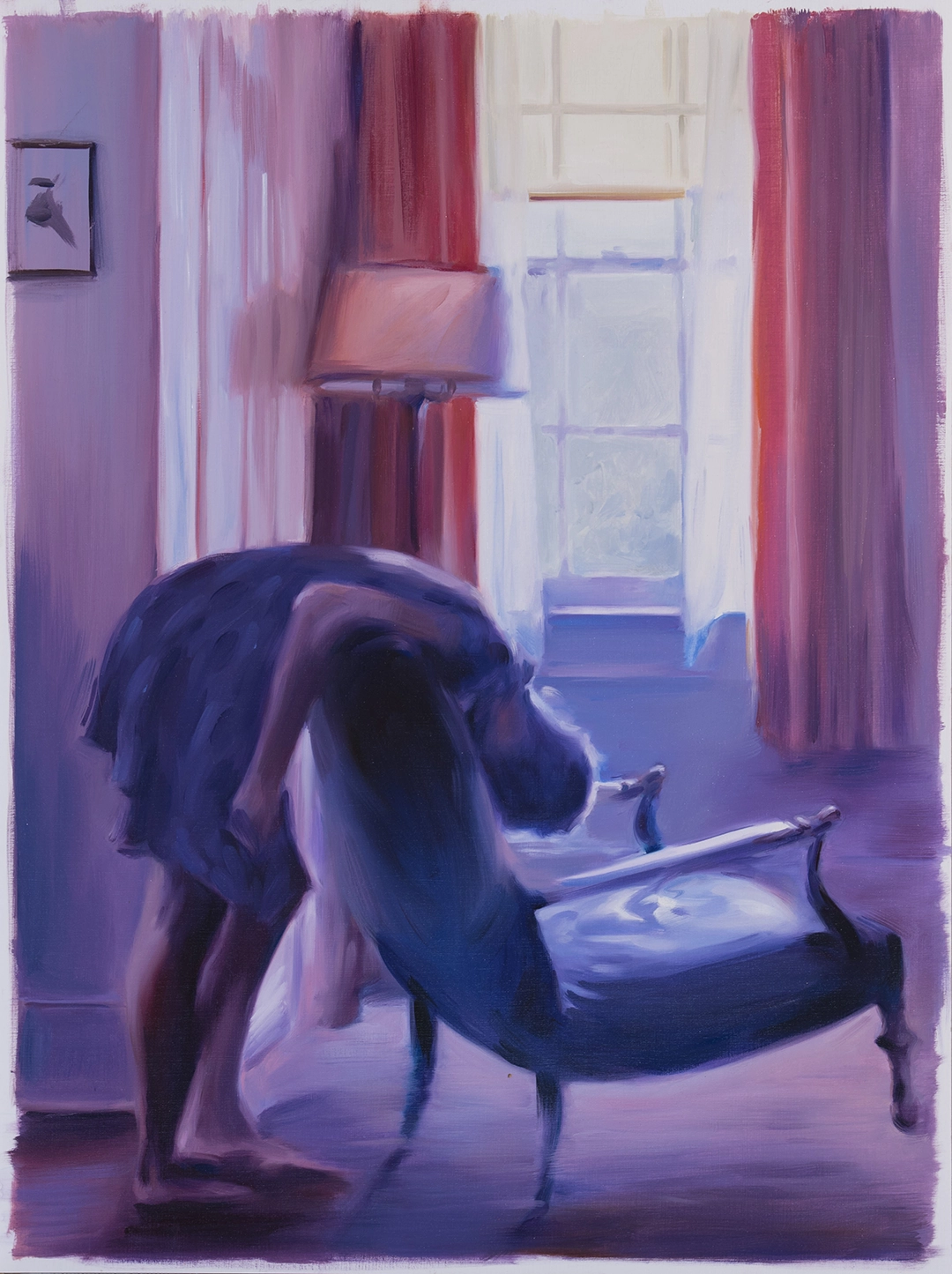
Study for Awkward Age, 2023
Oil on canvas | 18 x 24 in
Left Alone | By Fiona Apple
A body negotiating with gravity. Apple’s song refuses representation. It refuses to explain pain in socially acceptable form. The painting shares that refusal. The posture is awkward, inelegant, apparently necessary. This is what honesty looks like once it stops worrying about beauty.
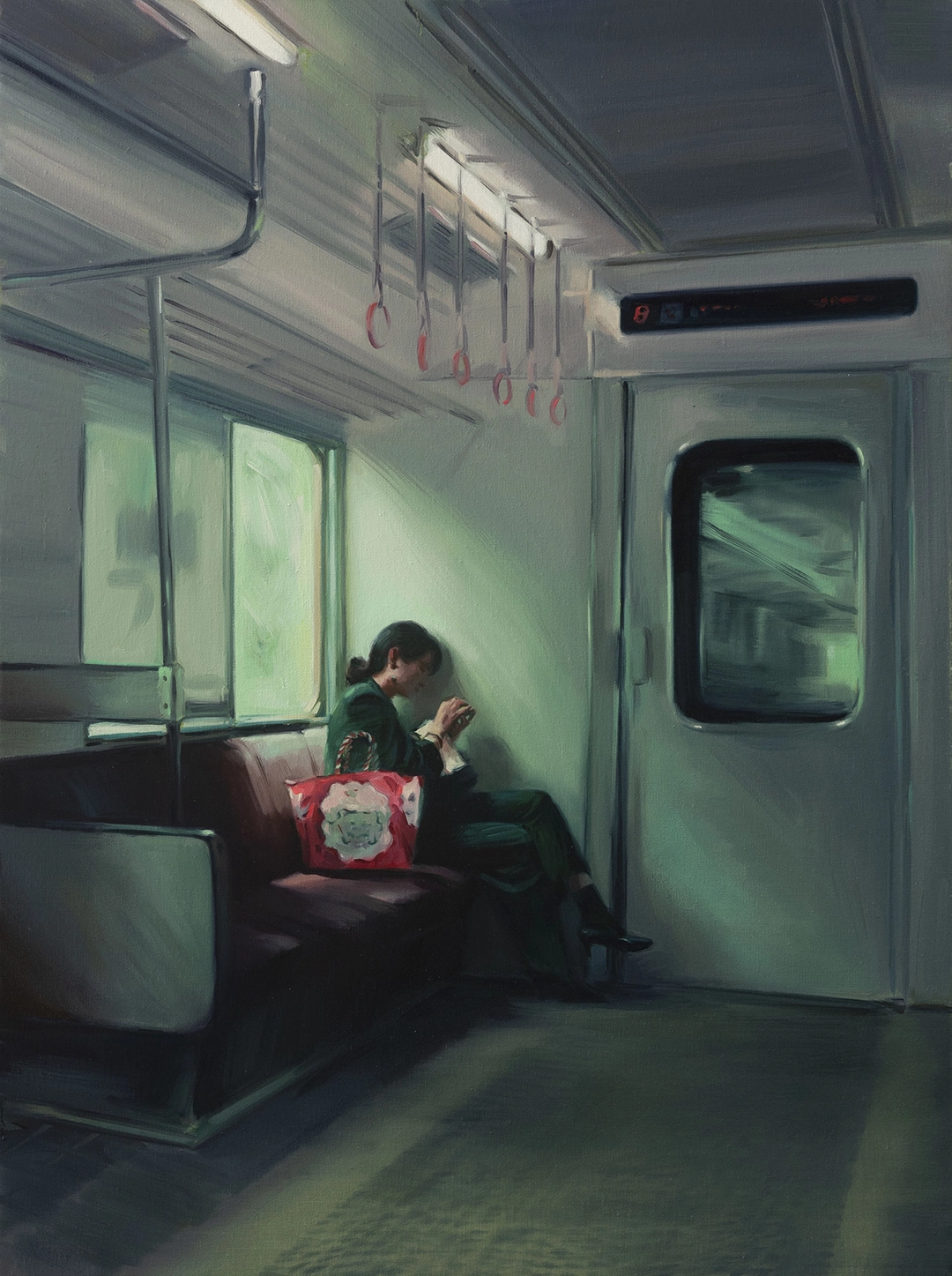
Jorneywoman, 2024
Oil on linen | 24 x 18 in
An Ending (Ascent) | By Brian Eno
Movement without narrative. Journey without destination. The figure exists inside a mechanical hum that neither threatens nor consoles. Eno’s piece does not tell you what to feel. It alters how long you are willing to feel it. The painting does the same.

Lavandería
Spiegel im Spiegel | By Arvo Pärt
Repetition. Cycles. The ethics of waiting. The laundromat is one of the most honest spaces in contemporary life: time passes whether you want it to or not. Pärt’s music does not accompany the scene. It is the scene. Slow, circular, reverent.
This article was previously published in Diario de Cuba on March 8, 2026.




If you’re a regular reader of this blog and enjoy its content, you might consider contributing to its upkeep. Any amount, no matter how small, will be warmly appreciated
Founded in 2021, Echoes (Notes of Visual Narrative) invites everyone to explore together the visual codes that shape our world—art, photography, design, and advertising in dialogue with society.

Copyright © 2026 r10studio.com. All Rights Reserved. Website Powered by r10studio.com
Cincinnati, Ohio



Comments powered by Talkyard.