
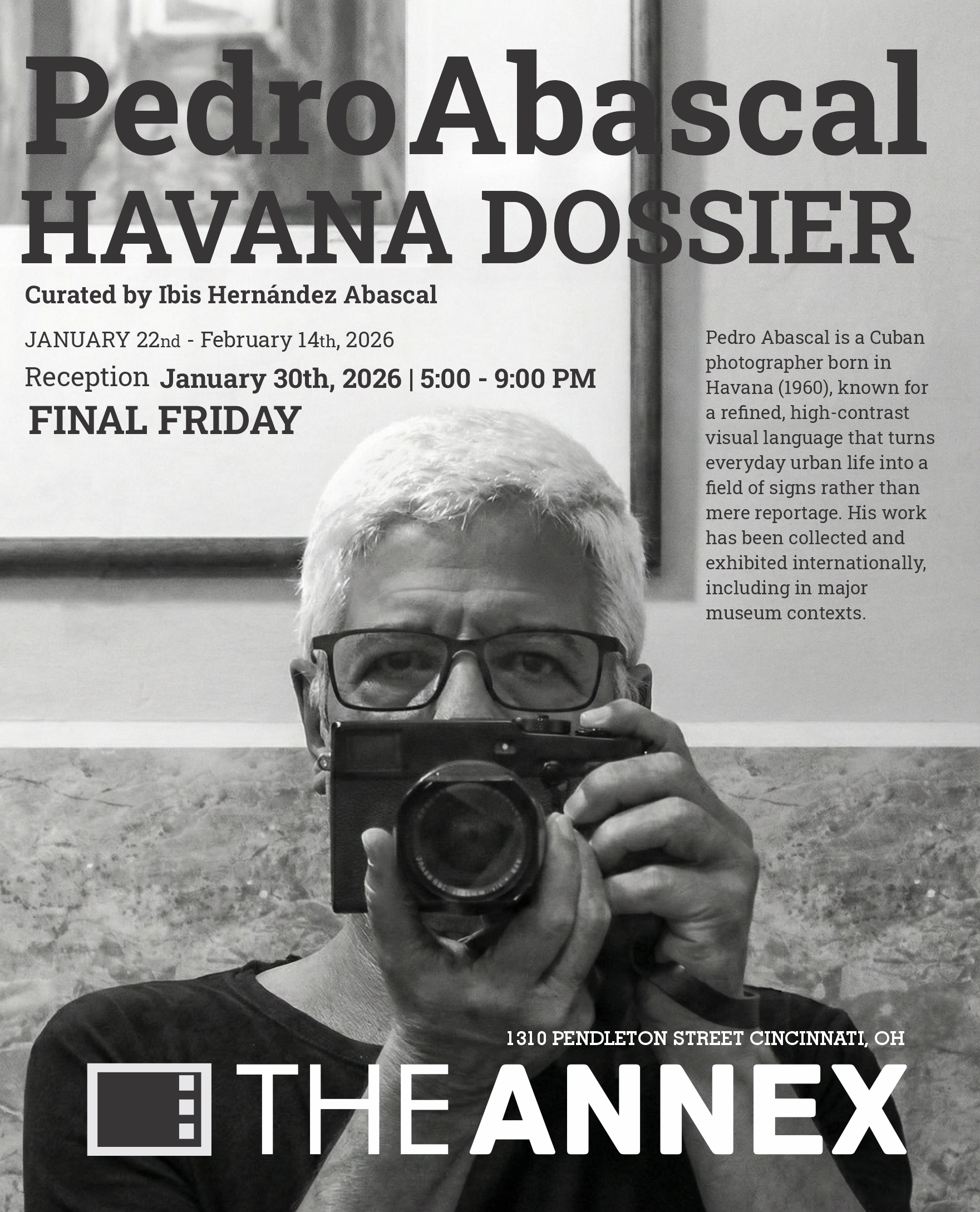
There are cities that return the gaze: they do not yield docilely to the frame, but rather address those who contemplate them. They demand a way of seeing that does not reduce, that does not foreclose. Havana, in this Dossier conceived by the Cuban photographer Pedro Abascal, appears as an entity that observes, folds, and tenses; it refuses to become a mere stage or backdrop.
Abascal does not document: he interrogates. He does not seek the tourist postcard nor the ruin, but the fold where the everyday becomes sign. His camera does not capture—it converses, and in that conversation the visible—a gesture, a body, a texture, a transparency—becomes unstable or settles into waiting. Nor does it impose itself; it coexists with each scene where it crosses paths with people who pass, wait, improvise—bodies that inhabit the city from vulnerability and dignity.
Even when the figure of the photographer allows himself to be glimpsed in some of these images, he inscribes himself discreetly in the glass, mirrors, and translucent surfaces of the surroundings, and his appearance does not interfere with the rhythms of daily life: he enters naturally, as if the city itself absorbed him without disturbance. It is a presence that assumes its place without claiming prominence.
There is something of archive and of poem in this Dossier that began to take shape in the early years of the last decade of the twentieth century on the island—an austere, shadowed period that extends to this day in chronic fluctuation. It is as though each photograph were a marginal note to a history that resists being fully written, that does not conclude. There is in them neither a will to denounce nor ornament; one senses, rather, the search for a humanity that endures in fragility, sustained equally by light and by shadow. Nor do they illustrate a thesis or respond to a slogan. They are, instead, moments of open conversation with the city, with its inhabitants, with its suspended rhythms…
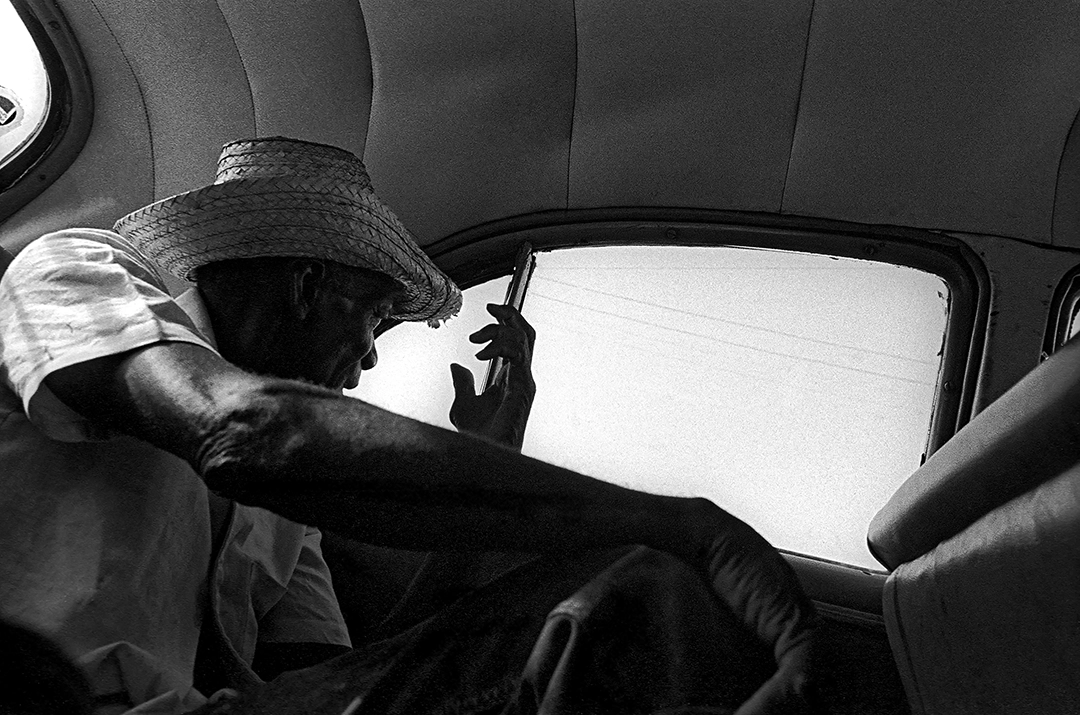
From the Dossier Havana Series. Digital photo on Archival paper | 13 x 19 in | Exhibition print
There is here no intention to monumentalize or aestheticize precariousness; what is revealed, instead, is an ethics of attention, a slow mode of approach that resists the rapid consumption of the visual.
Recognized as an active member of the generation of photographers who reformulated in the 1990s the paradigm of Cuban photography inherited from previous decades, Abascal did not disdain the best of that tradition. He combined it with the legacy of significant international figures whom he studied in depth and assimilated critically and selectively, remaining aloof from the pressures of fashion. This has allowed him to imprint upon his work a personal stamp in which testimony and poetry fuse in an effective alloy, giving rise to images that invite sustained exploration—something equally evident in Dossier Havana.
On repeated occasions, Abascal has expressed his discomfort with the urge to confine photography within airtight compartments and, in particular, with the attempt to label his work under the heading of “the documentary” (understood here in its most traditional sense: capturing reality exactly as it is). Aware that every photograph is a choice—of framing, of moment, of distance, of light—he knows that classifying his work as document would entail the risk of disregarding its poetic reach, of ignoring its aesthetic, emotional, and philosophical dimension.
Abascal does not aspire to capture an “objective truth” but an intimate truth, the result of a form of knowledge sustained by his own experience and sensibility, not by data. In Dossier Havana, the documentary and the poetic coexist and overlap. The images are not merely informative. Each contains fragments of the everyday life of a city which, read as an essay, form a nucleus of paradox where resistance and resilience, resignation and hope, remnants of utopia and dystopian traces fuse in asymmetric tension.
Beyond his technical and conceptual command of photographic language, one must admire the singular manner in which Abascal directs his gaze toward the apparently ordinary in order to offer us images of elevated aesthetic level, bearers of multiple layers of meaning that touch upon transcendent aspects of human existence. Perhaps herein lies one of his most important contributions to Cuban photography: the capacity to make the essential visible without resorting to the spectacular.
Without excluding other possibilities, these images may be read as one reads a field notebook: with attention, with doubt, with the awareness that every “stroke” is also an omission. For in Dossier Havana, what is not shown is as eloquent as what is seen. And in that tension between the visible and the elusive, between what is denoted and what is hidden, a space opens for imagination and experience.
Ibis Hernández Abascal is Art critic and independent curator





If you’re a regular reader of this blog and enjoy its content, you might consider contributing to its upkeep. Any amount, no matter how small, will be warmly appreciated
Founded in 2021, Echoes (Notes of Visual Narrative) invites everyone to explore together the visual codes that shape our world—art, photography, design, and advertising in dialogue with society.

Copyright © 2026 r10studio.com. All Rights Reserved. Website Powered by r10studio.com
Cincinnati, Ohio
Comments powered by Talkyard.