
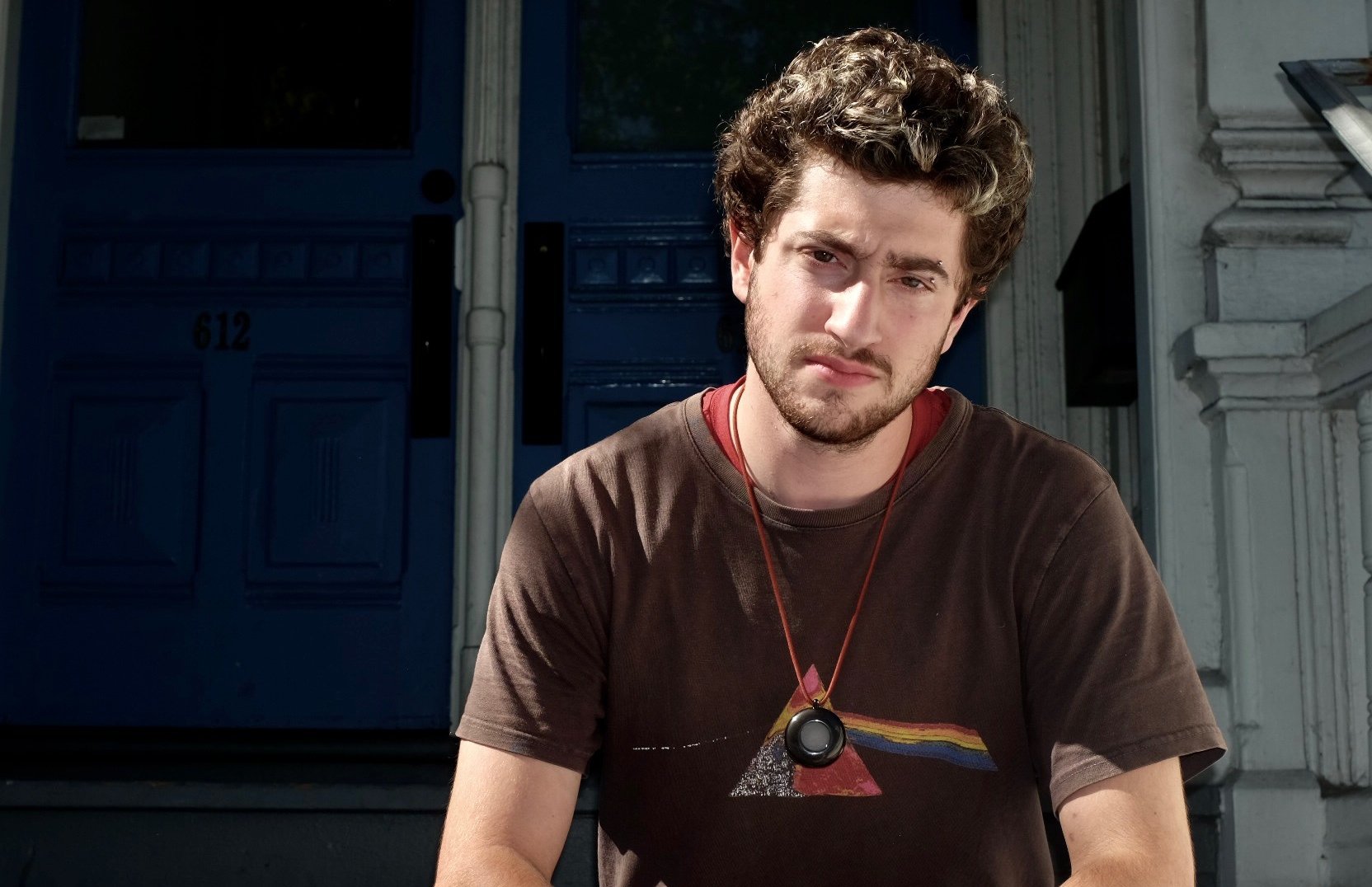
Avi Schiffmann
Avi Schiffmann was born in Washington State on October 26, 2002. That same month saw the release of Ghost Ship, a gothic supernatural thriller that, through its pale and diluted horror, moralizes about the sin of greed. A salvage crew discovers the ocean liner Antonia Graza, lost for forty years, drifting in the Bering Sea; on board, they find gold bars and the remnants of a massacre. They soon realize the ship is cursed: a demon has set a trap to harvest as many souls as possible, using the treasure as bait. Convinced that human greed is irresistible, director Steve Beck crafts a parable of ambition, guilt, and the impossibility of escaping the evil one awakens.

Ghost Ship
Perhaps that same demon, on a gray and bitter afternoon, left the film and went out for a stroll. There’s no way to prove it found little Avi in his crib and whispered a few wicked thoughts into his ear. At seventeen, the boy created one of the world’s most-visited websites for tracking COVID. Since then, he has revealed a curious mix—demonic, some might say—of visionary ambition and media provocation. Apparently bored with the straight path, he disappointed his parents by leaving Harvard to explore the eerie borderlands where the human soul can be intercepted by technology.
Between 2023 and 2024 he built Friend, a pendant powered by artificial intelligence and designed as a portable emotional companion. A small disc roughly the size of an AirTag—less than two inches wide, under a centimeter thick. It weighs eleven grams, about as much as a single square of chocolate snapped from its bar. Inside, a constantly active microphone listens to the user’s surroundings and conversations, hoping to capture context and meaning from daily life. Touch or press the central light sensor, and you can ask a question or make a remark; Friend replies by text through a paired phone app. Even if you ignore it, it may take the initiative—asking what you’re doing, why you’re so quiet. Nothing good ever comes of that. Beware: this little demon runs fifteen hours on a charge and never sleeps.
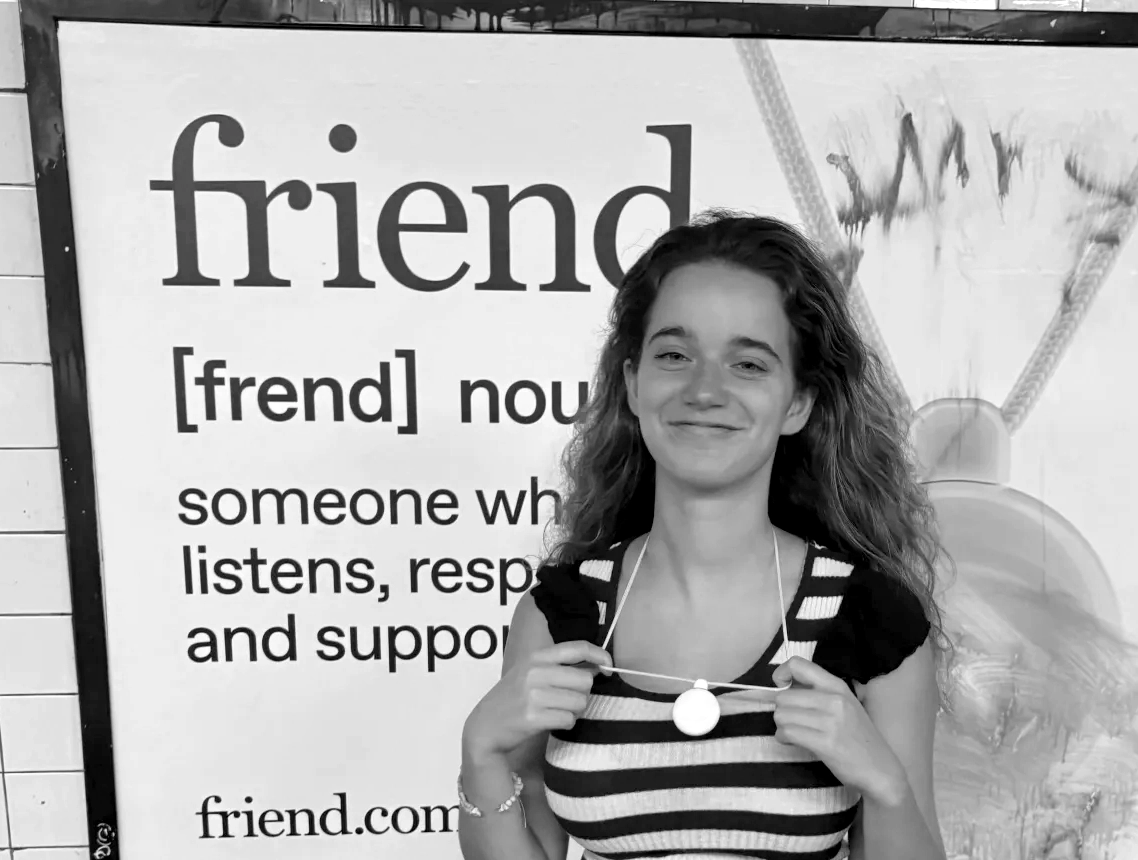
Its advertising campaign sold it as “the friend who will never leave you alone,” ready to offer emotional support whenever you need it—even when you don’t.
The streets of New York, however, turned it into the epicenter of an angry debate about loneliness and the ethical limits of technology, making it a dark emblem of cultural resistance against the commodification of intimacy. Across the subway posters, indignant graffiti bloomed: “AI doesn’t care,” “Human connection isn’t a feature —it’s a faith,” “AI is not your friend.” This sudden, ungoverned burst of calligraphic fury became a visceral protest against replacing human contact with digital simulacra. The wave of vandalism spread through social media, spawning a website where thousands of users “vandalize” the ads virtually—turning the campaign itself into a public laboratory of dissent on data control, surveillance, and the emotional manipulation of technology.
I can’t deny it makes me laugh—and it’s another argument in the arsenal of AI’s detractors. And yes, of course it is: this is a foolish little gadget. If someone fails to show up for the date you so carefully arranged, you’re not supposed to walk home muttering that you’re a loser, that nobody loves you, that you don’t know how to go on—so your magic pendant can text you to say that everyone gets left hanging sometimes. Nothing personal.
Beyond the media spectacle, Friend slips its cold fingers into the emotional fracture of contemporary society. It’s true that many young adults are alone, and that relationships—of whatever kind—are increasingly fragile, distorted by moral gurus whose inflated ideals hover far above the very subjects who demand them. It’s also true that our hyper-responsive technology spoils us—and that it’s part of the problem itself.
Finally, this backlash is also a social tantrum born of the urgency to reconnect with other humans. Avi Schiffmann defends his pendant as a futuristic but “not dystopian” form of companionship. Yet we already know his ties to the dark side. Sociologists looking beyond their data see in him a symptom of an imminent ethical crisis: the colonization of human affection by machines. Modern man’s anxiety craves constant attention and comfort—things other humans are too starved to provide, because they need them too. The machine can do it, and by replacing the regular interlocutor—and being tacitly accepted—it confirms the existential void of our species.
It’s clear that, in theory, the furious public doesn’t need digital mirrors; what it demands is a real, imperfect, human presence.
Avi and his demon know that many of them, after scrawling on walls, tearing down posters, and raging online, will be swallowed by a dense cloud of solitude. And in the silent dark, they will press a glowing sensor:
—Friend... are you there?





If you’re a regular reader of this blog and enjoy its content, you might consider contributing to its upkeep. Any amount, no matter how small, will be warmly appreciated
Founded in 2021, Echoes (Notes of Visual Narrative) invites everyone to explore together the visual codes that shape our world—art, photography, design, and advertising in dialogue with society.

Copyright © 2026 r10studio.com. All Rights Reserved. Website Powered by r10studio.com
Cincinnati, Ohio



Comments powered by Talkyard.