
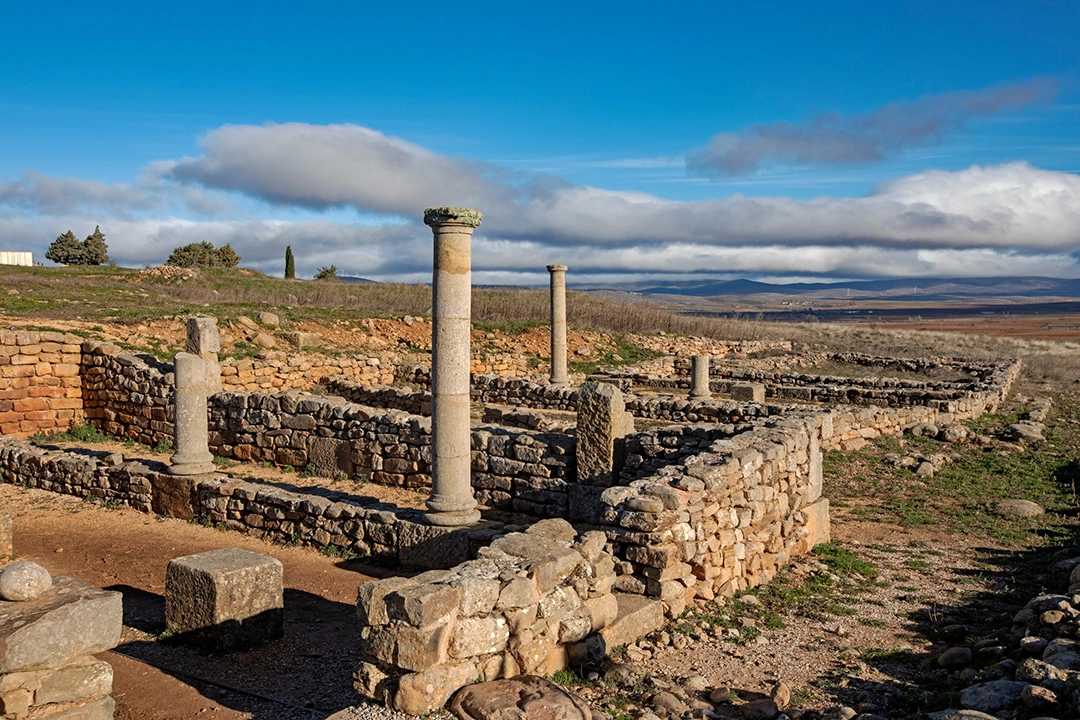
For a very long time, the overhandled story of Numantia has occupied a central place in the repertoire of national political rhetoric. It is cited in such a reduced, schematic way that it borders on the grotesque. The citadel stood on a hill slightly over one kilometer above sea level. At its foot lies today the village of Garray, barely sixty meters lower—modern, pragmatic.
The first thing I would like to remind the parrots—those who repeat history without rest—is that the elevation where the Numantine ruins stand is known as Cerro de la Muela.
The story of Numantia belongs to what one might call a “Roman affair.” It bears many points of contact with our own and can be observed from different angles. Let us begin with how it looked to those watching from behind the parapet.
After several years of siege without decisive results, Rome chose not to exhaust itself further in frontal confrontation and instead adopted a strategy of isolation. Scipio Aemilianus conceived a circumvallation—a literal, methodical, sustained enclosure—designed to defeat “the resistance” through starvation. After roughly a year, Numantia fell, emaciated.
What matters most is the way this event has been narrated. The ancient version transmitted by Appian (attributed to Polybius) states quite plainly: “(…) those who so wished took their own lives, each in his own way; the rest came out on the third day to the appointed place…” That is to say: those who felt that dying by their own hand was unbearable surrendered. Not all were automatically imprisoned and sold into slavery. Some became citizens of the Empire, with all the good and all the bad such a status entailed.
The outcome fixed a deeply manipulative narrative. As our national anthem proclaims: To die for the homeland is to live. I believe that dying for anything is simply dying—nothing more. Of all the ways in which the decision to immolate oneself rather than surrender—respectable when personal—could have been interpreted, its specific, contingent context was ignored in order to transform it into a moral lesson. A lesson that magnifies a peculiar notion of dignity by equating two entirely different states: desperation, hunger, and necessity on one side; freedom and dignity on the other.
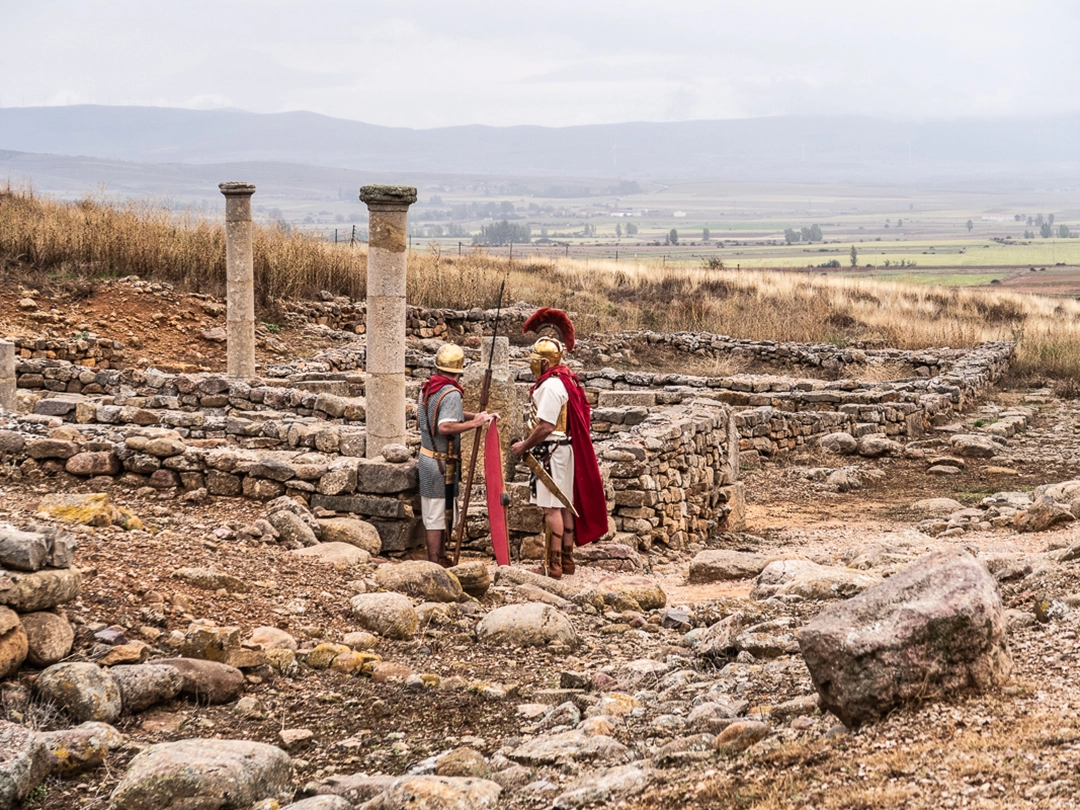
This is how Cervantes encountered the story, and with Castilian fervor he wrote La Numancia, also known as The Siege of Numantia. A tragedy written in four jornadas—or acts—performed on several occasions between 1580 and 1585. As an independent literary work, it was not published until 1784, two centuries later, edited by Antonio de Sacha.
It is at this point that the facts absorb the essence of a tremendous moral tragedy. The disparate victims merge into a single protagonist: the city. In four voices—Spain, the Duero, Hunger, and Fame—verse gives shape to an exemplary tale of dignity, resistance, and memory. Its historical meaning is sealed. The Cervantine core establishes it as narrative, while the tedious, methodical Roman siege fades away. The myth is born.
Let us now shift to the point of view of the elderly, of children. Of those who were behind—behind those who stood behind the parapet. Above all, the women.
How do you imagine life atop a hill more than a hundred years before Christ? Can you picture fetching water from the Duero, hauling it uphill, storing it in cisterns? Gathering firewood, keeping the fire alive for cooking, drying clothes, with average temperatures hovering around six degrees at best, one at worst? Under such conditions, the rhythm of gathering must have been relentless, exhausting. They ate mostly acorn-flour porridge, and every seven Sundays, a pinch of chicken. Now imagine those poor women trudging uphill and downhill, burdened with jars and branches, slipping, cursing the entire Celtic pantheon. But remember: they had dignity.
What, then, did it mean to become a Roman province?
The appealing part—available to some—was participation in an extraordinary network of solid roads and stations that facilitated, as never before, the movement of people and goods. News traveled faster, which is never trivial. Urban centers were Romanized, which typically meant architectural improvements, aqueducts bringing river water into the city. Productive improvements as well. A standardized administrative and legal framework that favored property stability, exchange, and taxation. Monetary circulation. Connection to other regional centers. Regular commerce. Supplies. What some in their time called “progress.” That all of this served imperial interests? Who the hell could have cared?
In Numantia, many died because that is what the stubborn, well-fed tough guys—who probably ate and drank more than the rest—decided. Others died terrified, their minds infected by stories—almost certainly grotesquely distorted—that those same fools had fed them. Others surrendered. Some were sold into slavery and may then have found, with greater clarity, the option of a blessed death by their own hand. Others became Roman citizens, opened Roman taverns, ate and drank, cheerfully fornicated, and enjoyed themselves.
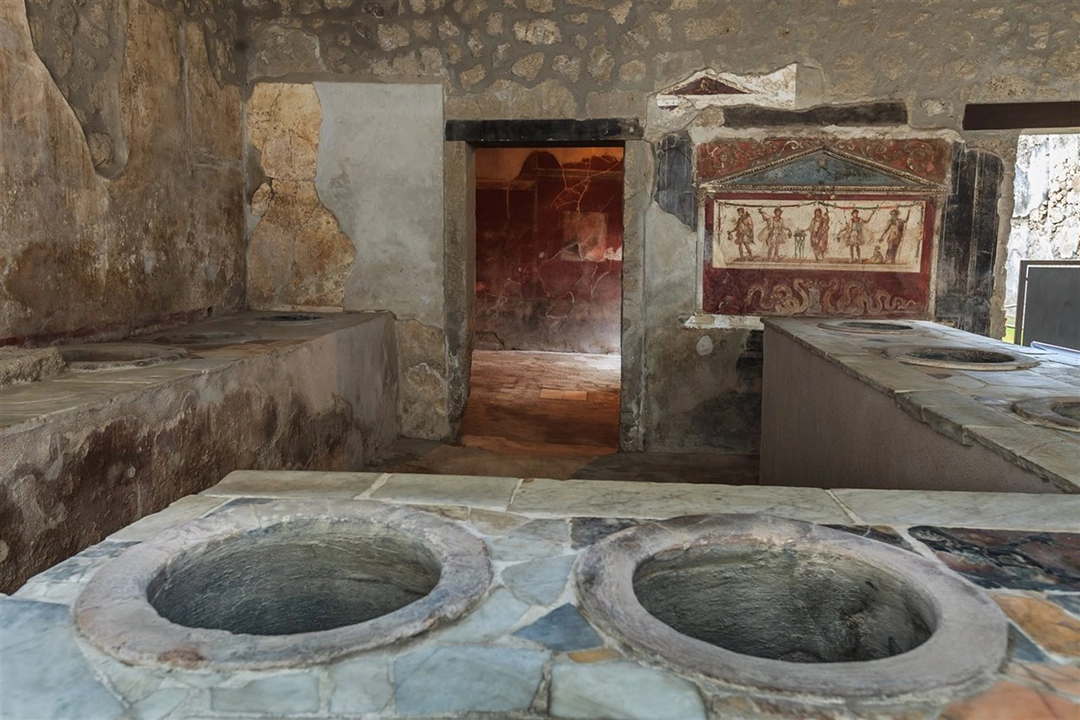
An authentic Roman tavern
In my fifty-seven years, as far as I can tell, I have never enjoyed the warmth—or the coolness—of what the red-eyed fools call “independence.” Not the slightest idea what that feels like. But everyone is free to tell themselves whatever movie they please.





If you’re a regular reader of this blog and enjoy its content, you might consider contributing to its upkeep. Any amount, no matter how small, will be warmly appreciated
Founded in 2021, Echoes (Notes of Visual Narrative) invites everyone to explore together the visual codes that shape our world—art, photography, design, and advertising in dialogue with society.

Copyright © 2026 r10studio.com. All Rights Reserved. Website Powered by r10studio.com
Cincinnati, Ohio



Comments powered by Talkyard.