
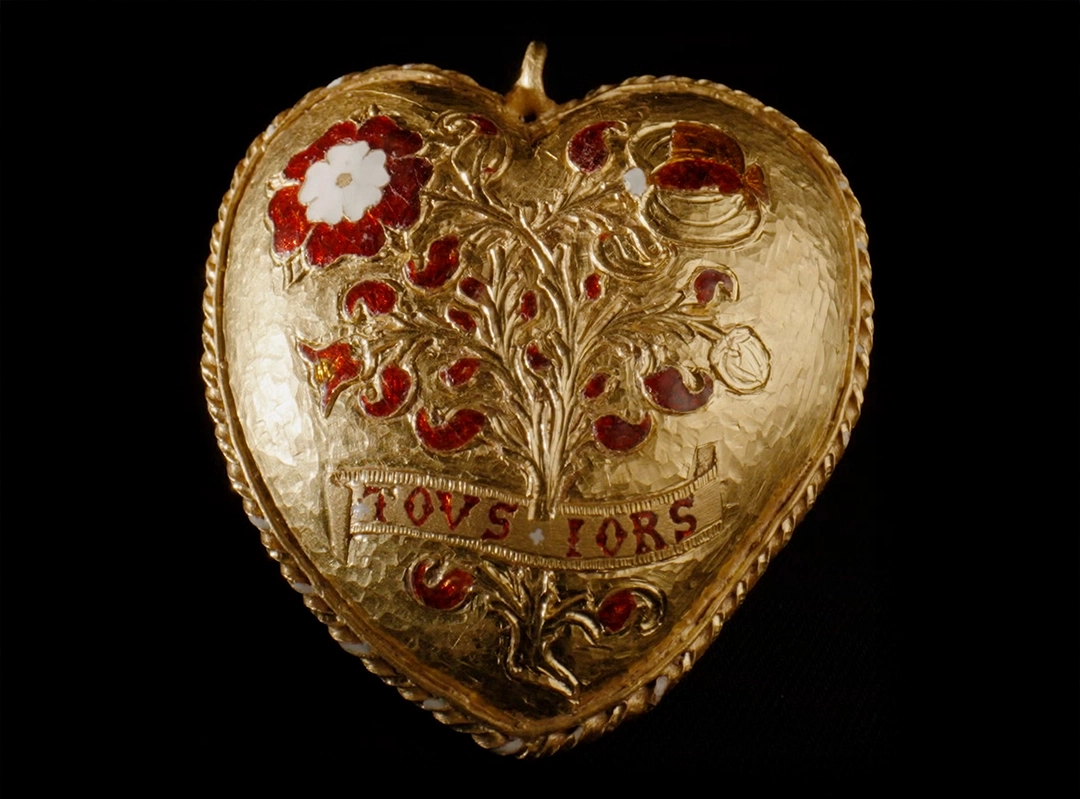
The British Museum has launched a campaign to secure the Tudor Heart, an ostentatious gold pendant linked to Henry VIII and Catherine of Aragon. Its aim is to prevent the object from falling into private hands and vanishing from public view.
Discovered in Warwickshire in 2019 by a metal-detecting enthusiast, the piece was automatically placed under the provisions of the Treasure Act of 1996. This legislation requires that any find liable to be considered a treasure of national significance be formally declared. Finders are compensated for incorporating such discoveries into the nation’s historical patrimony. This system, administered by the Portable Antiquities Scheme (PAS), provides museums and galleries in England with a legal pathway that grants public institutions priority in acquiring unique and historically significant objects, thereby safeguarding the historical record.
The Museum hopes to raise £3.5 million by April 2026 and has issued a public appeal to reach this goal and prevent the piece from slipping beyond public access.
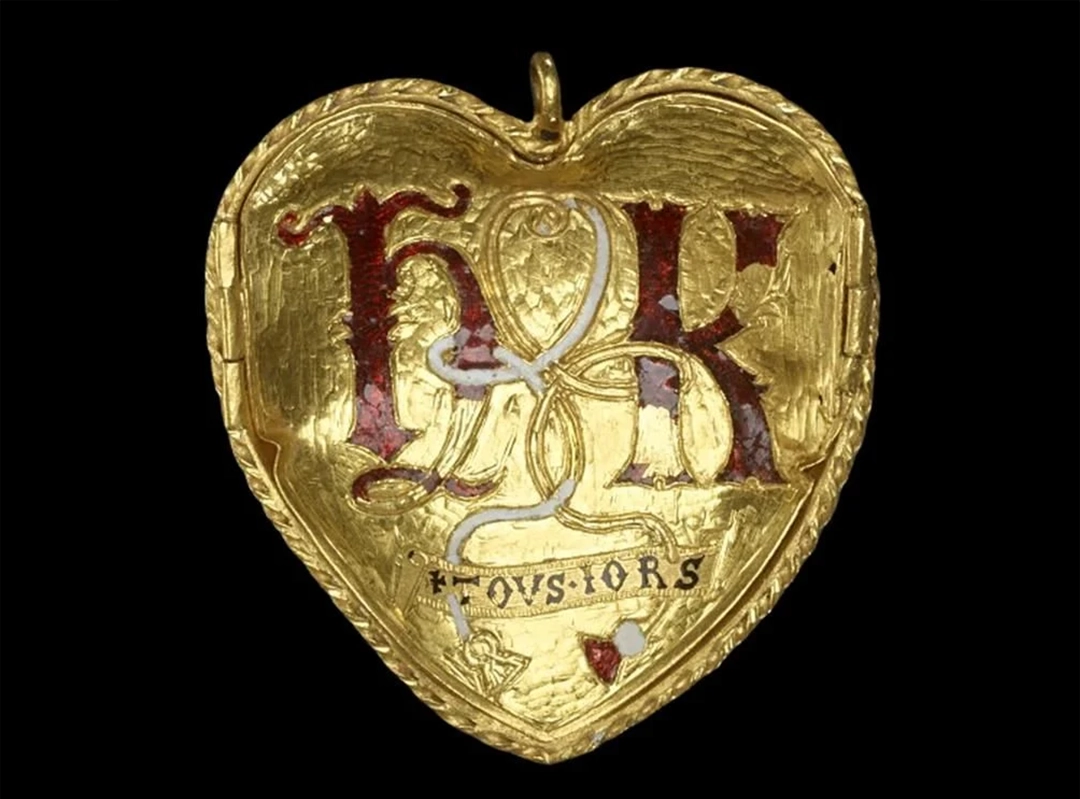
The dazzling heart-shaped pendant—crafted in 24-carat gold—offers a curious glimpse into the marriage between Henry VIII and Catherine of Aragon. It unites the Tudor rose with Catherine’s emblem, the pomegranate. Below, a band bears the inscription tousjours, Old French for “always,” a touching declaration of eternal union. The reality, however, is that the marriage lasted twenty-four years, the longest of Henry’s life, and helped shape the early Tudor court. Catherine became his trusted partner and, on several occasions, acted as regent during the king’s absences.
No other object celebrating the relationship between Henry and Catherine has survived. Most were lost to time. The Tudor Heart thus stands as an exceptional historical witness, attesting both to the luxury of Henry VIII’s early reign and to the convenience of a union that would nonetheless be annulled in 1533.
The Museum suggests that the substantial pendant may have been created for a tournament held in October 1518 to mark the betrothal of Henry’s daughter, Princess Mary Tudor, to the heir to the French throne—the Dauphin Francis of Valois. Henry frequently commissioned ceremonial jewelry of an explicitly ephemeral nature for major celebrations and affairs of state. Members of the court wore these pieces for as long as they could, staging a spectacle of fastuous display designed to neutralize any lingering trace of moderation.
In the end, the Dauphin died young, in 1536. Princess Mary later married Philip II of Spain in 1554. He was twenty-six; she was thirty-seven. No evidence suggests that Henry ever ordered a second medallion to be melted down. Perhaps the object had already done its work.
Why tempt the devil twice?
P.S.
The Julia Rausing Trust, a private UK philanthropic foundation established in memory of Julia Rausing (1962–2019), contributed £500,000—an intervention that reminds us that cultural heritage, today, survives less by reverence than by solvency.





If you’re a regular reader of this blog and enjoy its content, you might consider contributing to its upkeep. Any amount, no matter how small, will be warmly appreciated
Founded in 2021, Echoes (Notes of Visual Narrative) invites everyone to explore together the visual codes that shape our world—art, photography, design, and advertising in dialogue with society.

Copyright © 2026 r10studio.com. All Rights Reserved. Website Powered by r10studio.com
Cincinnati, Ohio



Comments powered by Talkyard.