
It is not the same to watch a cyclone from the window of your house as from an orbital station. They are two entirely different spectacles. When I was a child, it filled me with tremendous excitement. I had eyes only for its ravaging gusts. I did not notice my father sweating as he nailed boards over the windows. That is the distortion produced by perspective. From the distance established by innocence, catastrophe becomes nothing more than a majestic spectacle.
With a similar innocence, I now watch—almost spellbound—as the global board rearranges its pieces into something faintly new. Europe seems to be losing momentum. The West staggers forward, drunk on itself. On the other side, China rises like a ruthless giant. It offers anyone willing to listen a model of non-liberal modernization, in which inconvenient civil liberties give way to stable dynamics of growth. The Belt and Road Initiative (BRI) seeks to connect Asia, the Middle East, Africa, and Europe through ports, railways, roads, energy, and digital networks. For a long time, this was called the Silk Road.
It is likely that nowhere does this proposal generate more enthusiasm than in the Middle East. A pragmatic alliance of exchange with the Asian giant would consolidate a multipolar bloc, shift the economic axis eastward, and weaken the centrality of the United States and Europe across all domains.
In the Middle East, Dubai is one of the emirates that invests most clearly and ambitiously in the future. With money to burn, it has chosen to convert part of its wealth into symbolic capital, using iconic architecture, museums, international events, and contemporary art as tools of soft power. These efforts are aimed at global projection, paying little attention to internal criticism. The result is a pragmatic model of a city-state: economically efficient, politically centralized, and carefully designed on the cultural level.
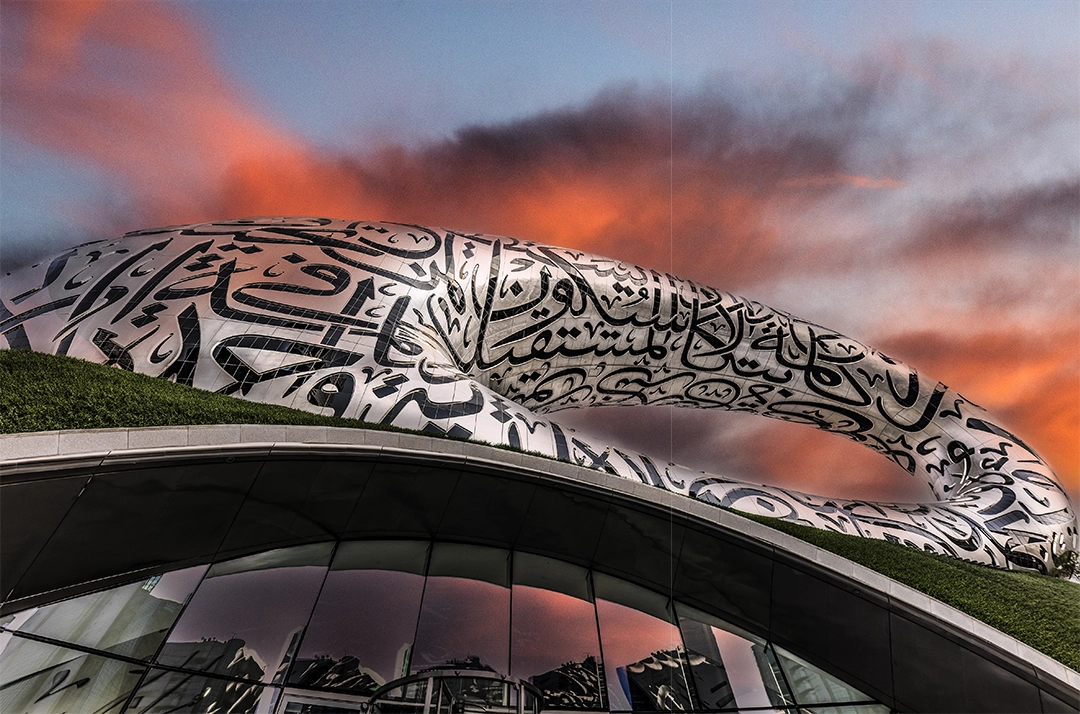
Not long ago, the American photographer Jim Zuckerman passed through there. I suspect he may still be there, as he is on a research trip to develop a series on Dubai and Abu Dhabi. At some point, he visited the Museum of the Future—at dusk, shortly after sunset. Taking advantage of the residual light and the chromatic contrasts of the sky, he made this photograph from the sidewalk, at street level. He used an ultra-wide 14 mm lens with an f/1.8 aperture. His aim was to capture the entire structure in a single frame, to emphasize its sculptural character and monumentality without the need for a tripod.
The choice of viewpoint and time of day sought to maximize the building’s graphic impact—its curves, voids, and calligraphy—integrating it into a dramatic yet stable atmosphere, where architecture functions above all as a visual sign.
Do you see it? Everything lies in perspective. From below, the museum appears imposing. The rooftop is surely packed with air-conditioning units. We are not interested in the museum’s varicose veins. Nor in civil liberties.
Since Deng Xiaoping’s reforms began in 1978, China has lifted hundreds of millions of people out of poverty in four decades. Today it is engaged in a race with the United States for dominance in artificial intelligence. No other country has achieved a leap so vast, so fast, and with a population so large. When China connects a direct pipeline to the Middle East—metaphorically speaking, for the purists—the rotation of the Earth will change.
There will be no twilight, nothing left to observe from the sidewalk, no reason for the wide angle. It will no longer be a matter of perspective.





If you’re a regular reader of this blog and enjoy its content, you might consider contributing to its upkeep. Any amount, no matter how small, will be warmly appreciated
Founded in 2021, Echoes (Notes of Visual Narrative) invites everyone to explore together the visual codes that shape our world—art, photography, design, and advertising in dialogue with society.

Copyright © 2026 r10studio.com. All Rights Reserved. Website Powered by r10studio.com
Cincinnati, Ohio

Comments powered by Talkyard.