
Salgado is indispensable to twentieth-century photography. His unmistakable images of vast crowds working—fighting to survive the world’s violence—remain permanently fresh in the memory of those of us who love the medium. So do his extraordinary photographs of the attempted assassination of Ronald Reagan, along with the work he produced while covering the conflicts in Rwanda and the Balkans, among many others. Broadly speaking, he documented the hard life of workers—many of them migrants—embedded in large projects across the planet.
After photographing the Rwandan genocide, he fell into depression. He withdrew with his family to his farm in Brazil. Discouraged, too, by the environmental destruction he found everywhere, he committed himself to ecological restoration of the Atlantic Forest through a reforestation program. Blessed by that energy, he later returned to photography. His Genesis project grew alongside that initiative. He felt the understandable urgency to capture what had not yet been destroyed or contaminated—something he would later confirm in a 2024 interview. He moved from the mountains of Alaska to the Indigenous communities of the Amazon. Such an itinerary could only end by turning him into a convinced environmentalist.
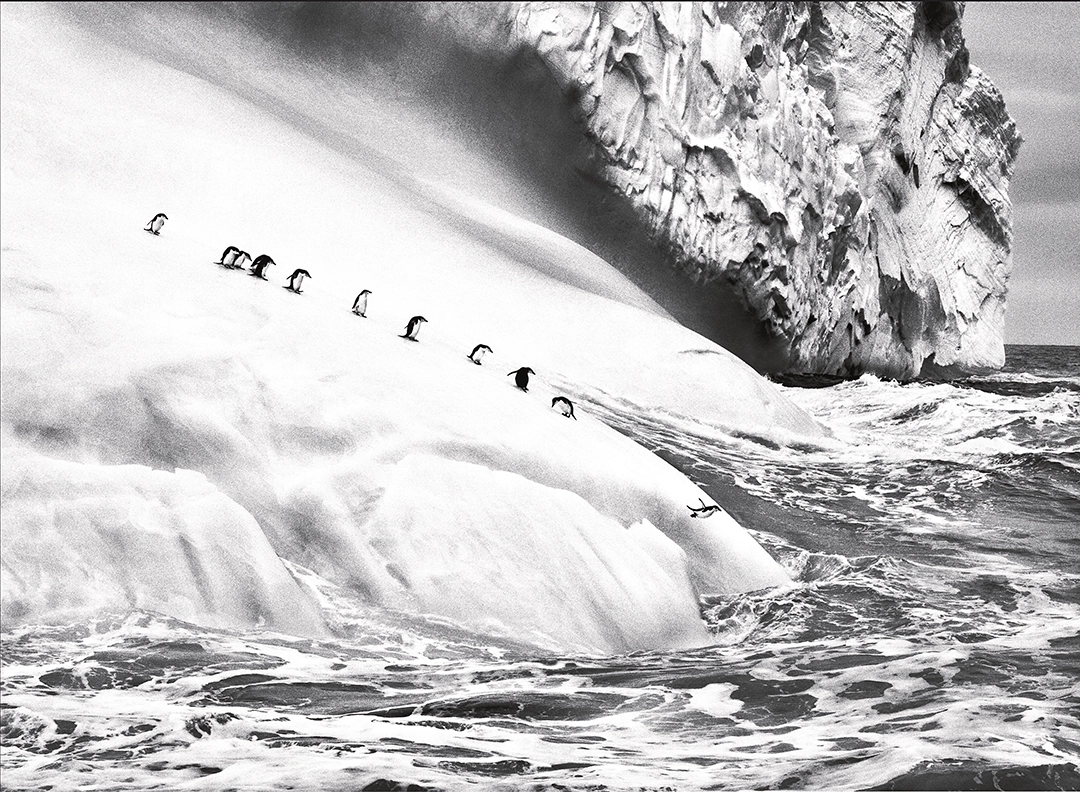
Glaciers—published after Salgado’s death last year—brings together 65 black-and-white photographs of glaciers and other icebound landscapes made for Genesis. They are timeless images: frozen film-frames of the ice’s large and small movements in the coldest regions. One of the most stirring photographs shows a procession of penguins hurling themselves into the sea from an iceberg in the South Sandwich Islands in 2009.
But reality is less timeless. The planet is already shedding hundreds to around a thousand glaciers a year, and projections suggest a mid-century surge in “glacier extinctions,” with the annual number of disappearing glaciers peaking between the 2040s and mid-2050s—reaching ~2,000 per year under lower warming and rising to ~4,000 per year under much higher warming. Under a high-warming trajectory, what looks eternal in duotone becomes brutally contingent: at around 4°C of warming, researchers have estimated that ~80% of the world’s glaciers could disappear. The disaster will have other witnesses, for better or for worse.
Note
Glaciers presents 65 duotone photographs (black and white) from Salgado’s Genesis, centered on the planet’s frozen landscapes. The volume offers a visual account of some of Earth’s most remote and inhospitable regions—from the ice fields of Patagonia and the peaks of the Himalayas to the shelves of Antarctica and the volcanic flanks of Kamchatka—emphasizing ice as physical presence: texture, fracture, density, and form. The photographs are accompanied by an essay by climate scientist Elisa Palazzi. The book is published by Prestel Publishing and is listed with a publication date of February 3, 2026. Retail pricing varies by seller; some listings show $50.
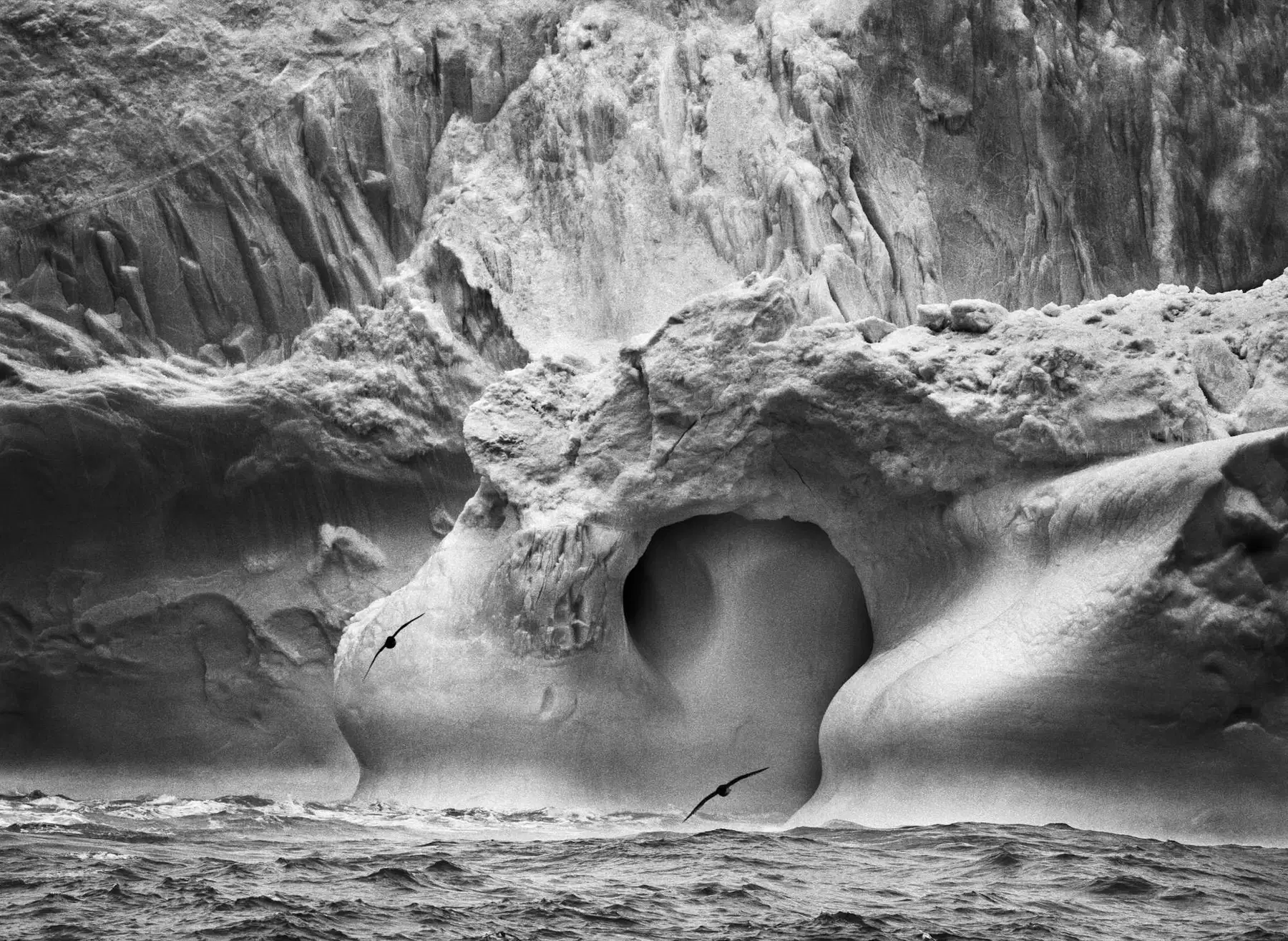
Icebergs are pieces of glacier that break off and drift into the sea. Between Bristol Island and Bellingshausen Island, Australian Sandwich Islands, 2009 © Sebastião Salgado/Contrasto





If you’re a regular reader of this blog and enjoy its content, you might consider contributing to its upkeep. Any amount, no matter how small, will be warmly appreciated
Founded in 2021, Echoes (Notes of Visual Narrative) invites everyone to explore together the visual codes that shape our world—art, photography, design, and advertising in dialogue with society.

Copyright © 2026 r10studio.com. All Rights Reserved. Website Powered by r10studio.com
Cincinnati, Ohio

Comments powered by Talkyard.