
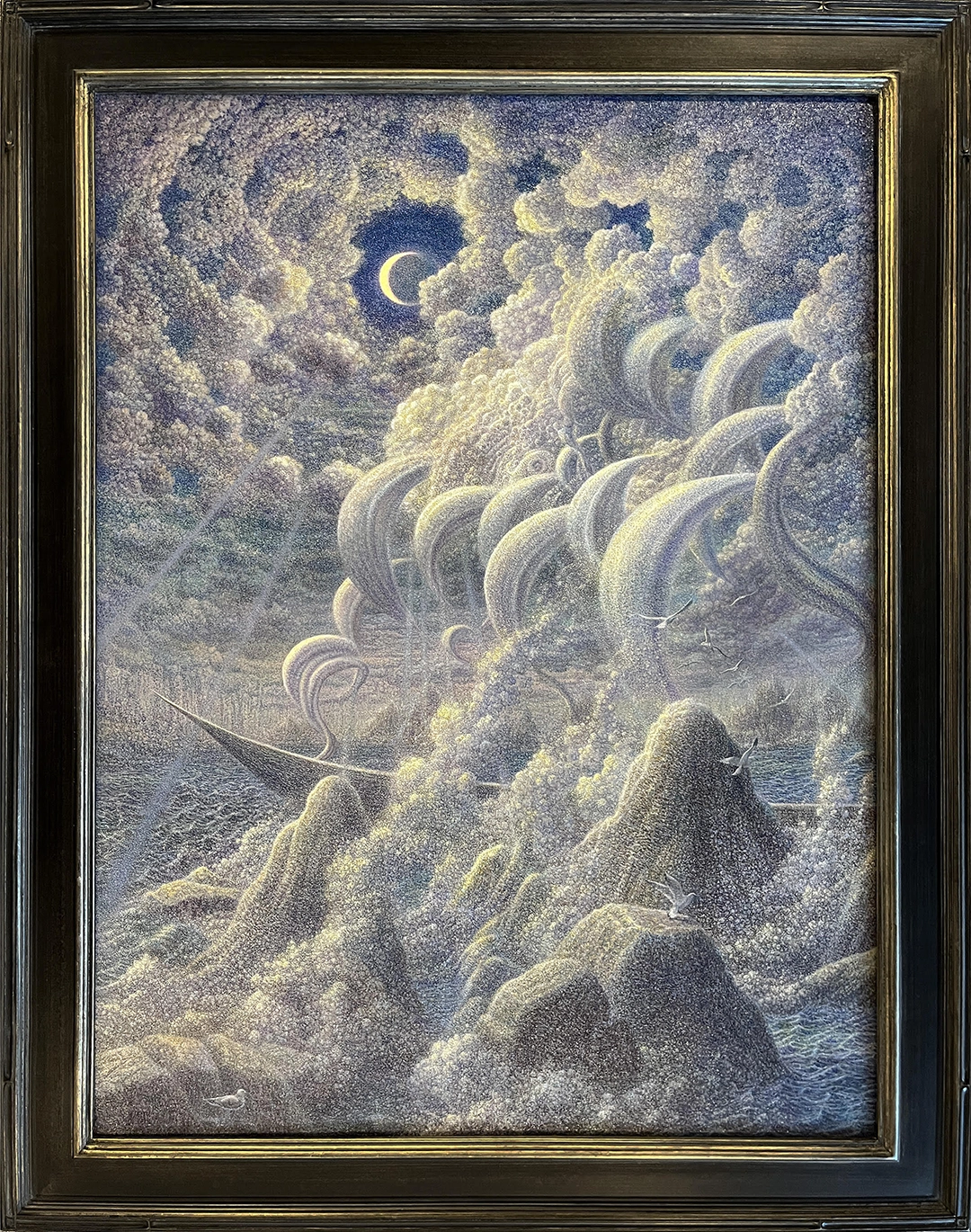
Passage
Perhaps no other work distills Passage’s purity so completely. It begins as vision and unfolds as a crossing—a passage from one mode of understanding to another. Clouds turn into sails, the moon dissolves into eclipse, and recurring forms oscillate between waves and particles. Birds rise toward a luminous void while violet circulates like an inner pulse. For Klein, these transformations express his fascination with change and with the fluid movement between states of being. “In life,” he says, “one is always passing from one state to another. My styles are hybrids, in constant motion.” What matters are not the answers—there are none—but the path itself: the journey as revelation.
One of the people I love most in the world—among other reasons, for something like this—cried for several minutes upon realizing that the book which had occupied her for a brief stretch of time had come to an end. To close it and return it to the shelf meant abandoning a world she already considered her own: one where good and evil were distinguished in every conceivable way. Beyond its beauty, that universe offered purpose, a sanctioned form of contemplation, and a steadfast commitment to the benevolence of the spirit. For evil too possesses its own kind of being, and that quality does not diminish its darkness in the least.
I wanted to meet Keith Klein in person because, beyond being an artist, he is a creator of worlds. In this one—the one we inhabit—the institution of art tends to validate, and sometimes rightly, those who expose the contradictions of reality, political cynicism, or the existential tribulations of a particular group, sometimes of a single soul. Yet it often treats, with a certain arrogant condescension, those who construct worlds of their own—worlds where good still reigns and evil takes on other forms, where the monsters are less evident but no less real.
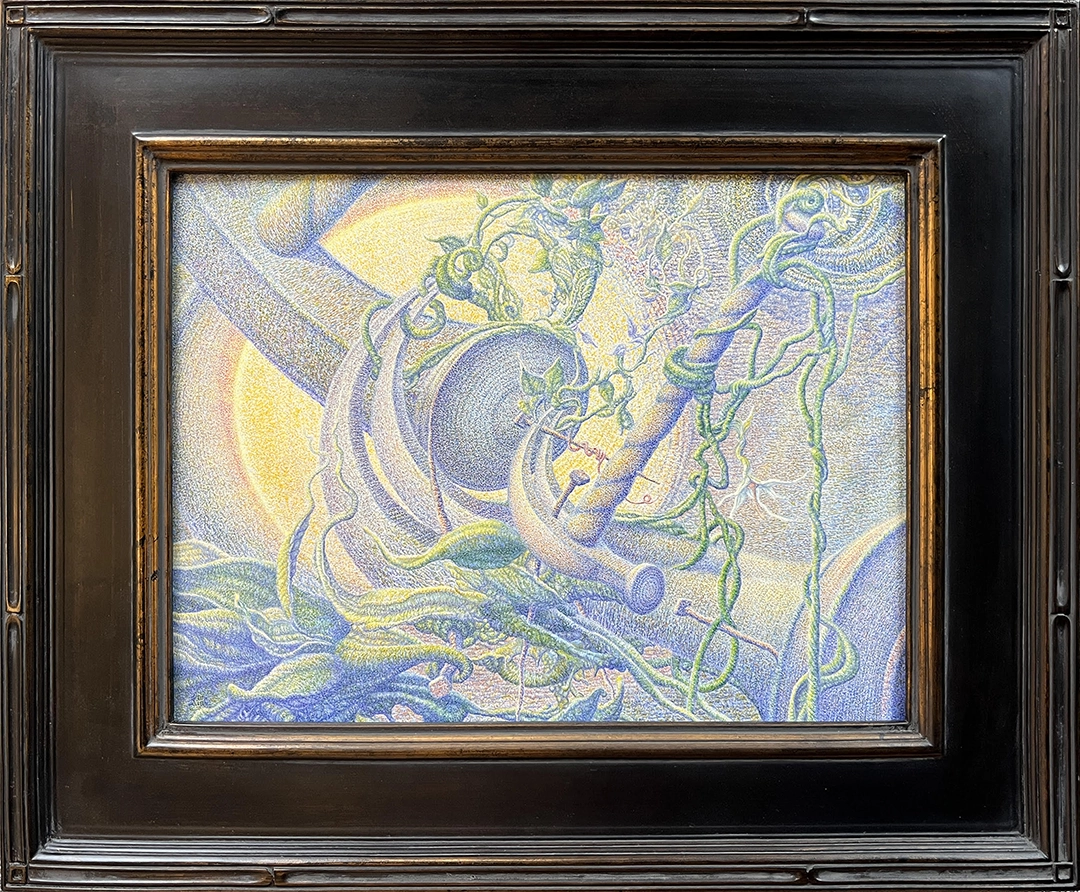
Repetition is the mother of study
'A work of art is the trace of a magnificent struggle' - Robert Henri
This piece speaks of learning that returns, of lessons that circle back. It is a work the artist esteems in a singular way, though to many it may appear unusual. It grows from the premise that repetition is the mother of study. The overactive mind—the mind that hammers too much—becomes a hammer itself. Life’s lessons recur until they are finally absorbed. The image repeats and, in its persistence, takes on the traits of a dragon: a nose, an eye, the intimation of a head. A single nail becomes both the creature’s eye and an ambivalent emblem—the same tool that drives in also extracts. The choice belongs to the one who looks. The painting meditates on the loop of error, awareness, and the transformation of the gesture.
In 1848, when the skies of the world still appeared unspoiled, a group of English painters—Dante Gabriel Rossetti, John Everett Millais, and William Holman Hunt among them—founded what they called the Pre-Raphaelite Brotherhood. They wished to return to the art that had preceded the genius of Urbino. They sought visual and moral honesty, to look upon nature with clean eyes. Before Raphael, forgotten beneath centuries of polish, lay that medieval purity—the innocence that regarded art as an instrument of devotion, symbol, and poetry. Their works combined naturalistic precision—elements rendered with microscopic care—with mythical and religious subjects imbued with emotion and moral significance. Their art stands as a precedent for all those who have since sought inner truths and transcendental beauty. They paved, with light and reflection, a path toward the sacred.
Their legacy also became a conceptual foundation from which Symbolism, the Aesthetic Movement in London, Arts and Crafts, the harsher strains of Symbolism, and the Catalan Modernisme all drew strength. So too did poetic Surrealism and Neo-Romanticism.
Not long after, in France, under the hand of Georges Seurat, came Pointillism. I am not interested in its arguments—they mean nothing to this story—only in its results. What its founders intended—to lend artistic form to the scientific color theories of Michel Eugène Chevreul and Ogden Rood—produced a way of painting that abandoned theatrical gesture, the unruly and rearing brushstroke, in order to sink into the meticulous, into painting as a kind of mystical embroidery. Its very execution brought them close to the amanuensis monks, the scribes and illuminators who worked in the scriptoria between the sixth and fifteenth centuries. Those monks considered their labor—the arts of writing and illumination—as acts of penitence and praise. They sought to replicate the principle of the verb in action, to join the act of Creation itself as a living process.
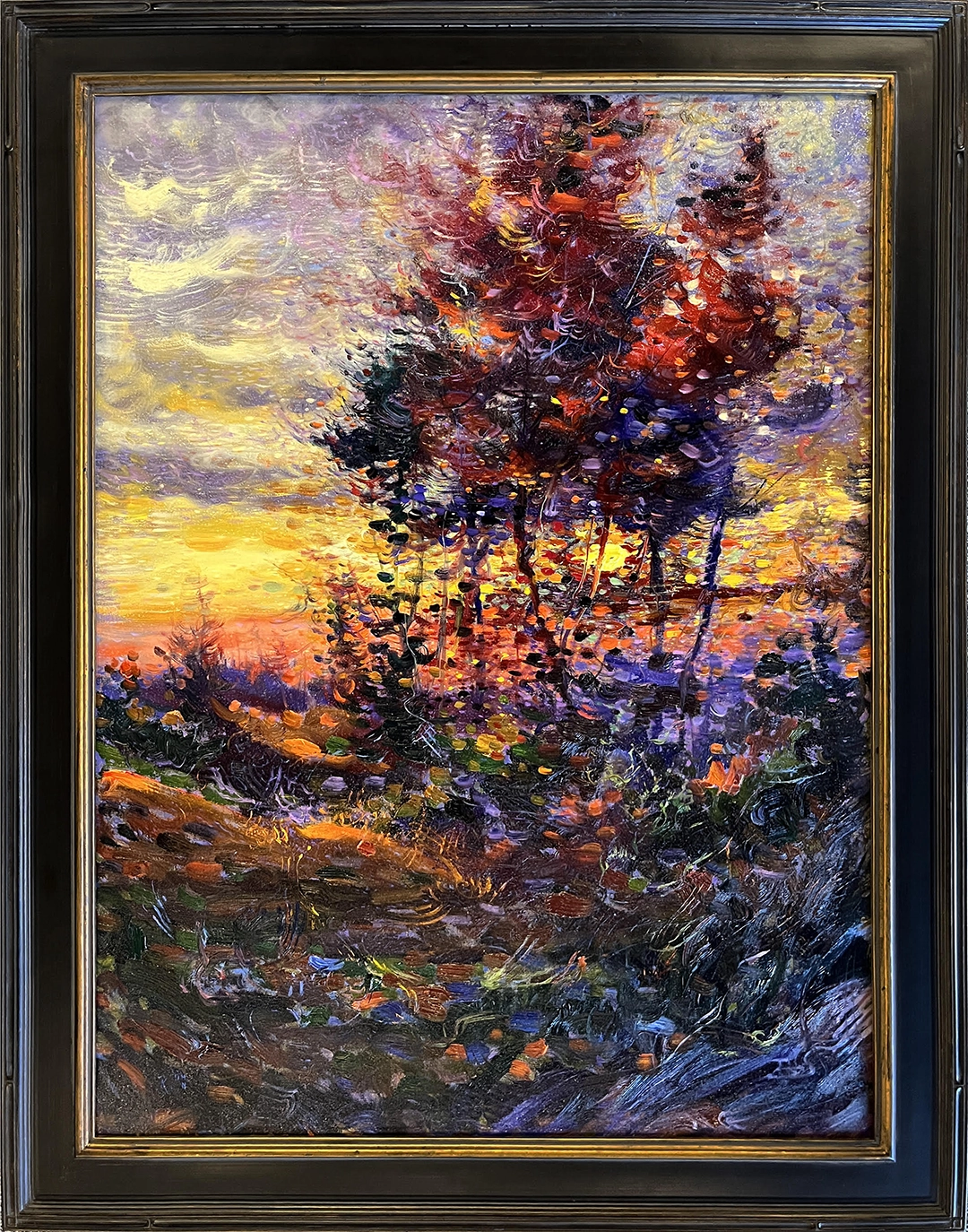
Tambourine Sunset by Keith Klein
Oil on Canvas | 40 x 30 inches. Signed Lower Left
'The act of painting is about one heart telling another heart where he found salvation' - Francisco José de Goya y Lucientes
The museography—Klein admits with humor—was resolved perfectly by the team: “I would have ruined it.” It achieves accents that propose different rhythms: works that are “very bright” framed by others more restrained. The artist himself offers a key to reading: each wall may be read as words. In a grouping of still lifes, for instance, proximity summons seasons, harvest times, cycles. Tambourine Sunset, for example, captures the precise instant when light flares at its fullest only to vanish immediately after—a moment so intense one can almost hear the hum of insects. The show comes to an end. In the tension between epiphany and loss, the artist’s ethic is inscribed.
As I see it, in Keith Klein coexist both the devotee of painting and the architect as creator of worlds. Neither the physical manifestation of reality nor its spiritual dimension fulfills the expectations that many sensitive souls demand. It is in the space opened by these inconformists—between what is and what might be—that imagination gallops freely, jubilant and unbridled.
Klein’s works are the mirror—magical, to distinguish it from the one that merely reflects—into which we may peer and glimpse a singular radiance. There, lavender, German iris, clematis, hydrangea, and agapanthus bloom, while fear and desire acquire material dimension. Invested with a quality that belongs neither to them nor within them, they render experience bearable and temper the inexorable passing of time. In those blue, lilac, sometimes purple meadows, the consequences of reality cease to be irreversible; chaos finds its order, and good, evil, birth, and death arrange themselves into rational harmony.
Within this particular universe, this body of work conceives of beauty as necessity. Many of these paintings are healing—and I will not linger on any single one, so as not to lose the sense of wholeness. They mend the fractures that noise, ugliness, or cynicism inflict upon the spirit, reminding us that being can feel, can exist in feeling, and can endure in what remains untainted.
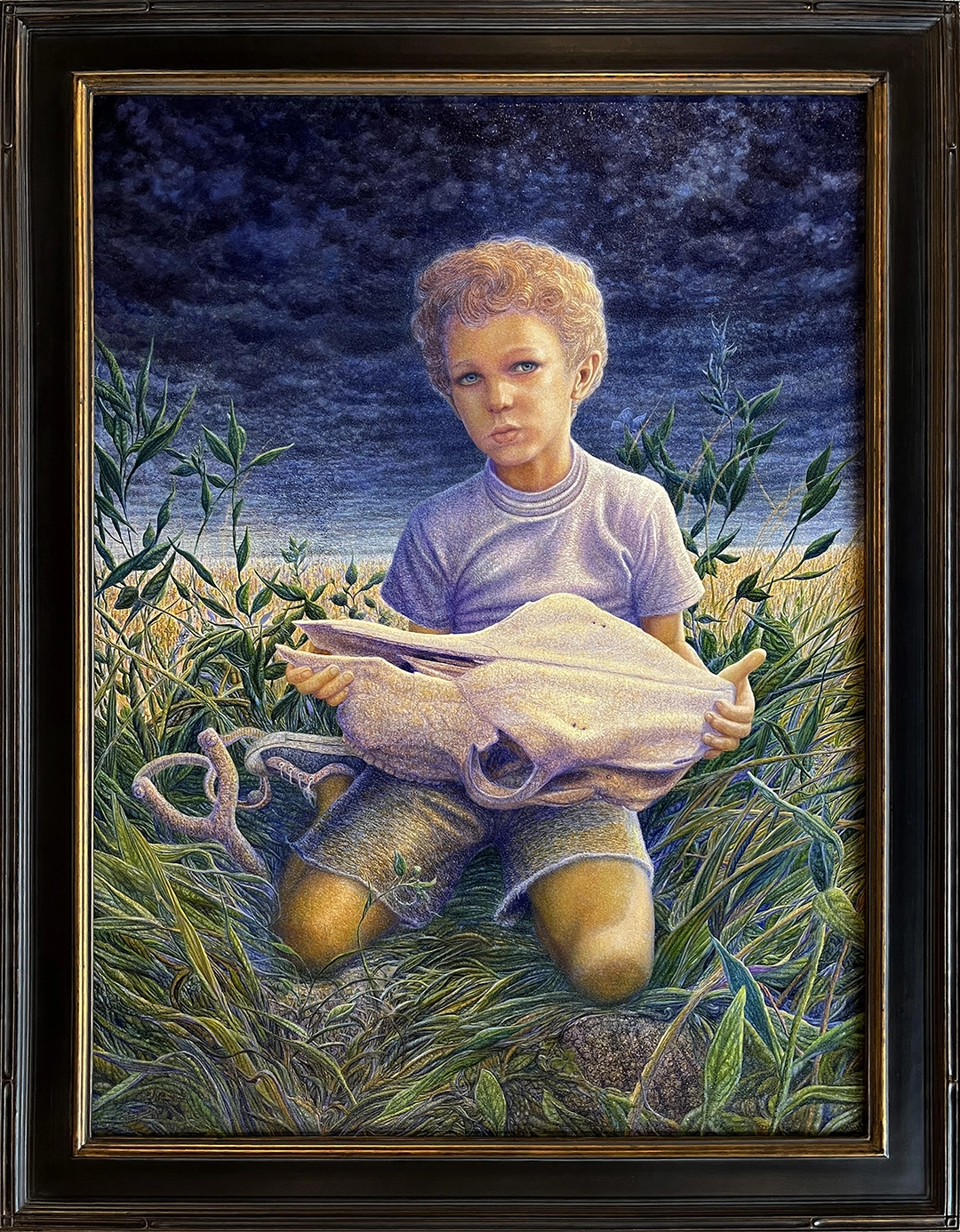
The Dragon Slayer
The dragon is not the beast that harasses us from without. It is the one that devours us from within. It is the ego. This is a biographical piece—childhood with a slingshot, the imagined hunt, the sudden jolt of conscience when a cousin kills a bird and the grandmother protests. That event was foundational. It shaped an ethical vow: if you kill, let it remain dead; one day it might be yourself. On the canvas, the dragon barely emerges (an eye, horns, a snout); birds rise and fall, a butterfly beats as a sign of eternal life. When the ego appears, the artist says, do not assume it. Simply observe: there is my little friend.
The Whisper
It may be that a balanced life arises from the energy that chaos returns once we impose upon it the necessary restraints. It may also be that art itself emerges from that very conflict. Only contradiction gives rise to growth. The whisper might be the magic dust, the infinitesimal weave, the finest scattering that—precisely through its meticulousness—contains disorder and the radiance of irregularity. The effect, shifting according to our distance from the work, produces optical tremors that distract, that conceal its private mythology. Many of its protagonists are camouflaged in the vegetation, hidden behind innocent games of light—so much so that they seem to invite discovery.
I am not sure I wish to enter that universe. Neither that one nor any other. For I have gathered the walls of my own to the point of turning it into a cell. Yet it comforts me that we still have artists who, like Keith Klein, are capable of conjuring such worlds. They are the demiurges who help slow the fall of creative humanity, who reaffirm patience, diligence, and repetition as the mothers of the virtuous, the elevated—of Love as accumulation and sum.

The Calling
Perhaps the artist’s most personal work in the series. A submerged figure breathes through a lily. From within, a child transmits knowledge. The struggle is against everything learned—parents, church, society—in search of a path of one’s own. As in Passage, there is an opening and an ascent, yet here each breath becomes a practice: spiritual traditions teach us to attend to the vibrations carried by air. The title plays wryly on the telephone call. If society is obsessed with calls, this is another—one that turns inward. The canvas becomes an expanded self-portrait: the artist concedes that “everyone” is an extension of himself, though some reach to deeper levels.
Whisper: Paintings by Keith Klein opened on October 3, 2025, and will remain on view through November 26. It is a space that will not cool his universe—but it may well warm the one we share outside the gallery. I would go as soon as possible. For me, the pleasure of this aesthetic warms like a bowl of homemade soup.
Cincinnati Art Galleries, 225 E 6th Street, Cincinnati, OH | 513-381-2128
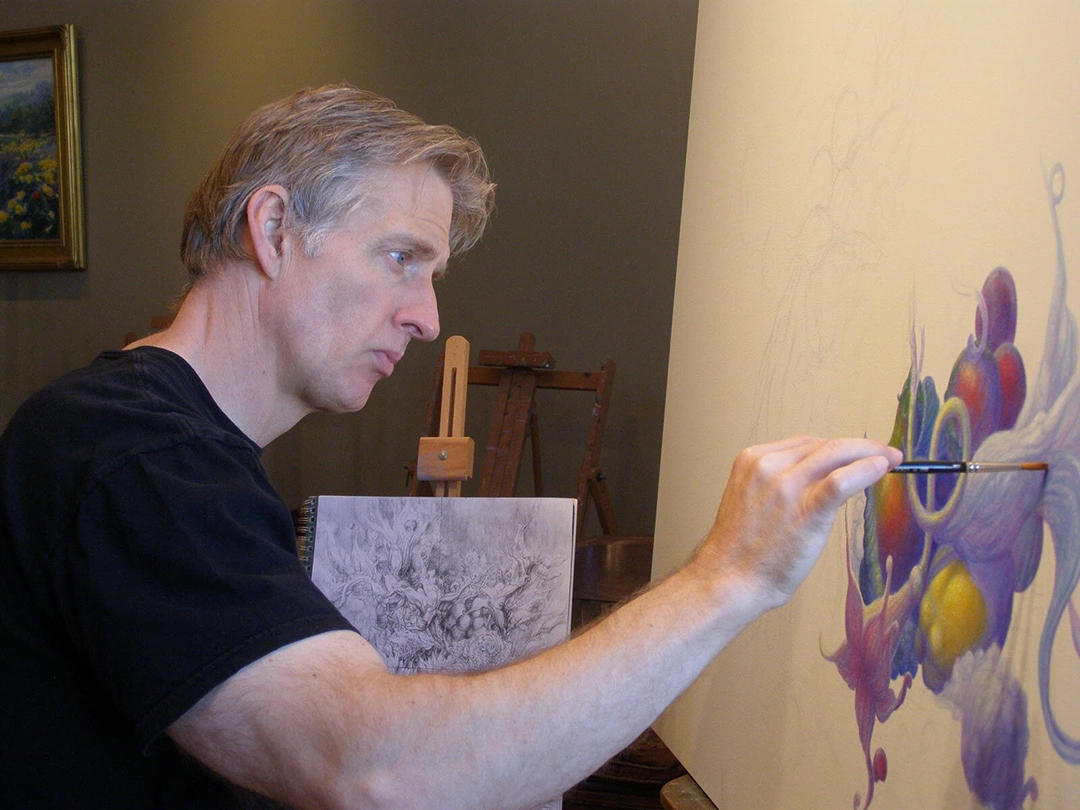
Keith Klein
Keith Klein's work is part of the collection(s) of the Princess of Saudi Arabia, Cincinnati Bell, Convergys, Cincinnati Financial, and many prestigious private collections across the United States. Keith is represented by Cincinnati Art Galleries located at 225 East Sixth Street, Cincinnati, Ohio 45202. Klein studied with Anneliese Wahrenburg in her atelier for ten years where he was trained in the Hague School manner of painting. Ms. Wahrenburg emigrated from Germany after being imprisoned in a Nazi concentration camp for sheltering and helping Jewish people during the war.
Keith is amazingly diverse, with styles that range from classical realism, impressionism, pointillism to paintings done en Plein-air – always painted with his recognizable "voice" even in these divergent styles. He often puts surprises and symbols in his work that are delightful to find.
Keith's studio in Florence, Kentucky, was built in 1903 and was once the First Florence Deposit Bank. Keith teaches classes in oil painting, acrylics, pastels, and watercolor five days a week in his studio. Many of his students are accepted into the prestigious Governor's School for the Arts and awarded full scholarships for college. He also has a particular affinity and gift for teaching special needs children and adults.





If you’re a regular reader of this blog and enjoy its content, you might consider contributing to its upkeep. Any amount, no matter how small, will be warmly appreciated
Founded in 2021, Echoes (Notes of Visual Narrative) invites everyone to explore together the visual codes that shape our world—art, photography, design, and advertising in dialogue with society.

Copyright © 2026 r10studio.com. All Rights Reserved. Website Powered by r10studio.com
Cincinnati, Ohio
Comments powered by Talkyard.