
By Way of a Prologue
These two consecutive texts do not originate in a symbolic or representational plane. They emerge from a reality subject to interpretation—one exceptionally rich and contradictory: politically, socially, and, needless to say, within the realm of representation itself.
In the country of origin of the author of the first text—Hamlet Fernández, which is also my own—myth has long had life bound hand and foot, along with the universal organizational agreement and its daily maintenance. Myth has ceased to be a narrative layer and has become an operating system.
We have also subordinated our own lives—understood individually—to a symbolic plane that is rapidly drifting away from common sense and from the simple enjoyment of existence. We, too, have become symbols. The global Left often bypasses our human, bodily experience—our raw sensoriality—and instead demands the preservation of a political and ideological way of life in service of a specific narrative.
This is something that has left deeply exhausted all Cubans who do not work directly for what is euphemistically called continuity.
In this digital notebook, we speak and concern ourselves primarily with symbols. We believe these texts may help us understand them—and understand ourselves—more clearly.
In Sapiens (From Animals into Gods: A Brief History of Humankind), the Israeli historian Yuval Noah Harari advances a disturbing yet lucid idea about the function of empires in history: imperial systems are neither pure evil nor pure progress. They conquer, repress, dominate, and exploit—but they also weave global networks: routes, rules, currencies, lingua francas, infrastructure, commercial circuits, the circulation of technologies and ideas, culture, art, and knowledge. Empire is, simultaneously, violence and integration; globalization, for better and for worse. For this reason, the historical question is not a moral one, but a practical one: what is gained, and what is lost, by integrating into—or remaining outside of—the network managed by imperial power?
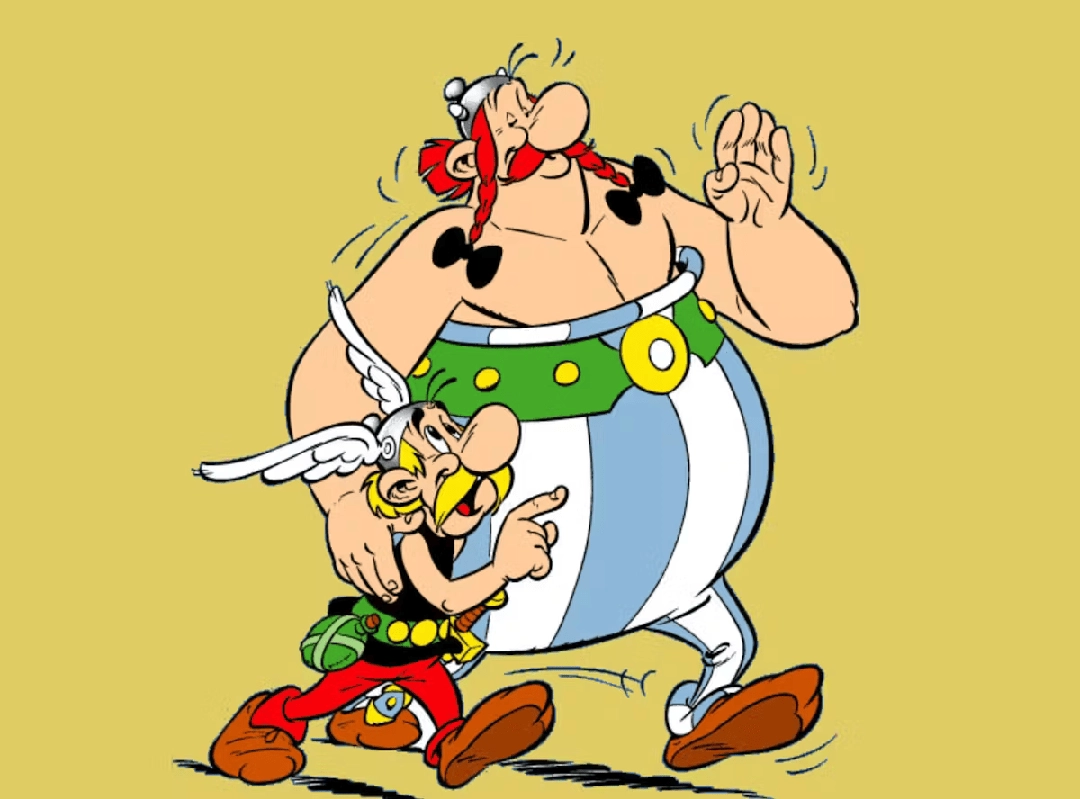
As a child, I was always fascinated by the adventures of Asterix and Obelix, eccentric and invincible warriors who defended their small village from succumbing to the conquest of the Roman Empire. The historical basis of Asterix lies in the Gauls, Celtic peoples of Gaul during the Roman conquest (Julius Caesar’s Gallic Wars). And in a striking coincidence, Asterix the Gaul—its original title—emerged in France as a comic series in… 1959.
Asterix dramatizes the dream of full autonomy: a community that escapes the costs of empire without paying the costs of isolation. Yet the comic is honest about its trick. The village can resist while remaining prosperous and secure because it possesses a wise druid who invents a magic potion—an absolute technological advantage. The potion makes the impossible viable: autonomy without isolation, resistance without total material cost. Harari’s theory, grounded in pragmatic historical realism, offers the counterpoint: in the real world, resistance may preserve dignity, ways of life, and local control, but it can also mean exclusion from the networks that accelerate development, the circulation of goods, information, knowledge, and technology.
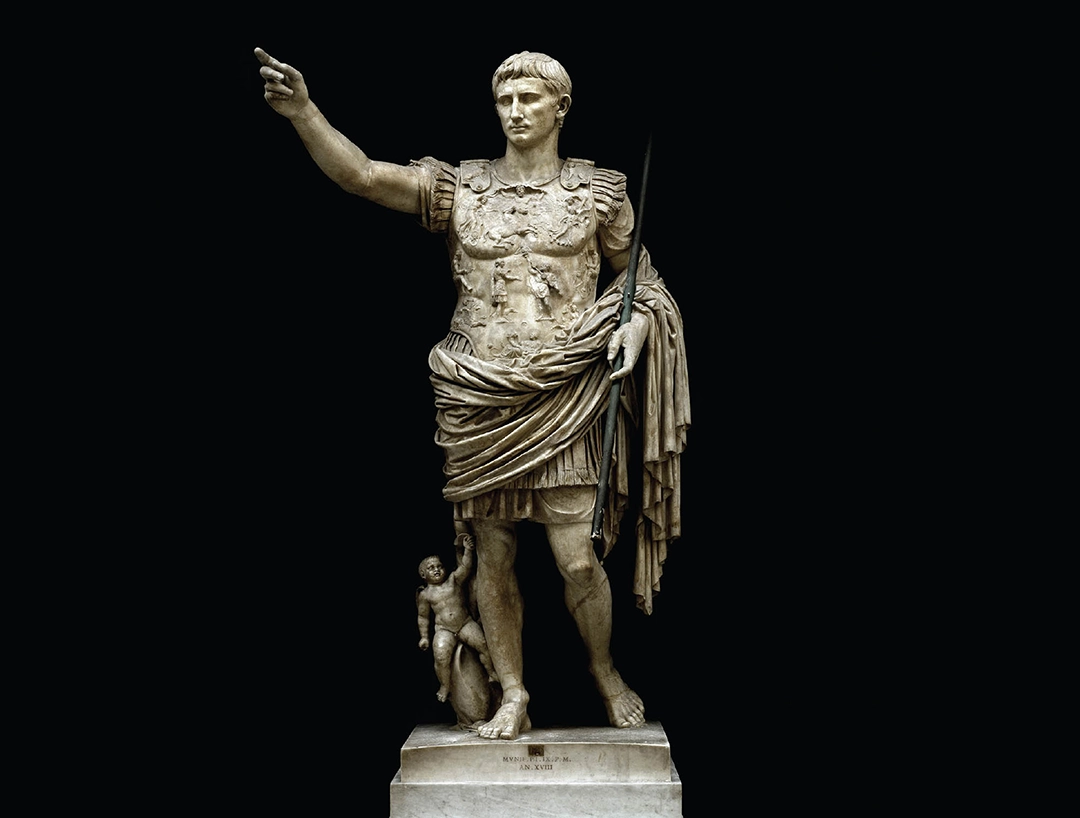
With that in mind, I turn directly to the analogy that concerns me here: the delicate present moment of Cuba. After 1959, our own small village also had its druid and its magic potion to stoically resist the reconquest of the Empire. But our comic, too, had its trick. The strength of our invincible warrior did not come from a magical brew; it was not magic, but a second imperial network—the Soviet one. A geopolitical backing that sustained the island through preferential trade, supplies, and subsidies of enormous scale relative to the size of the Cuban economy. Autonomy, sovereignty, independence… without integration into an imperial network?
The Soviet potion allowed our warrior-druid to maintain a posture of confrontation with the United States without fully paying the price of exclusion from the dominant circuit, simply because another network existed to absorb the shock. That is the concrete historical reality behind the Cuban “socialist miracle” of the 1980s.
That epic season of the Cuban comic ended exactly thirty-five years ago. With the collapse of the USSR, the tragic season began. The resistance of the Revolution and its heroic people ceased to be an epic fueled by external resources and became a daily administration of scarcity. Vietnam and China reformed, opened their economies to the global capitalist world, and integrated. Fidel and Raúl did not. They mortgaged the future of Cubans and condemned the country to destruction.
As everyone knows, at a certain point resisting the American empire ceased to be synonymous with popular consensus in Cuba. If the Revolution and socialism became an entelechy for the majority of Cubans, then what exactly was left to defend? In the ruins of today’s village, the so-called resistance proclaimed by the regime is nothing more than a technology of power: the classic formula used to justify closure, totalitarian control, and political repression in the name of sovereignty. Cuba has been governed for decades by a single family; what has truly been at stake all along is the sovereignty of that family and its economic and repressive apparatus.
By now, no one with a minimum of common sense should doubt that the immobility that has defined the tragic season of the last thirty-five years is due to the regime’s own survival instincts: a family and power group that fears economic and political opening because it would imply losing total control. The epic of resistance—now without a magic potion—has functioned as an alibi through which the terrible cost is paid by the population, while power entrenches itself in its privileges.
History, however, meanders like a river, and eventually it flows into the sea. As life in Cuba became increasingly unviable, something inevitable occurred: integration into the outside world was undertaken by ordinary Cubans themselves. When a society fails to transform autonomy into everyday prosperity, integration is reconfigured. It ceases to be a collective project and becomes a personal strategy. The village does not enter the empire as a state; it enters as individuals who leave. Capitulation becomes an individual exit: migration, remittances, informal economies. To synthesize the metaphor: when the siege persists, some stop trying to defend the wall and instead seek—individually—the path toward the open horizon of the global network.
Today, the situation is deeply complex, and as a people we must learn to think beyond traditional binaries. There exists a delicate point of equilibrium—a way of seeing and acting—where opening and integrating into the world as it actually functions today does not necessarily require renouncing all autonomy or national sovereignty. Many small nations have succeeded by escaping the suffocating dichotomy imposed on Cubans. One can resist in some areas and negotiate in others.
Without a magic potion and without real economic and political reforms, the resistance still imposed on the Cuban people has nothing to do with heroism and everything to do with a sentence administered by the Castro family and its bureaucratic structure of power.
In relation to the United States today, the Cuban people must ask themselves certain questions—and this time the approach should not be moral, but analytical and strategic. A small and devastated country: what real options does it have? And how, finally, will it integrate into the world?
Author’s comment included in the text by deliberate choice
— (…) “Morality is not the ultimate measure of all things. When morality works against survival, against the health of the social organism, it becomes immoral. From that point on, all resistance becomes immoral, because it seeks to preserve nothing that is alive: it would be like killing people in order to safeguard their statues.”





If you’re a regular reader of this blog and enjoy its content, you might consider contributing to its upkeep. Any amount, no matter how small, will be warmly appreciated
Founded in 2021, Echoes (Notes of Visual Narrative) invites everyone to explore together the visual codes that shape our world—art, photography, design, and advertising in dialogue with society.

Copyright © 2026 r10studio.com. All Rights Reserved. Website Powered by r10studio.com
Cincinnati, Ohio



Comments powered by Talkyard.