

R10 has invited me to collaborate on his project. I understood that, in order to be attuned to the spirit of this community—eager to find a certain pleasure seasoned with a Creole inflection—one had to think carefully when choosing the subject, and also when attempting to share observations that would neither sound grandiloquent, taste of formula, nor resemble verdicts issued by juries conditioned by multiple factors external to the artistic act itself. I thought that attempting an exegesis of the latest release by the singer Rosalía might involve imagining her opting for a first-rate lathering, if we consider one of the term’s meanings (to rebuke, to scold). The legendary soap, originally from the United Kingdom, began to be produced in the United States in the second decade of the twentieth century. Today, Unilever is the product’s principal global distributor. Lux—a term derived from the Latin lux, from the Indo-European root leuk- (“light, luminosity”)—at times seems to function here as a usage confined solely to the spiritual realm in this release by the Madrid-born artist, an album that marks a turning point in her recording career. And yet, I would argue that her strategy is so carefully designed that it also flirts with the market, with the esoteric, and with the global urgency to access creations capable of establishing a communion with the sensible world.
The cover image already anticipates this: she appears seated on the grass, wrapped in a white scarf and veil that transform her—more than into a saint (a figure referenced by the artist herself)—into a newly born creature. And here, from the observation of these visual symbols, one of the many questions raised by the Madrid artist’s musical offering begins to surface: what are soaps for, if not to bathe with them? Could there be, under current global conditions, a more urgent performative action than exploring the possibility of a liturgy that returns us to the territory of faith? Beyond any specific questions prompted by this production, one must sovereignly respect the artist’s capacity to depart from the predictable. That, in itself, constitutes an added value.
The reference to toilet soap could be dismissed as mere jocularity; however, I ask: could it also be associated with the vital need to revisit an artistic image in which mourning had settled as a kind of closure to a process of searching within her career? Ablutions have, throughout human history, been a fundamental part of the rituals required to attain states of purification. Today, the world of affect is being reconfigured in unforeseen ways. The shift toward digital technologies has rendered almost every act virtual: speaking, embracing, loving, even ending a romantic relationship. Contact with the natural world—the presence of her body resting on the grass, wrapped in this environment that evokes purity—invites us to recall the Nativity of the Christ child, at a moment when women are choosing to neo-historicize the past, religion, and taboos, advocating for a libertarian breath without neglecting candor. Her closed eyes also invite more conscious bonds with ourselves, an unburdening from the ballast of external image, while simultaneously calling for an introspection that frees us from social molds.
I will refer to the music videos for Berghain and La Perla, as I consider them heterodox in their musical and audiovisual solutions. Each deploys distinct aesthetic resources, and the manner in which the search for existential states of peace is articulated—and, why not, the possibility of certain exorcisms of the mundane—differs in each case. For the first time, I find myself listening to a corrido that does not provoke flight. The genre’s typical use of syncopation, which contrasts with the regular pulse as a kind of rhythmic “dislocation” guaranteeing its danceable character, had previously always generated in me a sense of rejection and stress.
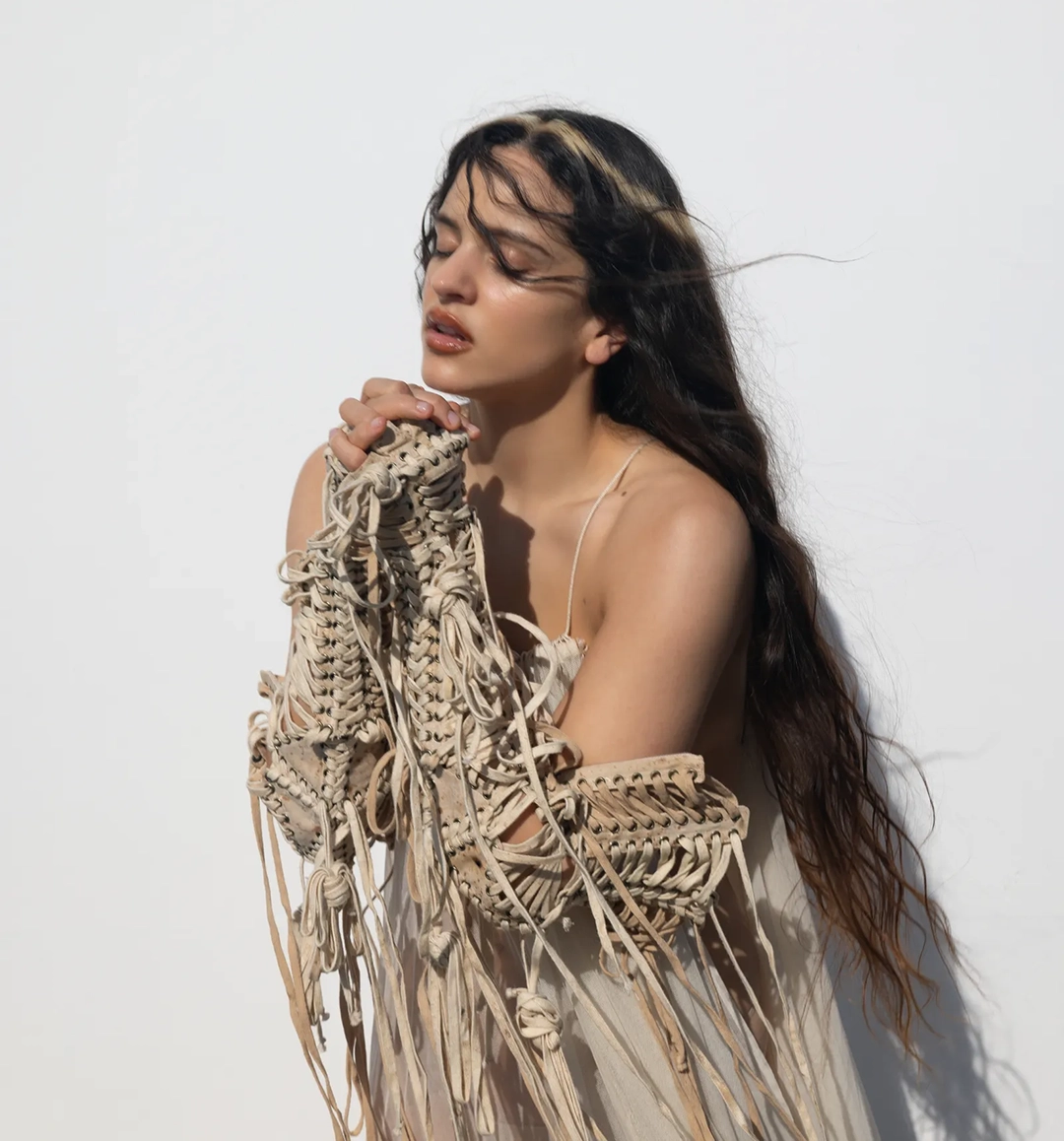
I scarcely knew who Rosalía was—or rather, how far Rosalía extended—until just a few months ago, after listening to her second album, El Mal Querer (2018). In it, the artist blends the languages of experimental flamenco-pop and Latin R& B with urban sounds. The album was warmly received by critics and garnered several awards in recognition of its significant production work. I assume I came across it years later because I do not usually have much free time for such pursuits, and also because there are moments in life when one connects synchronically with what one needs to hear, see, and enjoy—always in interaction with the right processes and the right people.
The fact is that a Cuban friend who has lived for many years in Córdoba, Spain—a context that naturally generates fascination with the legacy of al-Andalus—shared with me, just a few weeks ago via a post on my Facebook wall, the music video for the song Berghain. How is it possible that a single negative comment exists in response to such beauty in musical arrangement? Clarity of discourse—without lapsing into obviousness—abounds, alongside the use of countless references drawn from the spiritual universe: dove, Sacred Heart, cross, rosary, Virgin Mary, animals. These elements are introduced without religious Manichaeism, not as doctrinal symbols but as existential anchors that have accompanied humanity across time.
The presence of the orchestra within the domestic space, alluding to music as a sublime tool that requires no institutional or systemic mediation (a phenomenon akin to bilocation); the nod to nature in its pristine state, in an attempt to reconcile poiesis and Gaia, as a call of attention to our mystical impairment; the space for prayer—a space we have also lost when we abandoned our rituals—are all universal codes. We tend to approach them from a Manichaean perspective—belief or religiosity—when in fact they accompanied us long before Constantine, around 312 CE, experienced that emblematic dream in which he was instructed to use the symbol to secure victory.
Whenever I approach these themes, I recall an anecdote recounted by someone who attended a lecture by an ambassador of the Universal Peace Federation (UPF) in Argentina, where the official remarked that the cross represents the need to neutralize our ego. From whichever angle one examines it, Rosalía’s offering stands as an emphatic homage to the transcendental quest, to the reconnection of soul and spirit with the vital. The use of meditation, communion with nature, the enjoyment of solitude, and the practice of prayer all point toward inner well-being, empathy, and the possibility of a mental state not subordinated to the material world. In doing so, the work marks a watershed moment in the history of contemporary music, addressing universal themes with a delicacy and a refinement of taste that are nothing short of memorable.
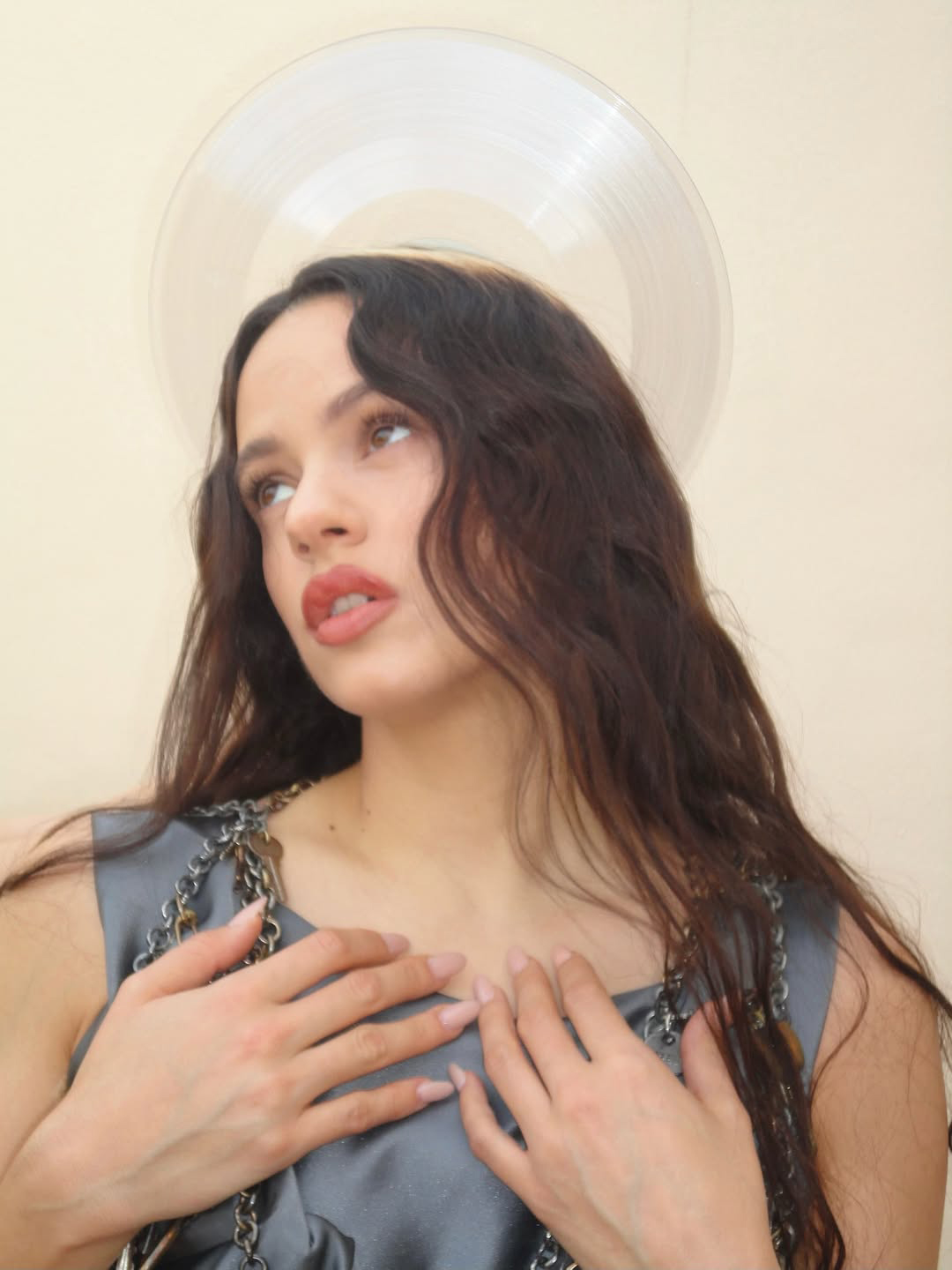
Lux is out.
Ablutions jacta est
Most religions and doctrinal systems incorporate ablutions into their liturgies. As I write this, I am reminded that on more than one occasion, in conversations with colleagues, we remarked on the way music videos have also suffered a precipitous decline in both formal and conceptual budgets. This erosion has likely occurred in direct proportion to the way reggaeton has foggily flooded the music industry, opening doors for mediocre artists who, through abject pelvic thrusts and the invasive display of semi-nude female bodies, conceal not only a lack of vocal ability but, more seriously, the absence of any artistic idea that might qualify as even marginally worthy.
In tandem, directors and video artists seem to have disengaged from the production of those music videos that once fascinated us precisely because they sometimes surpassed the virtuosity of the song that generated them. Do we not, then, need to “clean, clean, clean,” as Beuys would have it—through “baths” and “purifications”—in order to gain access to other narratives where banality is no longer the measure of the world?
The video for La Perla (ft. Yahritza y Su Esencia), for its part, explores regional Mexican music—specifically the so-called corridos tumbados—blended with trap, hip-hop, and urban sounds, also fused with pop. According to the artist herself, this results in an experimental avant-pop, as it incorporates Latin music, trap, and electronic elements. Her earlier albums fall more squarely within traditional pop. Lux, by contrast, is markedly more eclectic.
The clip unfolds with deliberate simplicity. The narrative presents Rosalía dressed in a fencer’s uniform, brandishing a foil with temerity at the end of the opening scene. She steps into the street, drives a Lamborghini—typically associated with masculinity and a status symbol commonly displayed by men in the urban music scene. She appears anxious, smoking; she walks her dogs (white and black, in an allusion to the familiar dualism); she carries a kevlar bite suit, robustly designed to withstand the attacks of a dog in training, which appears at the end of the scene entirely subdued. All these situations comment on forms of violence, while the lyrics point to an indifferent man, unscrupulous and narcissistically manipulative in his behavior. In the final scenes, the setting shifts to an ice rink where hockey is practiced. She appears without the masks or helmets customary in both combat sports, a metaphor for her toughness in facing the tribulations of a dysfunctional relationship.
Berghain (with the collaboration of Björk and Yves Tumor), meanwhile, reveals another facet of Rosalía. Here, the visual, musical, and literary fabric turns inward, akin to the moment when healing follows a period of mourning—particularly in the case of an album that took roughly three years to produce. These heteroclite registers within the artist’s work are entirely understandable. Anyone who has experienced grief knows its resemblance to a roller coaster: moments of apparent calm corrupted once again by sudden descents into renewed states of anguish and anxiety. Until, finally, one draws back the curtain—as in the video’s scene—and any landscape appears extraordinary. It is there that the violins emerge, in this cantata that fuses the classical and the contemporary. Emotional intensity is a fundamental component of this musical form.
Lux stands as a lucid and unpretentious conversation about the becoming of music itself. Given the space constraints of a blog, I will not delve into Mundo Nuevo, another track presented in this project, in which the artist—through an unsettling lighting scheme—addresses her mother (an emblem of the Virgin Mary), demanding the necessity of inhabiting a new world in order to find truth.
January 12th (and the light begins to emerge), 2026





If you’re a regular reader of this blog and enjoy its content, you might consider contributing to its upkeep. Any amount, no matter how small, will be warmly appreciated
Founded in 2021, Echoes (Notes of Visual Narrative) invites everyone to explore together the visual codes that shape our world—art, photography, design, and advertising in dialogue with society.

Copyright © 2026 r10studio.com. All Rights Reserved. Website Powered by r10studio.com
Cincinnati, Ohio



Comments powered by Talkyard.