
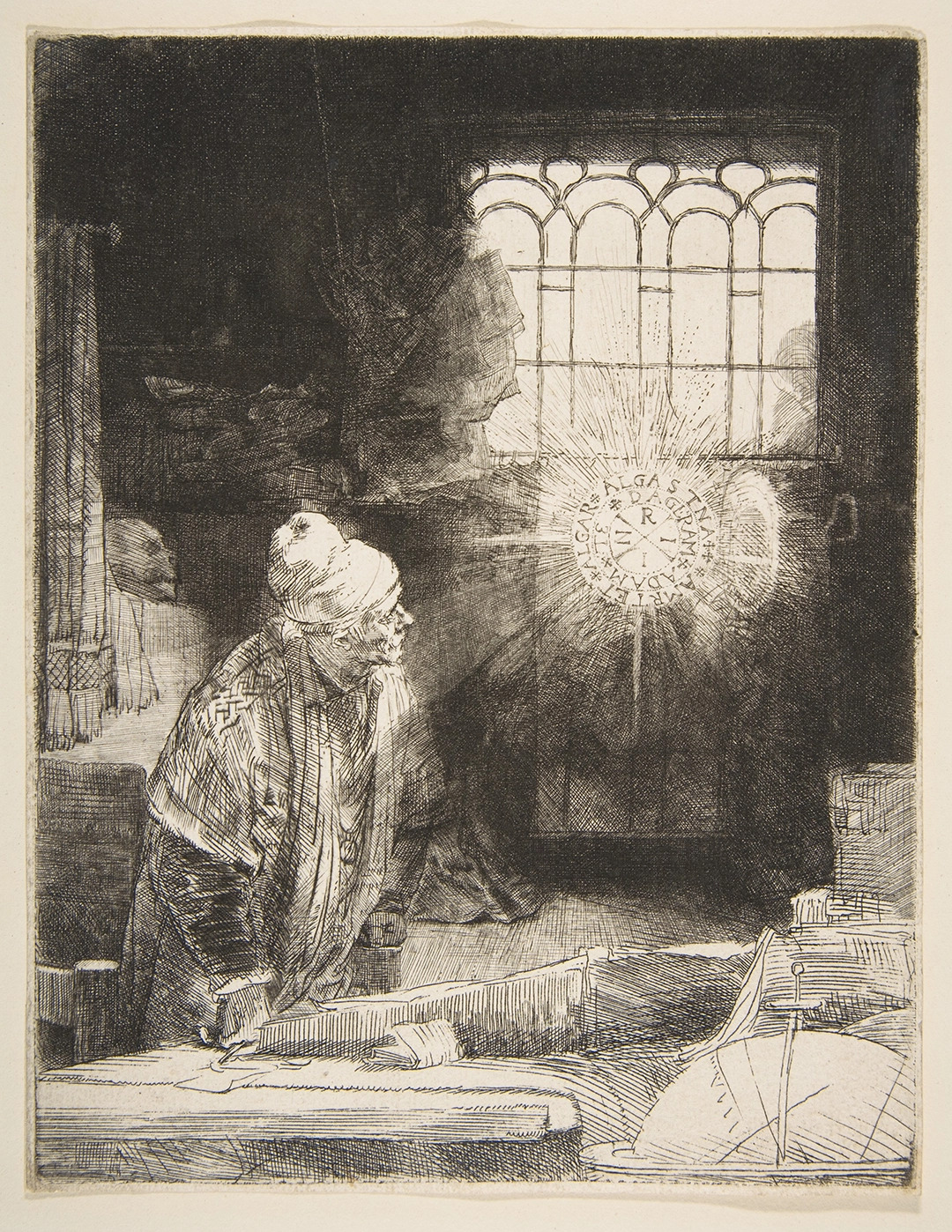
Faust, ca. 1652
Etching, engraving and drypoint on fine laid paper | 8¼ by 6¼ in approx.
I have yet to visit the exhibition Rembrandt: Masterpieces in Black and White. Prints from the Rembrandt House Museum, which opened on February 7 in the Fifth Third Gallery at the Taft Museum. Almost every day I find myself thinking I should go. Opportunities like this are not common, especially when dealing with a major figure of Dutch art.
The fact that so many of his works have been preserved—by which I mean not only his paintings, but also his prints, studies, and so on—indicates that he was already regarded in his own time as an exceptional artist, one whose work warranted careful custody. This belongs to a period without mass media, without the aggressive promotion and self-promotion we endure today. What we are dealing with is how he managed to stand out among many others, likely just as talented, who were not ultimately recognized by patrons or experts.
This exhibition offers direct evidence of an aspect of Rembrandt’s work that serious criticism has consistently acknowledged.
At a popular level, there circulates the idea of his almost supernatural command of chiaroscuro, of theatrical and dramatic light, and—through contemporary eyes—something close to the cinematic. Its persistence as a dominant criterion, while it illuminates both physically and sentimentally, restricts access to much else. Rembrandt remains a master, a demiurge who brings faces forth from shadow. That is only part of the matter.
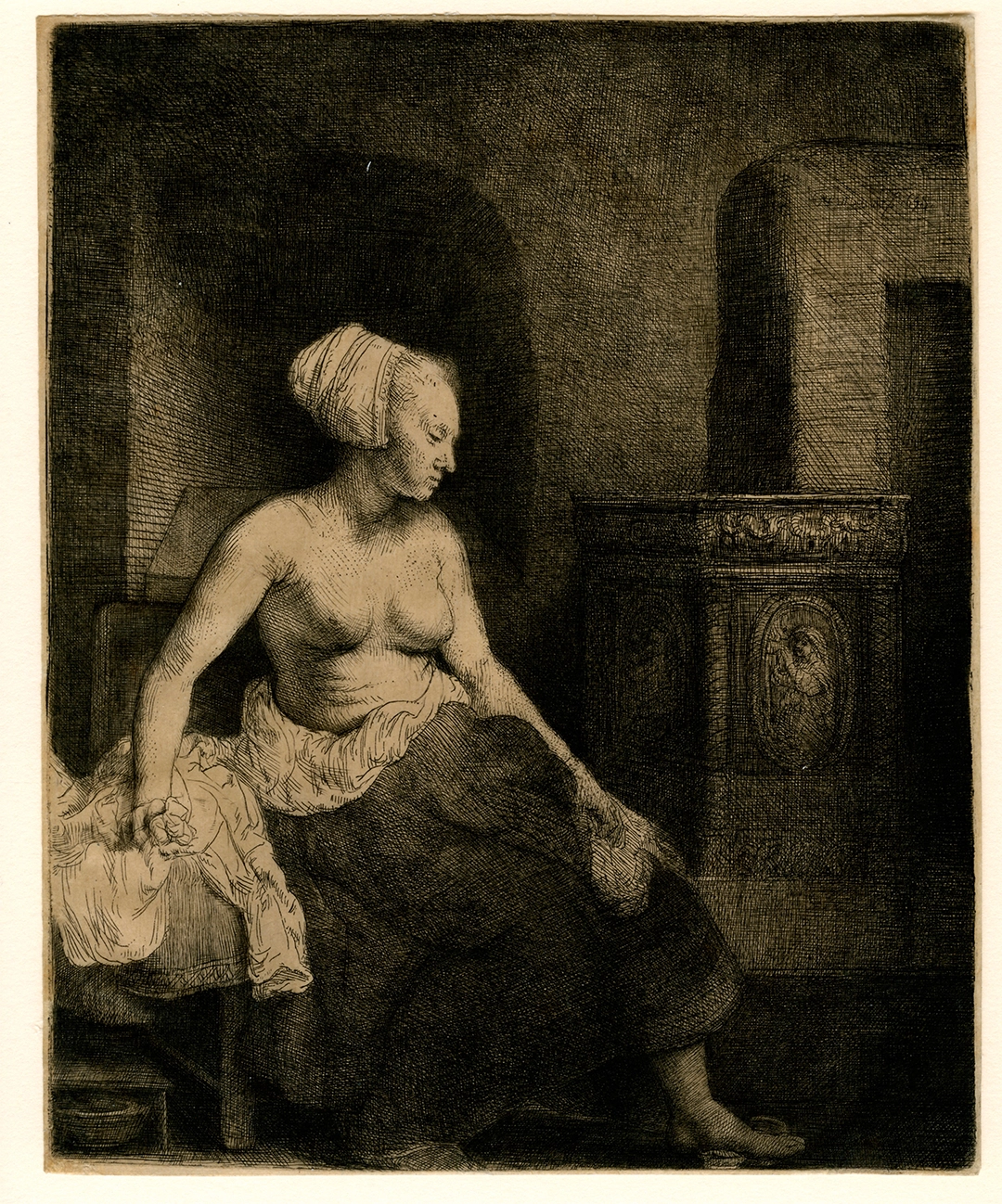
Woman Sitting Half Dressed Beside a Stove, 1658
Etching, engraving and drypoint, printed on Japanese paper | 9 × 7¼ in approx.
The exhibition at the Taft Museum of Art proposes another way of looking, a chance to engage the material presence of the works without the usual visual seasoning. It presents no oil paintings, only paper, ink, and the effect of pressure. It offers an intimate glimpse into one of the central structures of his visual thinking, an approach to his production shaped by experimentation, intimacy, and instability.
There are nearly fifty prints from the Rembrandt House Museum, a selection not seen outside the Netherlands in more than two decades.
Printmaking in the seventeenth century functioned largely as a reproductive medium. Rembrandt redirects it. One of the most consistent observations in the scholarship is that his prints operate as processes rather than fixed images, as sites of trial, variation, and persistence. He returns to the same image through multiple iterations, modifying lines, intensifying shadows, removing elements. His practice centers on the exploration of what the image can become. He worked the same plate over extended periods, producing different states of a single work. Each intervention altered more than detail. It could shift the emotional structure of the scene entirely. Steven Munson noted that Rembrandt could “completely alter the emotional content” of a print by adjusting light and darkness.
Other historians agree that Rembrandt turns printmaking into a laboratory, exploring ink, paper, and even pressure as active variables. He deliberately retained plate tone and used drypoint to produce unstable textures.
This breaks with the reproductive logic of the medium. Each variation produces a distinct object. The expectation that a plate would yield a stable number of identical impressions gives way to a field of singular results, closer to the condition of an original than to that of a multiple. I am convinced this was not merely a strategy to increase market value.
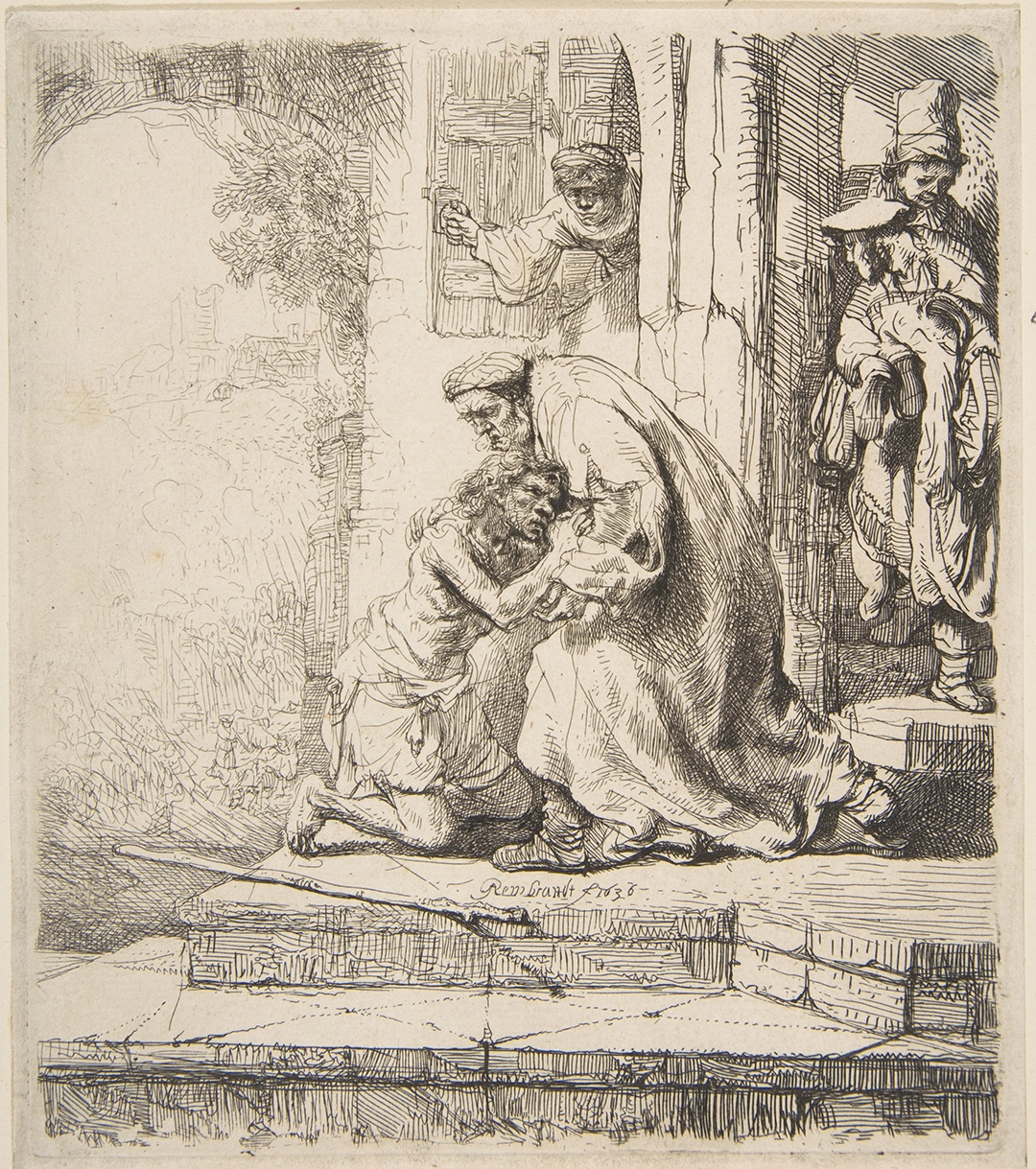
Return of the Prodigal Son, 1620–69
Etching, pen and ink | 6½ × 5½ in approx.
In terms of content, Rembrandt develops scenes as sites of emotional precarity. Analysis from the Telfair Museum points to the introduction of psychological depth in his biblical scenes through non-idealized faces, ambiguous gestures, and suspended narrative moments. He tends to avoid climactic points, concentrating instead on the uncertainty and imprecision that precede them.
One point of contact with his painting—inevitable, given its centrality to his visual language—is the use of light as a structuring tool rather than illumination. He builds images from shadow, whether faint or fully saturated. Technical studies indicate that he relied on line and acid work on the plate to generate pictorial density aligned with his narrative sensibility. Over time, he moved from dense networks of structural or contour lines toward broader darkened areas, reducing descriptive detail in favor of atmospheric or indeterminate effects.
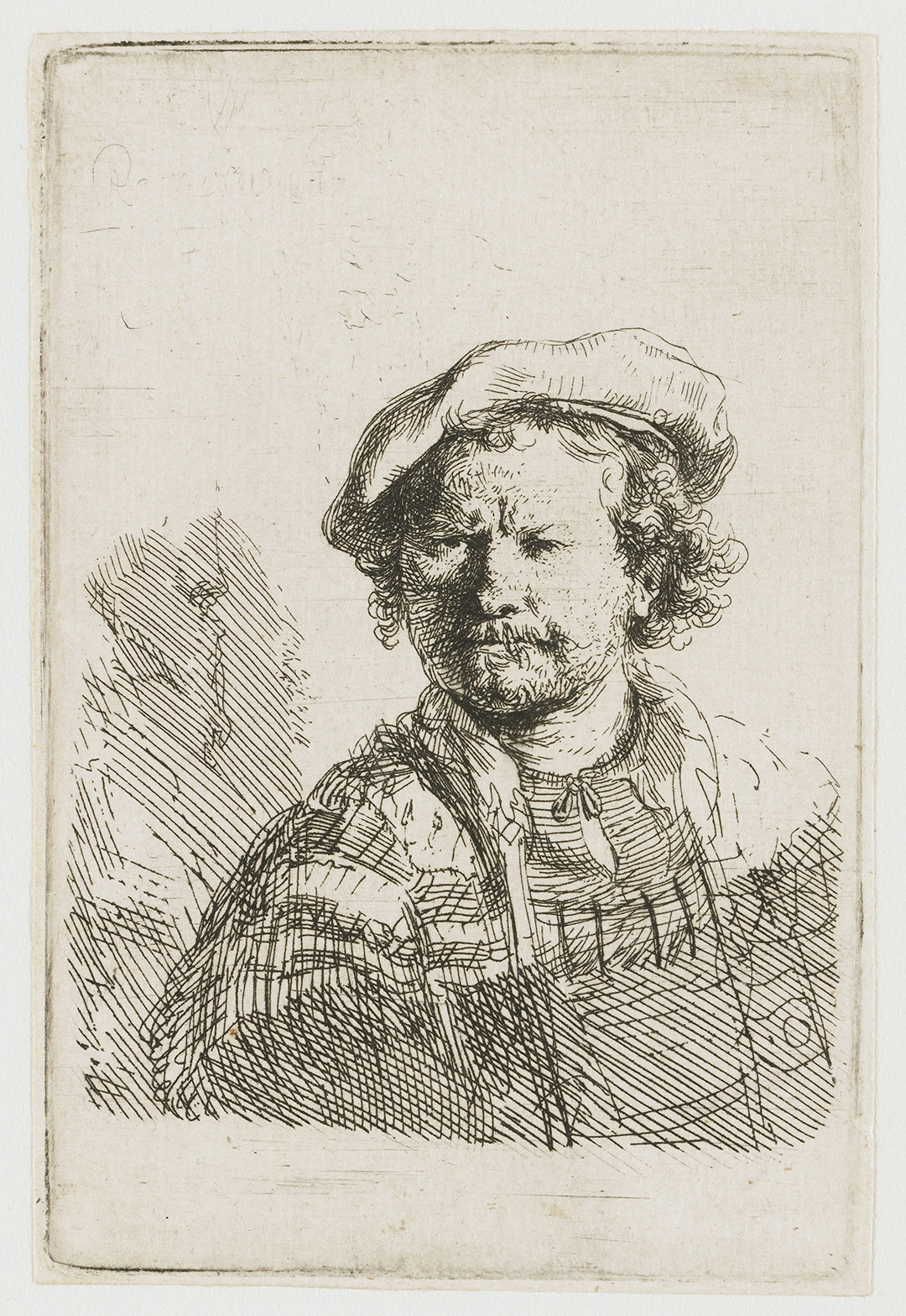
Self Portrait in a Flat Cap and Embroidered Dress. 1642.
Etching print. | 3½ × 2½ in approx. Various collections.
His self-portraits function as studies of himself. I am inclined to read them as exercises in gesture, costume, and variation. Scholars have approached them as fragmentary autobiographies, a kind of visual diary developed over the course of his life.
Rembrandt understood the commercial potential of printmaking. This had already been grasped, half a century earlier, by Martin Luther and Lucas Cranach. Where they mobilized the medium in the service of propaganda, the Dutch artist recognized that a public form of introspection could also operate within a market. Within that historical moment, printmaking occupies a position above painting. Rembrandt himself—according to Filippo Baldinucci—was more highly regarded for his prints than for his paintings. The seventeenth century comes to associate the medium with him, and through that association, he redefines it.
Unlike painting, printmaking demands proximity. It compels the viewer to reduce distance, to recalibrate vision, to remain. There is no immediate shock. No abrupt effect. It operates more like reading. The longer one attends to it, the more it yields. It unfolds through progressive discovery.
Rembrandt: Masterpieces in Black and White. Prints from the Rembrandt House Museum ultimately situates his work within this interpretive frame. It presents him as less monumental and more restless, less definitive and more exploratory. In the shift from oil to paper, the consecrated figure recedes and another presence emerges, one that questions and tests its own procedures.
In line with the invitation extended on the Taft Museum’s website, I share here two texts by curator Tamera Lenz Muente:
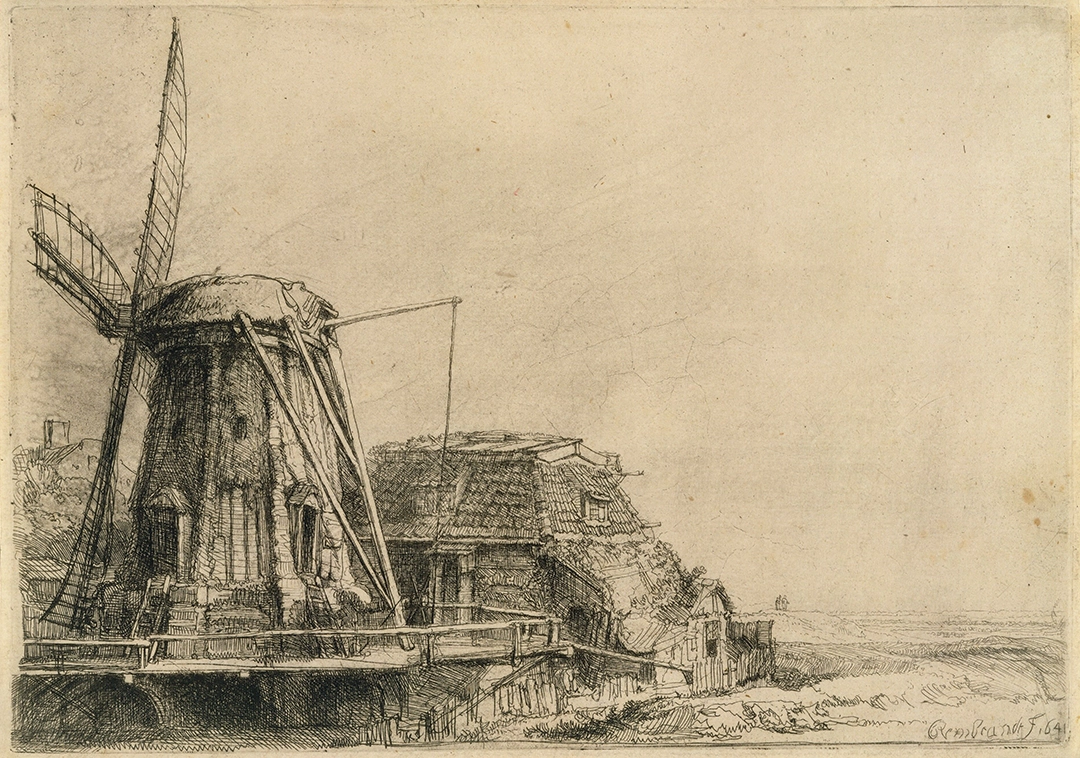
The Windmill, 1641
Etching and drypoint | 5¾ × 8¼ in approx.
Rembrandt House Museum, Amsterdam
Rembrandt depicted the boundary between city and countryside. The print shows the so-called Little Stink Mill, an actual windmill that stood on the De Passeerde bulwark along the city wall that ran down the west side of Amsterdam. The mill was owned by the Leathermakers Guild and its nickname derived from its activity of softening tanned leather by treating it with cod liver oil. Rembrandt traced the mill and its surroundings in such detail that it seems likely he began the print on site and then finished it in the studio. Visible in the sky are diagonal striations that result from his having brushed acid over the surface of the printing plate for effect, and craquelure was more likely the result of an accident that occurred as the plate was being bitten by the acid. | www.metmuseum.org
Rare Etchings by Rembrandt
January 5th, 2026 | By Tamera Lenz Muente, Curator
The innovation, creativity, and virtuosity of Rembrandt van Rijn (Dutch, 1606–1669) is evident not only in his paintings but also in the more than 300 etchings he made during his career. The Taft Museum of Art will be one of just four museums to present Rembrandt: Masterpieces in Black and White—Prints from the Rembrandt House Museum. This marks the first time in more than 25 years that the Rembrandt House Museum—the artist’s former home in Amsterdam—is sharing an exhibition of these rare and exquisite prints from its renowned collection with museums outside the Netherlands.
This is an exciting opportunity to showcase the pioneering techniques of one of the world’s most famous artists. One of the Taft’s most significant and beloved paintings is Rembrandt’s Portrait of a Man Rising from His Chair, so it’s wonderful to be able to further highlight his artistic achievements. Rembrandt’s etchings are among his greatest accomplishments. Their remarkable intimacy, awe-inspiring draftsmanship, and emotional impact make them still very relevant today.
At a time when most saw etching primarily as a vehicle to reproduce famous works of art, Rembrandt utilized the medium to create groundbreaking compositions. Filled with delicate lines and velvety shadows, his etchings often achieve the psychological intensity of his oil paintings. Nearly 50 works in Rembrandt: Masterpieces in Black and White—Prints from the Rembrandt House Museum present the depth and breadth of Rembrandt’s etching subjects, including portraits, self-portraits, scenes from daily life, landscapes, narrative scenes, and still lifes. A select group of etchings by Rembrandt’s contemporaries, as well as later admirers including James McNeill Whistler and Pablo Picasso, demonstrate the Dutch master’s enduring influence.
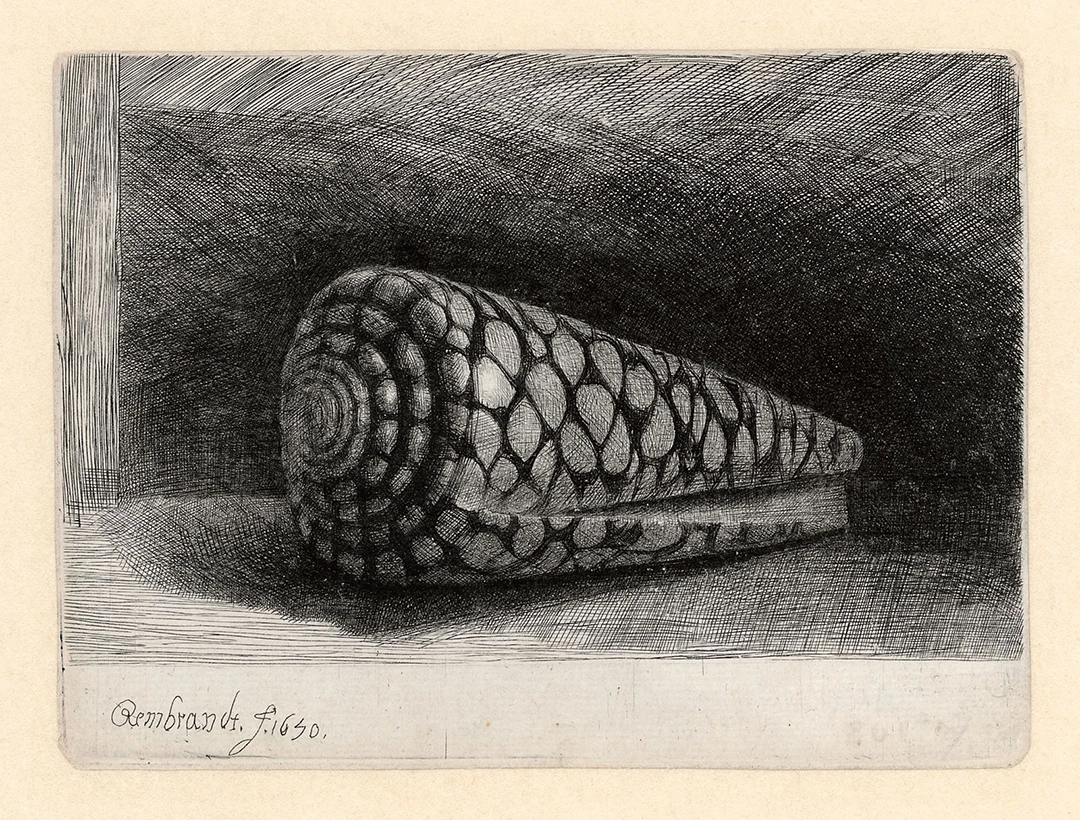
Conus Marmoreus, 1650
Third state, Rijksmuseum, signed 'Rembrandt. f. 1650'
3¾ × 5¼ in approx. Rijksmuseum, Amsterdam
The Shell, also known as Rembrandt's Shell or Conus Marmoreus, or in Dutch as De schelp ("the shell") or Het schelpje ("the little shell"), is a 1650 drypoint and etching by Rembrandt van Rijn. Catalogued as B.159, it is Rembrandt's only still life etching. Only a handful of original prints are known, in three states. Wiki
Stories in a Shell: Rembrandt’s "Conus marmoreus"
February 5th, 2026 | By Tamera Lenz Muente, Curator
A single shell emerges from shadow. One end coils in a perfect spiral, while the other tapers to a point, creating the conical shape described by the genus Conus. The shell’s dark surface gleams with irregular white spots, marking the pattern that characterizes the species marmoreus, Latin for “marbled.” Rembrandt’s fascination with the marbled cone shell shines through in his delicate, accurate—almost brooding—portrayal. This complex, high-contrast form provided a prime subject for the black-and-white medium of etching. It also suited Rembrandt’s interest in direct observation from nature. He rendered the shell at about 2 1/2 inches, approximately life-size, though printing the etching plate reversed the image—in reality, the shell spirals in the opposite direction.
A carnivorous snail, the marbled cone preys upon tiny organisms by injecting paralyzing venom with a harpoon-like tooth. Endemic to the Indian Ocean and the western Pacific, it would have been an exotic prize in the Dutch Republic. Global trade exposed Dutch artists, scientists, and collectors to species of flora and fauna from the other side of the world. Among the many coveted treasures were seashells, which in turn showed up in still lifes, such as Balthasar van der Ast’s in the Taft Museum of Art’s collection (which includes a Conus marmoreus at bottom right).
These paintings served not only to demonstrate wealth, but also to remind viewers of their own mortality. Vanitas objects like skulls, wilting flowers, and watches all carried the warning: do not be too distracted by all these worldly possessions, because you too, will die. Rembrandt’s exquisite shell is, after all, the vacant hull of a once-vibrant marine creature.
Rembrandt himself amassed a sizeable collection of corals and shells, along with other rare items including antlers and horns, swords and spears, preserved animals, and classical sculptures. His possessions were recorded systematically when he went bankrupt in 1656, enabling the Rembrandt House Museum to recreate his curiosity cabinet. Rembrandt often used costumes, weapons, and other objects from his collection in his paintings, but his marbled cone shell is the only treasure he recorded in a pure still life.
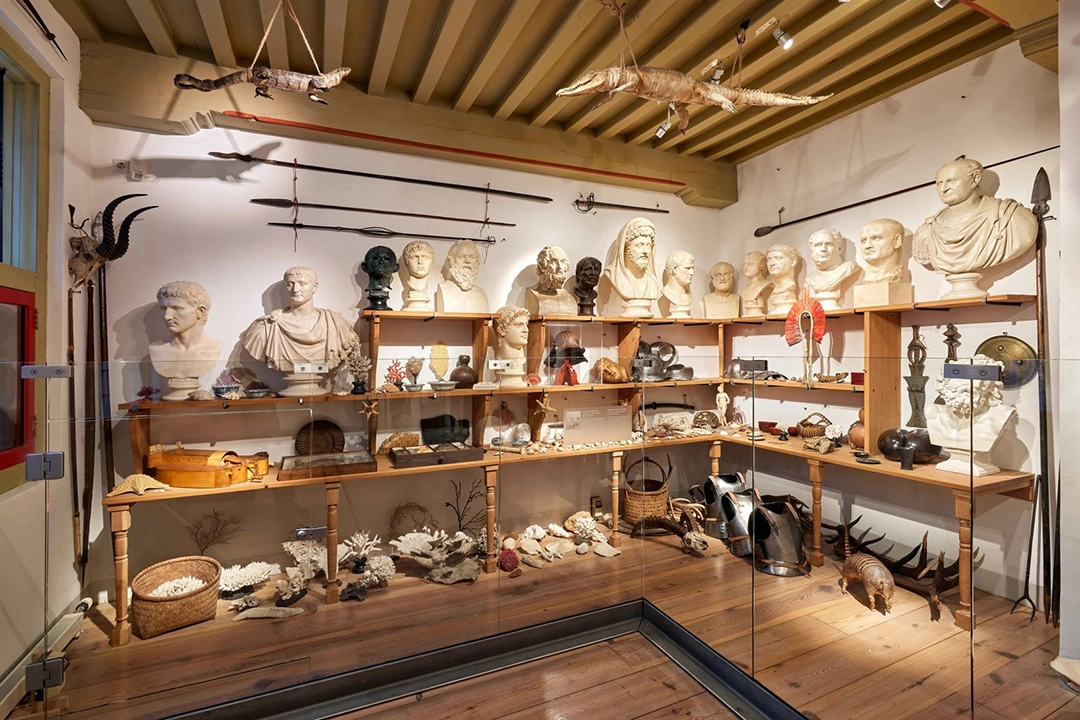
View of Rembrandt’s curiosity cabinet, Rembrandt House Museum, Amsterdam
The print also sheds light on Rembrandt’s etching practice. He frequently made alterations to a plate, printing it in multiple states. In the shell’s rare first state, Rembrandt rendered it entirely in drypoint, using a sharp needle to scratch directly into the copper plate’s surface. This resulted in an accurate depiction of the shell that floats on a creamy background. In the second state, however, he reworked the plate, etching thousands of fine, intersecting lines to build up a shadowy, recessed space. By pushing the dramatic contrasts of light and dark, Rembrandt went beyond a straightforward, scientific depiction, elevating the humble Conus marmoreus from a natural specimen to a transcendent object that evokes powerful emotion.





If you’re a regular reader of this blog and enjoy its content, you might consider contributing to its upkeep. Any amount, no matter how small, will be warmly appreciated
Founded in 2021, Echoes (Notes of Visual Narrative) invites everyone to explore together the visual codes that shape our world—art, photography, design, and advertising in dialogue with society.

Copyright © 2026 r10studio.com. All Rights Reserved. Website Powered by r10studio.com
Cincinnati, Ohio




Comments powered by Talkyard.