
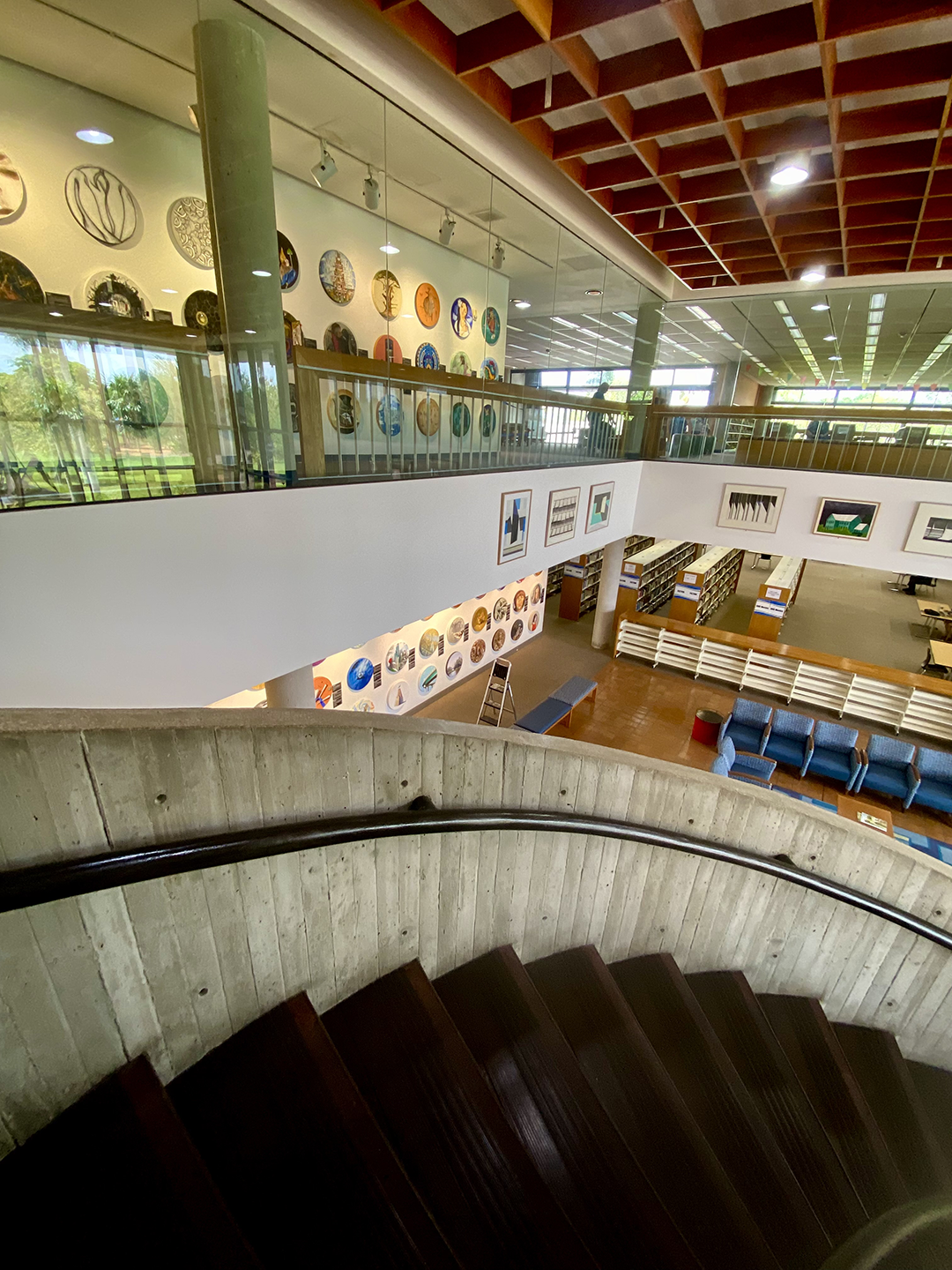
The exhibition Circular Reflections (Reflexiones Circulares) is presented at the Westchester Regional Library in Miami, where it may be visited from April 3 through June 25, 2026, with an opening reception on April 4 at 1:00 p.m., marking the public beginning of a project that unfolds within that shared interval between artwork and gaze.
Left to itself, matter organizes into the sphere. With no purpose other than being, it expends upon itself the least possible energy. A sphere contains any volume beneath a minimal surface, reaches maximum stability, and slips beyond the reach of any avoidable or unnecessary disturbance. It is optimal: the celestial bodies that drift and gravitate in the void are all spherical. One only has to look at them.
The circle, however, is not common in nature. It is a mathematical idealization in which every point lies at the same distance from the center.
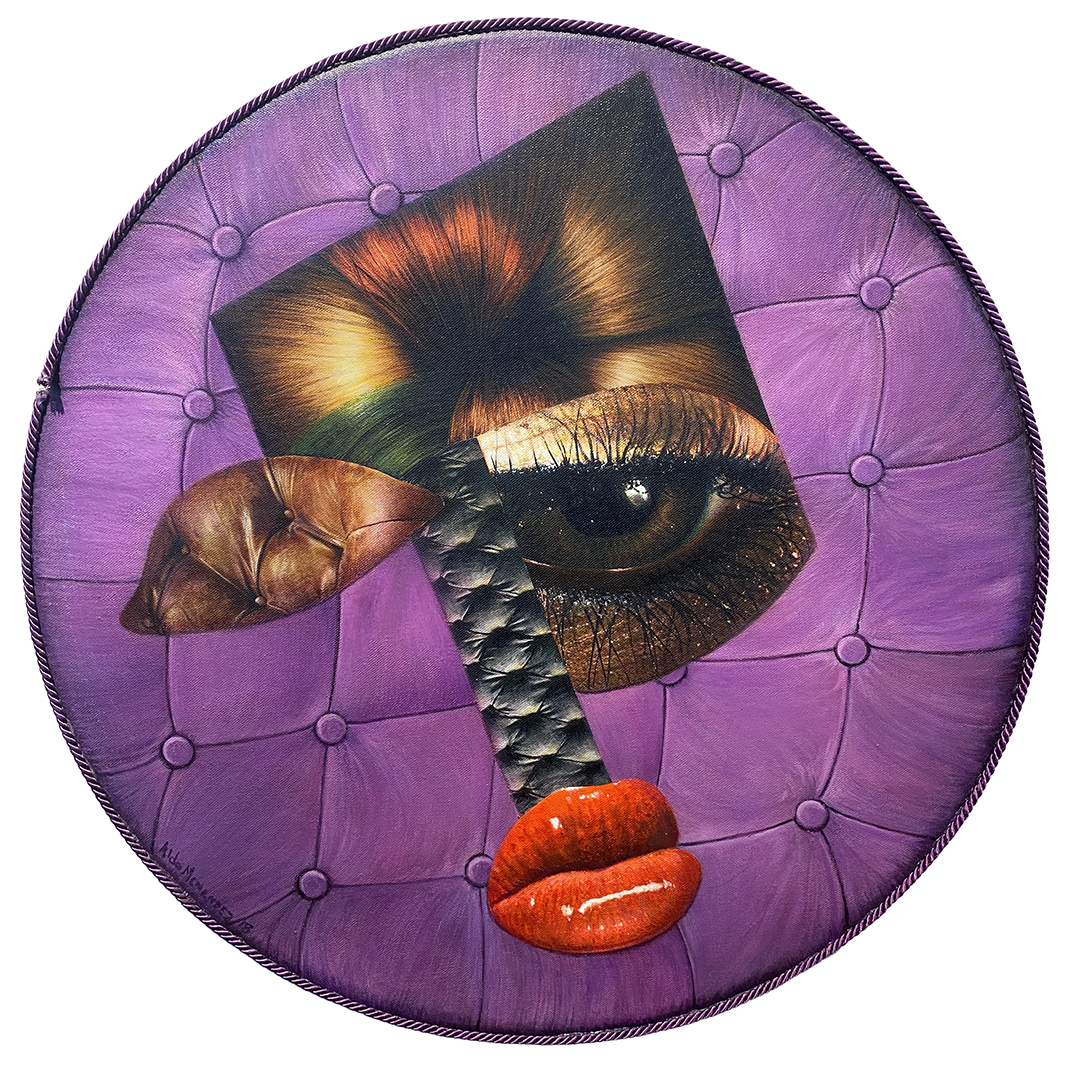
Aldo Menéndez proposes a tense relationship between containment and fragmentation. The support—padded, almost domestic—suggests a soft, intimate, even tactile surface, yet that promise is interrupted by the eruption of a face assembled from mismatched fragments. Although the eye—moist, vigilant—acts as a perceptual axis, it neither manages nor attempts to stabilize the whole. The mouth, absolutely protagonistic, red and swollen, saturated and autonomous, seems to belong to another order of meaning.
Human beings in general—before we even enter the territory of art—are fascinated by centers. Perhaps because if it sinks even slightly, everything converges there. If it rises even slightly, everything rolls around it. It is in the center that heat gathers in a soup, and to cool it we displace it with the spoon.
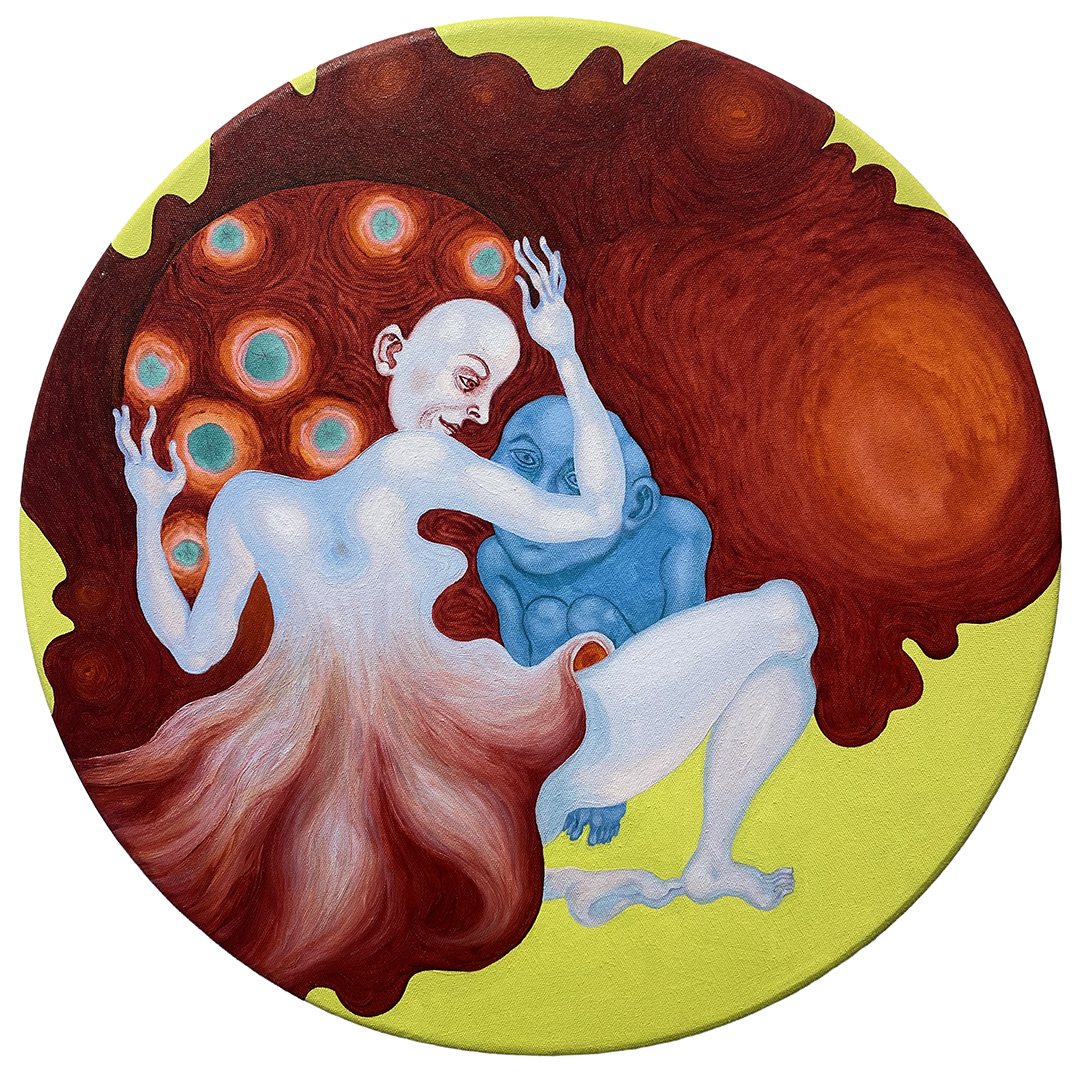
Ana Albertina’s piece exposes a radically asymmetrical bond between two bodies, whose apparent fusion does not obey the logic of union but that of domination. It reveals a tense, almost biological scene: one submits and the other yields—the precise instant when the prey stops resisting the weight of its predator.
This female figure, with fluid contours, expands like a living substance to envelop or absorb the restrained blue body. An organic mass—nearly visceral—unfolds as an active ground, punctuated by ocular forms that introduce a dimension of surveillance. The work does not fix a specific narrative instant, but rather a continuous process of assimilation, where the circular reinforces the cyclical, in terms of condemnation and repetition.
When man organizes structures of meaning—whether a worldview or a religious system—he makes the pieces rotate around a central core. There they are, for anyone willing to see them: mandalas, divine halos, serpents biting their own tails. The idea of perfection in classical philosophy. Even witches draw circles to contain certain forces, or to prevent their entry.
The circle also resolves three major human obsessions: cyclical time, the idea of totality, and the control of chaos through the limit. In the middle of the sea or the desert, the circle that surrounds us holds us inside the unresolved center of our existence. It forces us to occupy it.
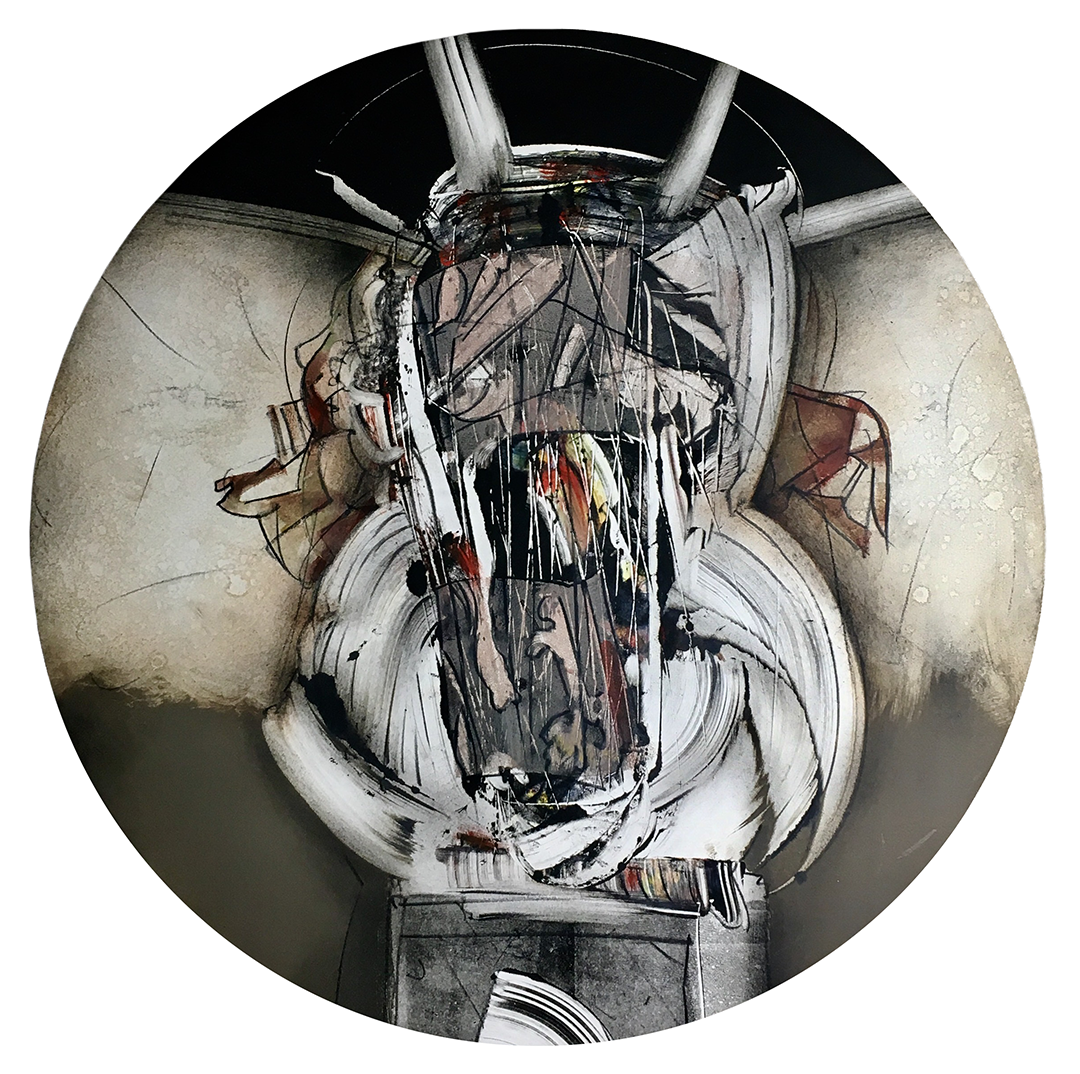
Víctor Gómez’s piece is sustained by instability; it exposes chaos and the collapse of a central semantic device. The image barely takes advantage of what appears to be a solid base. It is violated by a series of violent painterly gestures that tear into it and reveal, precisely, its lack of supporting structure. At the northern edge of the piece, several supports or beams extend beyond its limits, granting a measure of balance. But the whole radiates a state of saturation, of a weakened core, sustained—by persisting in deception—by both the earthly and the divine.
I know that with these notes, these “reflections,” I am moving away from the center of this text, which is Miguel Rodez’s Circulars project: “a nine-year curatorial odyssey toward the geometry of the infinite.”
Miguel cannot imagine how familiar these forms are to me. For four years I lived alongside the ceramic plates of the Rodríguez Collection—five days a week, twelve months a year. I even made a couple of them, and the experience carried its share of vertigo. Because although the circle absorbs everything that claims to be perfect, when we demand a precise reading of what surrounds us—when our life depends on it—we look for four corners to stop the drift. We trust quadrilaterals and parallelograms to domesticate chaos. There is a reason the eyes open wider than they do tall. To the sides unfolds what is interesting, what demands attention, what remains unknown. Below is too close; above, too far.
To paint on a circular format is to banish predictable coordinates and unmoor us from what has been “previously experienced.” Perhaps there is something that enchants and unsettles any narrative when its cardinal points are stolen. When it is forced to tell its story backward, or to walk in reverse, when it is tethered to a center.
With these lines I attempt to ricochet along the inner edges of the circumference, to dodge the axis. I have no interest in one so blatantly central, so exclusionary.
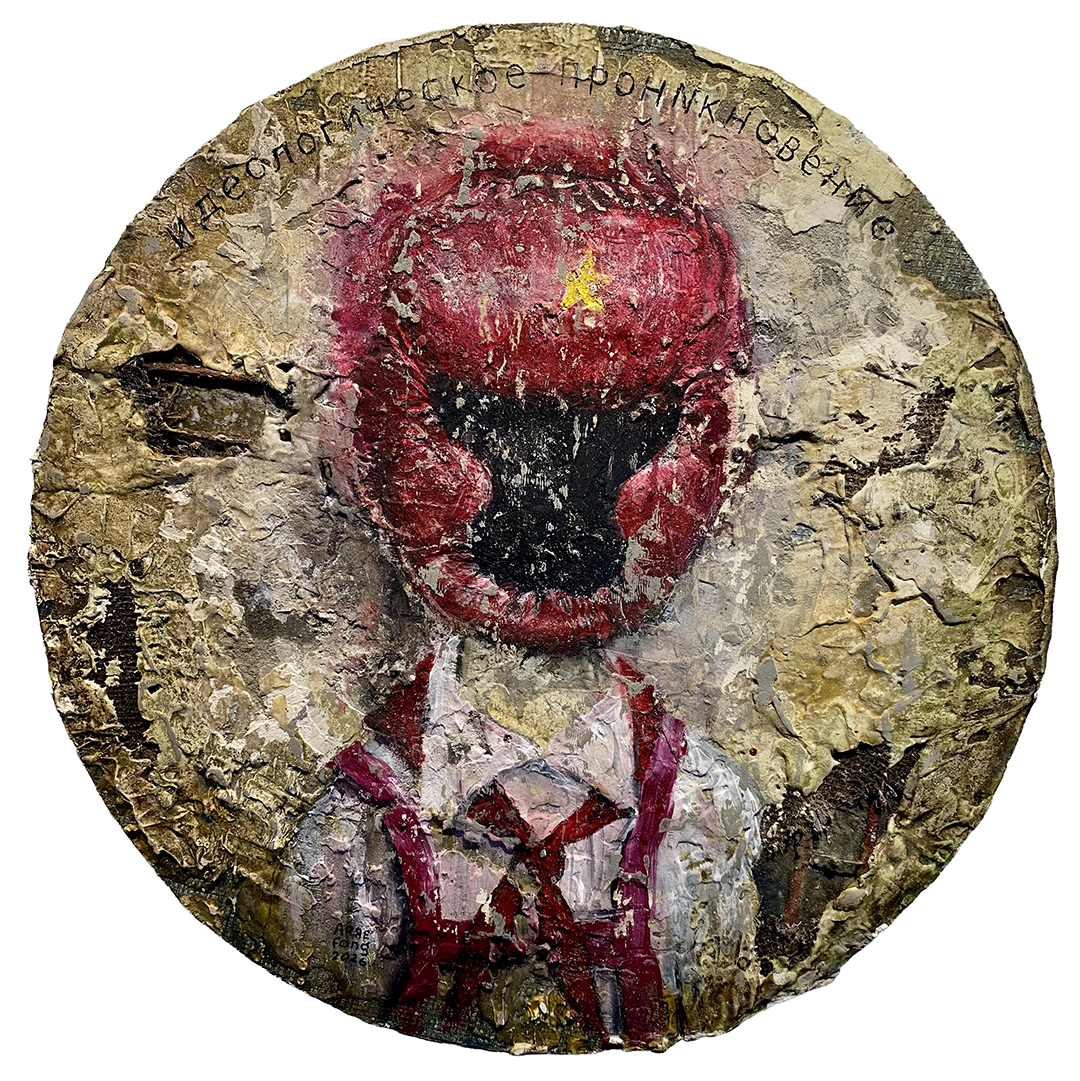
In Arrechea’s work, figuration leads us toward a historical judgment. The surface—eroded, dense—seems burdened by too many contaminating experiences, as though its author had been subjected to processes of wear, accumulation, and violence. Closer to the center, the figure—the distorted head of a pioneer, completely annulled—introduces a political dimension made explicit and ostentatious by the presence of Slavic writing along the perimeter. The circle recalls a votive object or a reliquary. Its image is frontal and unavoidable. It speaks to us of the annulment of the individual, of punishment.
I know the work of most of the artists in this project. I am familiar with their work in the “regular,” the accustomed format. And I sense—perhaps intoxicated by so much rotation around a pivot—that nothing settles, that the landscapes these circular stretchers contain remain in permanent suspension. That every attempt at grounding is fractured by a sudden agitation, that the elements seem fixed in place only to bind their disobedience.
If I look at them one by one, I cannot help but trace their perimeter. The gaze rushes like a deranged proton inside a particle accelerator. When it collides with the image, it disintegrates. It releases a thousand smaller approaches—of purer energy—that allow us to understand the matter that constitutes the artist’s proposition.
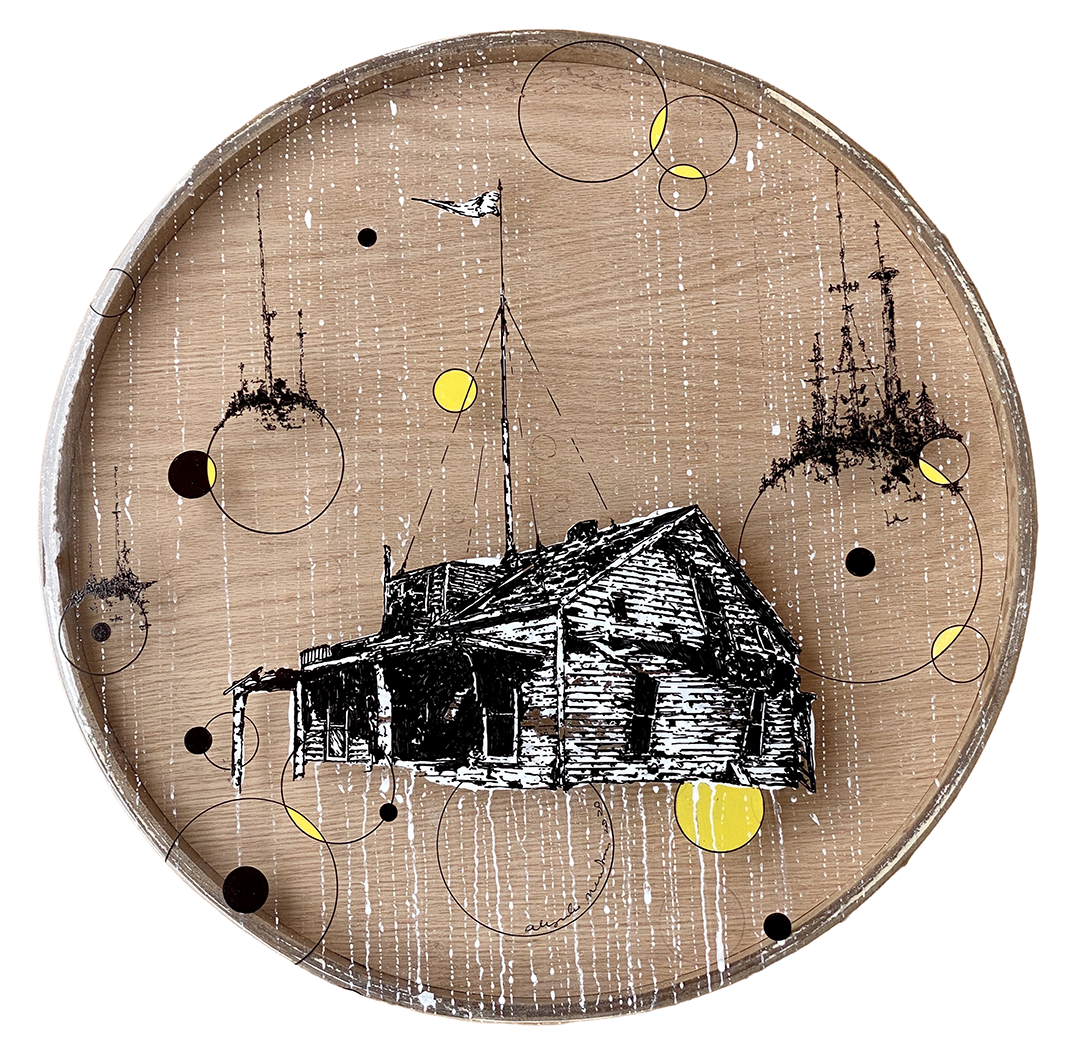
Mendoza, for his part, displaces the tension toward a suspended poetics. On a wooden surface—closer to a tray or a functional object—he inscribes a precarious, almost ghostly architecture. The house seems to stand in an improbable balance, surrounded by circular forms that orbit it, like autonomous systems activating the space and splitting it into multiple focal points. Of all these works, it is the one that most insists on the circle’s in-graspability—the only one that truly comments on it.
I am of the opinion that it is far healthier to see these circles as a whole. They will be hung on a rectangular wall that dominates and neutralizes them, and disarms their sinister potency.
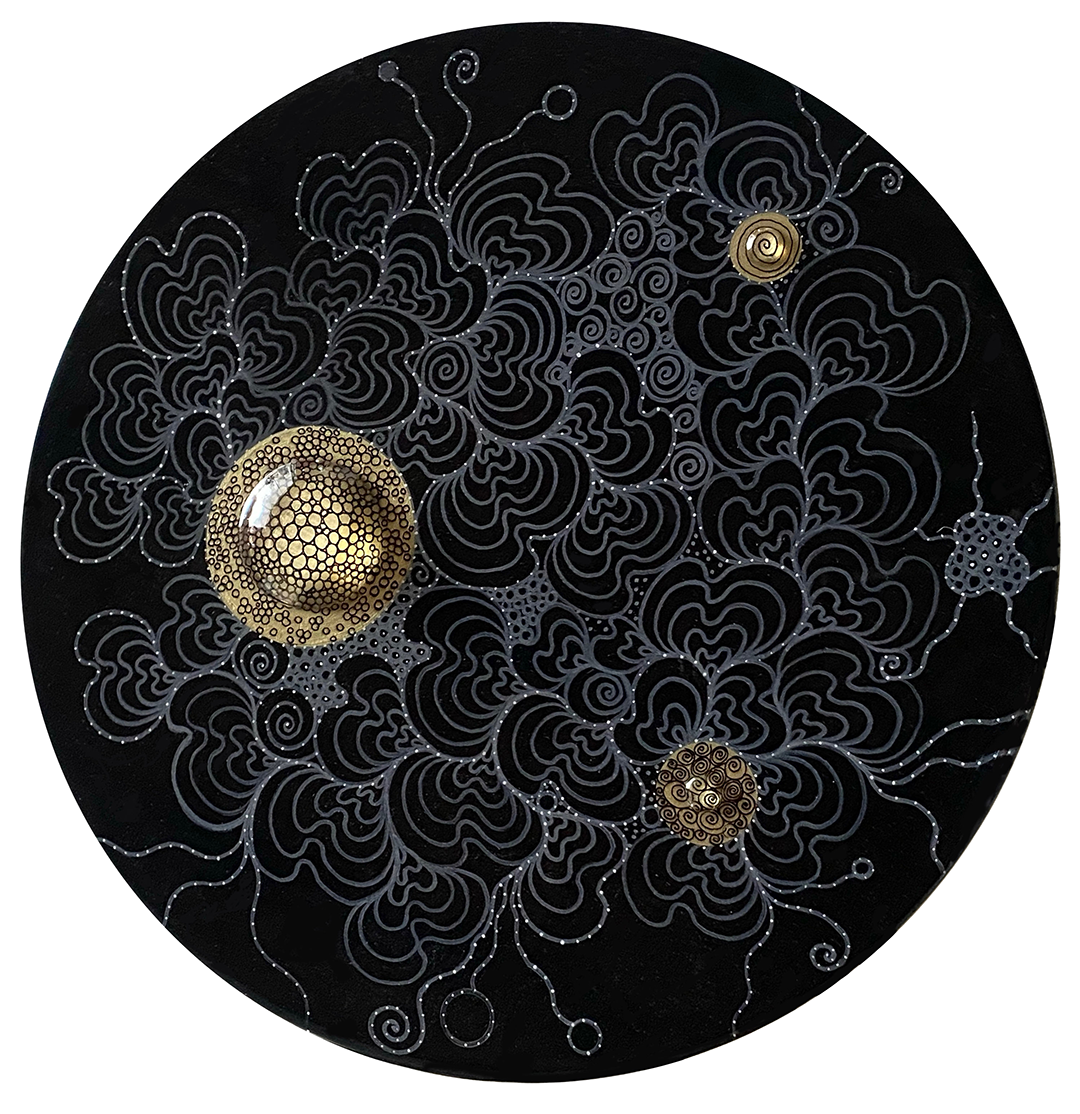
Lastly, I want to highlight the one that, in my view, makes the best use of the format. This piece by Luisa Mesa fills me with peace. The circular functions as an aperture through which we can peer into a world that is at once micro- and macroscopic. That dimensionless ground reveals itself covered by a web of sinuous, almost respiratory lines, expanding into patterns akin to cellular formations. These lines are drawn with an almost obsessive precision, and they support, on a second plane, three golden elements—like celestial bodies from an inhuman universe that, curiously, avoid the center. This piece, one minute later, could be another; a new one every hour, as happens on the plane where the organic grows and organizes itself as an ornament that looks very much like life itself.





If you’re a regular reader of this blog and enjoy its content, you might consider contributing to its upkeep. Any amount, no matter how small, will be warmly appreciated
Founded in 2021, Echoes (Notes of Visual Narrative) invites everyone to explore together the visual codes that shape our world—art, photography, design, and advertising in dialogue with society.

Copyright © 2026 r10studio.com. All Rights Reserved. Website Powered by r10studio.com
Cincinnati, Ohio
Comments powered by Talkyard.