
I have developed a faint affection for photography competitions. I go through them with an almost childish curiosity, looking for the good photographs the jury overlooked and the bad ones it chose to reward. In the latest issue of Camera Craft, its sixty-ninth, for March and April of this year, some of the results are published from the competition that The Guild of Photographers organizes annually.
The Guild of Photographers was founded back in 1988. At the time, it was an organization devoted to wedding photography. But they soon turned the page, and over the years broadened their scope until they became a more encompassing association, dedicated to supporting, training, and honoring photographers of widely differing profiles. Their annual awards do not operate as the punctual celebration of a good result, but as the culmination of a sustained, pedagogical competitive process, nourished by monthly contests and by the constant review of thousands of images. That continuity gives the competition a particular authority. It rewards not only the immediate impact of an image, but its capacity to hold up within a framework of constant evaluation.
The 2025 edition singled out works selected over the course of ten months of submissions and culminated in the presentation of awards in early February 2026, an occasion that also incorporated, for the first time, the UK Photography Print Awards.
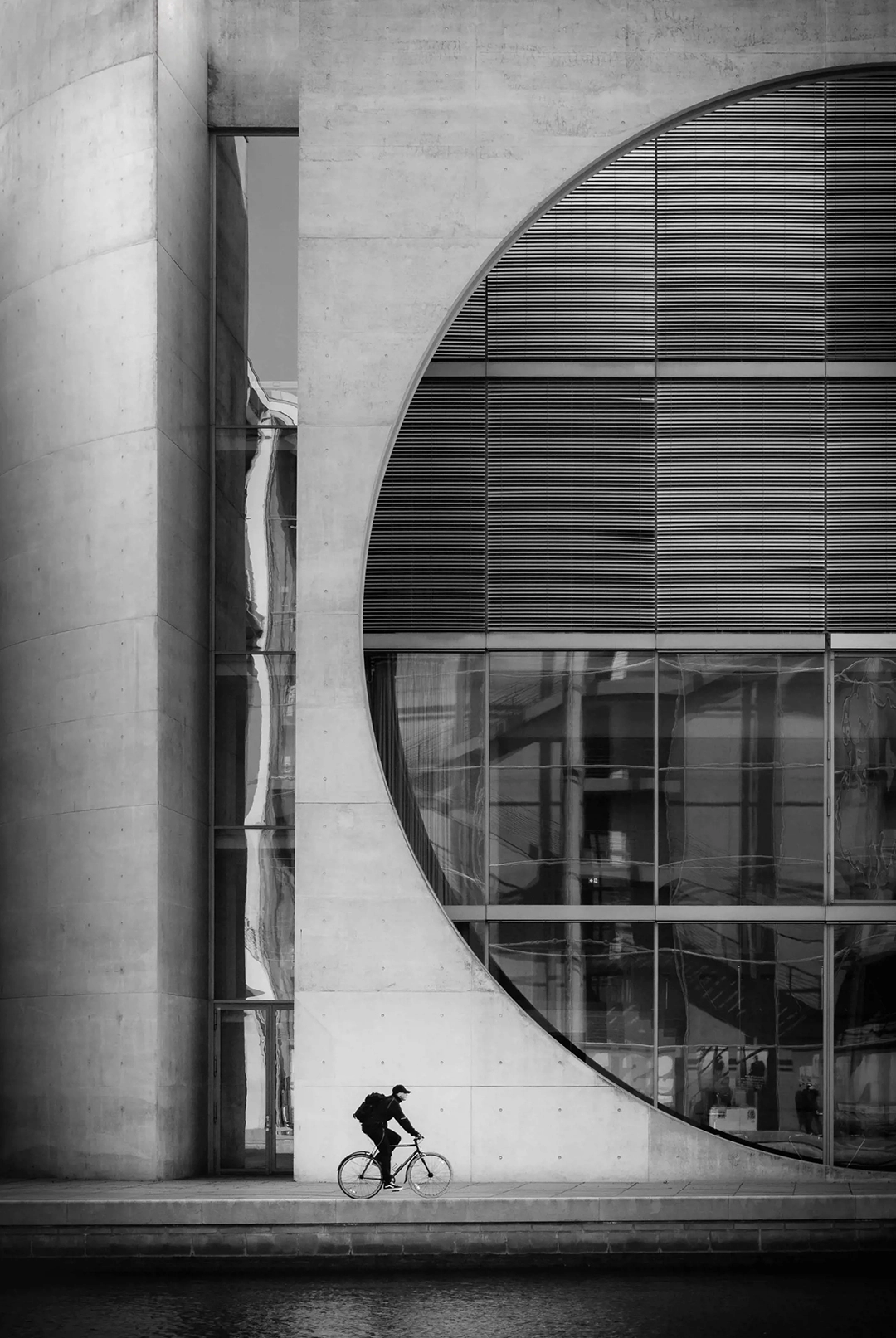
Of the winning pieces, only one caught my attention. And not precisely because of its technical quality or brilliance, but because it can be understood equally well by a professional critic and by a wiseass to whom nothing ever seems good enough. I know what I am talking about, because for sheer pleasure I move between both extremes. It is worth noting that the jury distinguished it as Image of the Year.
A critic would say that the piece stood out for its impeccable formal resolution. For the clarity with which it turns an urban scene into a visual reflection of broader reach. A call to attention regarding the disproportion between human scale and the structures it raises.
If we grant that point of departure, we can suffer through the rest.
At the visual center of the composition stands a severe building of concrete and glass, its façade articulating the image through a formal economy of verticals, concrete planes, and a curve of considerable visual weight. It is precisely that vast curvature that softens the building’s rigidity and shifts it toward a more complex form of monumentality which, nevertheless, never quite humanizes the space: perhaps more eloquent, but not much less unkind. The whole seems designed to underscore scale, order, and authority. The urban reveals itself here as cold, rational, and impersonal.
Below, beside the water, a cyclist cuts across the scene. It is a minimal figure, dark and solitary. It occupies barely a fraction of the frame, yet it gives the image its precise dose of vital substance. Its presence introduces the proper scale to the photograph and allows the building’s monumentality to be measured.
We perceive something else as well: the stubborn persistence of the organic, of the sinuous, within a world designed to a scale that frequently exceeds it. That cyclist—alive and in motion, concentrated and relishing his own fullness—neither defies nor seems crushed by the brutality of the architecture. He traverses it. He simply passes through.
The black and white is decisive. It purifies the image. By suppressing color, the photographer forces the eye to concentrate on the weight of the concrete, on the linear vibration of the blinds, on the reflections in the glass, on the dominant curve that relaxes the façade. The image approaches a form of abstraction without losing its anchorage in the real. It is urban landscape, of course, but also a study of form, an essay on proportion, and a meditation on the city. In short, it is an intelligent, exact, and precise photograph.
The wiseass sees nothing more than someone who, with a camera in hand, suddenly noticed the ridiculous—almost astronomical—relationship between the enormous planet looming at the right and the two tiny moons orbiting below it, the way flies circle a meringue. One big ball and two little ones. One does not move, the other two do. That is it. What more is there to say.
And I would not dare say for certain who, in the end, took the photograph: someone attached to formal reflection, or else to buffoonery.
P.S.
The photograph was taken by Ryan Hutton. It received the Jury’s selection for Overall Image of the Year, as well as Urban Image of the Year, and won the Landscape category in the UK Photography Print Awards, which are entered separately and are sponsored by Epson and Photoshield Insurance. Just look at everything this photograph has won on the strength of a simple contrast in size.





If you’re a regular reader of this blog and enjoy its content, you might consider contributing to its upkeep. Any amount, no matter how small, will be warmly appreciated
Founded in 2021, Echoes (Notes of Visual Narrative) invites everyone to explore together the visual codes that shape our world—art, photography, design, and advertising in dialogue with society.

Copyright © 2026 r10studio.com. All Rights Reserved. Website Powered by r10studio.com
Cincinnati, Ohio

Comments powered by Talkyard.