
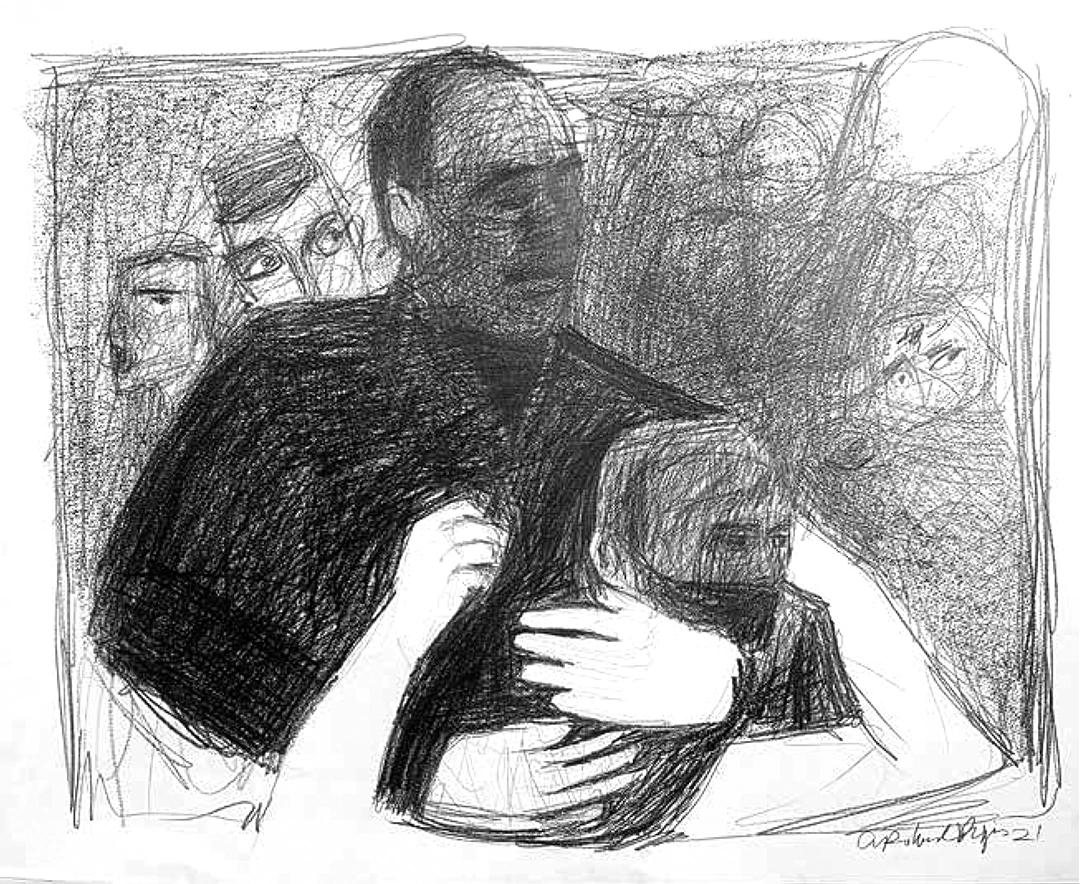
Agustín Rolando Rojas
With Your Arm Around My Neck, 2021
Drawing on paper | 25½ x 19¾ inches
When I was researching for my book La acera del sol: impactos de la política cultural socialista en el arte cubano 1961–1981, Professor Adelaida de Juan granted me an interview. We spoke for several hours, and among everything she told me, one remark stood out: for her, the most significant visual production of the 1960s had been neither painting, nor printmaking, nor photography, but graphic design—the posters produced by ICAIC, Casa de las Américas, and the National Council of Culture.
That value judgment struck me forcefully, because those posters—though formally virtuosic (in composition, synthesis, typography, color, contrast, communicative impact, etc.)—were and remain visual texts saturated with ideology, functioning as vehicles for the official discourse’s propaganda. Strictly speaking, they did not expand our understanding of reality; rather, they helped stabilize and fix a very specific vision of it—the vision of revolutionary power. That is what propaganda does, even when it is well made: it gives aesthetic form to an imaginary representation of reality prefigured by ideology.
Meanwhile, the works of Antonia Eiriz, Umberto Peña, Chago, Servando Cabrera, Raúl Martínez, Manuel Mendive, Rafael Zarza—within that same context—were also extraordinarily inventive at the formal level: original, experimental, and, crucially, opening a space for reflection, for critique, for grasping complex phenomena that exceeded the narrow and fossilized framework of ideology. So how is it that, for Dr. de Juan—teacher of generations of art historians—the graphic production of the sixties held greater artistic and historiographic value than the work of those artists? Speaking of Umberto Peña, for instance, she did not hesitate to say: “I don’t like his painting; I find it unpleasant, but his work as a designer at Casa de las Américas is unsurpassed”—a judgment shared by her husband, the poet and essayist Roberto Fernández Retamar.

Miguel Monkc
Flag, July 11, 2021
“I designed a flag that represents our cause for the freedom of Cuba. It came from my own initiative. No one asked me to do it. I am deeply hurt by the events of 11J. I thought: if our cause had a color, a symbol, a flag, wouldn’t it gain in organization? Perhaps demonstrations could evolve into more organized, non-violent marches, collectively demanding a new national project.”
From A Flag for Protest. Interview with Miguel Monkc about 11J
By Edgar Ariel, July 16, 2021
For me—having studied the reception of art for some time—it is clear that the foundation of that value judgment is political. For those who were deeply committed to and involved in the revolutionary process, an aesthetic expression of the highest formal level, understood as the concrete image of the principles and values dictated by ideology, represented the most refined version of socialist realism attainable. At its core, as I argued in La acera del sol when addressing Mirta Aguirre’s aesthetic doctrines, what emerges is nothing less than Hegelian aesthetics itself: the Idea—incarnated in history as the Absolute Spirit—finds in art its sensible expression and becomes knowable to the senses. Cuban Marxists produced their own pseudo-materialist inversion of that thesis: revolutionary ideology—embodied in history as the protagonism of the proletariat, the most progressive social class—finds in graphic design, in visual propaganda, its most perfect and beautiful sensible expression, becoming knowable to the masses through the senses.
Today, that graphic heritage belongs to the past—a palimpsest available to current generations of designers and artists, who have been working in a different dimension: the vast abyss that has opened in Cuba between ideology—the formal rhetoric of official political discourse—and social reality, the actual conditions of existence of Cubans on the island. In the last decade, a new Cuban graphic practice has emerged: dissident graphics, the protest poster, deterritorialized and inoculated like a virus into the ecosystem of global digital culture. This new graphic practice reuses the same weapons—ingenuity and communicative efficiency—but where there was once epic, there is now disenchantment; where there was revolutionary didacticism, there is now critical dismantling; where there was solemnity and heroism, there is now mockery, subversion, irreverence, and rebellion; where there was a teleological unity between Homeland and Revolution, there is now a nihilistic struggle over the rereading of national symbols; where institutional and print circulation once prevailed, digital, networked, diasporic circulation now dominates.
Historical graphic production—from the sixties through the seventies and even into the eighties and nineties—set itself the task of legitimizing the Revolution; contemporary poster-making, a kind of digital cimarrón insurgency, seeks instead to amplify to the maximum the delegitimization of the Revolution’s metanarrative, and to exhibit its ruins. For that very reason, it too constitutes a form of visual creation and communication saturated with ideology. This is one of the phenomenon’s complexities. And that intricate web between art, design, politics, and ideology in the recent history of Cuban society is examined exhaustively by Ernesto Menéndez-Conde and Luis Trápaga Brito in their book El cartel protesta. El arte cubano de la revolución en la era digital, published by Ediciones Hurón Azul in 2026.
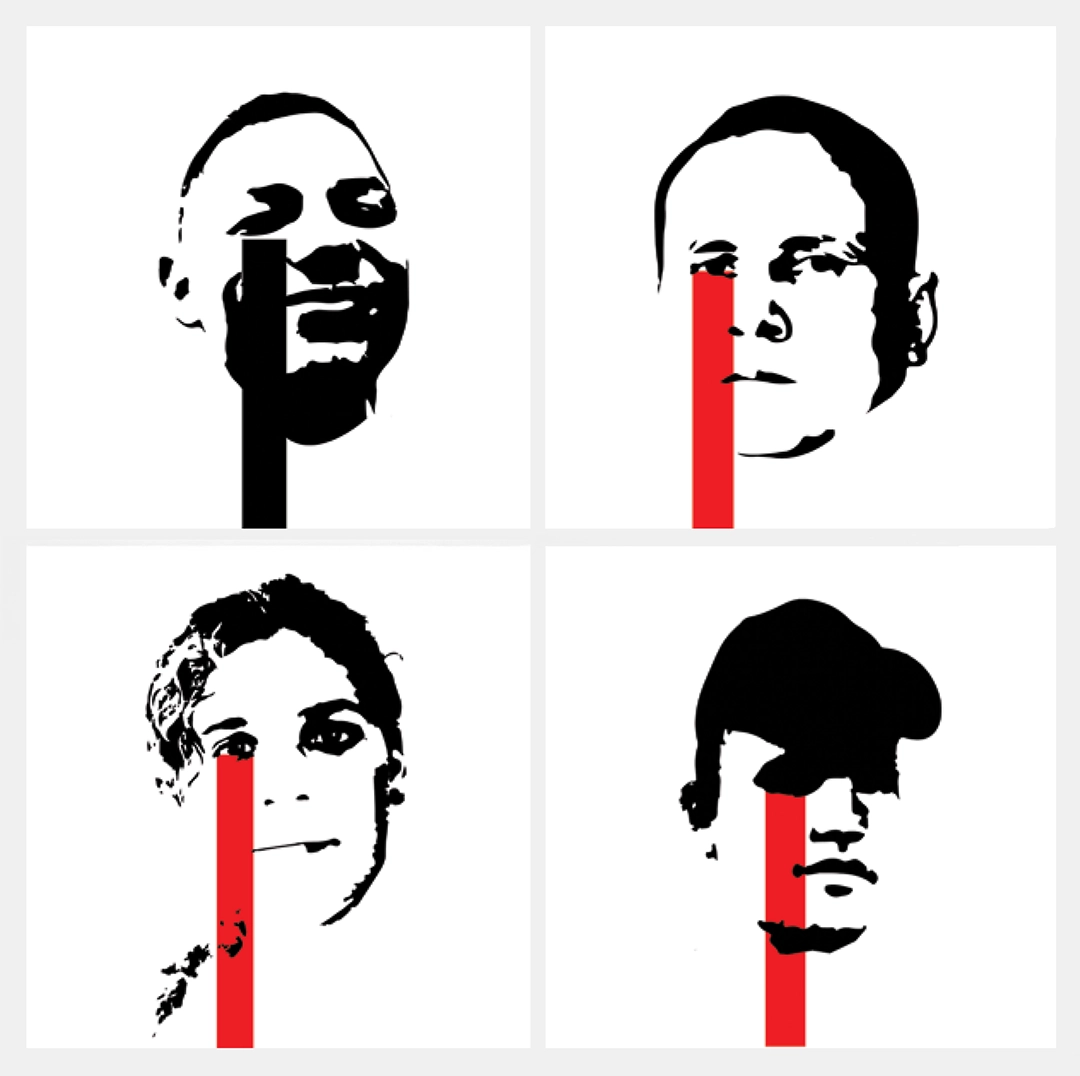
Julio Llópiz-Casal
Red Stripe Series
From left to right and top to bottom:
From the Red Stripe Series: Diubis Laurencio Tejeda, 2022
Age 36, was killed by police on July 12, 2021.
From the Red Stripe Series: José Daniel Ferrer, 2022
Age 53, four years in prison.
From the Red Stripe Series: Saily Navarro, 2022
Age 38, eight years in prison.
From the Red Stripe Series: Luis Robles, 2022
Age 31, five years in prison.
Julio: “Red Stripe is a series of portraits of Cuban political prisoners that I began in December 2020 with the face of artist Luis Manuel Otero Alcántara, who is currently imprisoned. The idea consists of a kind of template: the person’s face rendered in high-contrast black and white, with a red stripe emerging from one eye and running down the cheek. The central idea is that a political prisoner in Cuba weeps blood in a cascading flow: the blackmail, traps, and sophisticated methods of repression and psychological torture to which these prisoners are subjected are infernal. Unfortunately, this gallery of portraits continues to grow. Hopefully the day will come when I won’t have to make another one, and all of this will belong to History—not to the present.”
This is not a book that merely compiles a catalog of dissident posters. The authors, after conducting extensive research, advance a historical and aesthetic interpretation of a phenomenon in visual culture that is still unfolding. One of the book’s central arguments is that part of contemporary Cuban political graphics emerges from the very tradition of revolutionary poster-making itself—but with a decisive inversion of content and a subversive symbolic charge: the “art of the Revolution,” in the digital age, reappears as an irate, hygienic, sepulchral discourse, intent on burying the stench of a Revolution that persists in contemplating itself as an unburied corpse. This thesis is already articulated in the foreword by the legendary Cuban critic and curator Gerardo Mosquera, who underscores that these works—born in social media and the internet—are part of the civic uprising against the regime, while simultaneously inheriting the great tradition of Cuban posters from the sixties and seventies.[1]
The book also makes an invaluable contribution to the historiography of contemporary Cuban visual culture. It operates as a vast documentary archive, assembled with full editorial rigor. Menéndez-Conde and Trápaga do not analyze a corpus already consecrated by museums or by historiography; rather, they engage a dispersed, digital production—often censored, transnational, unstable, and precarious in its modes of circulation. El cartel protesta, therefore, not only interprets this universe—contextualizing it and reconstructing the cultural, social, and historical ground that renders it intelligible—but also functions as a repository that organizes and makes visible a scarcely studied zone of this deterritorialized digital visual production.
Among many other things, the volume examines how political emblems such as the Plaza de la Revolución, the iconography of Fidel, patriotic slogans, and the heroic signs of the socialist past are reappropriated through disenchantment, irony, or denunciation. What is at stake is not merely direct political critique, but the deactivation of the Revolution’s symbolic aura.
Another crucial axis is the construction of a new public sphere connecting the island and the diaspora. The internet, mobile devices, and Facebook (in the specific case of Cubans) have disruptively transformed the circulation of political critique and civic debate. Thanks to the expansion—however precarious and uneven—of connectivity, discourses that were once confined to the private sphere, or simply did not circulate within the island, became visible, shareable across networks, and capable of articulating a new specimen of civil society that exists only within digital communication platforms. Dialogue, protest, or simply Cuban shouting within these spaces of mediated virtuality have been accompanied by the visuality produced by those artists and designers whose work we can now study in El cartel protesta. The protagonists of this book have been forging, in the heat of unfolding events, a new image of the times, a new imaginary era of Cuban political culture—one that might well have drawn a sardonic smile, and perhaps even a restless shift in his armchair, from none other than Lezama Lima.
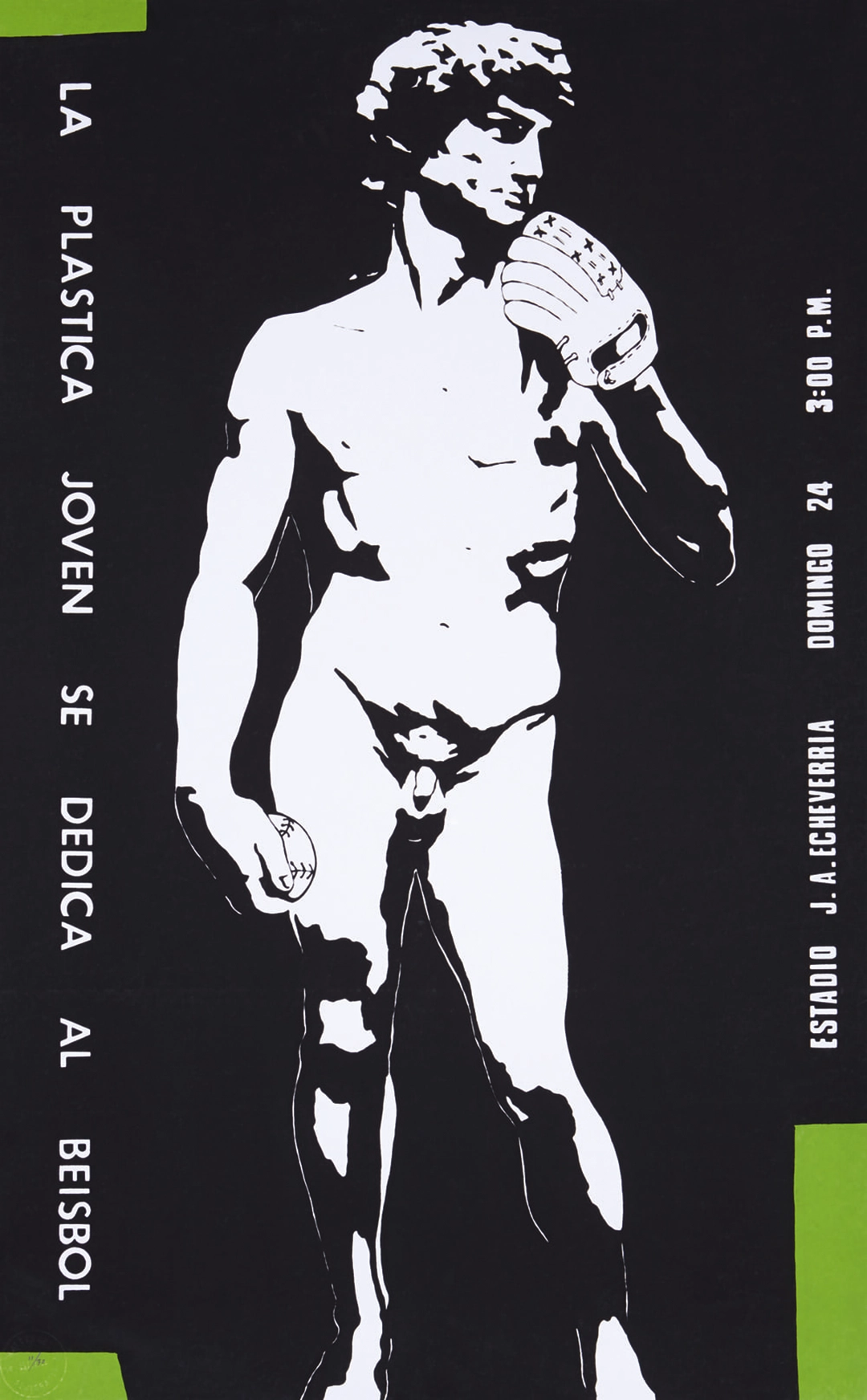
Grupo NUDO (Eduardo Marín and Vladimir Llaguno)
Young Plastic Arts Devote Itself to Baseball, 1989
Silkscreen | 30 x 20 inches
But the research by Menéndez-Conde and Trápaga also reminds us that the militancy of these restless creators has not been devoted solely to the critique of the solemn symbols of the socialist litany; they have also acted as chroniclers of the harsh experience of Cuban survival, of the consequences of an unending crisis. The third chapter, Everyday Life, addresses themes such as prostitution, elite corruption, shortages, queues, relentless propaganda, and police control. This thematic dimension is crucial because it prevents us from reducing oppositional graphics to a mere abstract opposition to communism. What emerges in this visuality is a critique of the drama of life on the island: a denunciation of how the political system inscribes itself onto bodies, routines, scarcities, traumas, and the distortions inherent to a permanent state of survival.
In my own case, I must confess that I became aware of the force and relevance of this new Cuban political graphic practice during the Covid-19 pandemic: on the one hand, the political police intensified their repression against activists, artists, the San Isidro Movement, and, in sequence, the events of 27N and July 11, 2021 unfolded; on the other, we all began spending much more time scrolling through Facebook and reading independent press platforms and digital magazines. Thus, dear readers, a significant portion of that production we first encountered on Facebook—often without even knowing who the author was—is compiled in the fourth section of the book, dedicated to recent protests and to how this new poster-making has accompanied contemporary Cuban dissent.
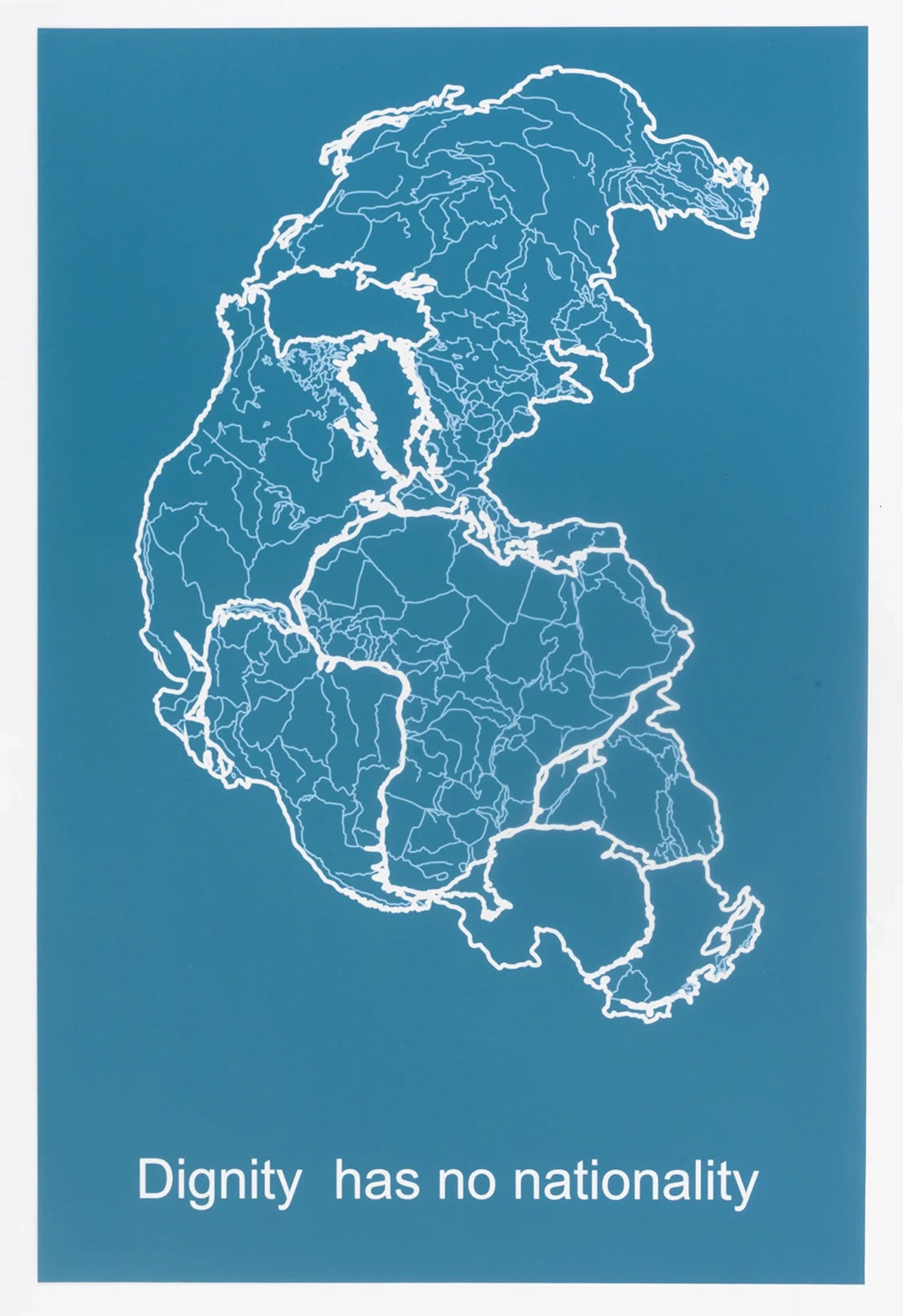
Tania Bruguera
Dignity Has No Nationality, 2017
Nylon and polyester, hand-applied elements
48 x 72 inches. Limited edition
In rhetorical terms, what stands out is the reappropriation of Martí, of the flag, and of the island’s map—not as the exclusive patrimony of the State, but as signs of a homeland understood through the lens of rights, dignity, and freedom. This has been a struggle for control over national symbols and for the legitimacy of imagining Cuba outside the official vocabulary. From an aesthetic standpoint, the authors delineate the most representative features of this guerrilla graphic practice: formal synthesis, immediate legibility, the use of recognizable emblems, verbal condensation, intense chromatic contrast, and the appropriation of patriotic and revolutionary symbols. Yet, unlike the classical poster, these resources no longer organize a proselytizing rhetoric of adhesion; they configure instead a semiotics of deconstruction. The image no longer calls for political faith; it works through deterioration, decay, failure, suffocation, humiliation, suspicion, irony, insolence, impotence, rage, and absurdity.
Within this aesthetic and rhetorical transformation, parody, the grotesque, kitsch, the carnivalesque, subversive irreverence, and the capacity to dismantle what has become fossilized and detached from reality play a decisive role. The authors situate these strategies in continuity with certain forms of critique developed by Cuban art of the 1980s, when confrontation with official discourse relied on performance, the grotesque, humor, and strategic uses of kitsch. In truth, the deeper precedent lies in the sixties. The outcome of this inheritance of Cuban critical art within the contemporary protest poster is not an aesthetic of solemn opposition, but an aggressive, mocking, demystifying visuality.
El cartel protesta is a historical map to be savored with a mischievous smile and a kind of salivating desire for symbolic revenge. Of course, in my view, these too are visual texts saturated with ideology—but they are sincere and organic, born of pure motivation, passion, pain, and personal indignation, rather than commissioned by state ideological apparatuses. What we once encountered while scrolling through social media can now be contemplated with composure on the pages of a book, properly situated within an interpretive framework. The merit of Menéndez-Conde and Trápaga lies not only in identifying an emerging visual corpus, but in demonstrating that the struggle over the meaning of nation, revolution, and freedom is also waged in the terrain of graphic visual composition.





If you’re a regular reader of this blog and enjoy its content, you might consider contributing to its upkeep. Any amount, no matter how small, will be warmly appreciated
Founded in 2021, Echoes (Notes of Visual Narrative) invites everyone to explore together the visual codes that shape our world—art, photography, design, and advertising in dialogue with society.

Copyright © 2026 r10studio.com. All Rights Reserved. Website Powered by r10studio.com
Cincinnati, Ohio


Comments powered by Talkyard.