

On my way home, on one of the trains at Miami Airport, I took this photograph. A passenger had left a sticker on one of the metal poles inside the carriage. Whoever it was—judging by the code—came from Guayaquil and carried it on their suitcase. The author, it would seem, now lives on these shores.
There is something deeply human—and not necessarily dignified—in the urge to leave a mark, in the desire to inscribe oneself into the narrative of the world. It does not matter if the gesture is minimal, precarious, or even illegible. Without some form of evidence, we are inclined to think we never were. There is nothing new in this. We have seen it since prehistory, and over the course of many millennia, this impulse has mutated and accelerated to the point of becoming almost compulsive.
Looking at the sticker, I was reminded of another image: hands pressed against rock, inside a cave. Those left by early humans in Leang-Leang, Maros, South Sulawesi—a prehistoric cave complex in Indonesia. Such “impressions” are key to understanding the origins of art and symbolic thought.
Still, beyond what is essential, I hesitate to grant our fellow traveler the grace of comparison with those cherished primitives.
Between those negative handprints and a luggage sticker functioning as a signature, there is a certain semiotic parallel. Both belong to the order of the index: signs that do not represent by resemblance or convention, but through direct contact with a real presence. The hands on the rock are literal traces of bodies that were once there. The sticker is the material trace of a displacement. In both cases, the sign tells us very little. It merely attests.
The passenger, however, should not feel overly compelled by his “performance.” It differs little from dropping a cigarette on the floor, scratching a surface with a key, or spilling half a drink across a table. Each of these gestures, in its own way, leaves behind the same residue: someone passed through.
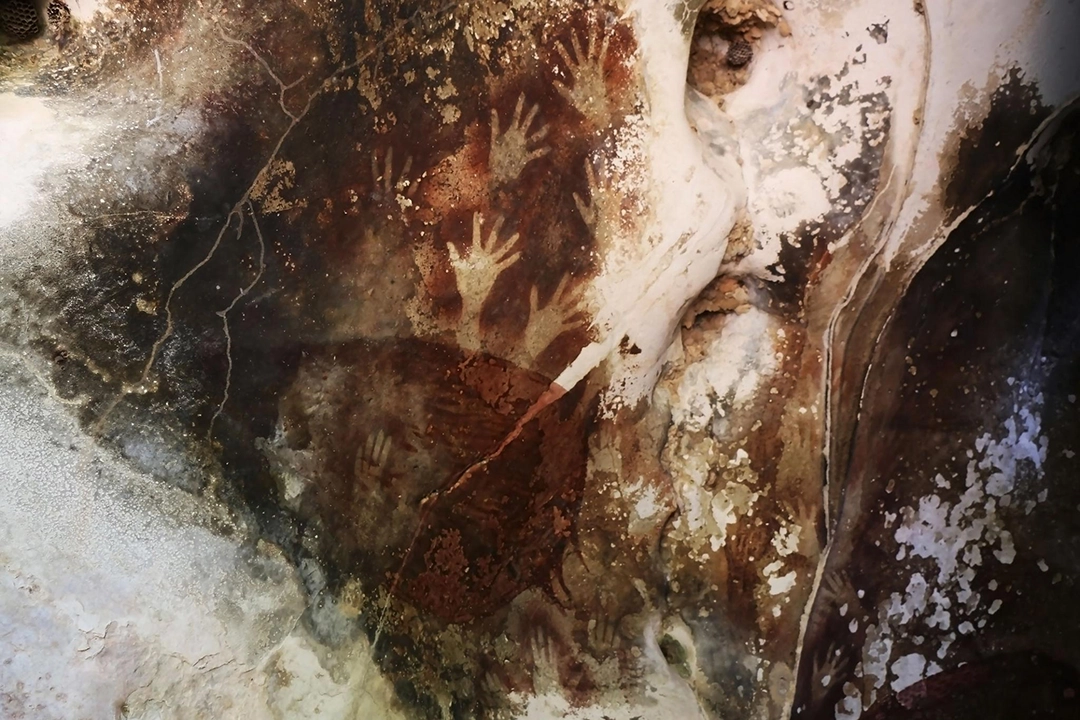
Since the 1950s, images and hand stencils like the ones shown here have been found in caves on the Indonesian island of Sulawesi. Credit: Naj Ativk/Shutterstock
Prehistoric hands constitute one of the earliest and most radical forms of human inscription. They affirm a presence; they index the body directly. For that reason, they do not seek representation, but rather recognize themselves as a possible trace. To do so—at that moment—already implied a mind capable of a minimal form of discernment, something not entirely negligible.
The label, being contemporary, introduces an additional layer: its belonging to a system. It encodes presence—number, origin, destination, traceability. It suggests that someone boarded a plane, crossed the sea, had the means to come and return, and might therefore be read, in a certain register, as “successful.” It is a sign that participates in—and settles comfortably within—the modern logistical network.
The hands, by contrast, are pure indices, almost ontological. Both gestures are basic, archaic, faintly disobedient… we were here. But one endures as a threshold; the other fades as a remainder.
From a semiotic perspective, one could trace a brief itinerary through the galleries of the Museum of Man as Communicator.
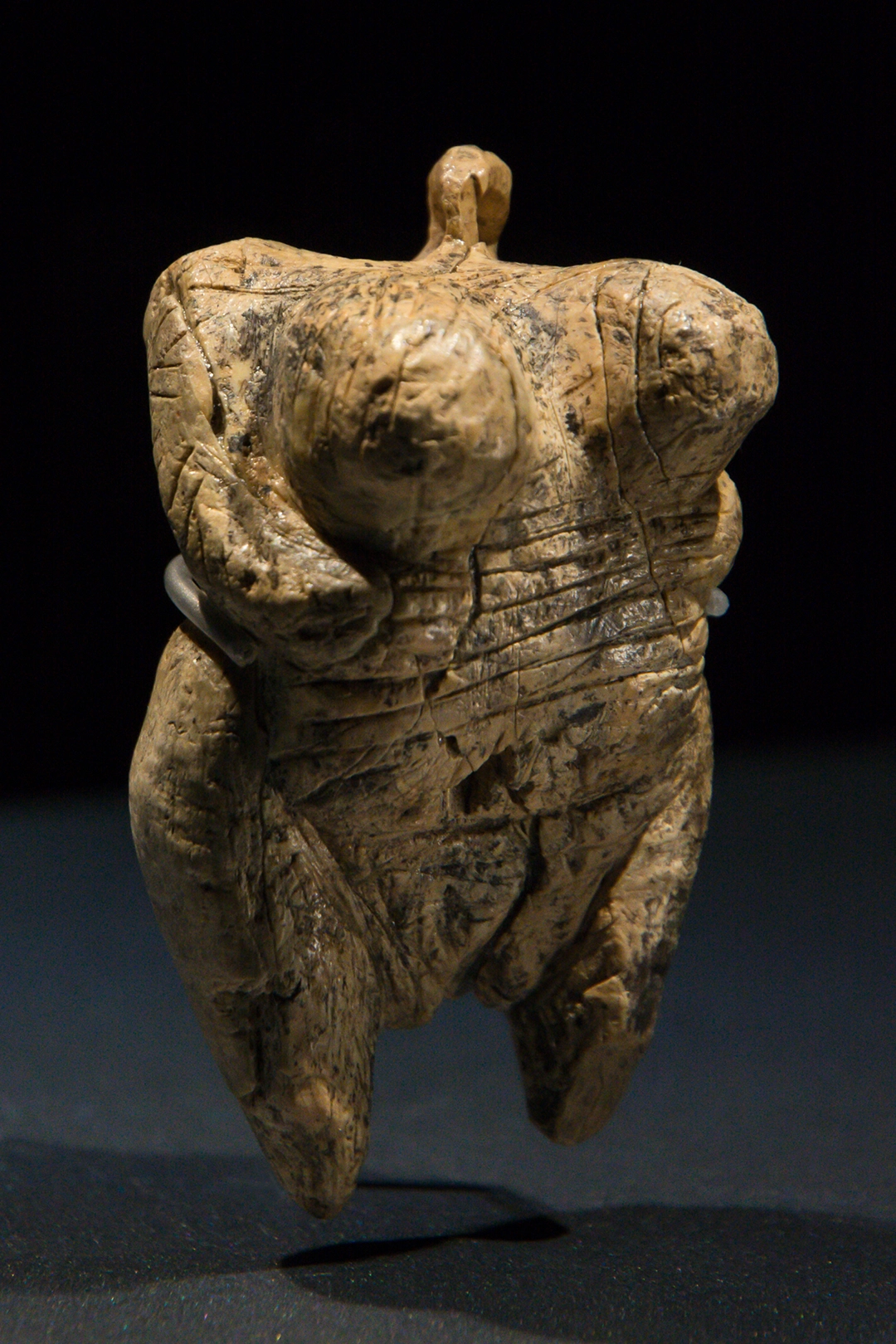
The Venus of Hohle Fels
The Paleolithic figures known as “Venuses”—such as the Venus of Hohle Fels—introduce a decisive shift. There is no longer direct contact, but representation. These small sculptures neither narrate nor construct scenes, nor are they simple traces. They operate as symbolic icons rooted in form. A human body emerges, abstracted and condensed so as to signify. The exaggeration of certain features suggests a more complex mental elaboration, possibly linked to fertility, identity, or an archetypal notion of the human. Whoever carved these figures was no longer confined to themselves.
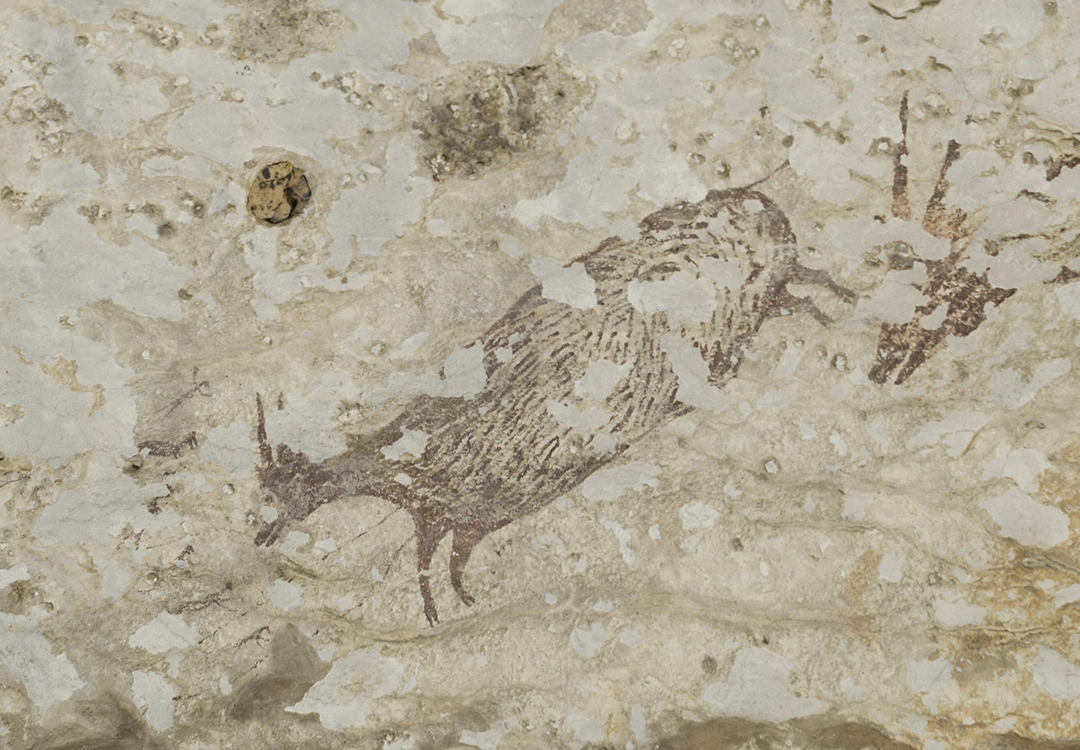
This is, to date, the oldest work of art ever discovered. It is approximately 44,000 years old. It was found deep within the limestone caves of Sulawesi, Indonesia. Our ancestors were engaged in complex narrative far earlier than previously understood. This discovery marks a decisive moment in human evolution, demonstrating that the capacity for creative and abstract thought was already well established in Southeast Asia during the Pleistocene.
In those same caves, hunting scenes were also found. A further shift. Images now possess narrative structure. Human figures—sometimes hybrid—interact with animals in compositions that imply action, time, and relation. They combine the iconic with the symbolic and, psychologically, reveal a mind capable of organizing collective experience, projecting situations, and constructing shared meaning. The image states: this happened.
In very few strokes: hand, female figure, hunting scene—index, abstraction of the body, construction of the world.
One could force—there is, scientifically speaking, some basis for it—a continuity between Leang-Leang and the train sticker. But doing so would require a certain indulgence, a softening of judgment: comparing a babble with a foundational language. If the latter is a cheap, almost tedious sign, the prehistoric forms remain evidence that those early humans resolved how to inscribe themselves into a world that, at the time, had no memory.
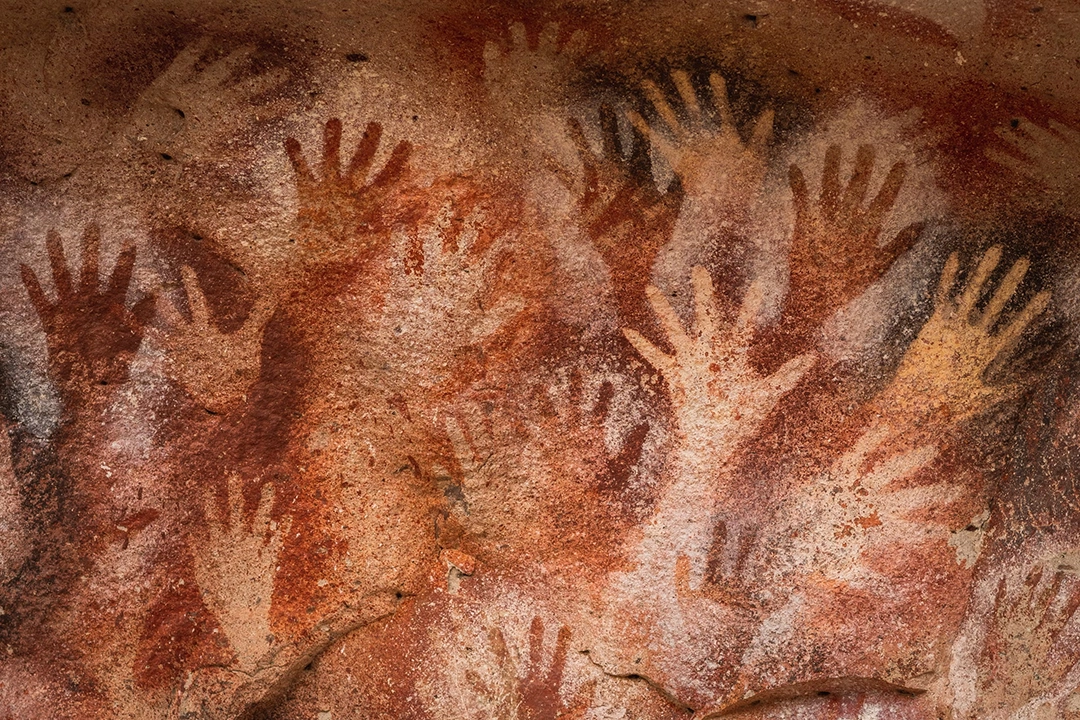
Prehistoric hand paintings at the Cave of Hands in Argentina, que superan los 10.000 años de antigüedad (Getty/iStock)





If you’re a regular reader of this blog and enjoy its content, you might consider contributing to its upkeep. Any amount, no matter how small, will be warmly appreciated
Founded in 2021, Echoes (Notes of Visual Narrative) invites everyone to explore together the visual codes that shape our world—art, photography, design, and advertising in dialogue with society.

Copyright © 2026 r10studio.com. All Rights Reserved. Website Powered by r10studio.com
Cincinnati, Ohio



Comments powered by Talkyard.