
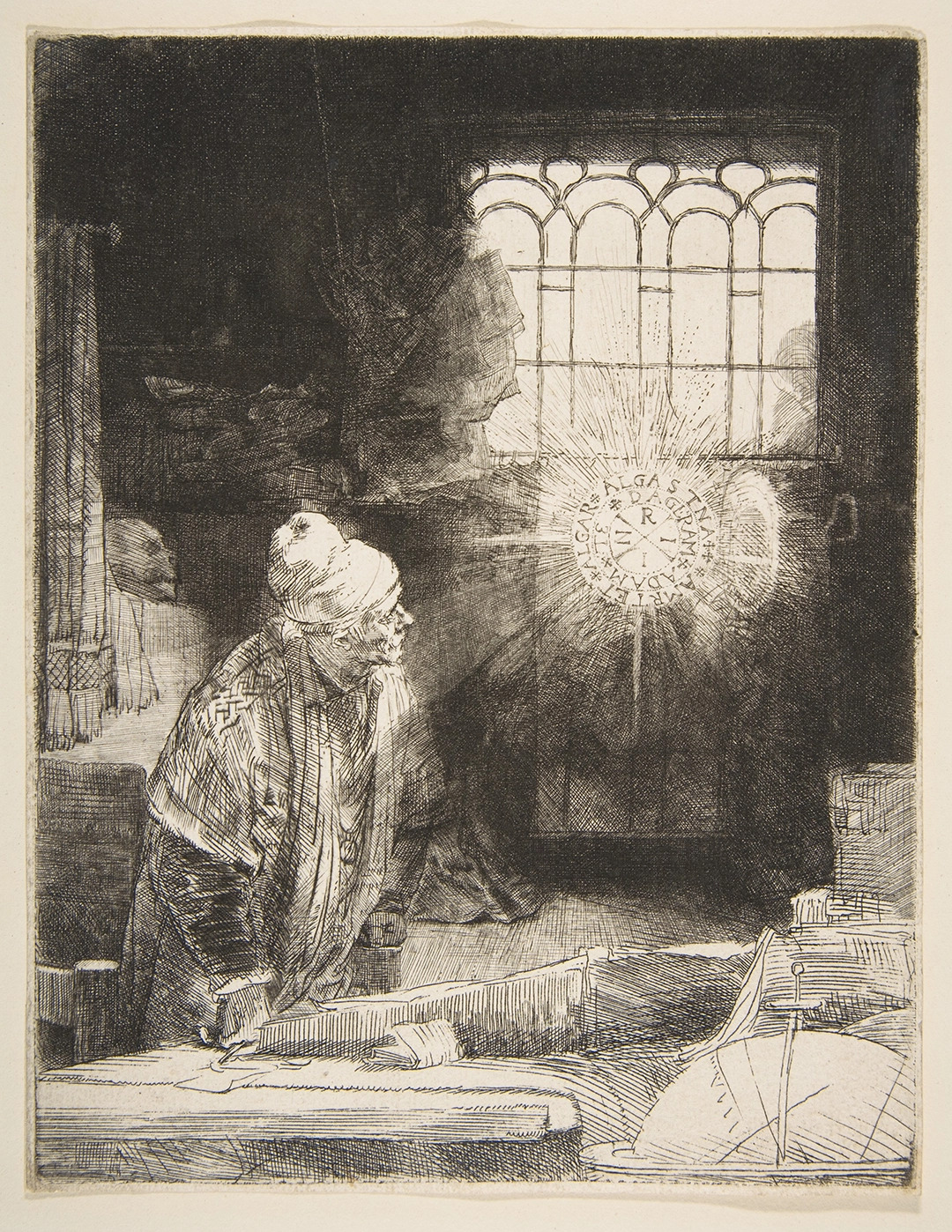
Faust, ca. 1652
Etching, engraving and drypoint on fine laid paper | 8¼ by 6¼ in approx.
No he podido visitar aún la exposición Rembrandt: Masterpieces in Black and White. Prints from the Rembrandt House Museum, inaugurada el 7 de febrero pasado en la Fifth Third Gallery del Taft Museum. Casi todos los días pienso en que debería ir, porque oportunidades como estas no son comunes. Más aún tratándose de un referente mayor del arte neerlandés.
Si se han logrado conservar tantas de sus piezas —y hablo no solo de sus telas, también de sus grabados, estudios, etc.— es porque ya en su tiempo fue considerado un artista excepcional, cuyo trabajo debía ser custodiado con celo mayor. Estamos en un tiempo sin medios de difusión masiva, sin la promoción y autopromoción extrema que sufrimos hoy. Hablamos de cómo sobresalió entre muchos otros, talentosísimos probablemente también, pero que no fueron entonces considerados por los mecenas y los expertos en lo sucesivo.
Esta exposición nos ofrece evidencia directa de un aspecto de la obra de Rembrandt que nunca ha sido pasado por alto por la crítica seria.
Circula a nivel popular la idea de su dominio casi sobrenatural del claroscuro, de la luz teatralizada y dramática y —con los ojos de hoy— casi cinematográfica. Y su persistencia como criterio, si bien es cierto que ofrece mucha luz física y también sentimental, impide apreciar mucho de lo demás. Rembrandt es un maestro, el demiurgo que hace crecer rostros desde la sombra. No solo eso.
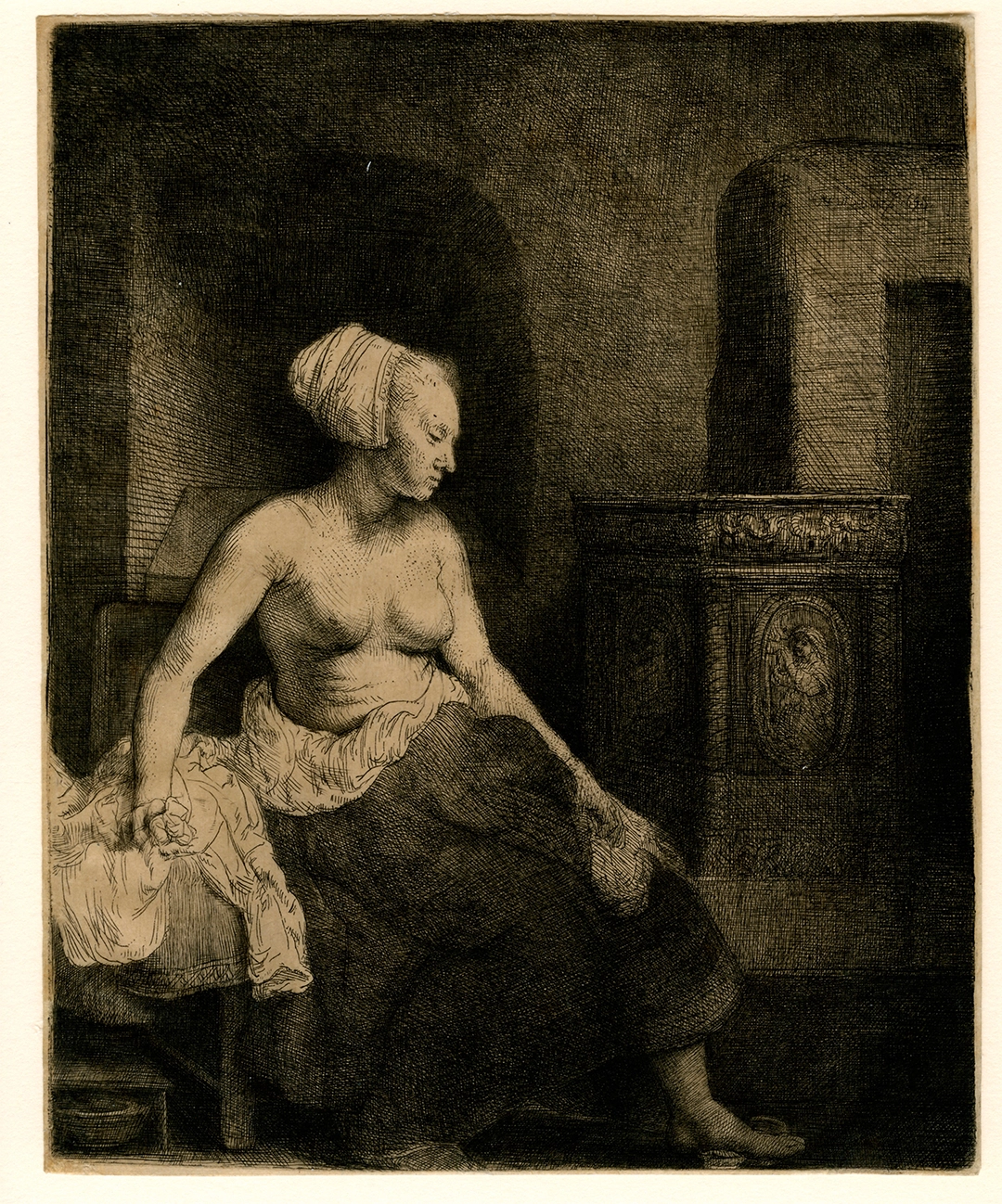
Woman Sitting Half Dressed Beside a Stove, 1658
Etching, engraving and drypoint, printed on Japanese paper | 9 × 7¼ in approx.
La exposición en el Taft Museum of Art propone otra mirada, paladear el sabor verdadero de las piezas, sin el habitual condimento visual. No incluye lienzos al óleo, solo papel, tinta y el uso de la presión. Nos ofrece un íntimo atisbo de uno de los núcleos de su pensamiento visual; una aproximación paralela a su producción, marcada por lo experimental, por lo íntimo y lo inestable.
Son cerca de cincuenta grabados procedentes del Rembrandt House Museum, algo que no se veía fuera de los Países Bajos desde hace más de dos décadas.
El grabado, en el siglo XVII, era en gran medida un medio de reproducción. Rembrandt lo transforma en otra cosa. Uno de los puntos más insistentes de la crítica es que sus grabados no son imágenes definitivas, sino procesos en curso, espacios de prueba, de variación, de insistencia. Trabaja una misma imagen en múltiples iteraciones, modifica líneas, intensifica sombras, elimina elementos. Centra su práctica en la exploración de las posibilidades de la imagen. Trabajaba una misma plancha durante años, generando distintos “estados” de una misma obra. Cada una de sus intervenciones cambiaba no solo pequeños detalles, sino el sentido emocional completo de la escena. Steven Munson señaló que Rembrandt podía “cambiar completamente el contenido emocional” de una estampa variando luz y oscuridad.
Otros historiadores coinciden en que Rembrandt convierte el grabado en un laboratorio, al explorar con la tinta, el papel e incluso con la presión. Dejaba restos de tinta (plate tone) deliberadamente y usaba el drypoint para generar texturas inestables.
Esto, por supuesto, rompe con la lógica reproductiva del grabado. Cada variación generaba una nueva pieza. Era de esperarse que cada plancha —único original en el proceso— ofreciera una determinada cantidad de copias. Pero las variaciones dejaban impresiones singulares, más cerca de la idea de un original que de una edición múltiple. Estoy convencido de que no lo hacía solo como un recurso para incrementar su precio.
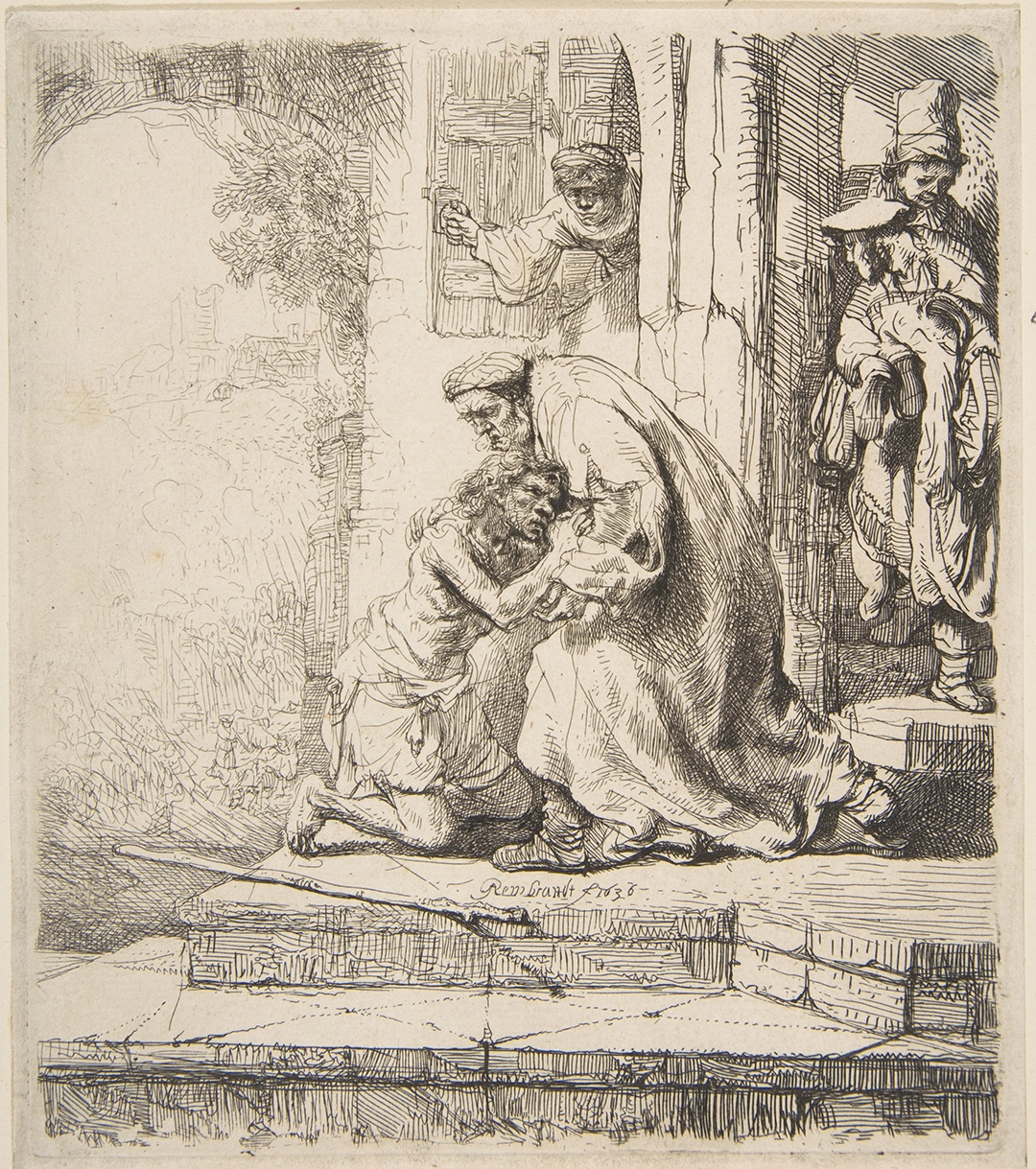
Return of the Prodigal Son, 1620–69
Etching, pen and ink | 6½ × 5½ in approx.
En cuanto al contenido, Rembrandt desarrolla las escenas como espacios de precariedad emocional. Según análisis del Telfair Museum, añadió una inesperada profundidad psicológica a sus escenas bíblicas mediante la representación de rostros no idealizados, ambigüedad gestual y momentos suspendidos de la narración. Solía evadir los instantes climáticos para enfocarse en la duda y la inexactitud que los precede.
Si hay un punto de contacto con su pintura —inevitable porque es troncal en su expresión gráfica— es el uso de la luz como herramienta, no como iluminación. Construye sus imágenes desde la sombra, sea leve o completamente oscura. Quienes han analizado su técnica concuerdan en que usó líneas e incisión sobre metal mediante ácido para crear la densidad pictórica que su sensibilidad narrativa sugería. Con el tiempo evolucionó desde el uso masivo de líneas estructurales o de contorno a oscurecer grandes áreas del plano, sacrificando lo descriptivo para llevarnos a lo atmosférico o a lo indeterminado.
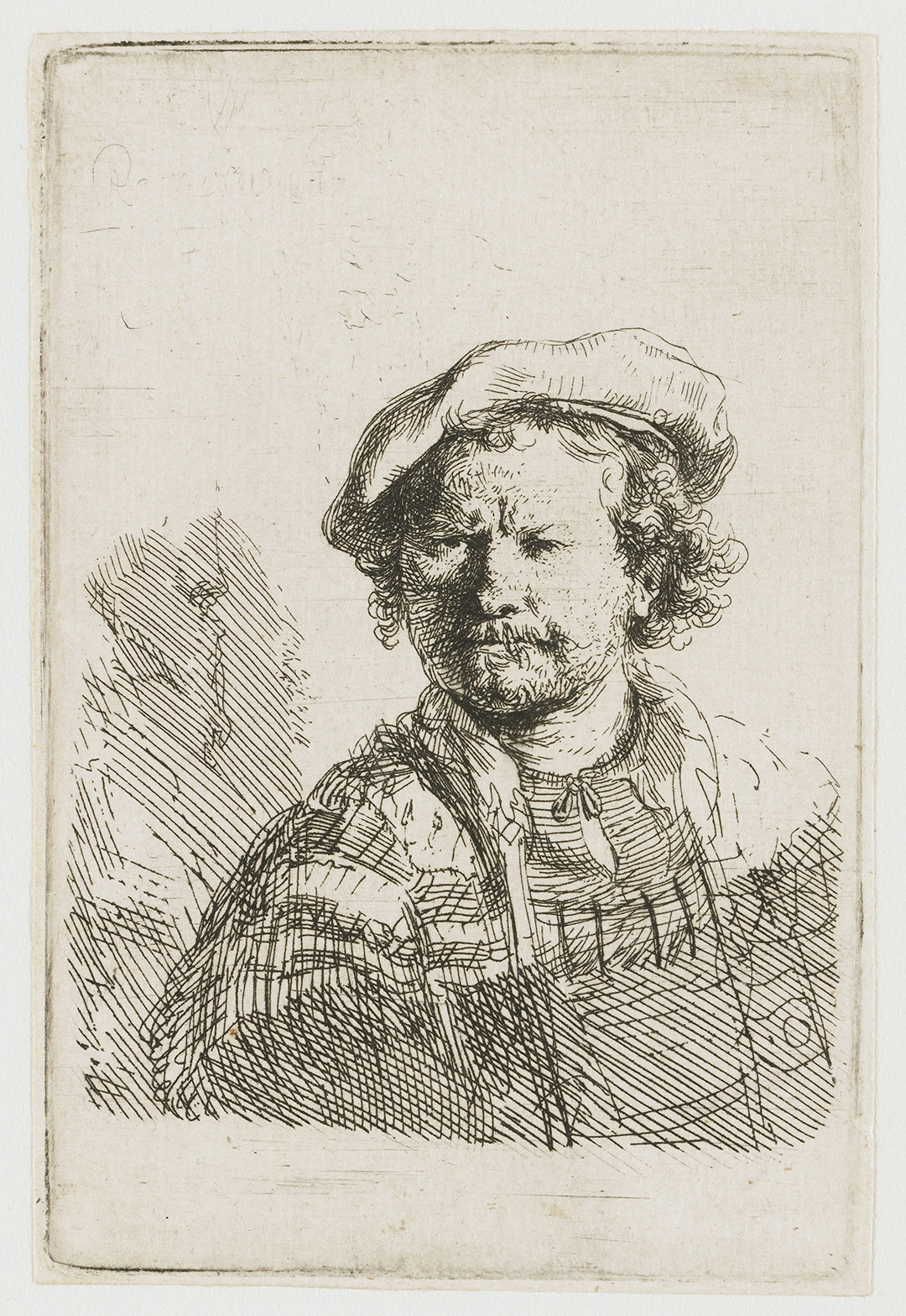
Self Portrait in a Flat Cap and Embroidered Dress. 1642.
Etching print. | 3½ × 2½ in approx. Various collections.
Sus autorretratos fueron más bien estudios sobre sí mismo. Es decir, quiero creer que no fueron figuraciones de autocomplacencia, sino estudios gestuales, disfraces, divertimentos. Los estudiosos de su obra los han entendido como autobiografías fragmentadas, una especie de diario visual que desarrolló a lo largo de su vida.
Rembrandt advirtió que el grabado tenía recorrido comercial. Lo que Martin Luther y Lucas Cranach entendieron como nadie hacía poco más de medio siglo. En tanto estos inventaron, desde algún punto de vista, la propaganda, el neerlandés tuvo claro que la introspección abierta o pública podía ser igual de rentable. De hecho, en ese momento histórico el grabado se sitúa por encima de la pintura. Rembrandt mismo —según el historiador Filippo Baldinucci— era más estimado por sus grabados que por su pintura. Todo el siglo XVII asocia con él la técnica del grabado, la cual redefine como medio gráfico.
A diferencia de la pintura, el grabado necesita cercanía. Obliga al espectador a reducir la distancia, a ajustar la mirada, a detenerse. No hay impacto inmediato, ni sobresalto, ni arritmias. Habla como la lectura: cuanto más tiempo se le dedica, más información aporta. Es una acción de descubrimiento progresivo.
Rembrandt: Masterpieces in Black and White. Prints from the Rembrandt House Museum sitúa entonces la obra de Rembrandt en este marco interpretativo, donde nos lo muestra menos monumental y más inquieto, menos definitivo y más experimental. En ese desplazamiento —del óleo al papel— emerge el artista que duda y se pregunta.
A tono con la invitación que hace la página del Taft Museum, les comparto dos notas escritas por la curadora Tamera Lenz Muente:
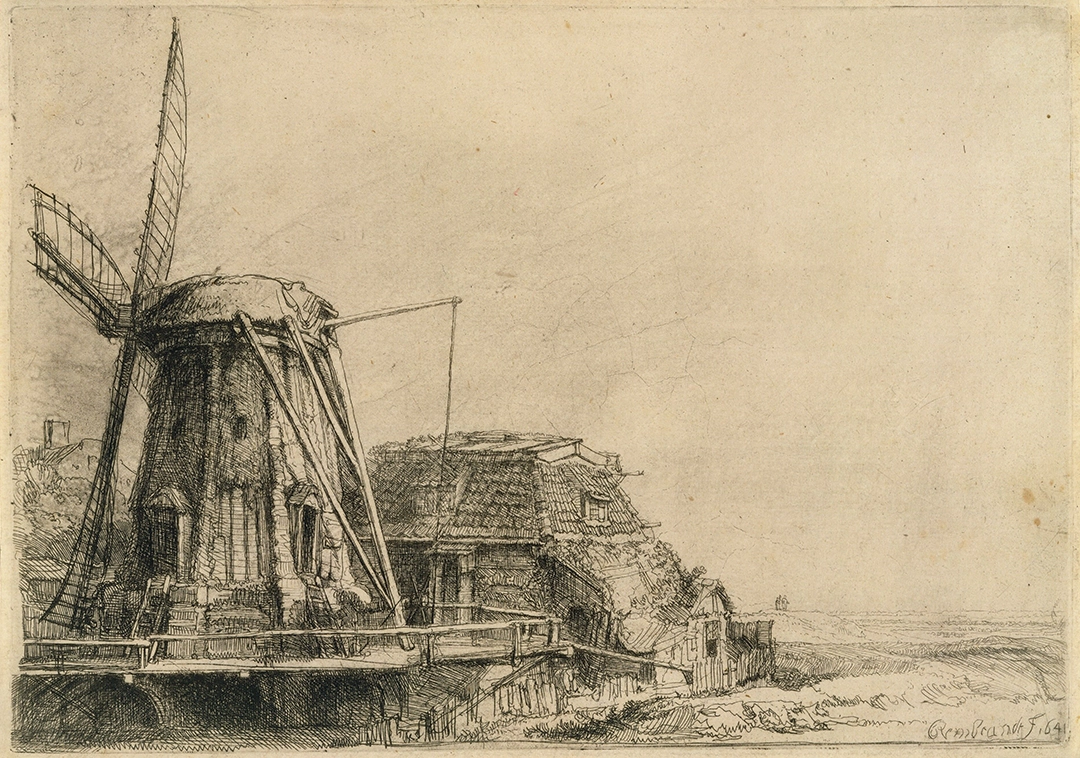
The Windmill, 1641
Etching and drypoint | 5¾ × 8¼ in approx.
Rembrandt House Museum, Amsterdam
Rembrandt depicted the boundary between city and countryside. The print shows the so-called Little Stink Mill, an actual windmill that stood on the De Passeerde bulwark along the city wall that ran down the west side of Amsterdam. The mill was owned by the Leathermakers Guild and its nickname derived from its activity of softening tanned leather by treating it with cod liver oil. Rembrandt traced the mill and its surroundings in such detail that it seems likely he began the print on site and then finished it in the studio. Visible in the sky are diagonal striations that result from his having brushed acid over the surface of the printing plate for effect, and craquelure was more likely the result of an accident that occurred as the plate was being bitten by the acid. | www.metmuseum.org
Rare Etchings by Rembrandt
January 5th, 2026 | By Tamera Lenz Muente, Curator
The innovation, creativity, and virtuosity of Rembrandt van Rijn (Dutch, 1606–1669) is evident not only in his paintings but also in the more than 300 etchings he made during his career. The Taft Museum of Art will be one of just four museums to present Rembrandt: Masterpieces in Black and White—Prints from the Rembrandt House Museum. This marks the first time in more than 25 years that the Rembrandt House Museum—the artist’s former home in Amsterdam—is sharing an exhibition of these rare and exquisite prints from its renowned collection with museums outside the Netherlands.
This is an exciting opportunity to showcase the pioneering techniques of one of the world’s most famous artists. One of the Taft’s most significant and beloved paintings is Rembrandt’s Portrait of a Man Rising from His Chair, so it’s wonderful to be able to further highlight his artistic achievements. Rembrandt’s etchings are among his greatest accomplishments. Their remarkable intimacy, awe-inspiring draftsmanship, and emotional impact make them still very relevant today.
At a time when most saw etching primarily as a vehicle to reproduce famous works of art, Rembrandt utilized the medium to create groundbreaking compositions. Filled with delicate lines and velvety shadows, his etchings often achieve the psychological intensity of his oil paintings. Nearly 50 works in Rembrandt: Masterpieces in Black and White—Prints from the Rembrandt House Museum present the depth and breadth of Rembrandt’s etching subjects, including portraits, self-portraits, scenes from daily life, landscapes, narrative scenes, and still lifes. A select group of etchings by Rembrandt’s contemporaries, as well as later admirers including James McNeill Whistler and Pablo Picasso, demonstrate the Dutch master’s enduring influence.
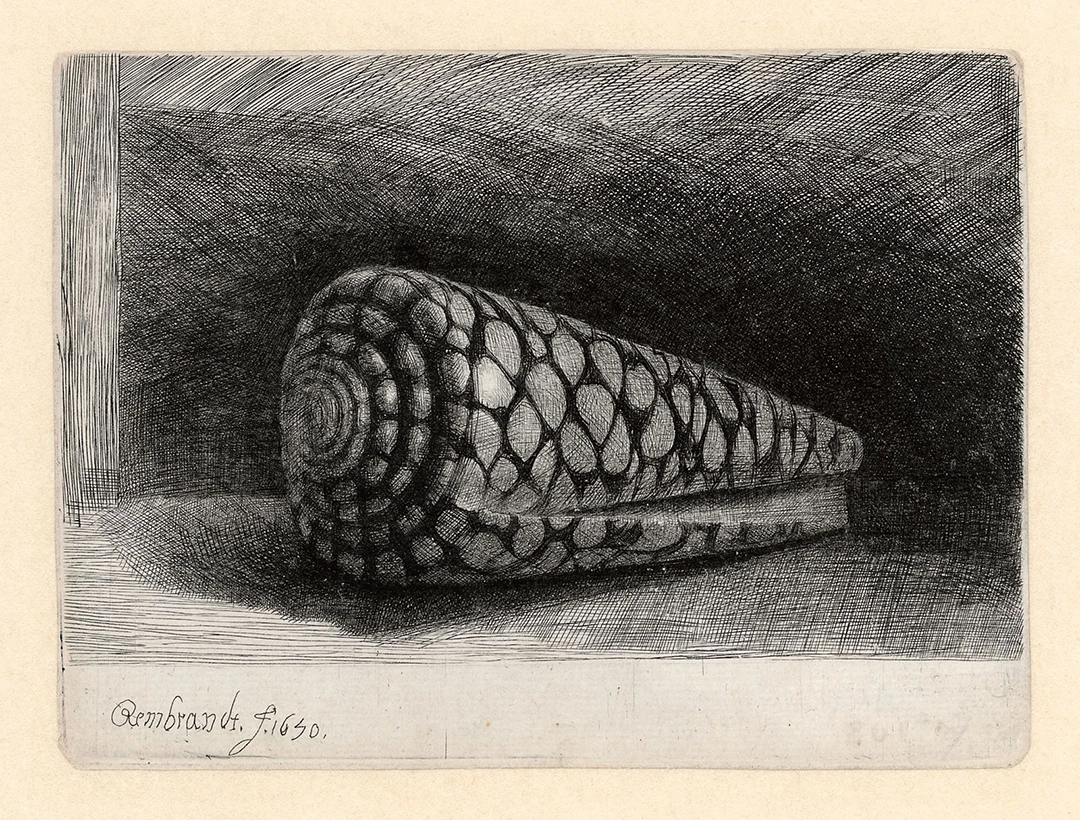
Conus Marmoreus, 1650
Third state, Rijksmuseum, signed 'Rembrandt. f. 1650'
3¾ × 5¼ in approx. Rijksmuseum, Amsterdam
The Shell, also known as Rembrandt's Shell or Conus Marmoreus, or in Dutch as De schelp ("the shell") or Het schelpje ("the little shell"), is a 1650 drypoint and etching by Rembrandt van Rijn. Catalogued as B.159, it is Rembrandt's only still life etching. Only a handful of original prints are known, in three states. Wiki
Stories in a Shell: Rembrandt’s "Conus marmoreus"
February 5th, 2026 | By Tamera Lenz Muente, Curator
A single shell emerges from shadow. One end coils in a perfect spiral, while the other tapers to a point, creating the conical shape described by the genus Conus. The shell’s dark surface gleams with irregular white spots, marking the pattern that characterizes the species marmoreus, Latin for “marbled.” Rembrandt’s fascination with the marbled cone shell shines through in his delicate, accurate—almost brooding—portrayal. This complex, high-contrast form provided a prime subject for the black-and-white medium of etching. It also suited Rembrandt’s interest in direct observation from nature. He rendered the shell at about 2 1/2 inches, approximately life-size, though printing the etching plate reversed the image—in reality, the shell spirals in the opposite direction.
A carnivorous snail, the marbled cone preys upon tiny organisms by injecting paralyzing venom with a harpoon-like tooth. Endemic to the Indian Ocean and the western Pacific, it would have been an exotic prize in the Dutch Republic. Global trade exposed Dutch artists, scientists, and collectors to species of flora and fauna from the other side of the world. Among the many coveted treasures were seashells, which in turn showed up in still lifes, such as Balthasar van der Ast’s in the Taft Museum of Art’s collection (which includes a Conus marmoreus at bottom right).
These paintings served not only to demonstrate wealth, but also to remind viewers of their own mortality. Vanitas objects like skulls, wilting flowers, and watches all carried the warning: do not be too distracted by all these worldly possessions, because you too, will die. Rembrandt’s exquisite shell is, after all, the vacant hull of a once-vibrant marine creature.
Rembrandt himself amassed a sizeable collection of corals and shells, along with other rare items including antlers and horns, swords and spears, preserved animals, and classical sculptures. His possessions were recorded systematically when he went bankrupt in 1656, enabling the Rembrandt House Museum to recreate his curiosity cabinet. Rembrandt often used costumes, weapons, and other objects from his collection in his paintings, but his marbled cone shell is the only treasure he recorded in a pure still life.
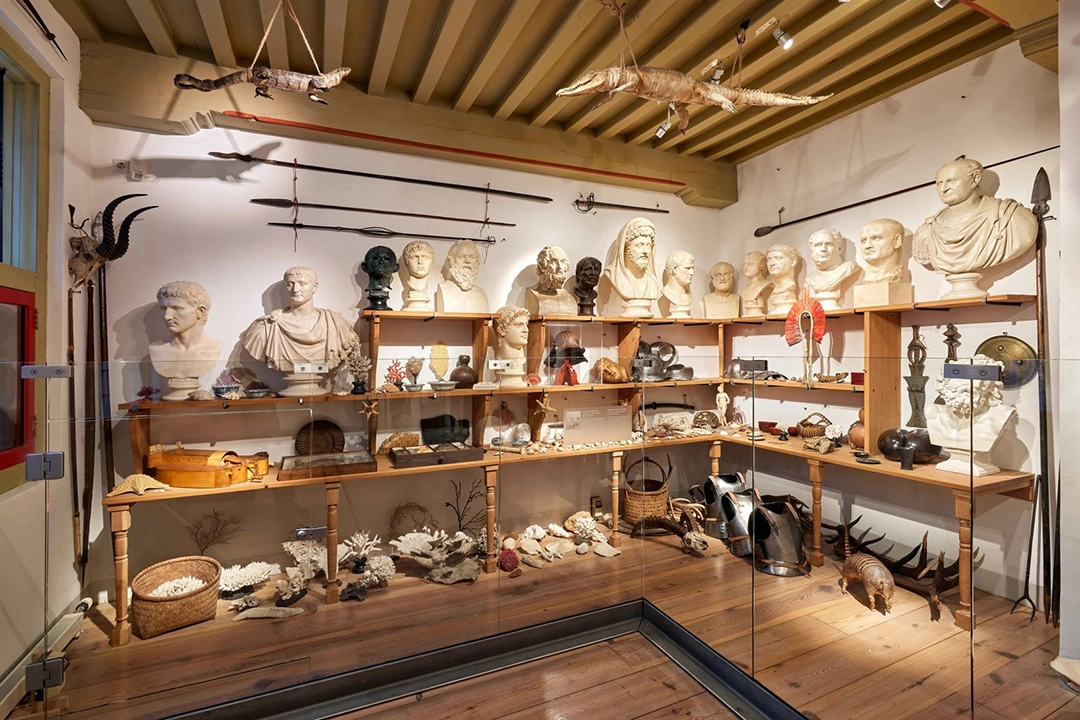
View of Rembrandt’s curiosity cabinet, Rembrandt House Museum, Amsterdam
The print also sheds light on Rembrandt’s etching practice. He frequently made alterations to a plate, printing it in multiple states. In the shell’s rare first state, Rembrandt rendered it entirely in drypoint, using a sharp needle to scratch directly into the copper plate’s surface. This resulted in an accurate depiction of the shell that floats on a creamy background. In the second state, however, he reworked the plate, etching thousands of fine, intersecting lines to build up a shadowy, recessed space. By pushing the dramatic contrasts of light and dark, Rembrandt went beyond a straightforward, scientific depiction, elevating the humble Conus marmoreus from a natural specimen to a transcendent object that evokes powerful emotion.





If you’re a regular reader of this blog and enjoy its content, you might consider contributing to its upkeep. Any amount, no matter how small, will be warmly appreciated
Founded in 2021, Echoes (Notes of Visual Narrative) invites everyone to explore together the visual codes that shape our world—art, photography, design, and advertising in dialogue with society.

Copyright © 2026 r10studio.com. All Rights Reserved. Website Powered by r10studio.com
Cincinnati, Ohio



Comments powered by Talkyard.