
Liudmila
In Book XXXV of his Natural History —Naturalis Historiae libri XXXVII— Pliny the Elder, while addressing the origins of modelling in clay, recounts the story of Butades, a potter from Corinth. Western scholarship places this account around the sixth century BCE. Butades had a daughter who loved, with uncommon intensity, a young man suddenly compelled to leave on a journey. On the eve of his departure, the inconsolable young woman, by lamplight, traced the outline of the shadow cast by her lover’s face upon the wall. She wished to retain his silhouette before enduring his absence. A simple gesture, free of display, yet foundational.
Soon afterwards, Butades filled in the profile with clay and fired it alongside his vessels. It was the first relief modelled from a face. Pliny reports that the piece remained in a sanctuary at Corinth until Mummius razed the city. Later tradition expanded the account, turning it into the myth of drawing’s birth, supported by another statement from Pliny, who suggests that painting began by enclosing the shadow of a man in lines.
To retain the features she held dear, she had to turn her eyes away from the living face in order to delineate it on the wall. She worked with her back to the real presence, turned toward and absorbed by its projection. Deconstructing that gesture became a temptation theory could not resist. Victor Stoichita built an entire history of the shadow as the substrate of the image around that scene, while Derrida read in the same distraction the constitutive blindness of the one who draws.
The fact remains that, although a shadow is absence by nature, as a presence it becomes a material contradiction. It ceases to be natural and becomes anomalous.
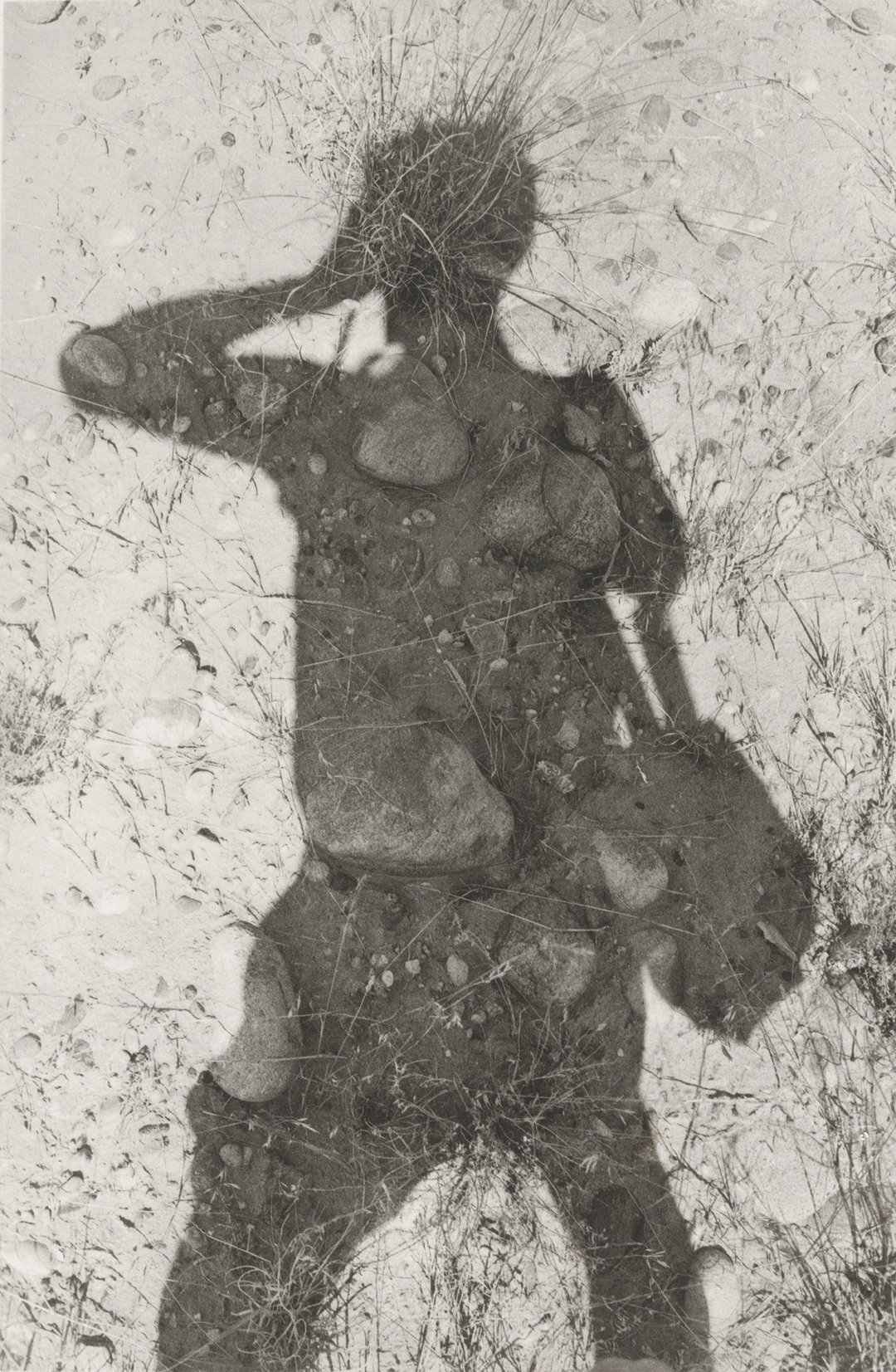
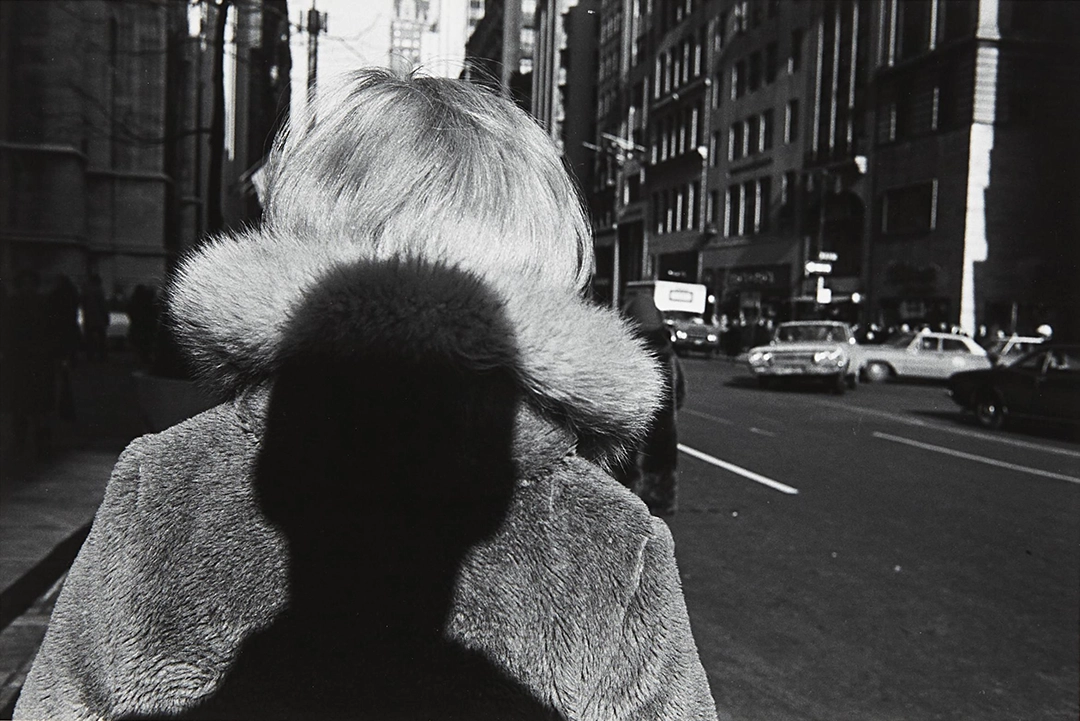
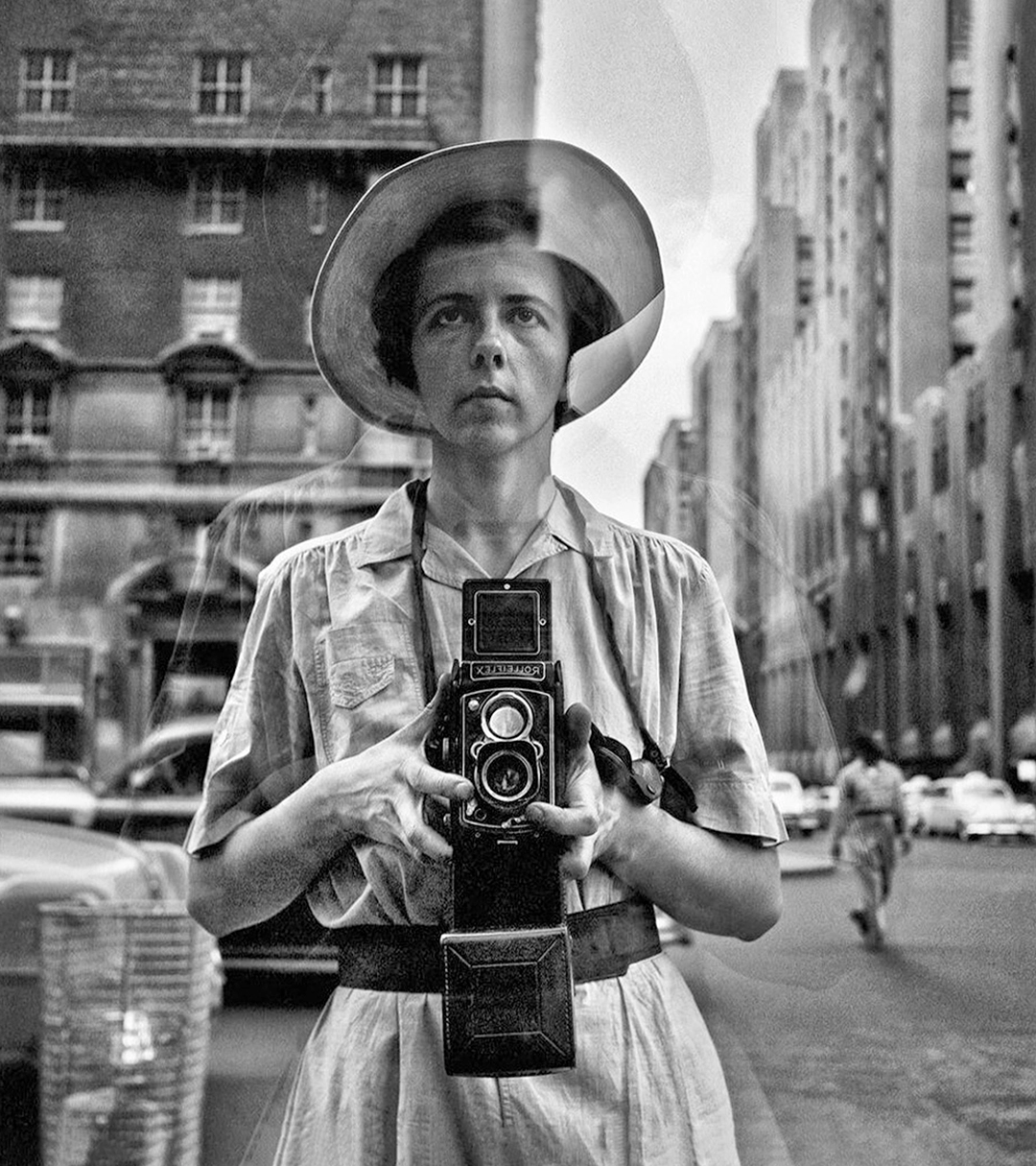
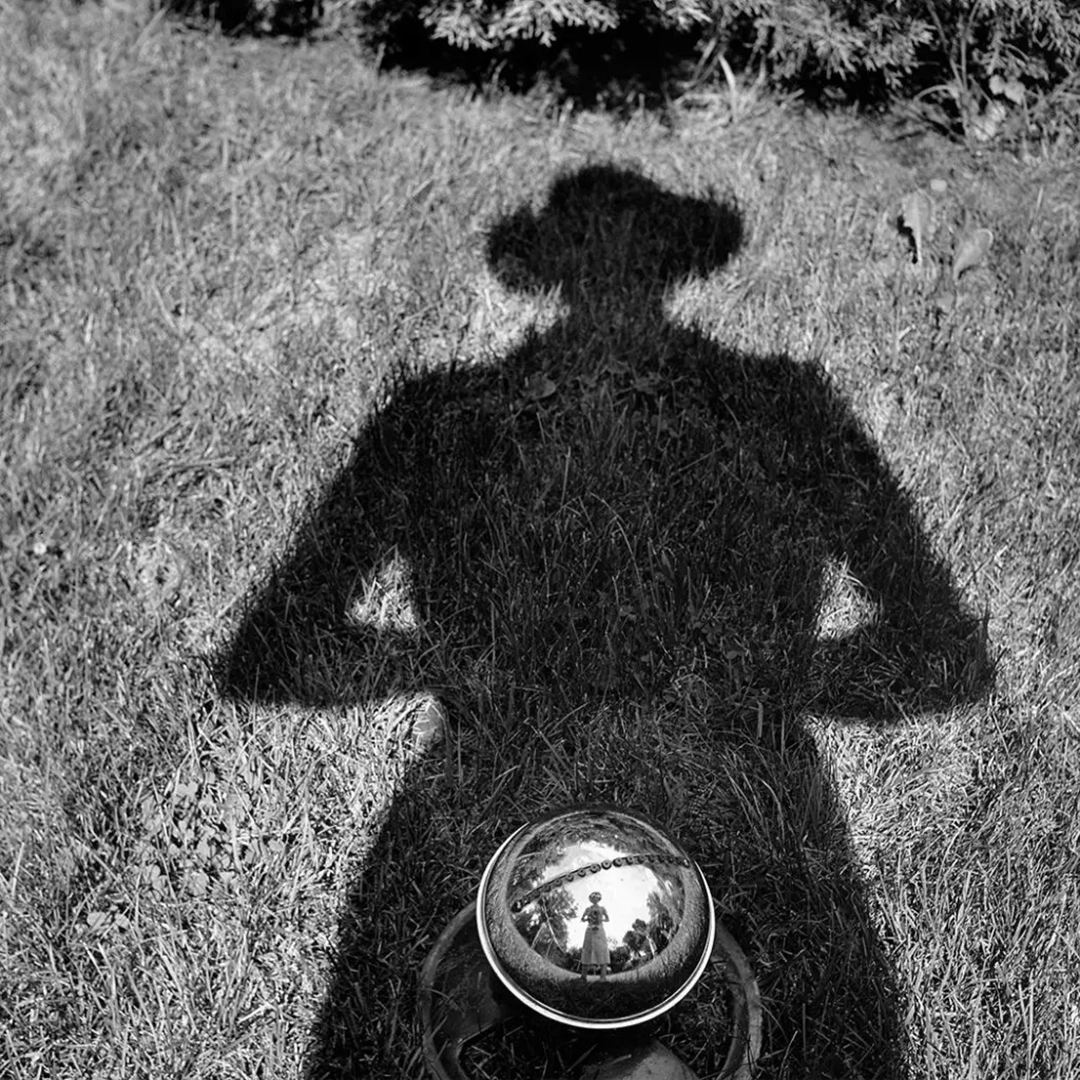
The lineage of Liudmila Velasco’s work with silhouettes runs through Lee Friedlander’s many self-portraits, in which his shadow bears the full weight of the narrative. In his case, however, it bursts into the scene with excessive roughness, casting a theatrical, performative masculinity in hard contrast. An almost animal need to occupy the heart of the frame, to display an undisputed command of space. It also runs through many works by Vivian Maier, in which she photographs herself with her elbows extended—she had no alternative either—forming, from the base of the image, a visual triangle equally rigorous and commanding.
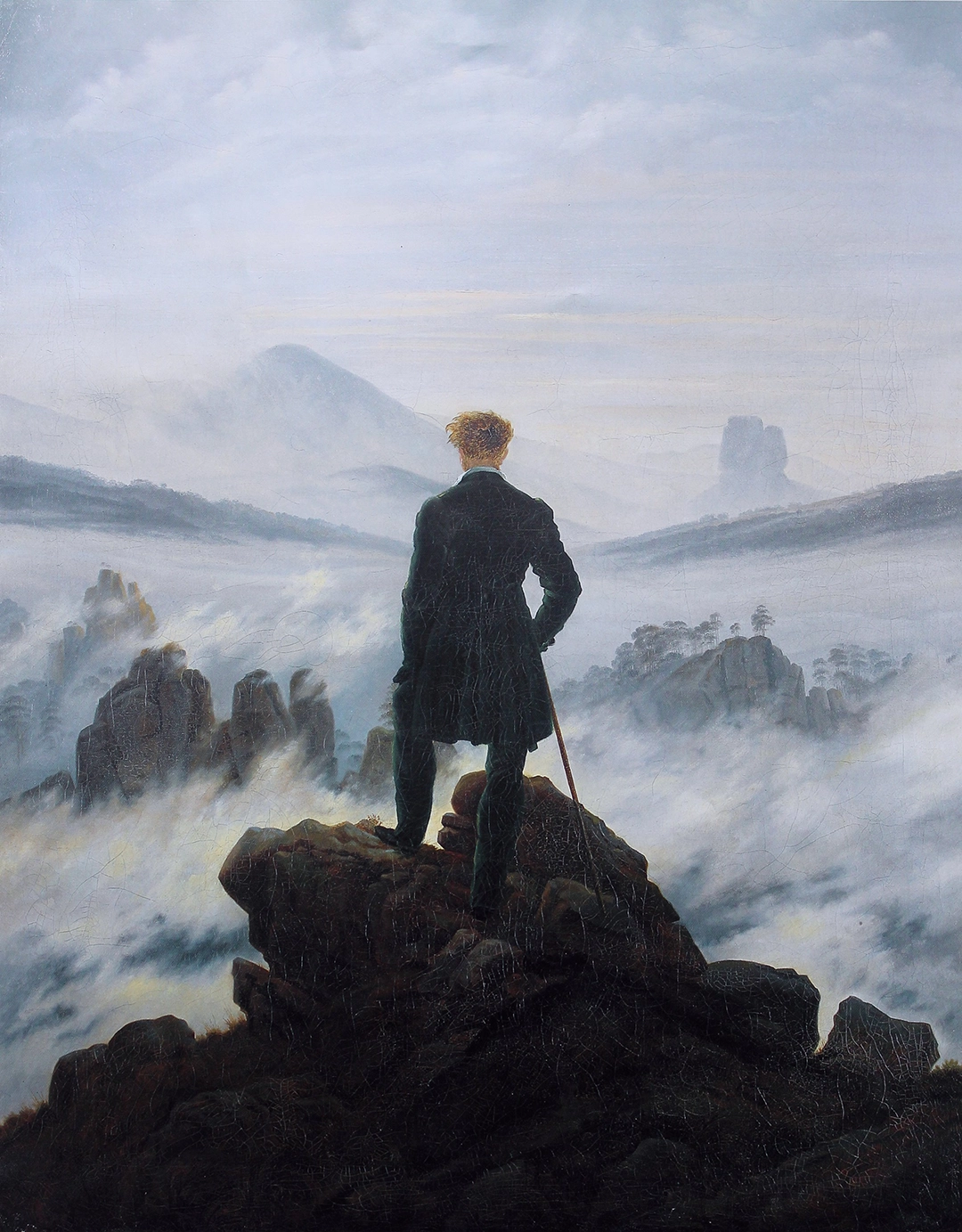
An even more distant precedent may be found in the rhetoric of the back, which Caspar David Friedrich made one of his most persistent expressions. His much-reproduced Der Wanderer über dem Nebelmeer, 1818 (Wanderer above the Sea of Fog), stages a man seen from behind, standing on a rock. It has become one of the emblematic images of German Romanticism. It presents fragile humanity before immense nature, untamed and sublime. Friedrich’s decision to show him from behind indicates that we are contemplating our own portrait. It is a veiled invitation to accompany him spiritually in the overwhelming moment when he confronts the boundless, a confrontation already enacted in physical terms.
This self-portrait by Liudmila also recalls, among other things, the formal logic of Floris Neusüss, regarded as a pioneer and master of photogram practice for more than four decades. His bodies remain visible as direct imprints of light, although the resemblance here operates as a visual reference, rather than as a technical procedure.
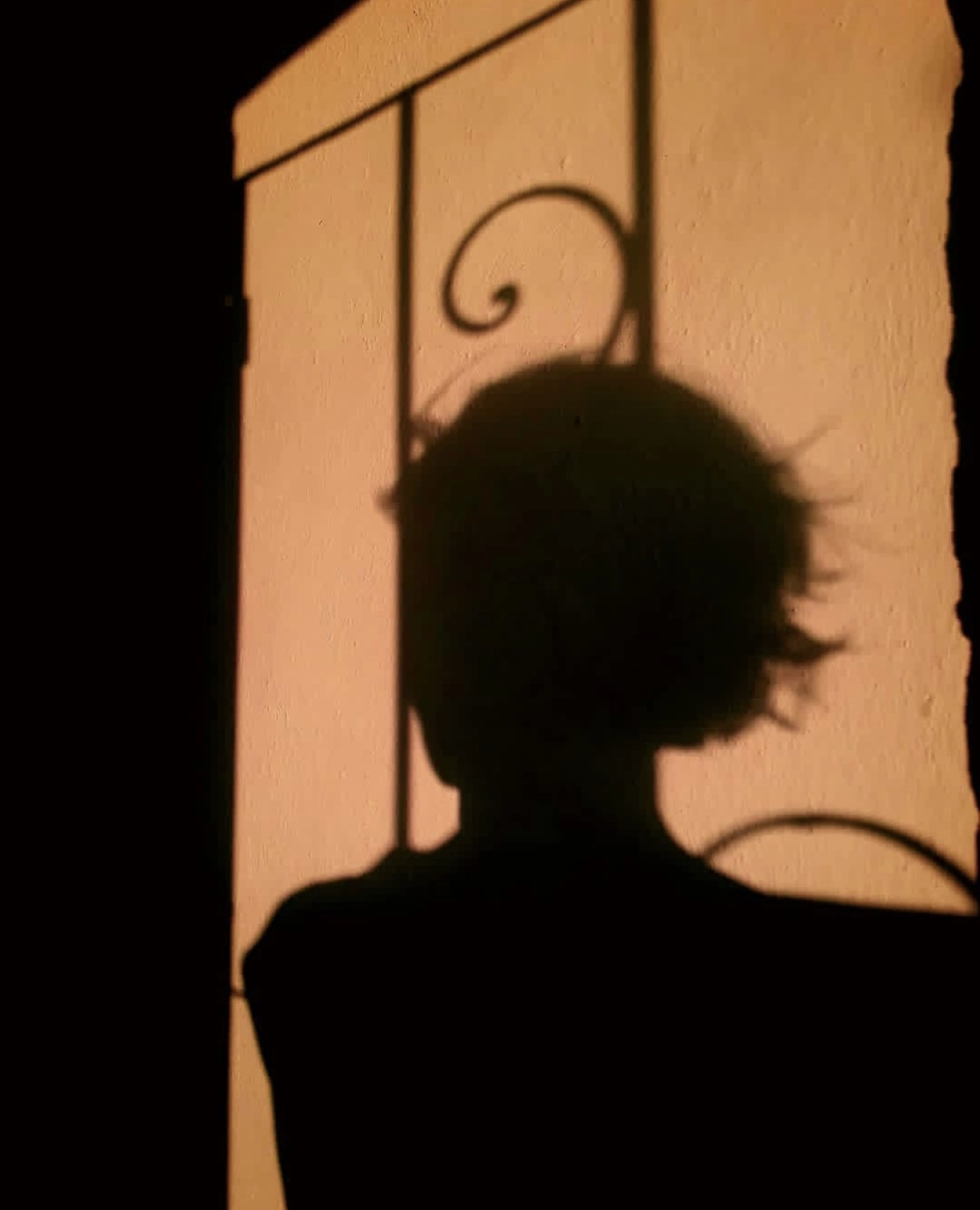
Turning squarely to our photograph, I cannot determine whether it is both precursor to and continuation of her phantasmagorias. Nor do I wish to ask, because I want to approach it unaided. Unlike the photographs in the series A través del espejo, this one does not record her fragmented body, but her shadow projected upon a wall. In a portrait by subtraction, what remains incomplete is her identity. Her decision to portray herself as a trace determines everything.
Let us see, then, what this small marvel contains within—or outside itself.
Physically and conceptually, the image is divided into two signifying spaces. A dense black mass enters from the left and, more narrowly, from the right—the dark edge of an opening, an area beyond the reach of light—and separates the signifying core from the exterior. These are territories of abstraction that press in upon the central quadrant from either side. They frame a warm, rough wall, ochre tending toward a subdued terracotta. The patch of light reads like a page torn out of darkness, exposed and made available to the eye. It is low, lateral, golden light. Its raking angle lengthens the shadow and makes it legible. The palette is narrow and warm, without a single cold tone. The blacks retain a brownish density and remain partially open. Without this light, and without this angle, no image could emerge.
The heart of the photograph beats quietly in the hair. Light separates the locks and turns them into vegetal filaments, into a crown breathing along the contour. They are scattered and open, like tall grasses that tempt us and awaken the strange desire to comb them as we pass, to let them run through our fingers. Because of them, the silhouette ceases to be a flat cut-out and gains air, movement, and lightness; they are the figure’s sole point of individuation. From the chin and the precise cut of the hair, an unknown yet recognizable dimension of Liudmila announces itself. I have no doubt that it is she.
The block of the shoulders, by contrast, dissolves into the black surface on the right. The body sinks into shadow, and the head alone remains alive and vivid against the illuminated wall. I will return to the grille later.
The genre of the self-portrait promises at least some resemblance to its maker. This is a faceless yet unmistakable index. The shadow proves that her body was there, under a certain light. It is a physical trace, like a footprint or a death mask, and it withholds an indisputable identity: the certainty of her face, above all the exchange of glances. The signifier of a presence that retains the signified.
Far from her familiar phantasmagorias, Liudmila presents herself with her back to us; that is, at least, how I see her. She breaks portraiture’s frontal pact. She is the Romantic Rückenfigur. She turns our gaze away from herself and toward something beyond, asking us to look with her. What do you want us to look at, Liudmila? Notice how particularly solid that “beyond” is. It is a wall, one against which the gaze comes to an end. The smooth parchment on which your silhouette is impressed.
What region of the psyche might have given rise to this singular portrait?
Perhaps it arises from the impulse to stage her own division: that of a photographer positioned, at once, on the side of the one who looks and on the side of that—or the one—exposed to the gaze. Liudmila projects one of her selves upon the wall, while another moves in to capture it. A third self orchestrates this dance from some other place. It frustrates the scopic drive, since a self-portrait leads us to expect the recognition of a particular face. Here, the curve of a chin and a few strands of hair end up bearing the full weight of her identity. I do not complain. It is enough for me. She is ultimately recognizable in her visible, social self. It withholds only her privacy.
As a shadow, it also summons the repressed, that which one refuses to acknowledge. It lives perfectly at ease within its limits, settling into the small warmth we imagine the wall to possess, into its domesticated shadow. Beneath it flows the elegiac structure Barthes attributed to every photograph. The trace is the trace of a trace.
Where does the modest singularity of this image vibrate? In my view, it lies in the grille, which inscribes it within the domestic iconography of the Caribbean threshold. The decision to allow the bars to frame her head suggests an awareness of confinement and of the threshold as a point of departure. It may suggest, obliquely, a relation to the limits and bars of her comfort zones. In Cuban visual grammar, the grille marks the boundary between the private interior and the collective street, between shelter and enclosure.
Yet as a grille, it is a delicate, almost floral element. The spiral arabesque crowning her head lends the whole composition an endearing note of mischief. It partly eases the severity of the shadow, just as vegetal scrollwork softens the rigidity of iron. Its emergence from the highest point of her head, like the charming antenna of a butterfly, is what turns this photograph into a kiss. Like the beetroot stain Lezama introduces into his celebrated meal, a red fissure, vegetable blood that gives the feast the relief of splendour. Beauty emerges in the irruption that disturbs order and brings depth into view, once pristine cleanliness has been breached.





If you’re a regular reader of this blog and enjoy its content, you might consider contributing to its upkeep. Any amount, no matter how small, will be warmly appreciated
Founded in 2021, Echoes (Notes of Visual Narrative) invites everyone to explore together the visual codes that shape our world—art, photography, design, and advertising in dialogue with society.

Copyright © 2026 r10studio.com. All Rights Reserved. Website Powered by r10studio.com
Cincinnati, Ohio

Comments powered by Talkyard.