
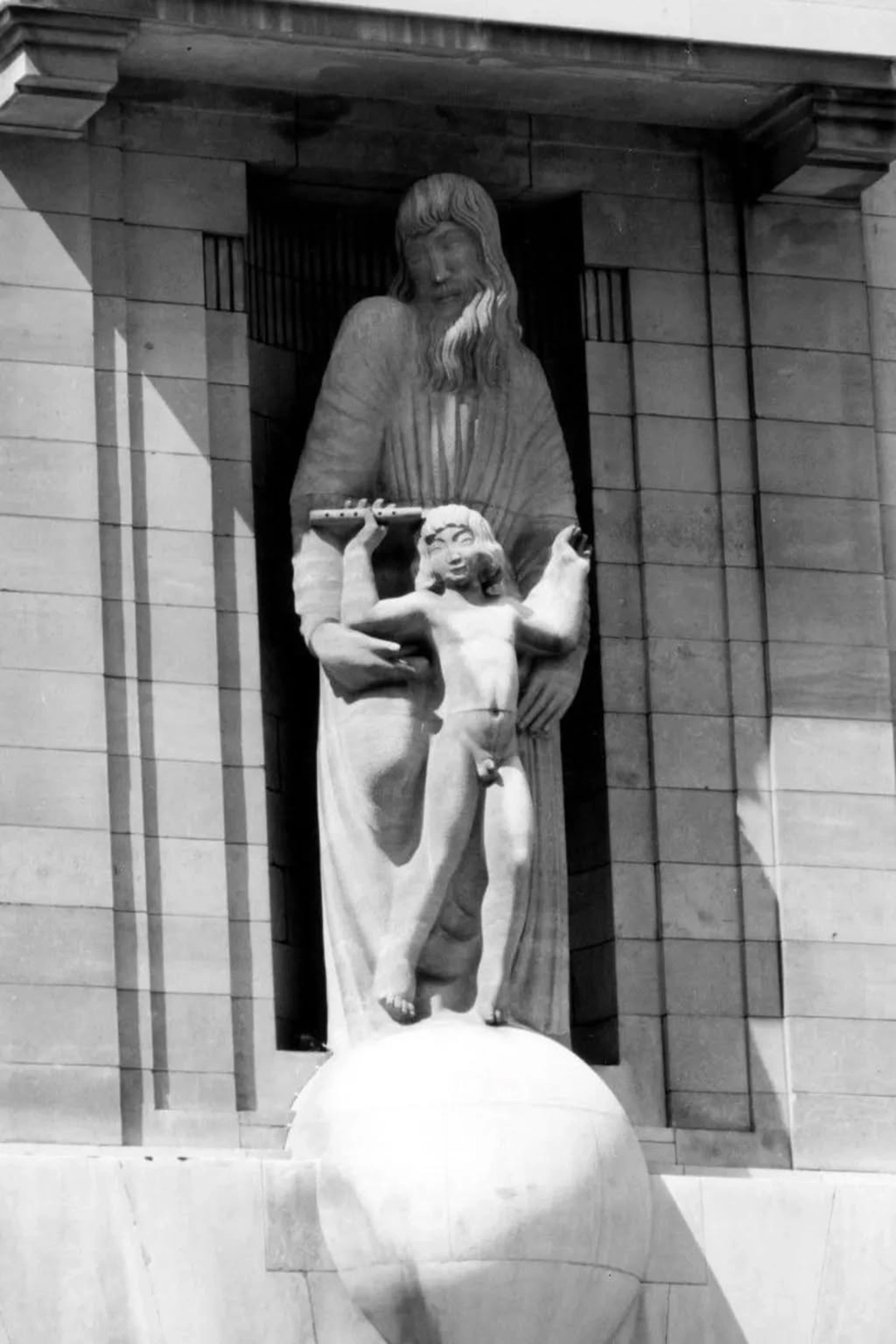
This is how *Prospero and Ariel* appeared on the façade of the BBC building in the 1930s.
This is one of those subjects that provokes a profound sense of revulsion in me. The feeling has several causes, and they contradict one another. Yesterday, *The Times* reported—more perceptive readers will already have noticed my fondness for Britain’s old-establishment newspapers, those faithful custodians of traditional intellectual hierarchies—that the British Broadcasting Corporation had restored a vandalised sculpture by Eric Gill and returned it to the place it had always occupied.
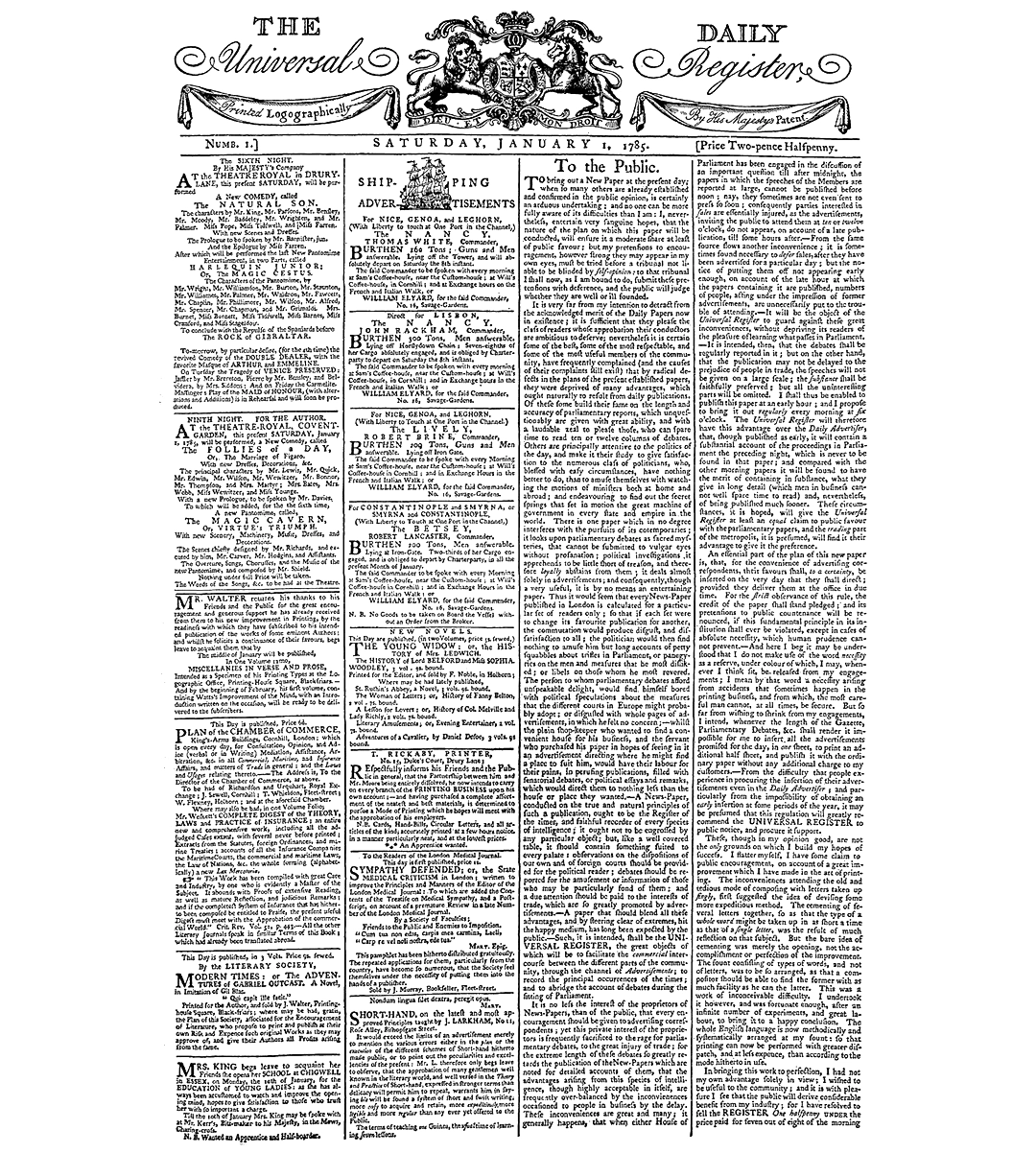
The front page of *The Daily Universal Register* dated January 1st, 1785.
The first issue of the newspaper appeared on January 1, 1785. It had yet to become *The Times* and was then called *The Daily Universal Register*. With a morbid attachment to the date, it adopted the name by which we know it on another January 1, three years later, in 1788. Over time, the newspaper became one of the most influential publications in the English-speaking world, earning a reputation for journalistic rigour and its close alignment with British political and economic power. To give you some idea, yesterday’s was issue number 74,691. I know this introduction may seem gratuitous. Perhaps it is, though to me it offers a point of departure for the first bend in this intellectual exercise. *Times New Roman* remains the preferred typeface of Microsoft Word’s autumnal devotees. How much good and evil must have been written in it. *The Times* commissioned its design in 1931. Curiously, it is a serif descended from an earlier sans serif. Stanley Morison conceived it with Starling Burgess and Victor Lardent, and the Monotype Corporation released it in 1932. The Times has long since abandoned it, while the rest of the world keeps it permanently at work.
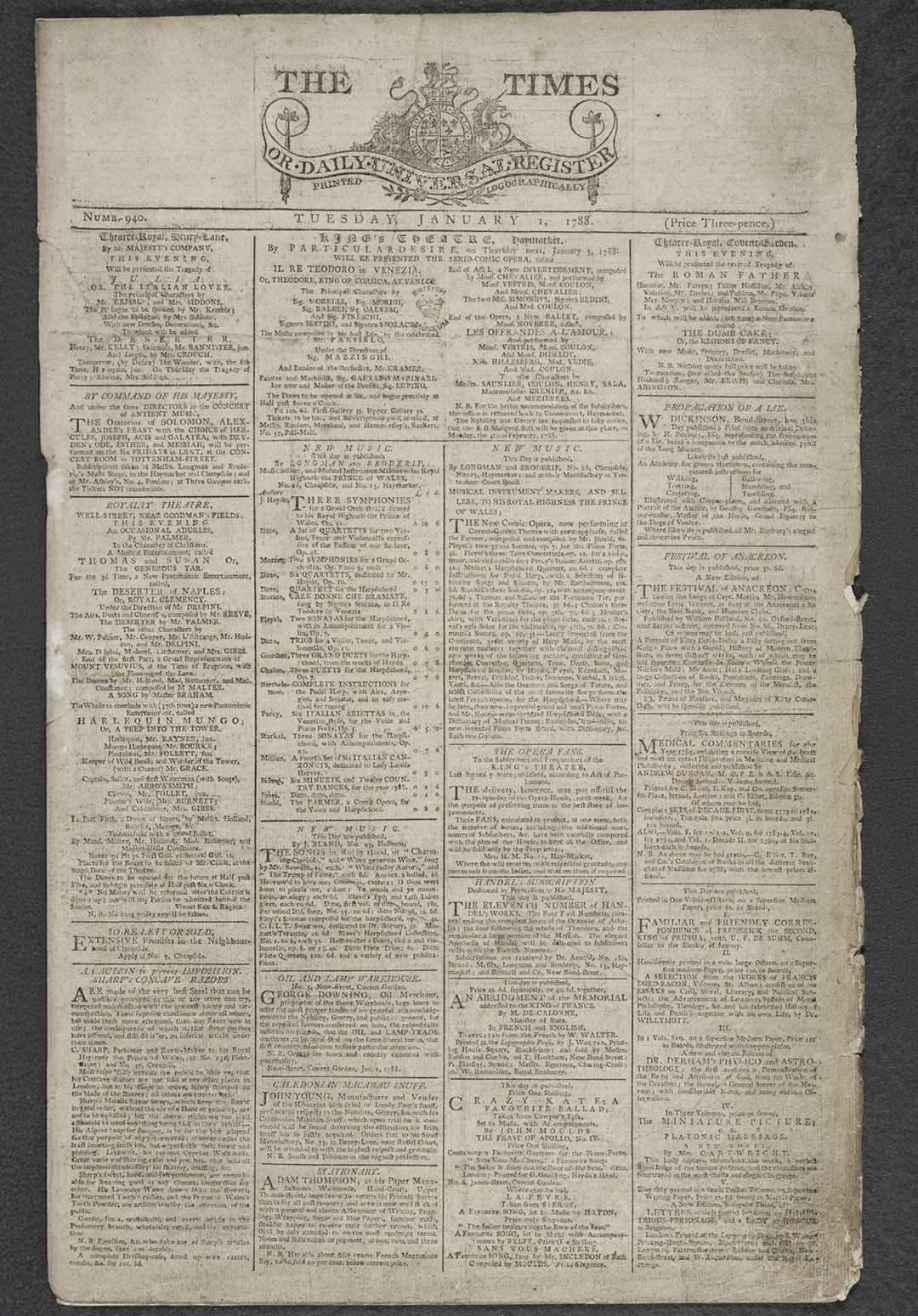
An issue of *The Times* dated January 1, 1788. Number 940, priced at three pence. In London at the time, that sum could buy approximately 750 to 800 grams of bread. A four-pound loaf cost around seven pence in 1789. According to court testimony from the same period, three pence could also pay for a night in the humblest of lodgings.
In 1932, the year *The Times* unveiled its new typeface, Arthur Eric Rowton Gill, already past fifty, was working on a sculpture commissioned by the British Broadcasting Company for the façade of Broadcasting House. The piece represented Prospero and Ariel, central figures in *The Tempest*, one of Shakespeare’s late plays. Gill, whose work was already present in Westminster Cathedral and at the headquarters of the London Underground, conceived it as a symbolic representation of the then almost inconceivable phenomenon of wireless radio communication—the transmission of the human voice through the air. Decades later, this almost ingenuous sculpture would become entangled in a controversy that drove the weary debate over art, authorship, memory, and collective morality to paroxysm.

Eric Gill works on Ariel, from The Tempest, one of his iconic statues at BBC Broadcasting House in London. March 1933. Photograph: BBC/Corbis
What does Times New Roman have to do with any of this? Very little, in truth. It enters the story obliquely, like the white cue ball rebounding off two cushions before crashing into the ball it has been sent after. What interests me is the weight a typeface can acquire once it takes root in the visual culture of its time, at least since Gutenberg’s invention of movable type in the mid-fifteenth century. That stature also attaches itself to the designer, especially when the work leaves a recognisable trace in other territories of artistic creation and, more particularly, in visual culture.
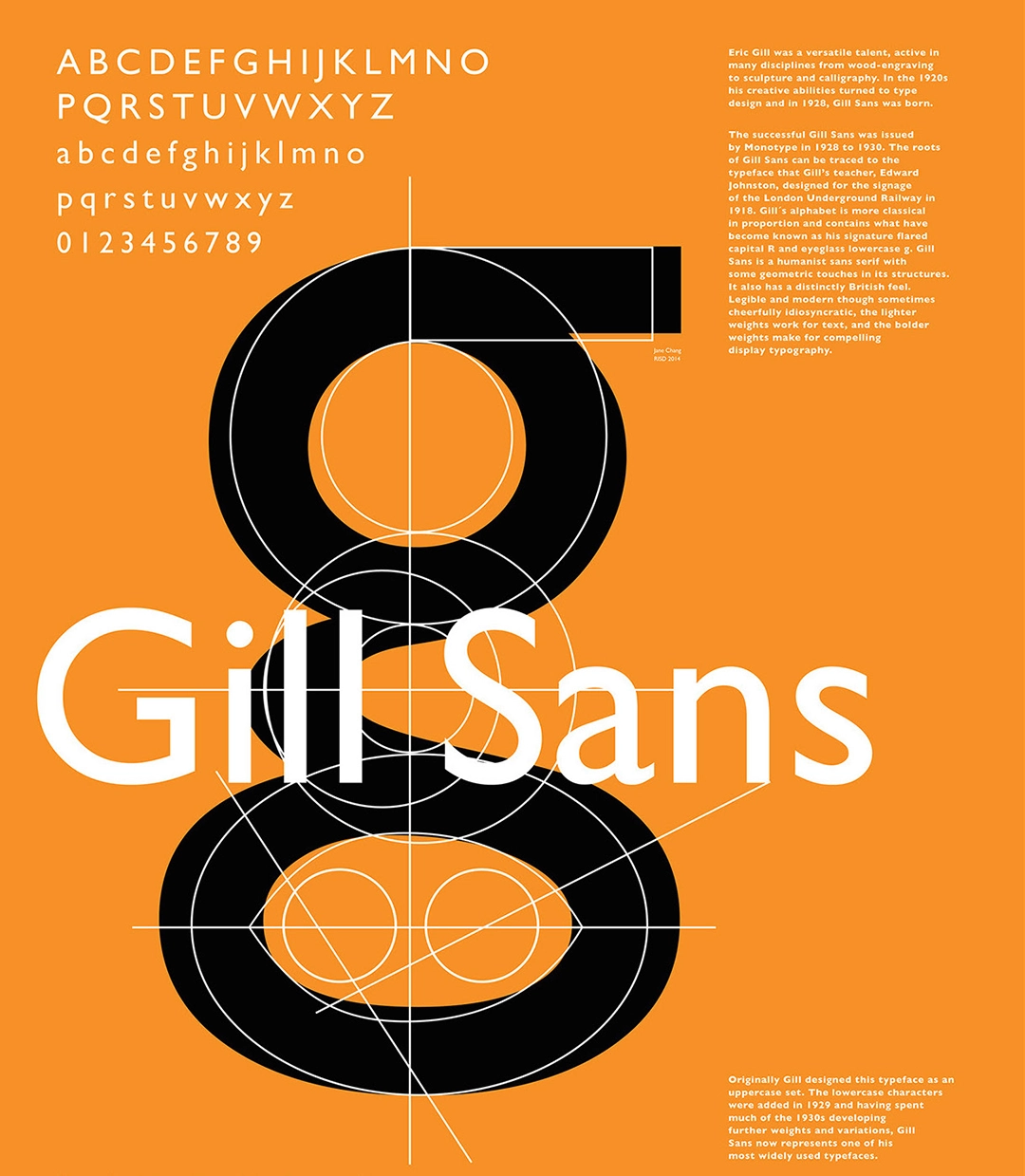
Eric Gill designed the typeface in the late 1920s, drawing inspiration from Edward Johnston’s lettering for the London Underground. It combines the clarity of modern forms with a structure rooted in calligraphy. Its extensive use across signage, publishing, transport, and institutional identity made it one of the most recognizable typefaces in twentieth-century British design. Monotype released it in 1928 as a humanist sans serif.
Gill designed several type families, none as popular as *Times New Roman*, though they remain in frequent use among graphic designers. *Gill Sans*, of course, which I used exclusively for every publication issued by Editorial Finlay, the division that gave physical form to the entire body of scientific literature produced by the institute of the same name. Its style manual earned me a commendation when I graduated from the Higher Institute of Design, to the astonishment of many who doubted I would ever graduate from anything in this life. Gill’s talent produced other typefaces every bit as celebrated, including *Perpetua* and *Joanna*, both widely used in publishing and advertising. Gill was an intellectual in every sense of the word. He wrote on politics and art and, more significantly, devoted essays—remarkably perceptive for their time—to religion and morality. He was also a practising mystic. Already in his thirties when he converted to Catholicism, he committed himself to Catholic social doctrine and adopted an ascetic life. He believed in cleansing the mind through manual labour. He contemplated Creation through an intensely spiritual relationship with process and materials. His aesthetic was as austere as his supposed moral principles. Slender bodies, flattened forms, and a powerful symbolic language. His works fused the sacred with the carnal, the divine with the human, exposing a permanent friction between spirit and sensuality. This is precisely where we enter the dark side of the moon. In 1989, I was studying German in preparation for further study in Halle (Saale), home to the legendary Burg Giebichenstein Kunsthochschule, one of the Bauhaus centres, in the vanished German Democratic Republic. On the quiet nights of that winter, Europe could hear the muffled blows that seemed to rise from the foundations of the Berlin Wall. With the United Kingdom transfixed by the immense political upheavals unfolding across socialist Europe, Fiona MacCarthy’s biography of Eric Gill passed almost unnoticed through the major media. The silence surrounding it lasted only briefly. Within a short time, the intellectual world would recoil in disgust at the disclosure of profoundly disturbing aspects of Gill’s private life, admissions he had recorded in his own intimate diaries. Repeated sexual abuse of his daughters, an incestuous relationship with his sister, sex with the dog. A human bankruptcy so complete that it reduced his pose as custodian of Moral Rectitude to rubble. The ethical and cultural consequences of these revelations remain very much alive. Disgust moves comfortably from year to year through essays, reflections, and social-media commentary. Museums, religious institutions, and public bodies still struggle with the fate of his work. Should it be preserved as cultural heritage? Removed as an act of symbolic justice? Critically reinterpreted?

Eric in his favourite madman’s get-up.
Eric Gill has become one more emblem of the virulent debates surrounding art and morality, the artist’s role in society, and the limits of cultural recognition. His legacy—a scalding, quivering hot potato once celebrated without reservation—is now examined through a more complex lens, one that confronts formal genius with ethical horror. For many, his case has become a textbook example in the global argument over whether a work can, should, or must ever be separated from its creator. I have made my position on the matter fairly clear. During the thirty years I have spent in the field of visual communication design, including several years teaching typography at university level, I have never seen a designer renounce Gill Sans or Perpetua on moral grounds. Throughout my five years at design school, no professor ever raised the dilemma. Everyone already knew about the dark figure behind the typefaces.

The irate David Chick, taking the law into his own hands.
In January 2022, an enraged David Chick climbed the façade of the corporation’s building and repeatedly attacked the sculpture with a hammer and chisel. The damage was repairable. London and the BBC proved remarkably understanding. They grasped the depth of his distress and, although he was arrested at the scene, soon returned him to the street with little more than a mild scolding. Gill’s record, however, proved too much for David’s rectitude. In May 2023, he climbed the scaffolding once again and, shouting “paedophile,” savagely set upon Prospero and Ariel with his customary hammer and chisel. This time the results were more satisfying. He hammered away until sleep overtook him. Arrested once more, he now faced charges of causing significant damage. He remained in prison until last month, when he was granted bail on the condition that he stay at least one hundred metres away from the building—for the rest of his life.
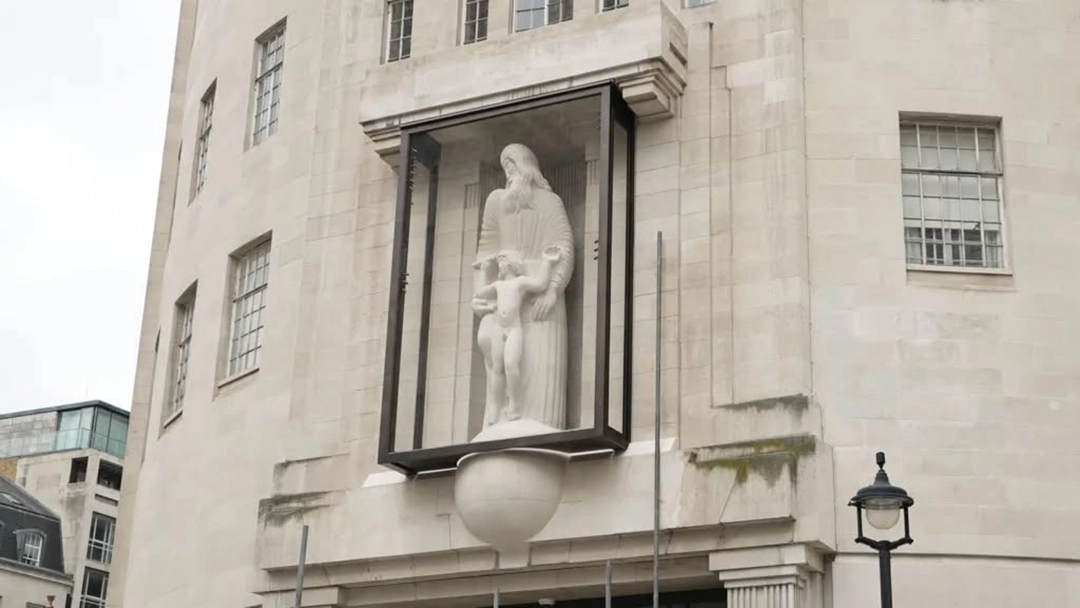
Protective screen installed by the BBC.
Perhaps no one wished to keep him locked away. He is, after all, a man of such charming principles. His imprisonment simply matched the time the BBC needed to repair the damage and complete a protection system intended to prevent future episodes. A transparent, fanatic-proof polycarbonate screen now surrounds the monument. QR codes provide access to documents offering historical context on the work, its creator, and the restoration. The entire operation follows a policy of critical reinterpretation rather than cancellation. You may safely assume that the surrounding area now bristles with sensors and early-warning systems for vandals. The building itself is Grade II listed. Historic England and Westminster City Council restored the sculpture at a cost of £529,715. The BBC paid without a murmur and declined to involve its insurers. Why keep stirring such a sticky affair? The conduct of the BBC and the city clarifies several things for me. A corporate spokesperson said that the BBC “does not condone Gill’s abusive behaviour,” while drawing “a distinction between his actions and the status of his works.” Duncan Wilson, Chief Executive of Historic England, acknowledged that Gill had become a controversial, even deeply problematic figure since the details of his private life emerged in the late 1980s. He nevertheless welcomed the BBC’s approach—repairing the work and offering an indignant contemporary public the means to interpret it reflectively, with due consideration for its historical context and the artist’s personality. Many disputed places and objects now require additional “layers” of meaning and understanding. The underlying question remains. What defines an artist today—the work or the conduct of the person who made it? Art is increasingly judged through the sins or virtues of its maker, while its intrinsic value recedes from view. We encounter attacks of this kind with alarming frequency. Gill was an abominable man, a depraved paedophile who abused his daughters and others. His private life offends even the most ordinary human sensibility.

David Chick making sure there are no police officers near the BBC building.
And that, David, gives you the right to destroy his work? Do you really think I would want to live in your pristine, flavourless, scent-free utopia? In 2019, visitors to the Gauguin exhibition at the National Gallery were greeted by an audio recording asking, “Has the time come to ignore Gauguin altogether?” The curators wanted the public to carry into the aesthetic experience an awareness of the artist’s inappropriate sexual relationships with adolescent girls and his contemptuous remarks about Polynesian people. The same question has been asked of Woody Allen’s films, Michael Jackson’s music, and Philip Roth’s novels. The list is merciless—Picasso, Chaplin, Caravaggio, Dalí, Chuck Close, Balthus, Richard Prince, Roman Polanski, Marlon Brando, Leni Riefenstahl, Mel Gibson, William Burroughs, J. K. Rowling, Lovecraft, Bukowski, Roald Dahl, Rousseau, David Bowie, Marilyn Manson, Helmut Newton, Jean-Paul Gaultier, Mario Testino. Even Walt Disney, with his incorrect and shameful little dwarfs. When charities campaigning against sexual abuse called on the BBC to remove Gill’s sculpture in 2013, the corporation refused outright. Its statement described Gill as “one of the foremost British artists of the last century, whose work has been widely exhibited in major museums and galleries across the United Kingdom.” A little over ten years later, does the BBC still possess the will to maintain such an iron defence? In my view, official statements aside, the decision to return the sculpture to its original position beneath a level of protection bordering on paranoia provides a sufficiently clear answer. One can sense certain institutions central to the formation of contemporary thought reacting, as best they can, to the rise of a *Stultitia socialis* that disguises itself as civic virtue and, amplified by social media, seeks to impose its whims upon the public sphere. In the hands of these deranged people, every idea emerges disfigured and reduced to an assault upon the person who voiced it. They have normalised attacks on the artist while disregarding the work, and the outcome of artistic judgment now depends heavily upon their verdict. These Purity Crusaders decide whether an artist is politically correct enough and whether the intentions behind the work are sufficiently transparent. As the morality and tolerance of *Homo maniacus* continue to evolve, will only works produced by ethically and morally pure artists be allowed to remain?

This unbridled cultural revisionism may bring about the death of Art—music, literature, and every form in which we have known them until now. No creator can withstand the scrutiny of the mob, and none of us can anticipate the value system that will govern the future. Any work connected to a figure whose behaviour has been judged “morally reprehensible” risks destruction or censorship. Do they fail to see that almost the entire artistic and cultural heritage of humanity stands in danger? However contemptible the conduct of some of history’s most celebrated artists may have been, a society with sufficient intellectual maturity should assess art on its own terms, rather than through the identity and behaviour of its maker. Applying contemporary standards of conduct to test the political purity of artists and historical figures would lead us towards a society stripped of statues, sculpture, and public art. A world without art is a world without humanity. A world governed by moralising art would sink into dogma and render every aesthetic experience unbearable. In 1977, Roland Barthes proclaimed “the death of the author.” He argued that a “text” could become truly free only after escaping the tyranny of authorial intention. Half a century after that pronouncement, what comes next? Resurrect the author and tear the work to pieces? Few things exasperate me more than people who, without the slightest evidence, take it for granted that they are better than everyone else.

Eric Gill with the sculpture in 1932.



If you’re a regular reader of this blog and enjoy its content, you might consider contributing to its upkeep. Any amount, no matter how small, will be warmly appreciated
Founded in 2021, Echoes (Notes of Visual Narrative) invites everyone to explore together the visual codes that shape our world—art, photography, design, and advertising in dialogue with society.

Copyright © 2026 r10studio.com. All Rights Reserved. Website Powered by r10studio.com
Cincinnati, Ohio



Comments powered by Talkyard.