
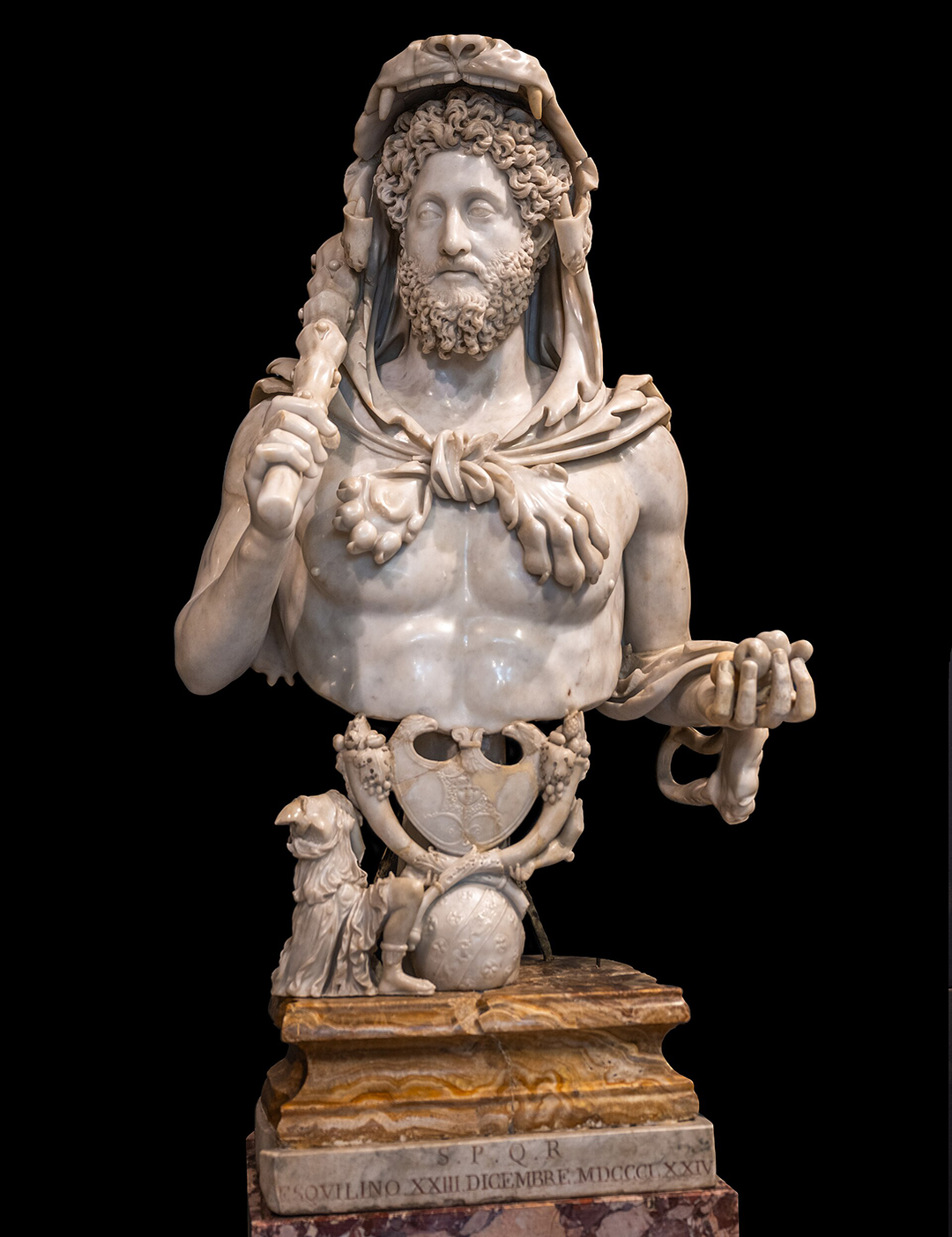
Bust of Commodus as Hercules, wearing the skin of the Nemean lion, c. 191–192 CE.
Marble, Capitoline Museums, Rome.
Photo: Wilfredor, Wikimedia Commons, CC0.
The Roman historian, senator, and politician Cassius Dio loved a front-row seat. To tell how Commodus, that son of Marcus Aurelius who liked to rule Rome dressed as Hercules, went down into the amphitheatre arena one afternoon and beheaded an incredulous ostrich. With the creature’s head in his left hand and the wet sword in his right, he climbed to the stands where the senators were sitting. He said nothing. He gave them an imperial look to suggest he could do the same to them whenever he pleased, then, smug and heroic, turned his back and sat down with a grim smile on his lips. Dio, to hold back the laugh about to leap from his throat, plucked a few laurel leaves from his crown and began chewing them. He persuaded the others to do the same, because laughing at that moment would have been the last thing they ever did. This was in the year 192. Commodus was murdered that December 31, in the bath.
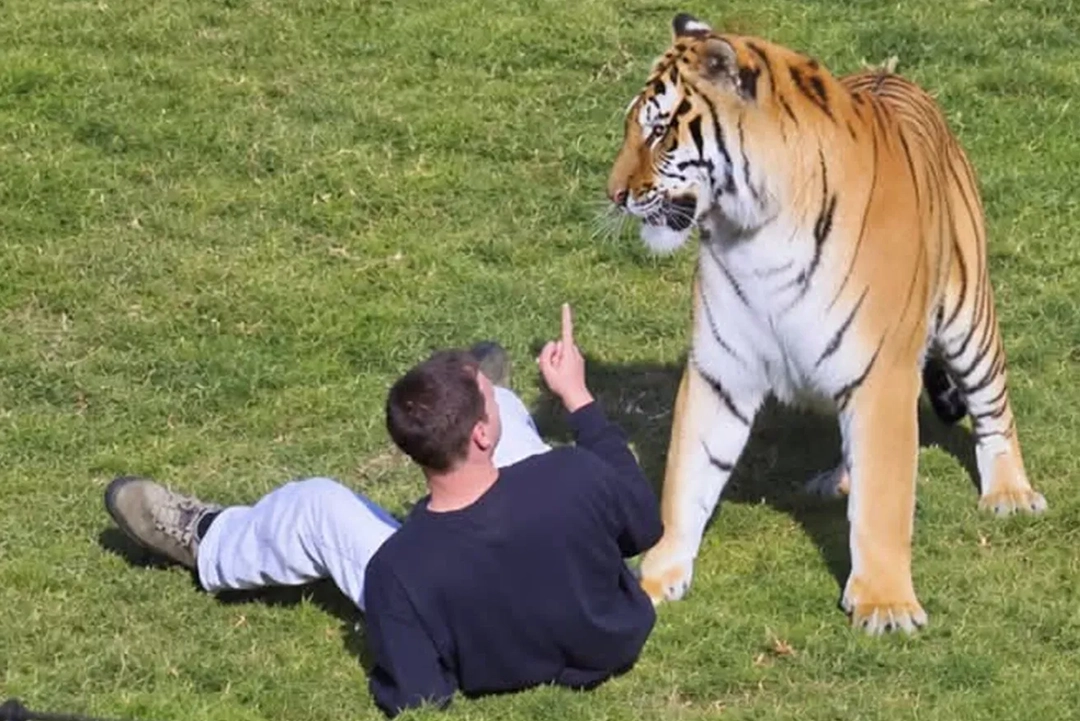
William Chapman facing Altai, an Amur tiger, at Yorkshire Wildlife Park, near Doncaster, before the fatal attack on October 10, 2026.
On Saturday, October 10, 2026, shortly after half past one in the afternoon, a 23-year-old man named William Chapman entered an Amur tiger’s enclosure at Yorkshire Wildlife Park, near Doncaster. Alive, in any sense of the word, he did not come out. The tiger’s name is Altai, he is five years old, and he weighs about two hundred kilos. He is doing splendidly, in good spirits, happy, you might say.
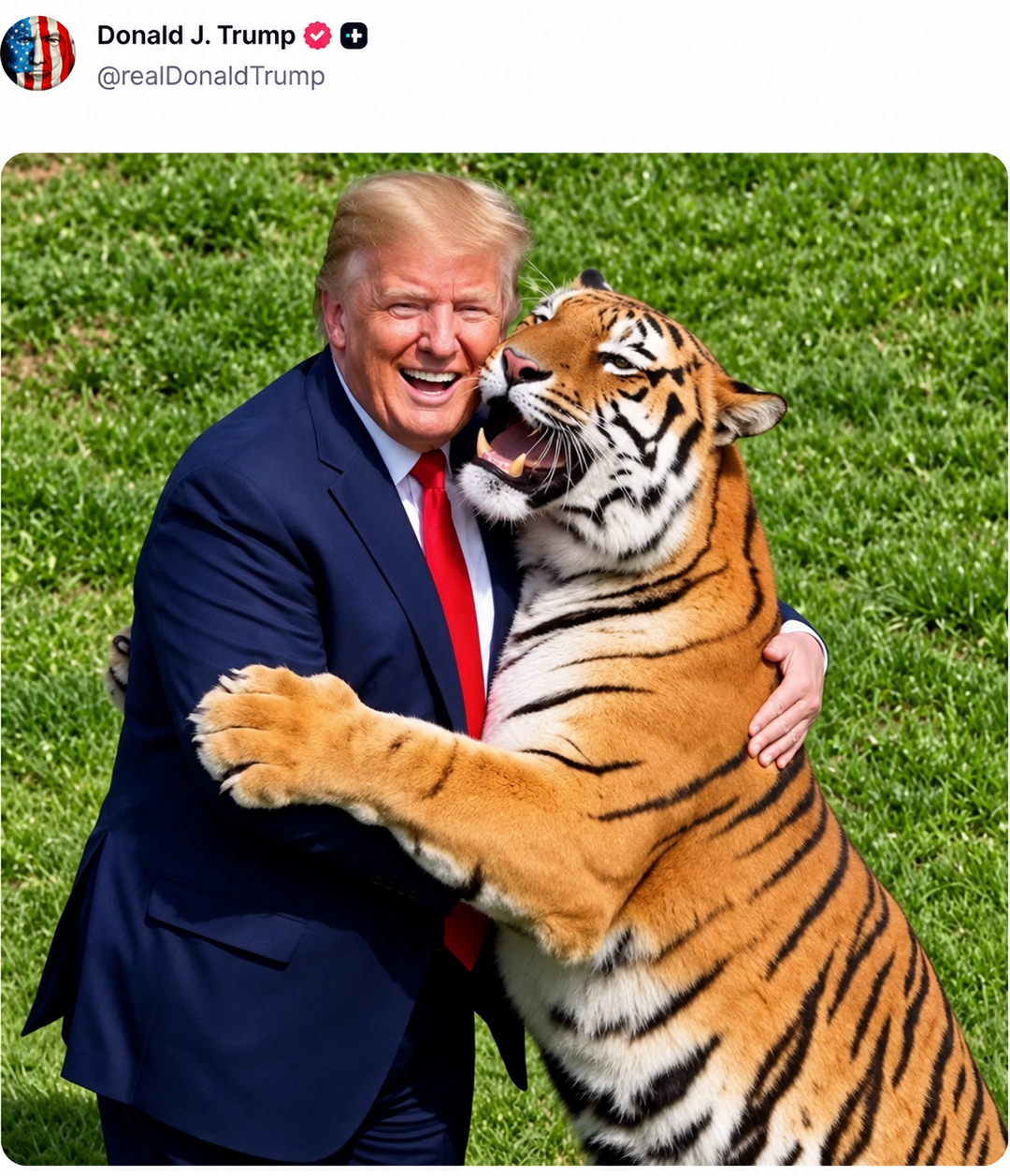
On the night of Tuesday, October 13, the president of the United States shared forty-one seconds of the attack with his thirteen million followers on Truth Social, cut just before Chapman’s death. Beneath it he wrote “Don’t ever mess with nature!” and even signed it: “President DJT.” A minute later he posted another video, twenty-four seconds of big cats leaping onto assorted unfortunates, with music and no comment.
That same night, a few hours later, a third appeared, generated by artificial intelligence. In this one, Trump wrestles a plump tiger on the grass, knocks it down, points his finger at it—the same gesture Chapman made in his own clip, before he was grabbed by the scruff of the neck—and hugs it as The Lion Sleeps Tonight plays. It was actually a tiger, but that is a minor slip. Nobody at the White House objected to the change of species.
Chapman’s family had also released a statement that Tuesday. They said their son was a “bright, warm and approachable” young man who had spent years with a serious mental illness and on strong medication, and that the footage was causing them “severe distress at an exceptionally vulnerable time.” They asked people to stop sharing it. South Yorkshire Police asked the same. The region’s mayor accused the president of using AI to mock the matter. Downing Street said it respected the family’s position and would not comment on such posts.
At this point I have several questions the president’s infantry would consider superfluous. What does an eighty-year-old man feel as he watches a video of a twenty-three-year-old being nibbled on by a tiger? Who does he identify with? Why, a few hours later, does he feel the urge to replicate the scene, with himself in the starring role, and emerge victorious from his drowsy interaction with the feline?
Until I am eighty, I will have no way of knowing how to interpret it. The event, I mean, through an elderly gaze. The question of who the president identifies with is answered by the caption: “Don’t ever mess with nature.” He has sided with nature, meaning the tiger. Where I come from, people used to warn you: “Play with the chain, but don’t touch the monkey.” The one issuing the warning now is the monkey himself. The third question interests me most, because the impulse is ancient... older than yawning.
A few months ago I wrote about Naram-Sin of Akkad, the first king to proclaim himself a god while still alive and have himself carved wearing a horned helmet, towering over his enemies. Then came Hercules wearing the skin of the Nemean lion, and Commodus having himself sculpted in turn as the demigod in his invulnerable fur coat. Putin, in 2008, lets himself be photographed shooting a tranquillizer dart at an Amur tigress in the Ussuri reserve to fit her with a GPS collar. The king and the beast is probably the oldest political self-portrait in existence. The beast supplies the danger and the king controls it, laying his hand upon it.
The dialectic of time is delicious. The next rung dispenses with the beast altogether.
Commodus at least killed an ostrich. A bird capable of leaving you one-eyed, as Pai Mei did to Elle Driver, also known as California Mountain Snake.
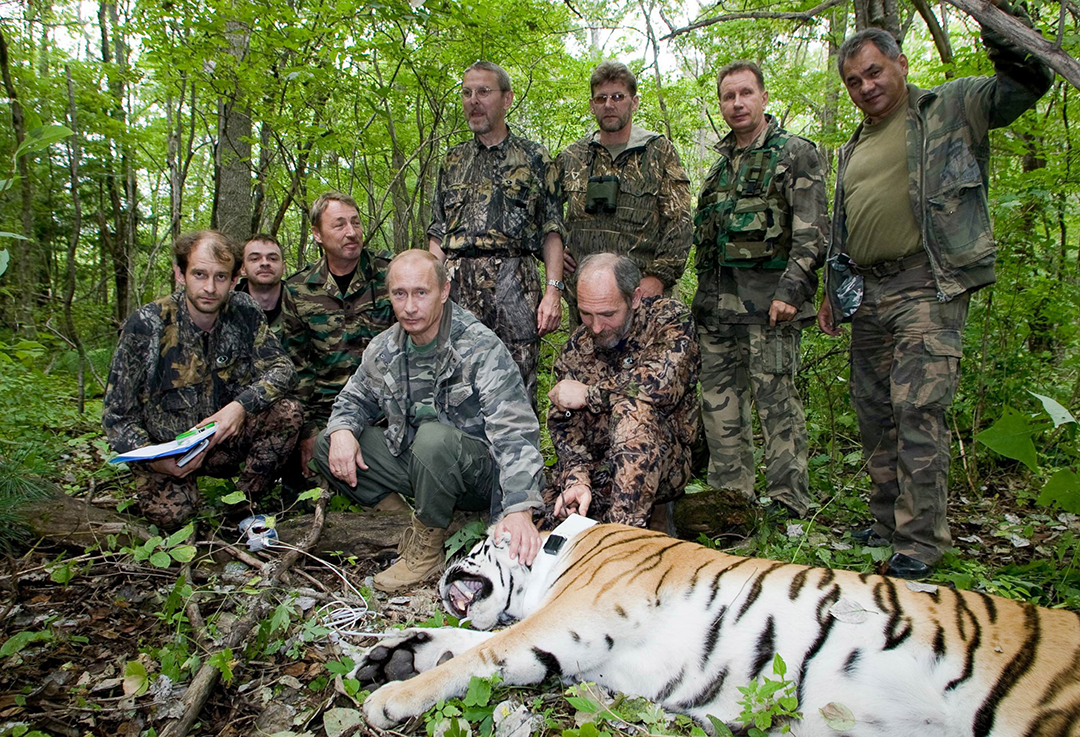
Vladimir Putin is seen in this undated file photo tagging a Siberian Tiger while visiting the Barabash tiger reserve, in eastern Siberia in the Amur Region of the Russian Federation.
Putin had to crouch beside the sleeping animal. The White House tiger is digital, and digital are the grass and the embrace. The only real thing in this whole strange sequence is the poor chewed-up fellow in the first video, who no longer appears in the third. Psychologists have a name for the ease with which a tragedy stops hurting us once it becomes a statistic—I used it a year ago to discuss a fire in Hong Kong—. Here the phenomenon happens in reverse, and considerably faster. Because Chapman did have a name, an age, a family, and an official statement. Once he was dead, a few hours were enough to turn him into a cautionary tale, and a few more to make him an extra in his own tragedy.
On February 28, 2016, Trump retweeted “it is better to live one day as a lion than a hundred years as a sheep,” a line from Mussolini that Gawker had dangled as bait from an account called @ilduce2016. Asked about it, he said he wanted to be associated with interesting quotes. In February 2025, he conceived of the new Gaza as a tourist resort, with his golden effigy presiding from the beach. In May he displayed himself dressed as the pope. In October, in a fighter jet with King Trump painted on the fuselage, dumping excrement on a demonstration. The tiger business is one more episode this season. There will be others.
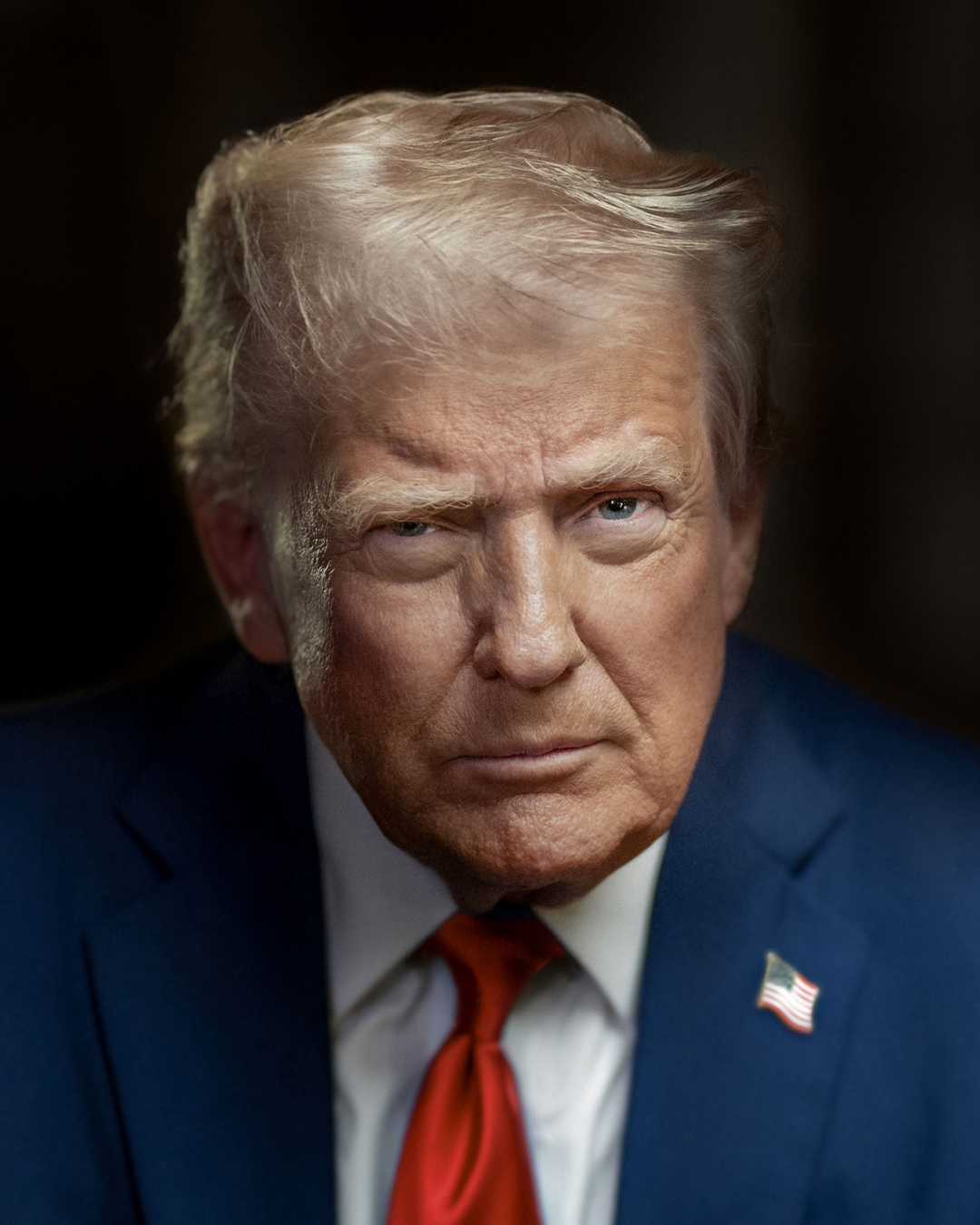
“He gave them an imperial look to suggest he could do the same to them whenever he pleased”...
Official portrait of Donald J. Trump, 2025
Photo: Daniel Torok, White House.
The inquest into Chapman’s death opened on Thursday in Doncaster and was adjourned until March. Altai still has his belly in the sun and the park remains closed. Cassius Dio outlived Commodus by more than forty years and was able to write the history. As you can see, laurel has uses beyond seasoning. Chewing it in certain contexts prevents an early death and has a decisive influence on longevity.
P.S.
The videos exist and can be found in two minutes. I am not sharing them. The family asked people not to, so did the police, and it is the only reasonable request to have come out of this story. Sources: Newsweek (October 13 and 14, 2026), ITV News and TheJournal.ie (October 14), The Star of Sheffield (October 15); on Putin, The Moscow Times, which maintains that the tigress came from a zoo in Khabarovsk; on Commodus, Cassius Dio, Roman History, Book LXXIII. Chapman’s family says he was 23; the police, 24. Either way, his prostate didn’t kill him.
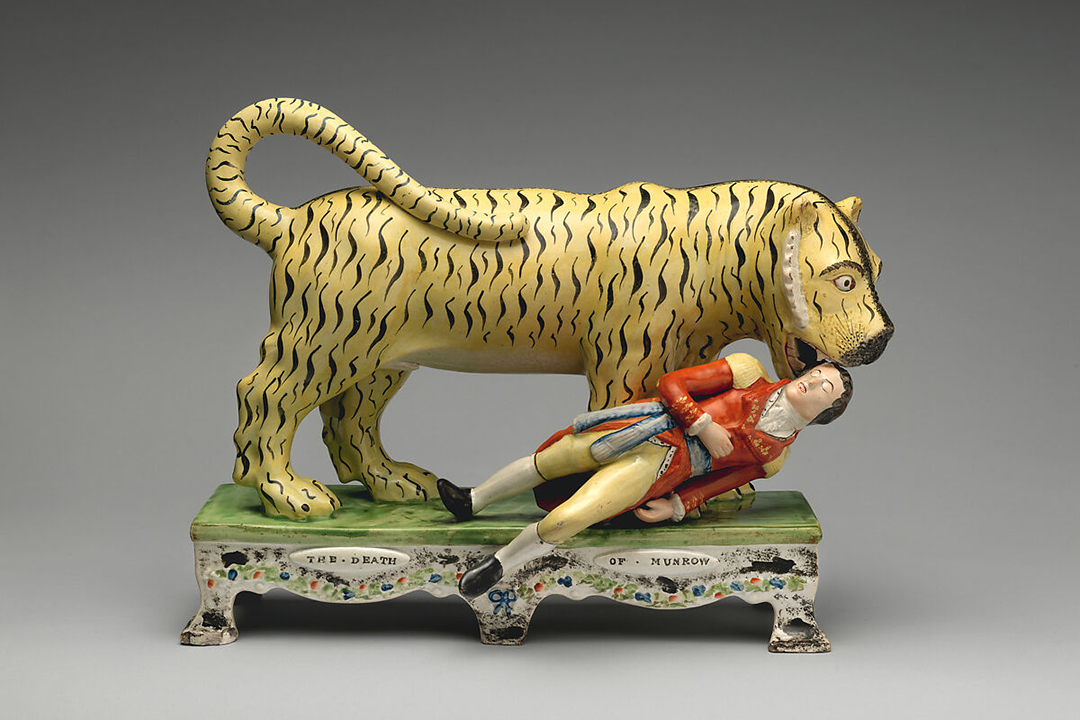
The Death of Munrow, ca. 1820–30
British, Staffordshire. On view at The Met Fifth Avenue in Gallery 251
Lead-glazed earthenware with enamel decoration | 27.9 × 36.5 × 14.6 cm
Purchase, Funds from various donors, The Charles E. Sampson Memorial Fund, and The Malcolm Hewitt Wiener Foundation Gift, in memory of George Munroe, 2016
This figure group records a specific historic event in which Hugh Munro, a British soldier, was killed by a tiger in India in 1791. Its composition was inspired by an almost life-size wooden sculpture depicting a tiger killing a European that was owned by Tipu Sultan, the ruler of Mysore in India. Tipu’s sculpture was seized by the British army in 1799 and brought to London, where it was put on public display. Its great popularity inspired the creation of the Staffordshire figure group.





If you’re a regular reader of this blog and enjoy its content, you might consider contributing to its upkeep. Any amount, no matter how small, will be warmly appreciated
Founded in 2021, Echoes (Notes of Visual Narrative) invites everyone to explore together the visual codes that shape our world—art, photography, design, and advertising in dialogue with society.

Copyright © 2026 r10studio.com. All Rights Reserved. Website Powered by r10studio.com
Cincinnati, Ohio


Comments powered by Talkyard.