
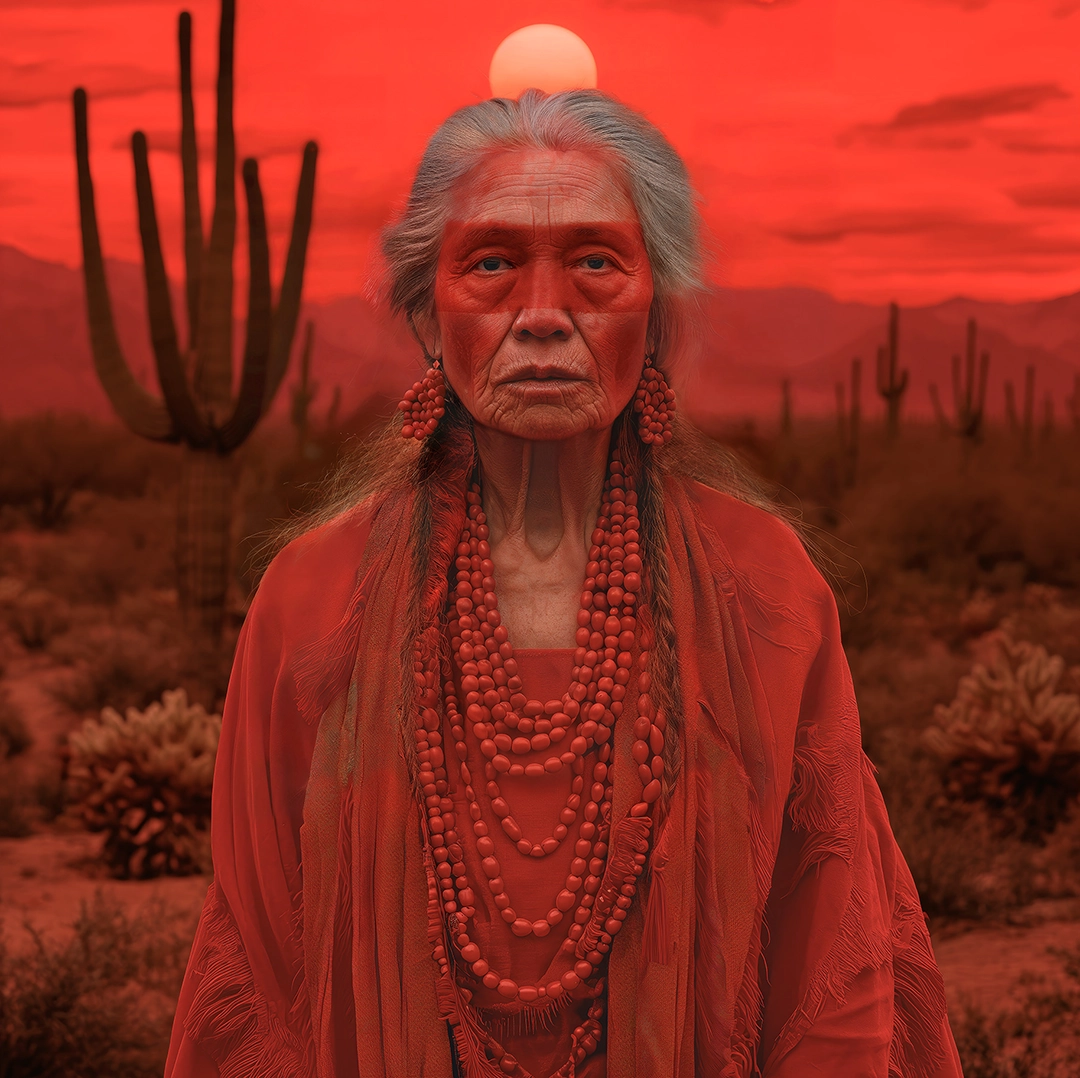
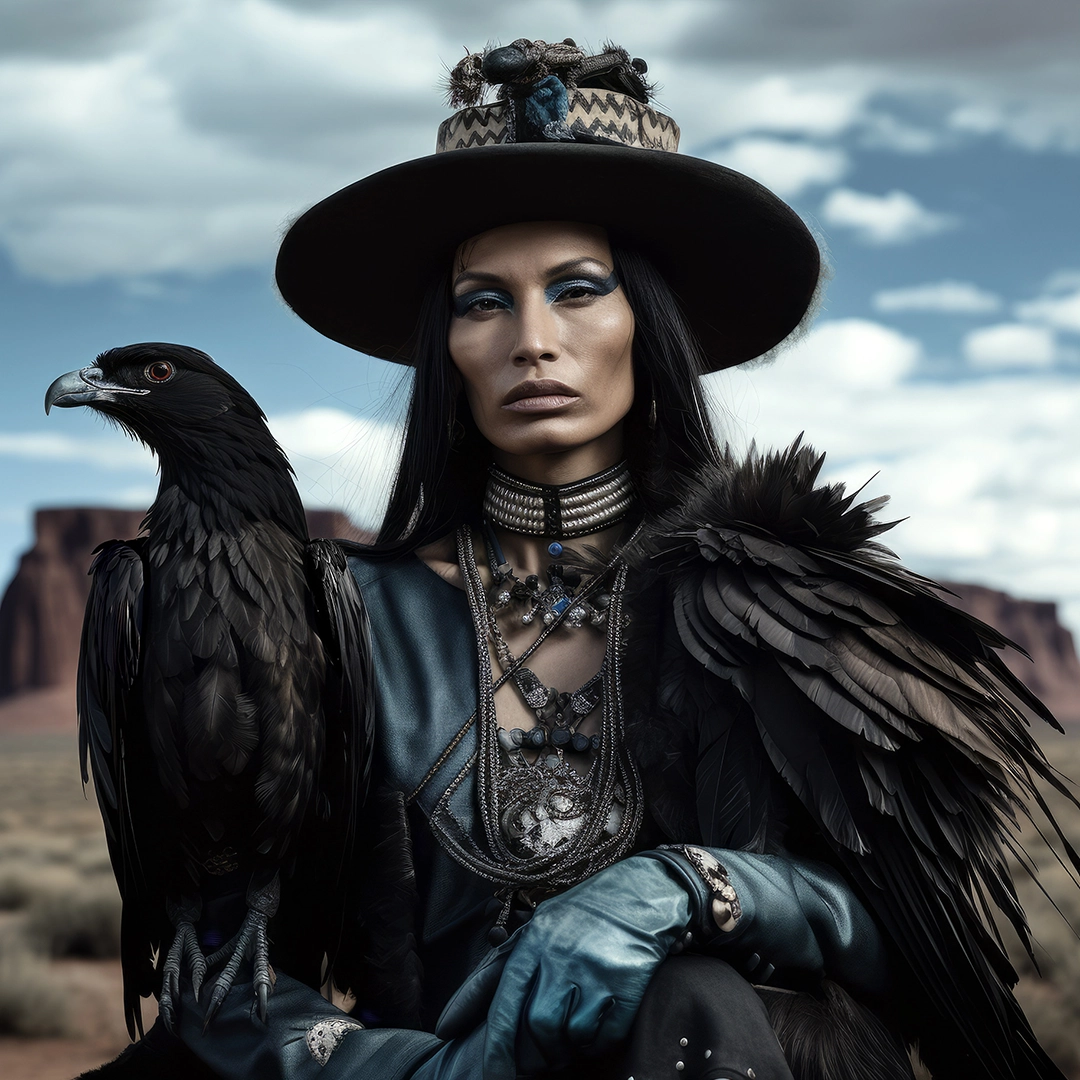
When we first came across Tim Harrier’s Shaman Spirit Guides, we dismissed them without mercy as the product of artificial intelligence. The mud-covered faces, the animals emerging from the background, and an unbroken frontal force produced, almost at once, a malignant suspicion. Suspicion ran far ahead of the work. And we are right to suspect almost everything in life. This series, no. We would be wrong, and we would look mildly ridiculous, at least now and then, as in this case, because these pieces were not produced with an image generator. Harrier built each one by hand, layer upon layer, from real people who posed before his camera in New Mexico.
The misunderstanding gains weight because it happens at this precise moment, when universal visual culture is trembling. We live saturated by images, and a considerable part of contemporary art has been sliding toward the decorative, toward a kitsch even cheaper than the one the vitrines of the world have already forced us to digest. In all this noise, it is difficult to find something that smells of clean, chlorinated reality. These photographs have it, and they have it precisely because they appear not to.
I spoke at length with Harrier about this series and others from his recent work. The one at hand was born far from the art circuit. Harrier made the photographs while working for the Department of Defense at Los Alamos National Laboratory, a commission he had turned down three times before accepting. An FBI file inherited from his youth among radicals and protesters convinced him that he would never pass a security clearance. When they insisted, he named a figure he thought impossible, and they accepted it. He did everything he could not to make the work. Then the pincers of reality convinced him of the uselessness of the effort.
That is how, on his days off, he traveled through the reservations and met people connected to shamanism. He noticed a void, and that void pointed him in the right direction. There was no shared imaginary consensus capable of sustaining that mythology in a world already hypervisualized. The very concept, that religion, was being staged with great naïveté, with a folklorizing intention and with archetypes made safe and satisfying archetypes for the transcendentalist tourist, always ready to find cosmic purpose where the sun strikes hard and water feels like a divine gift.
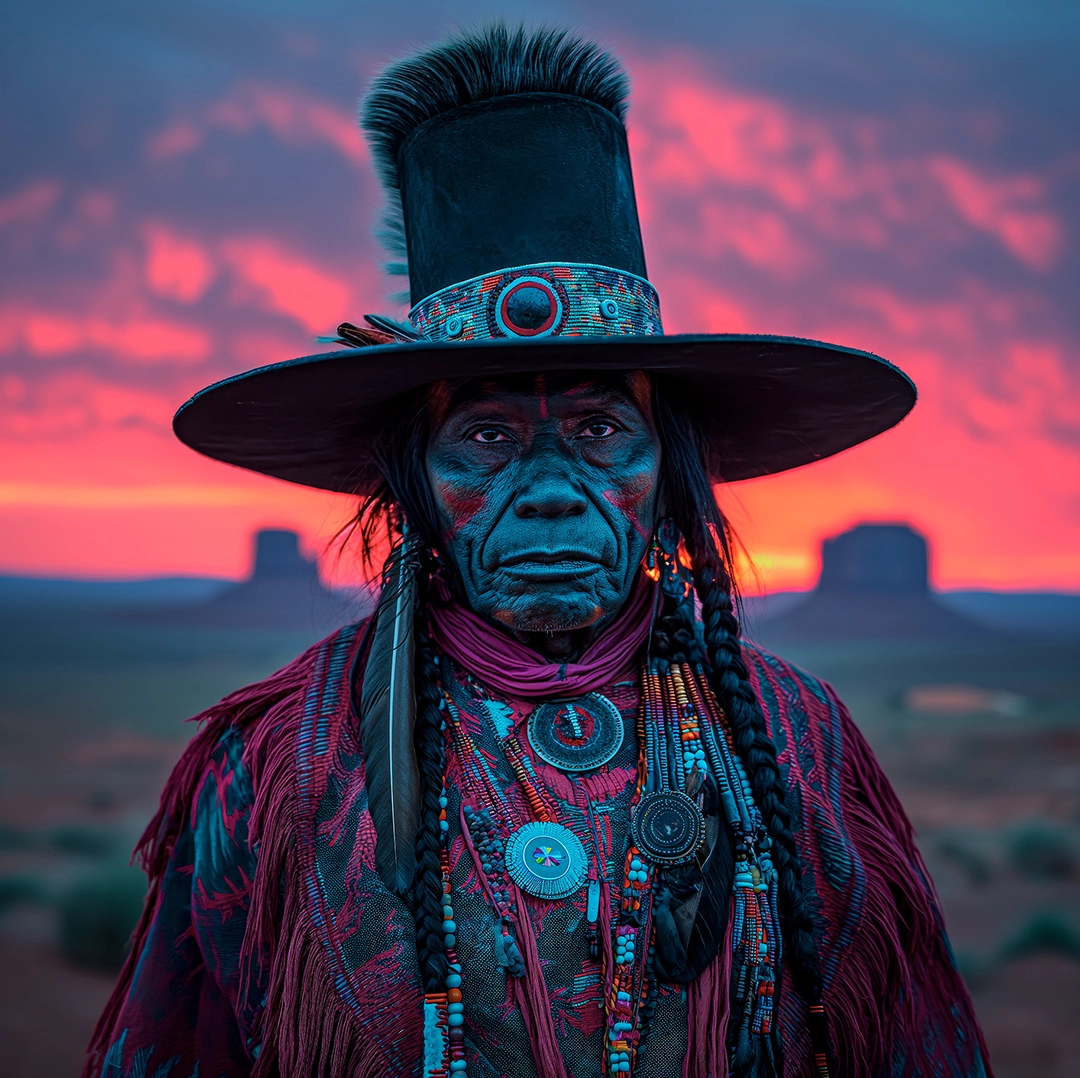
This explains his access to faces, trades, and the resources of a region where the film industry leaves makeup artists, costume designers, and character specialists close at hand, people with no particular investment in the ideological or metaphysical foundations of the matter. Upon that infrastructure, foreign to the galleries, Harrier mounted an iconography no gallery had commissioned.
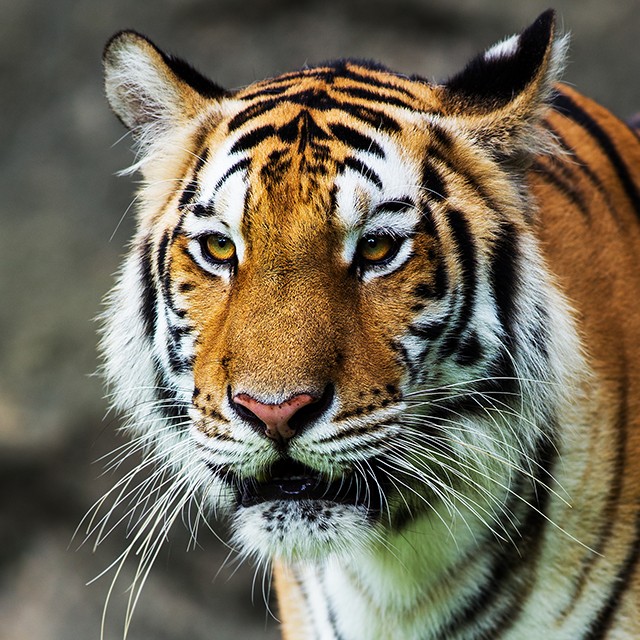
The procedure refutes the suspicion of the hurried viewer who disqualifies too soon. Each image brings together three to five people. Harrier commissions the casting with a precise brief, someone of a certain age and with a certain mystical quality, then sends the process toward theatrical wardrobe in search of beads, hats, and clothing from another era. He works with a makeup artist he has relied on for years. He applies mud to the faces. He photographs the animals separately and later integrates them over a green-screen background. He still intervenes in the image afterward, drawing over it. He himself summarizes the distance separating the work from automatic capture when he says that it has nothing in common with the immediacy of an instant photograph, that it belongs instead to an image built through slower, more deliberate attention.
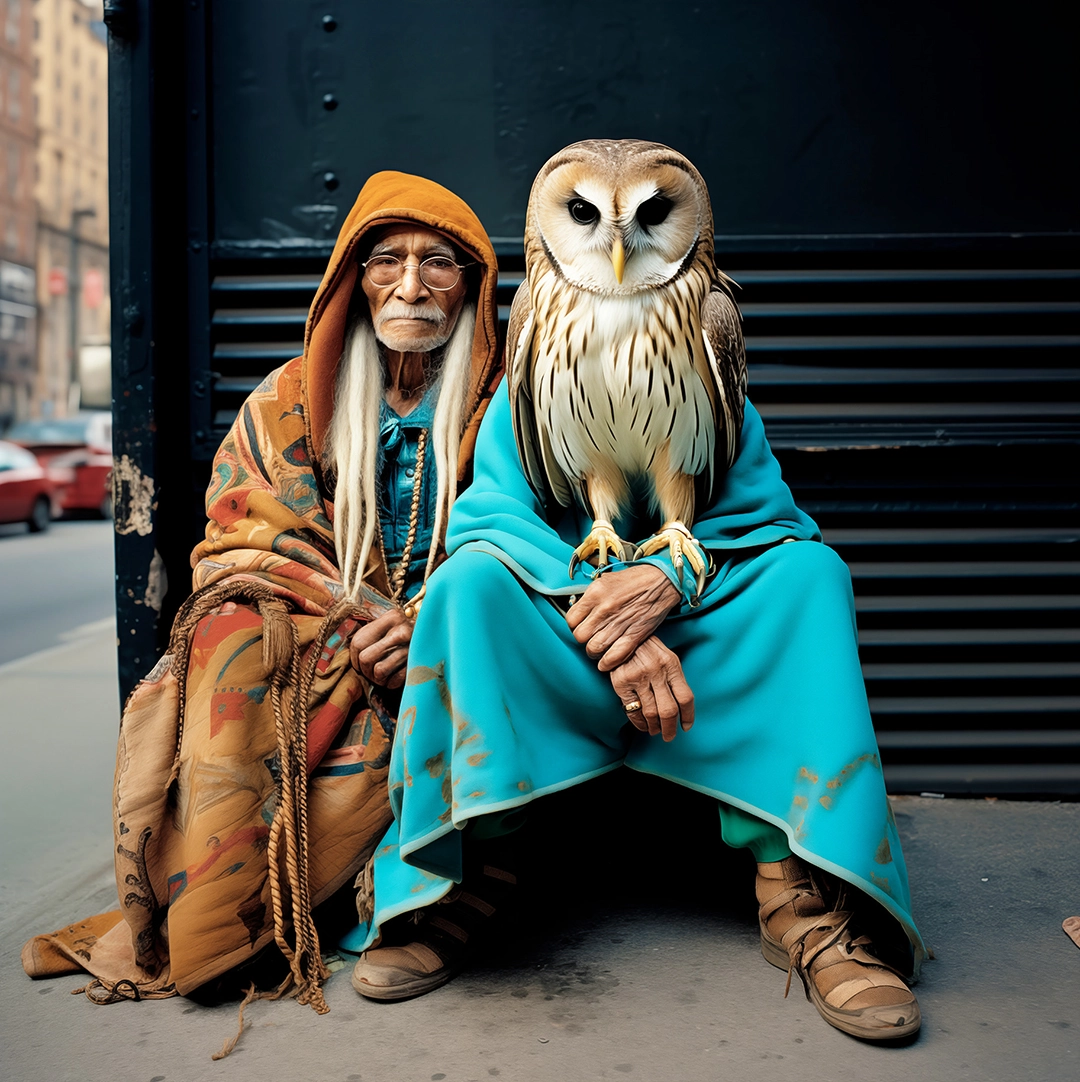
One of the pieces concentrates the method and its meaning. Harrier takes up the composition of a celebrated black-and-white New York photograph and constructs the urban portrait of a shaman holding his spirit guide in front of his face until the face disappears. Man and animal are, in his words, spiritually joined. The concealment of the face does not weaken the portrait. It turns it into something else, into the representation of a paranormal fusion.
Within the series, several images are Kachinas. They are not iridescent inventions. The blue Kachina is a spirit that comes to the tribe in moments of extreme danger in order to lead it to safety. Each character carries its own mission. These precisions hold the line between iconography and fantasy. Harrier says that never before had a body of works been created that gave image, in this manner, to shamans and spirit guides. The claim can be sustained by moving through the series, where each figure responds to a specific function within a system and none has been subjected to ornamental whim.
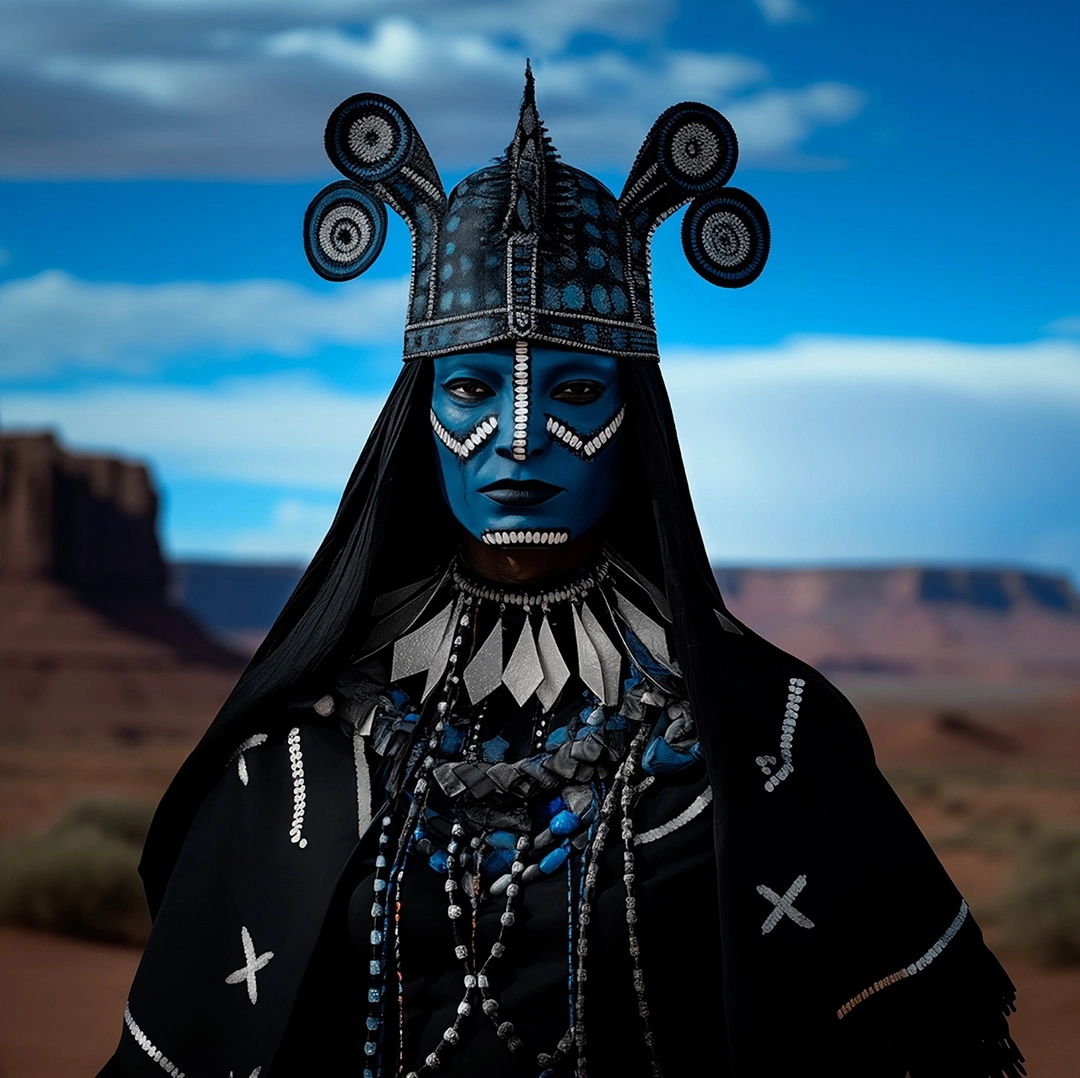
Harrier made these images around the time of the pandemic and began exhibiting them in 2021, just before the avalanche of generative images flooded contemporary culture. Seen today, they were a presage of what was coming. He himself describes them as an early vision of what artificial intelligence would become. The formal coincidence is real, and striking, which makes it essential to mark the difference that runs through it.
At this moment, we may assume that an image generator ignores context, origin, circumstance. It begins with a written instruction, a prompt, and delivers an image without a real referent, without a living model before a camera, without mud drying on skin. Harrier operates in the opposite direction. He accumulates real referents until the image, worked and intervened to such a degree, begins to look artificial, begins to lose nature. What the eye reads as a soulless synthesis is in fact a dense record of real human labor and physical presence in situ.
The conversation with Harrier moves, without strain, toward the horizon that makes this distinction urgent. The prompt writer as author, as maker, as artist in full right. Are we going to deny him that condition with all the absurd denials that came before us? I, for one, do not deny it. It is true that actual actors, the potential protagonists, are beginning to become unnecessary. It is a matter of hours before we find a Native face more Native than the one distilled by a paid generator capable of grinding and pasting an entire ethnicity into an absolutum plenum. We will watch high-definition films in which we can count the hairs of performers long dead. Jingle musicians will be replaced by applications. Does anyone remember piano tuners? Will any remain half a century from now? Against that background, these spirit guides accept a task they never set out to perform, the task of sustaining an image still anchored in what truly exists.
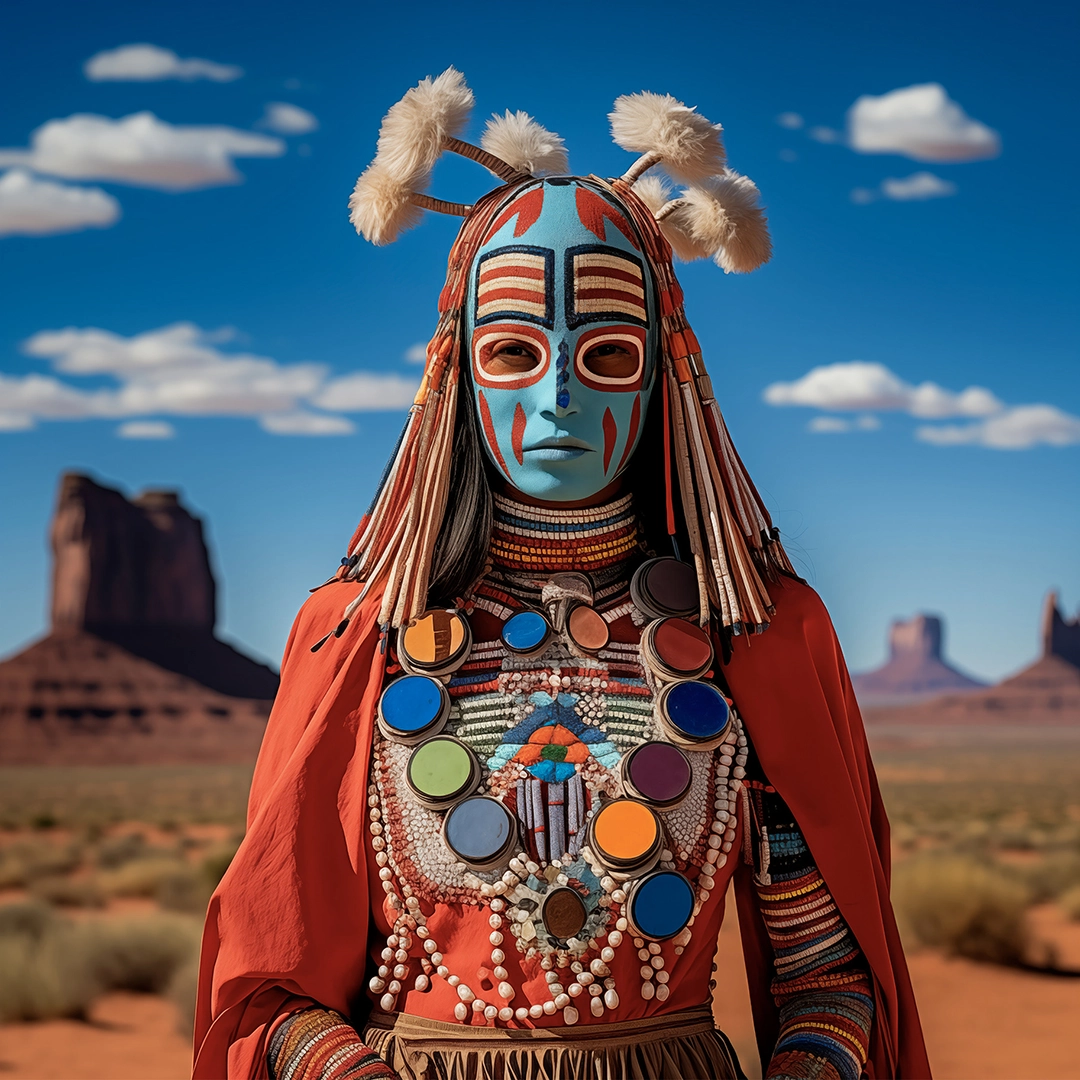
The frontal force of these pieces is no accident. Harrier comes from the world of graphic design, and the precision of the composition gives him away. He knows the old rule of the portrait whose gaze follows the viewer from every angle, and he takes it to an extreme. The result is a series of planted, almost defiant images that allow no detour. The viewer is summoned, compelled into a face-to-face encounter with a figure that, at times, has hidden its face behind the animal it holds.
It is precisely the compositional rigor that guarantees a presence. Without it, the accumulation of mud, costume, and animals would scatter into the picturesque. With it, each figure appears before us. The president of the FotoFocus board, after moving through the series, declared that he had never seen anything like it. His judgment matters less as praise than as a symptom of bewilderment before images that resist immediate classification.
That said, I choose to approach this series through an intimate and personal key. My entrance into the subject came many years ago through The Teachings of Don Juan. I mention this because it places the reading within a tradition, far from any capricious occurrence. The figure of the shaman occupies the place of the one who mediates between spheres. For that reason, he unsettles his community. Hesse narrated this masterfully in one of the curricula of The Glass Bead Game (Das Glasperlenspiel), where whoever aspires to become Magister Ludi must imagine and recreate his previous lives. In one of them, that of the Rainmaker, he describes a man at once respected and feared, set apart from the warmth of the group because his gaze and his thoughts come and go from unknown regions. Spirituality isolates in the same measure that these figures move unmistakably away from the limits of the frame, rigorously centered, equidistant from the margins, which function for me, because this is how I choose to read them, naturally, as social contexts.
Harrier’s shamans inhabit that uncomfortable position, that of the suspicious yet necessary intermediary. And the artist who constructs them shares the same temperament. He works in solitude, far from the noise, with the discipline that silence grants, and with silence, suspicion.
It matters to state once more that this series is not purely representational. It summons practitioners. When Harrier exhibited it, viewers came from four or five states, psychologists and behavioral specialists, nurses and caregivers, psychics and witches. A post-tribal shaman from Cincinnati, Ken Day, author of three books and a teacher of the subject inside and outside the country, accompanied the exhibitions with theoretical talks. The work opens, in this register, a space where image and practice converge. And this point of confluence is the structure, beyond axiality, that sustains each of the works.

I return to the image of the urban shaman. He holds his spirit guide before his face until he erases it. To reveal the spirit, the man relinquishes his own face. The viewer of 2026, trained to discard any image of pronounced power as false, must perform the opposite movement, must renounce the reflex of pointing out the trick and accept, though no one is obliged to do so, that he stands before something constructed, piece by piece, with real people who were there to be recorded. These two concessions are harmonious. What remains is the sustained animality and the gaze that authorizes permanence. And the proof that an image can still preserve, even today, the same weight as a hyperprocessed reality.
P.S.
Harrier’s work neither begins nor ends here. There is much more, and much of it is interesting.





If you’re a regular reader of this blog and enjoy its content, you might consider contributing to its upkeep. Any amount, no matter how small, will be warmly appreciated
Founded in 2021, Echoes (Notes of Visual Narrative) invites everyone to explore together the visual codes that shape our world—art, photography, design, and advertising in dialogue with society.

Copyright © 2026 r10studio.com. All Rights Reserved. Website Powered by r10studio.com
Cincinnati, Ohio

Comments powered by Talkyard.