
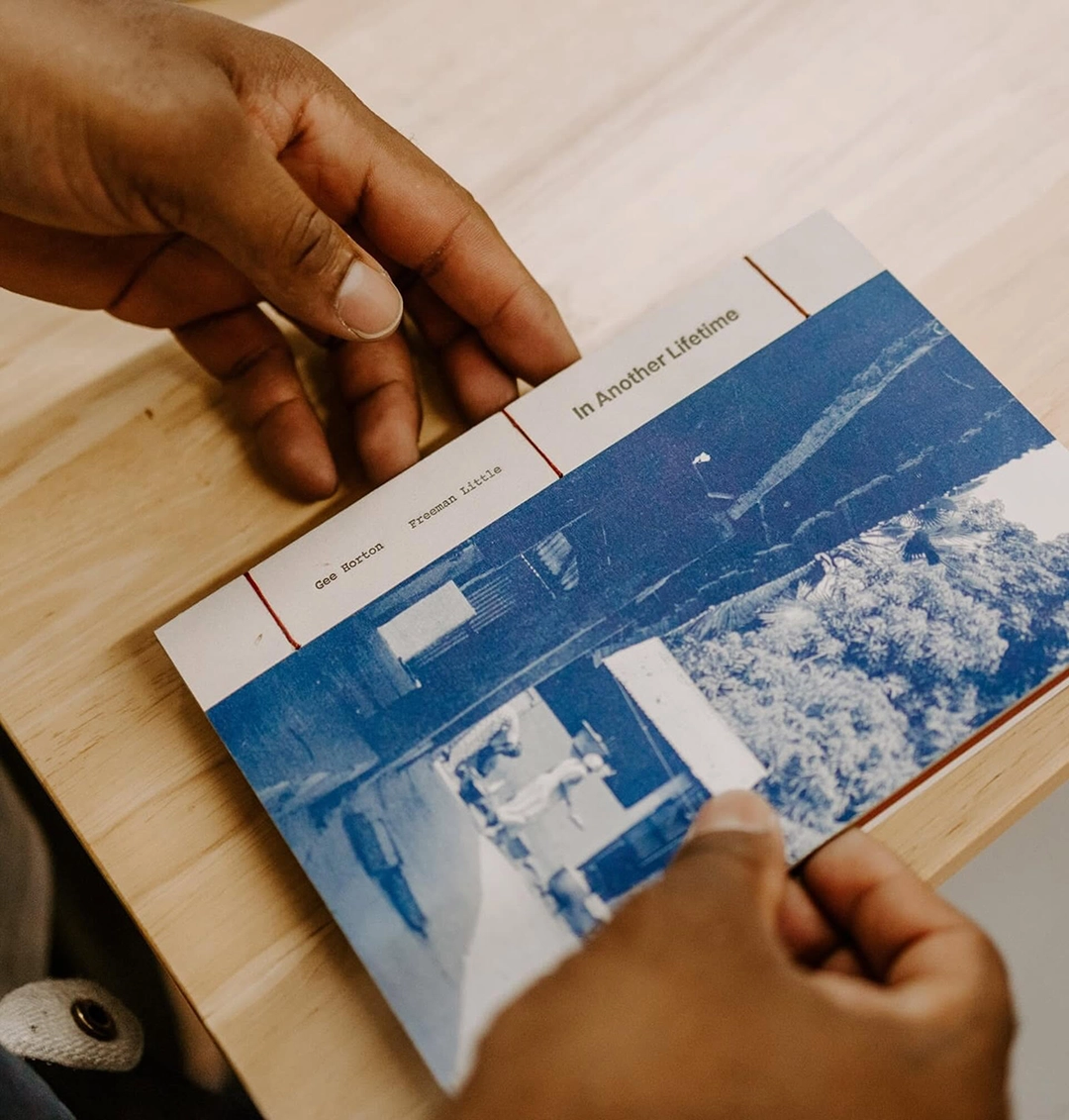
There is a book. Before the exhibition, before the charcoal drawings spread across the galleries of the Contemporary Arts Center, before the viewer crosses the blue thresholds into the dreamworld of Freeman Little, there is a self-published book, hand-sewn with red thread, bound by Cereal Box Studio in Cincinnati, arriving in a paper bag stamped with the CAC logo. Inside lies a script co-written by Gee Horton and Freeman Little, cyanotype photographs, a hand-altered map of New Bern, North Carolina, a sealed envelope bearing a vintage stamp and holding a fictional medical diagnosis, and a postcard postmarked from Senegal. The book is called In Another Lifetime. Its credits page defines it without ambiguity as "the conceptual foundation of the exhibition," the axiological frame that sustains the entire proposal and the palpable evidence that his whole worldview is in full development.
There is a question Horton has carried with him since 2019, one he reformulates in every work he produces without ever exhausting it. Simple to state, abyssal in its implications. What does it mean to grow up Black in America when no one has designed for you a ceremony of transition, a rite of initiation? It is a serious structural absence. These are not children's games. In many cultures of sub-Saharan Africa, the passage from child to adult is marked by codified ceremonies, by marks on the body, by a community that collectively assures him he is seen, recognized, one of our own. The transatlantic slave trade tore away presence, interrupted entire symbolic systems, and severed chains of ritual transmission that no individual will can restore. What remained in their place was the surroundings, the street, the music, the violence, and the loss. Black adolescents of the twenty-first century have inherited that rupture, and it is upon them—upon their fragility, their dignity, their potential—that Horton builds his practice.
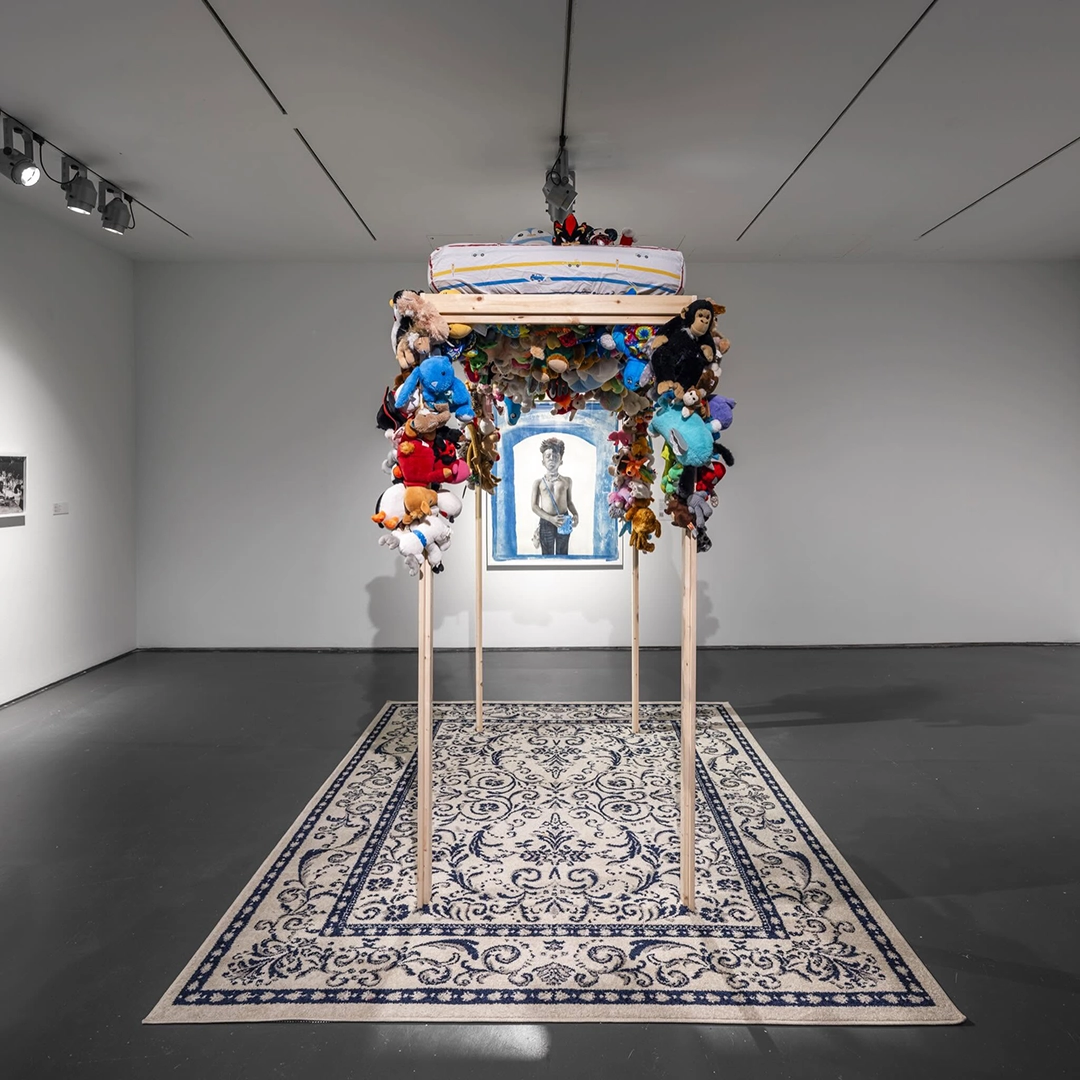
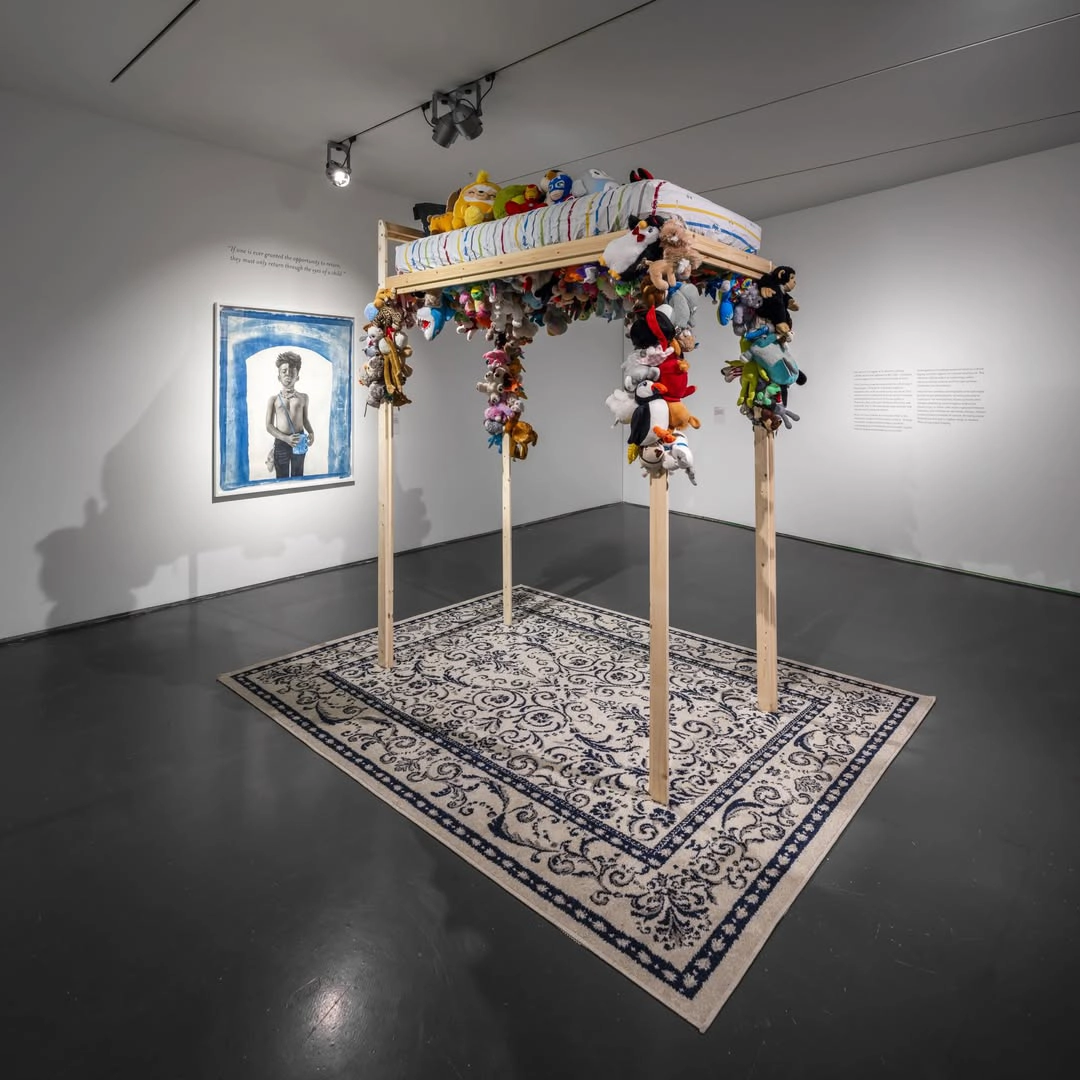
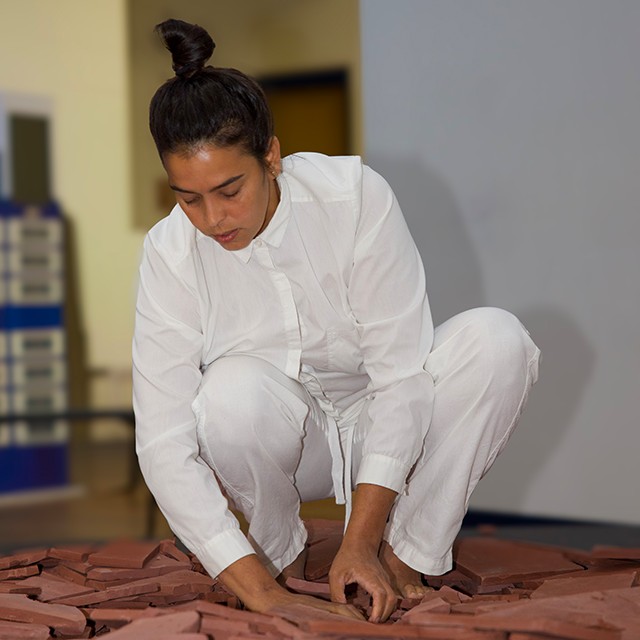
And the bed grew. On view at the Contemporary Arts Center, Cincinnati, through August 30. Image from the Contemporary Arts Center's Instagram, Cincinnati, May 28, 2026.
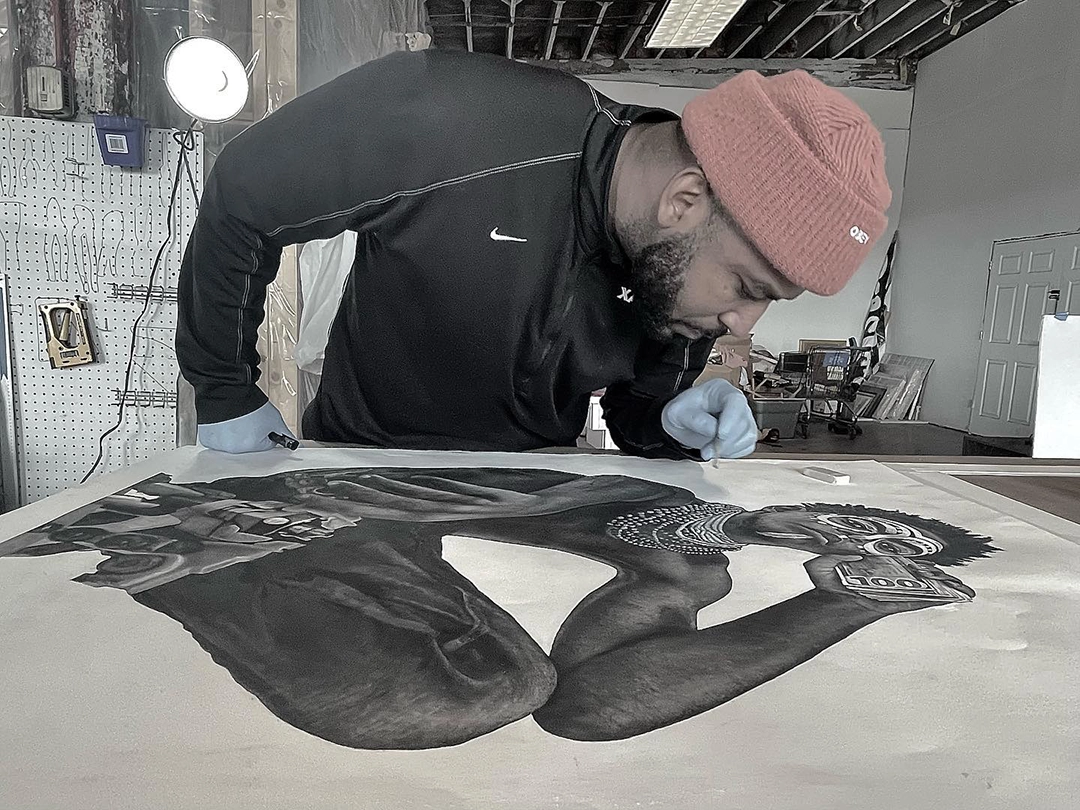
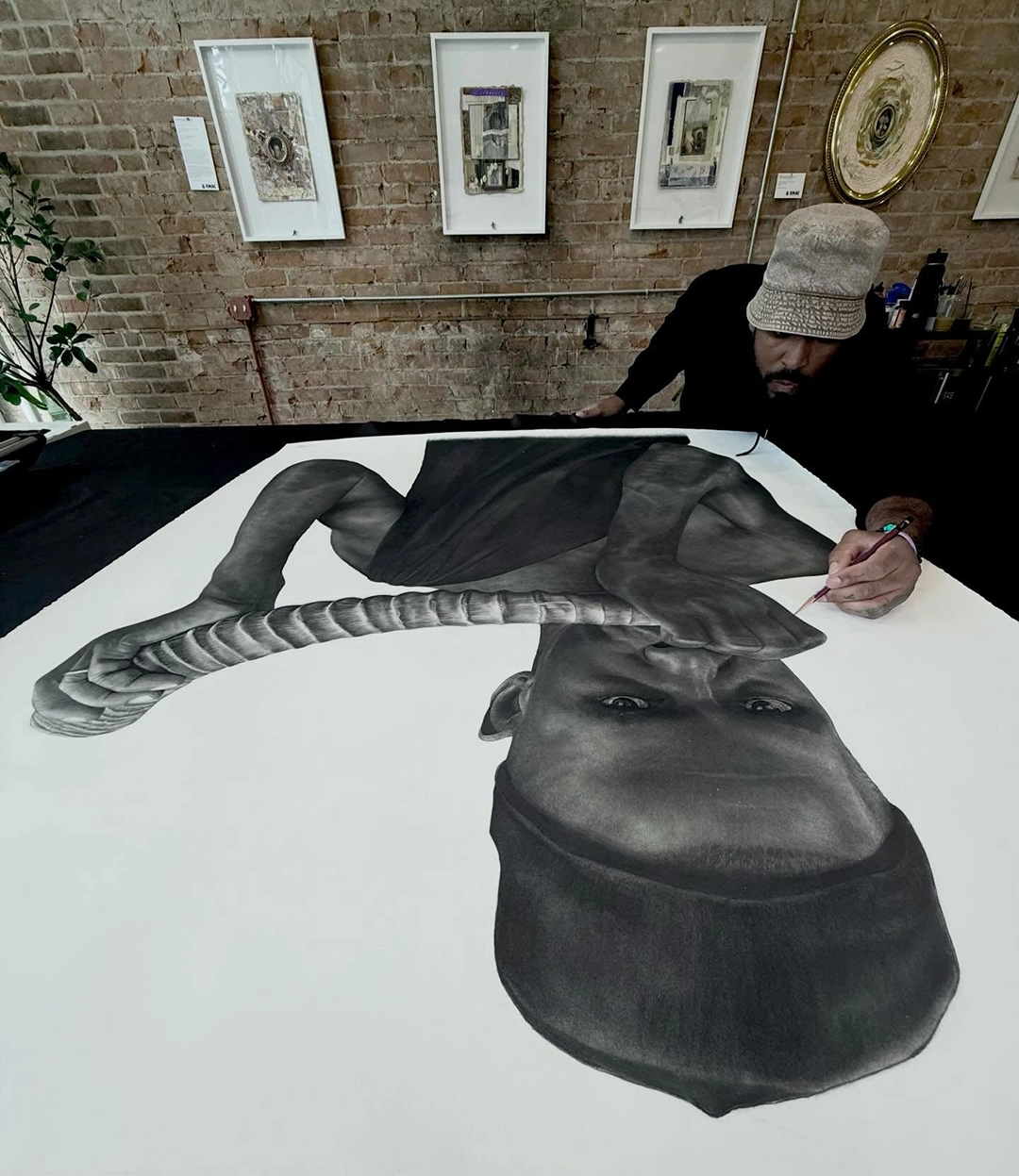
Horton was born in Louisville, Kentucky, in 1983, and earned a master's degree in social work from the University of Louisville. In 2020 he walked away from years of a corporate career to devote himself entirely to charcoal drawing on paper. That gesture carries a philosophical underpinning, for it implies a conviction about the kind of knowledge art produces, a knowledge no other form of social intervention can replace. This is why his practice should not be reduced to activism. He retains the methods and the ethics of social work, and with them an intellectual discipline. He understands that art reaches what the social report would not even know how to see.
To situate Gee Horton within the tradition of contemporary African American art demands first that we recognize that tradition in its complexity. Since the second half of the twentieth century, a series of artists have turned the Black body into a site of historical, political, and emotional inquiry. Kara Walker exhumes the brutality of slavery through silhouettes that wed nineteenth-century formal elegance to a content that shakes the viewer's conscience. Kerry James Marshall reclaims Black presence in the history of Western painting with a monumentality that defies centuries of invisibility. Kehinde Wiley inserts contemporary Black figures into poses drawn from the European old masters, interrogating who has counted as a legitimate subject of heroic representation. Jordan Casteel paints her neighbors, friends, and family with an intimacy that turns portraiture into an act of community. Romare Bearden, decades earlier, had already found in collage a way to narrate the African diaspora through fragmentation and recomposition.
Horton shares with all of them the treatment of the Black body as historical archive, memory as raw material, representation as political act. Yet his position within that tradition has features of its own that merit specific analysis. Unlike Walker or Marshall, whose relationship to history is fundamentally archaeological—to exhume, to confront, to recontextualize—Horton works on the living present of his immediate community. His subjects are his niece and his nephew. His objects are his great-grandfather's pipes and his grandmother's bells. His reading of history is built through direct dialogue with the members of his family. It owes nothing to the documentary archive. That immediacy defines the character of his practice. Wiley needs the distance of pastiche for the irony to work. Horton draws from inside the scene, with the closeness of one who bears witness.
There is another trait that sets him apart from many of his contemporaries, and it is the narrative scale of his project. Most of the artists named here produce works, group them into series, and over the years consolidate a body of work that defines them. Horton produces a system. His practice is, in the most rigorous sense of the word, novelistic. It has characters who develop over years. It has an architecture of chapters. It has an artist's book that functions as the conceptual frame of the entire exhibition. It has a mythology of its own, with deities, rites, invented languages, and fictional geographies that condense real ones. When he himself compares his project to Harry Potter—a story born as a book and later adapted to the visual realm—he does not do so out of naïveté. He does so because he has understood something few contemporary visual artists have carried to its final consequences. Narrative sustained over time generates a kind of emotional and intellectual understanding that the isolated image, however powerful, cannot produce on its own.
That book is the most forceful proof of the argument, and also its origin. The exhibition is its adaptation, and what hangs in the CAC derives from something that already existed—sewn, bound—before the doors opened. That changes the nature of everything on the walls.
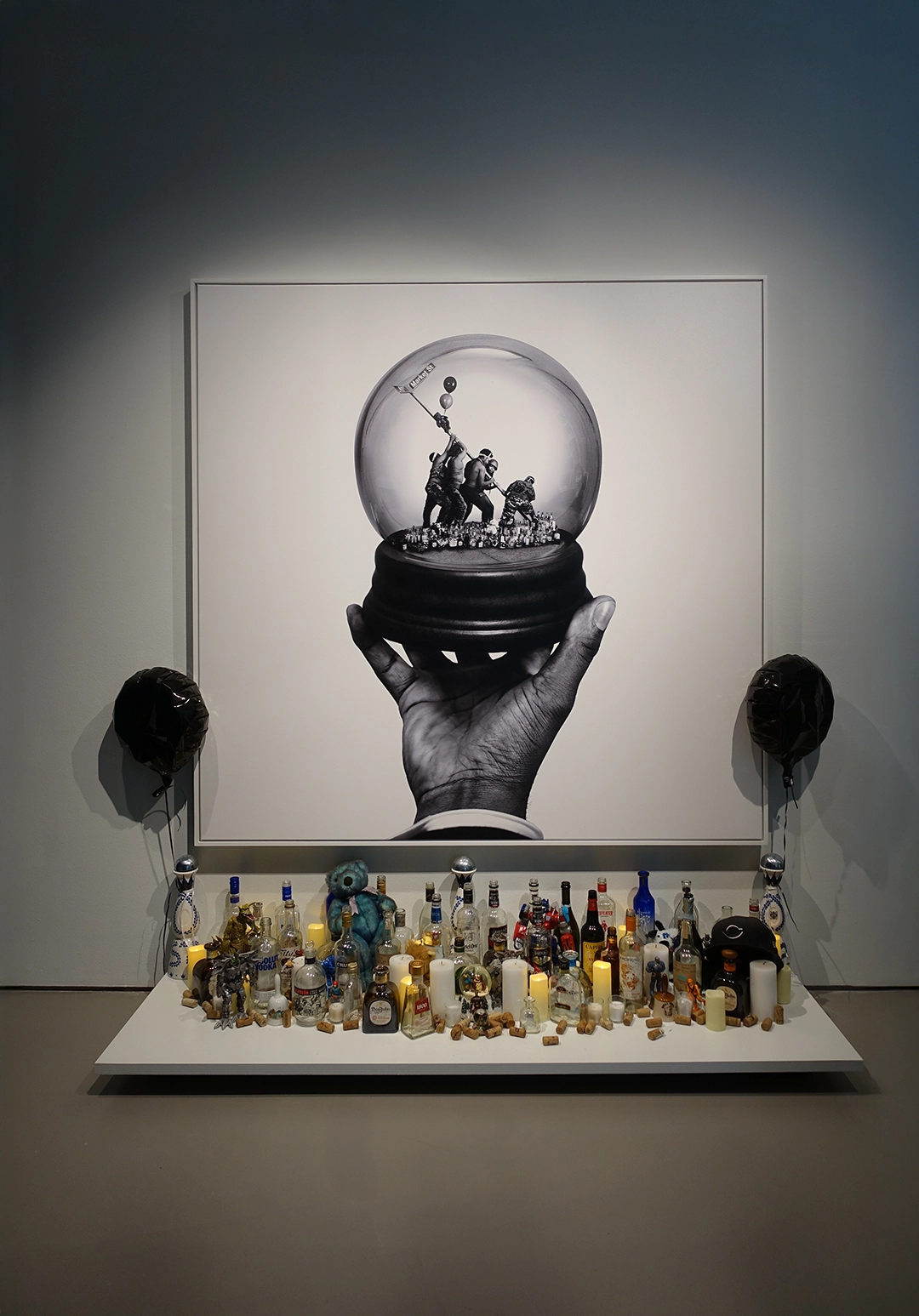
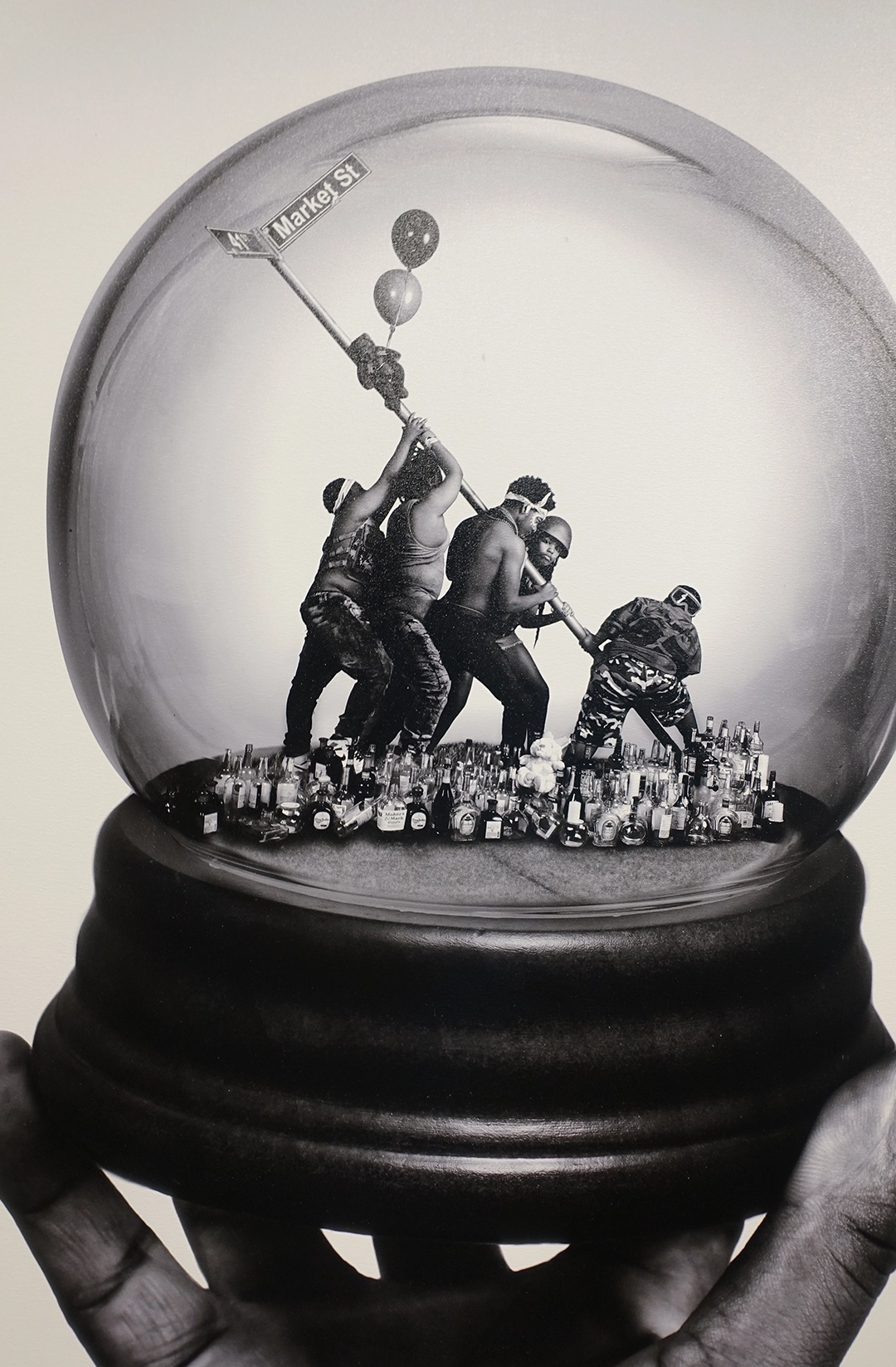
Ville Mentality Installation (mixed media) | Variable dimensions Ville Mentality is a meditation on Black identity, memory, grief, and the complexities of survival within environments shaped by loss, resilience, and fragility—all while navigating the grips of invisible, suppressive systems. Set within a snow globe—a symbol of frozen nostalgia and containment—this print invites viewers to reflect on what it means to remember, to survive, and to carry the weight of home and legacy. It holds the tension of those realities, preserved like a moment inside glass.
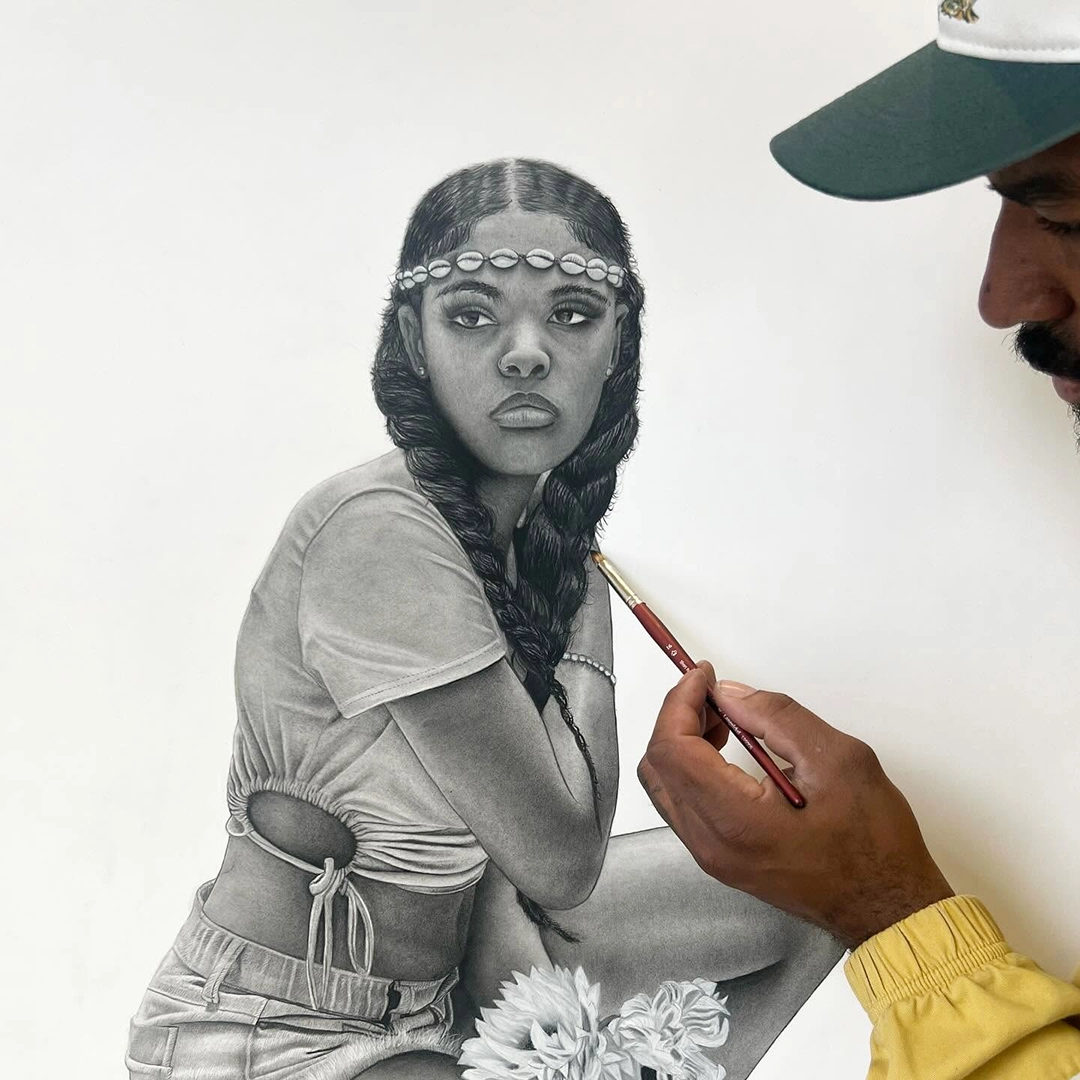
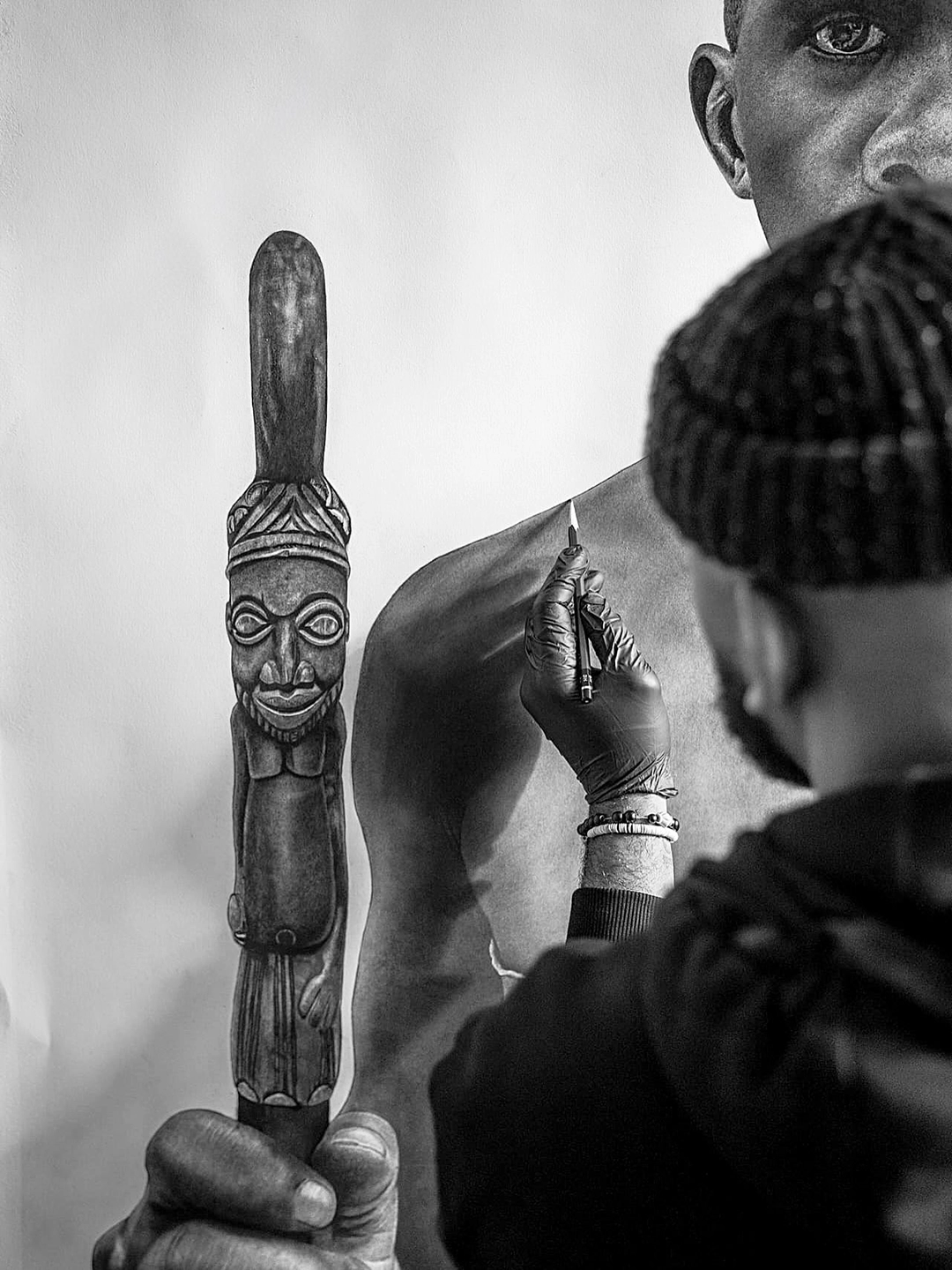
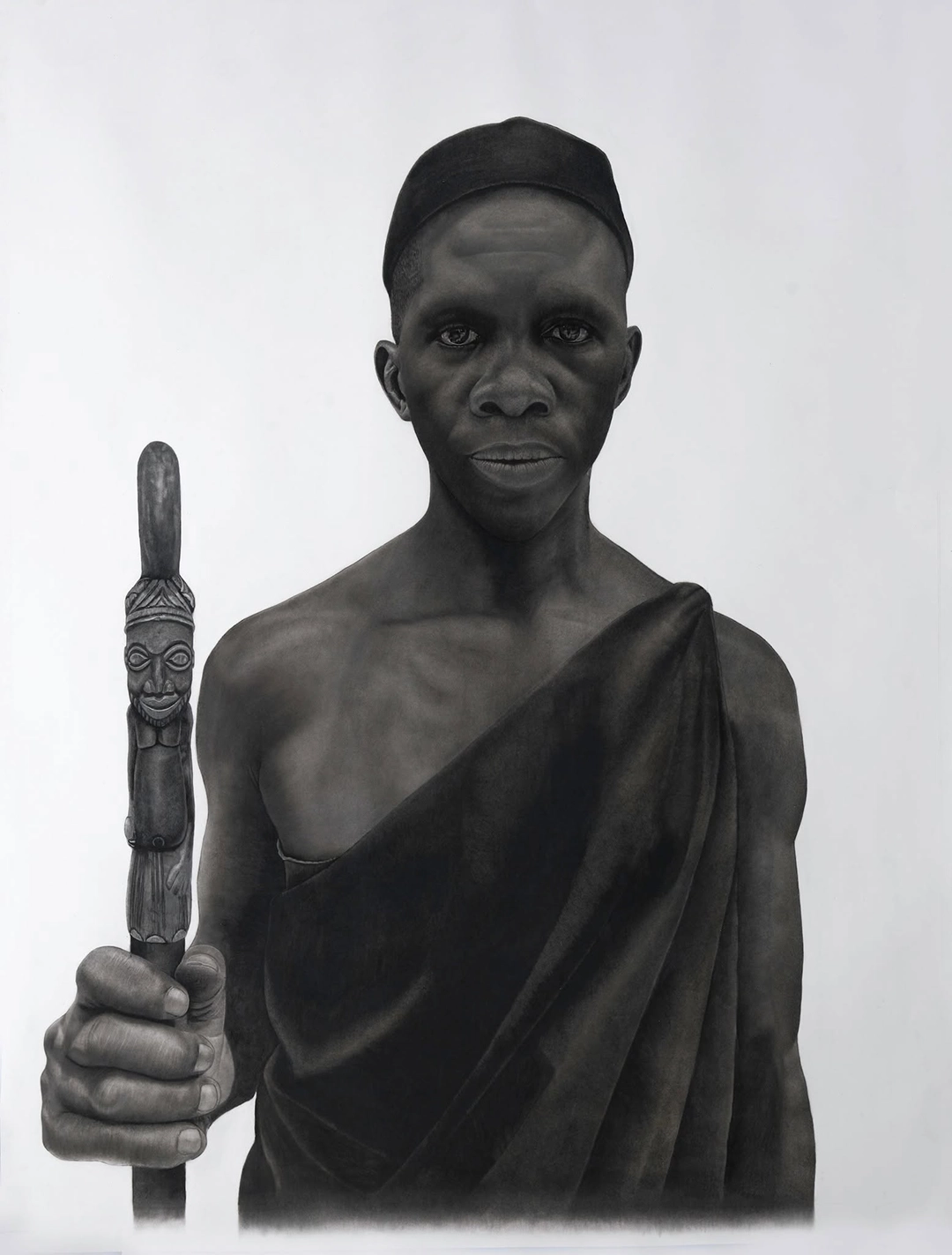
Horton's hyperrealism is, above all, a political act of visibility. In a visual culture saturated with representations of the Black body that objectify it, brutalize it, or caricature it, to pause and spend dozens of hours drawing the face of a Black adolescent until every pore of his skin is recognizable amounts to a declaration about the worth of that subject. The time invested in producing the image is itself an argument. In the Western tradition, hyperrealism was for centuries a privilege reserved for those who could pay to be portrayed with such meticulousness. It is possible that Horton regards it as an act of symbolic reparation.
The Polaroid framing operates in a completely different semiotic register. The Polaroid is a conceptual decision about the borders of the story; the nostalgic charge of an analog technology is the smaller part of what it does. The white border of the Polaroid frames and also contains, delimits, silences. Horton puts it precisely. It cancels the subject's capacity to articulate anything else. It allows us only to bear witness. The adolescent, hemmed in by the space, cannot speak beyond the frame. He cannot claim more space than he has been allotted. And yet his presence within what is permitted is total, ineluctable, urgent. That double movement—to contain and to magnify at once—is one of the most sophisticated formal gestures in all of Horton's practice.
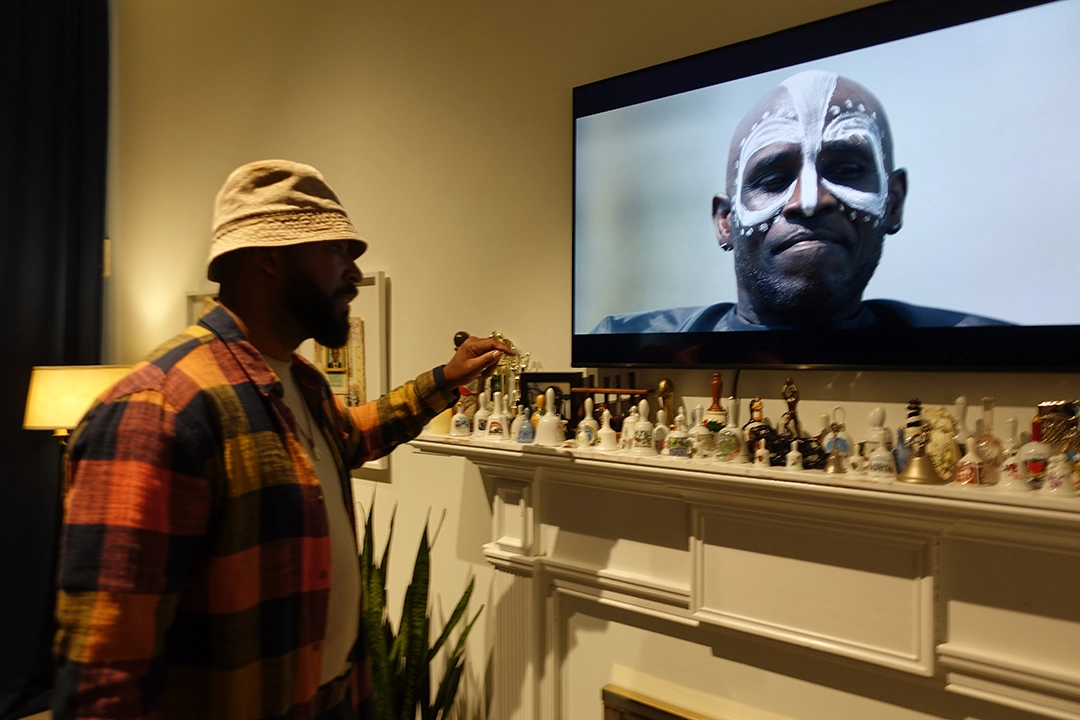
The tribal markings on the face of the fourteen-year-old work differently. Horton does not assign them to any specific African ethnicity, and the choice is strategic. The question the markings pose is precisely the one the boy cannot answer with any certainty. What does it mean to be African when your connection to Africa has been dissolving for generations? The markings are, in that sense, an image of longing and of loss at once. They are what a rite of passage might have been had history run another course. The Parental Advisory sticker that appears in the same work completes the argument with a perfect, ironic brutality. In the absence of a communal ceremony, African American culture has found in hip hop something that functions like a system of initiation. Though it was never designed for that purpose, it filled the void.
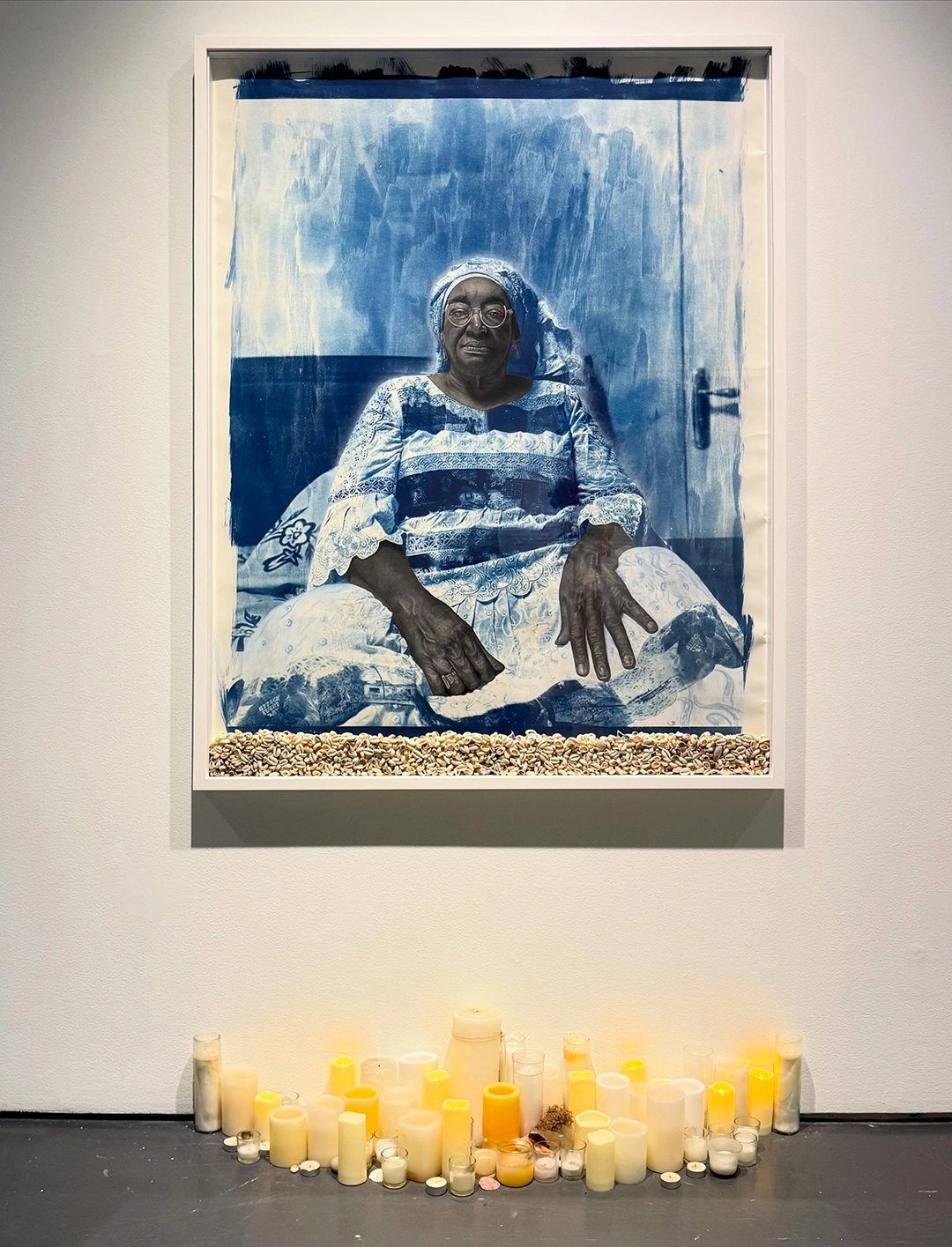
The Elder (Ida)
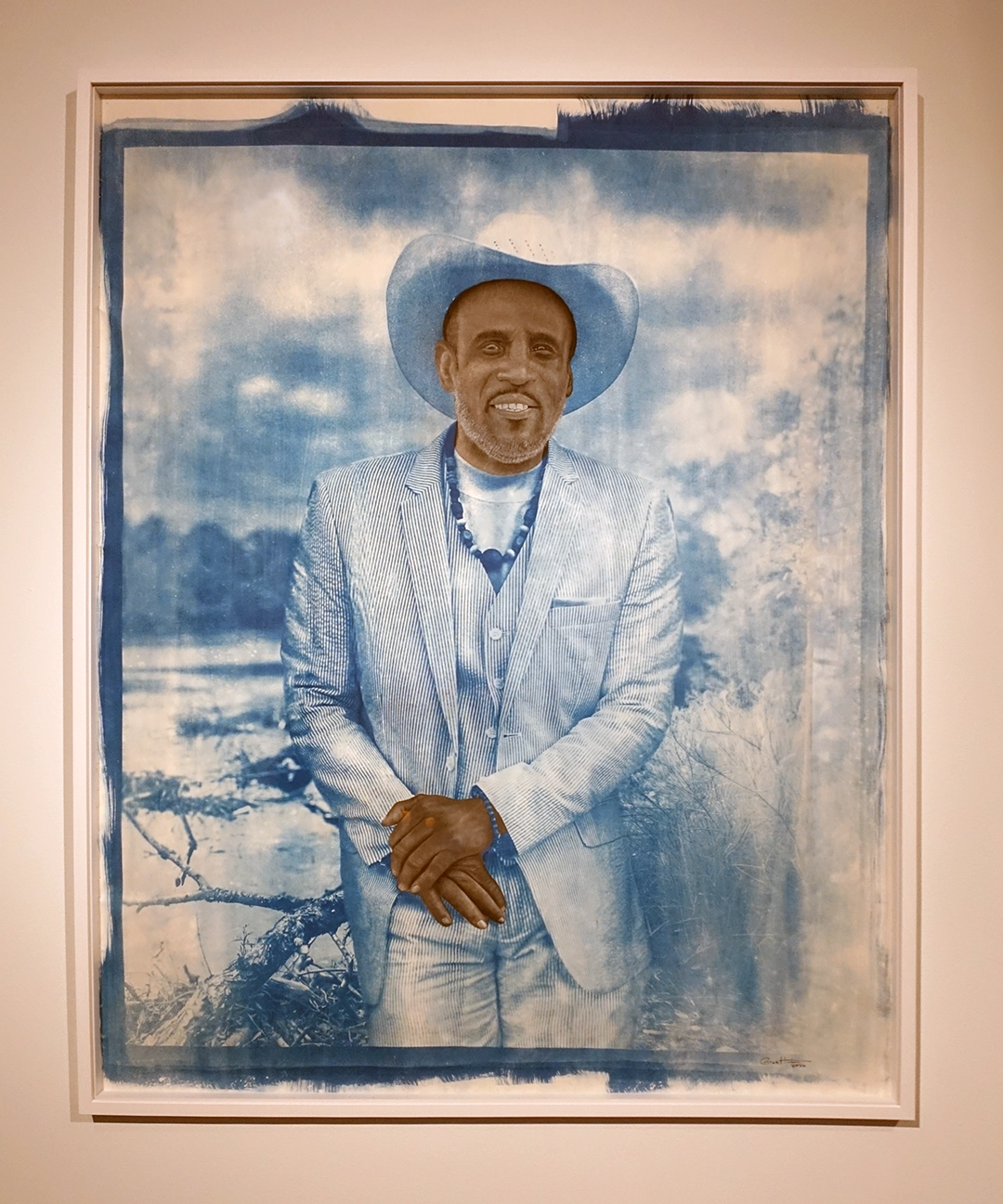
The cyanotype and the color blue make up another coherent system of meaning across the whole of his practice. The cyanotype process—one of the oldest photographic techniques, older than the daguerreotype in its chemical principles—yields images in a deep blue that, by its very nature, points back to past time, to what was and is no longer. Horton uses it to photograph himself approaching his childhood home in Kentucky. The result is an image that documents and celebrates at once the grown man drawing near the boy he once was, in the blue of nostalgia and, in the African American musical tradition, the color of the blues. The overlay is deliberate. The blues as a musical form was born precisely out of the need to articulate a mourning that had no other socially recognized form of expression.
In the book, the cyanotype is the entire narrative system as much as a photographic technique. The images of Freeman Little that accompany the script—water from the Neuse River, the architecture of Gorée, baobab forests in the Casamance, human figures on the docks of Ziguinchor—are all printed in that deep blue on cream paper, and their cumulative effect is that of a memory that resists lasting. They are almost documentary evocations. The sequence opens with watery horizons that barely tell sky from river, moves toward architectures that are at once North Carolina and Senegal, and ends with portraits of people who seem to belong at once to the present and to a far older history. Horton and Little use the cyanotype, among other reasons, because its chemical process does not fix with the sharpness of digital photography. The image always keeps something spectral, something in the act of leaving. It is the most honest photographic process for portraying diasporic memory.
The red strokes that interrupt some of those images—three parallel horizontal lines that appear over the Neuse River, over the Ziguinchor market, and over the photograph of the Seven Boys—are the only element of color in the whole book that is neither blue nor terracotta. They work, perhaps, as sutures, as marks on the body of the photographic archive. Their appearance over the Seven Boys is the densest moment in the book. The red lines connect the image to all the ones before it, suggesting that the river in North Carolina and the boys in Senegal are bound by something one might call a hereditary geography.
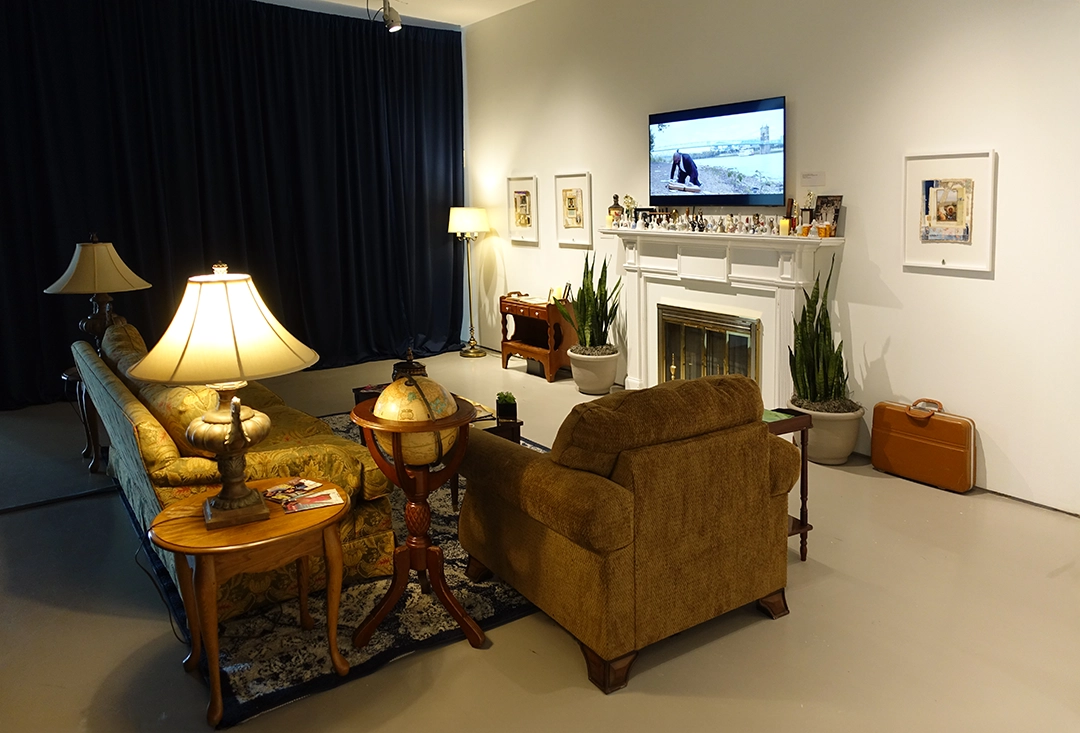
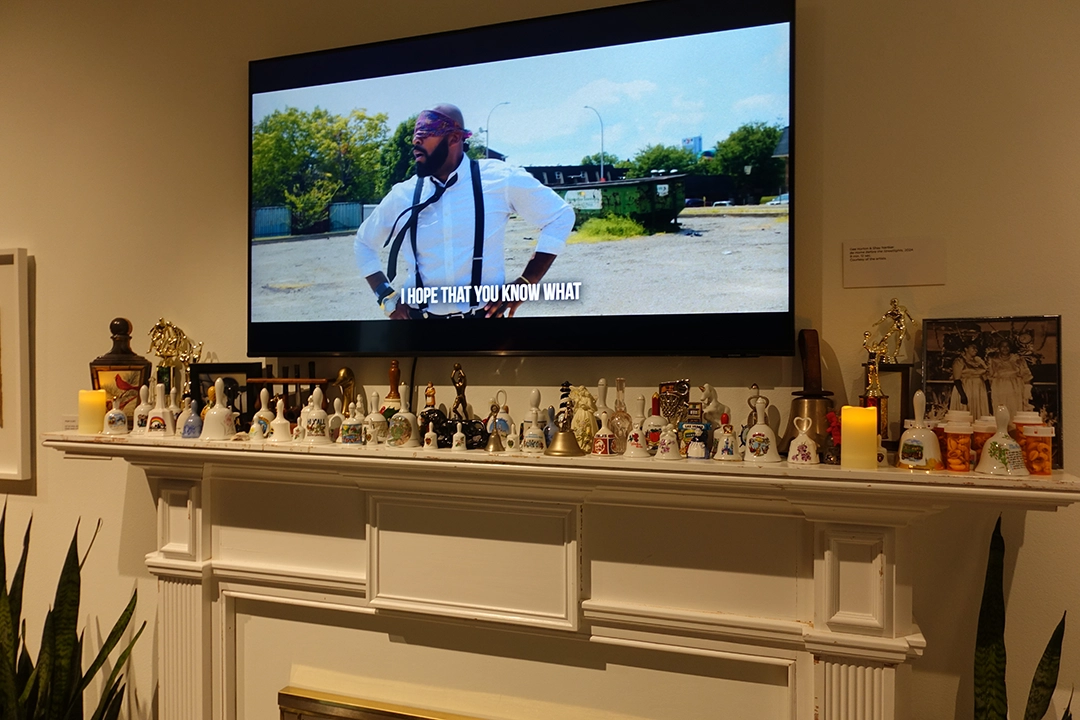
The use of the found object and the family archive deserves separate consideration. The grandmother's bells, the great-grandfather's pipes, the furniture acquired through Habitat for Humanity. Horton brings them into the exhibition space as relics that already carry their own symbolic weight before they ever touch art, unlike the Duchampian ready-made, which artistic logic rescues from the ordinary world in order to resignify it. He honors them. That distinction is crucial for understanding the difference between his practice and that of artists who work with found objects from a more distanced or ironic stance. For Horton these objects have spirit—he uses exactly that word—and bringing them into the exhibition space is an act of invocation, not of appropriation.
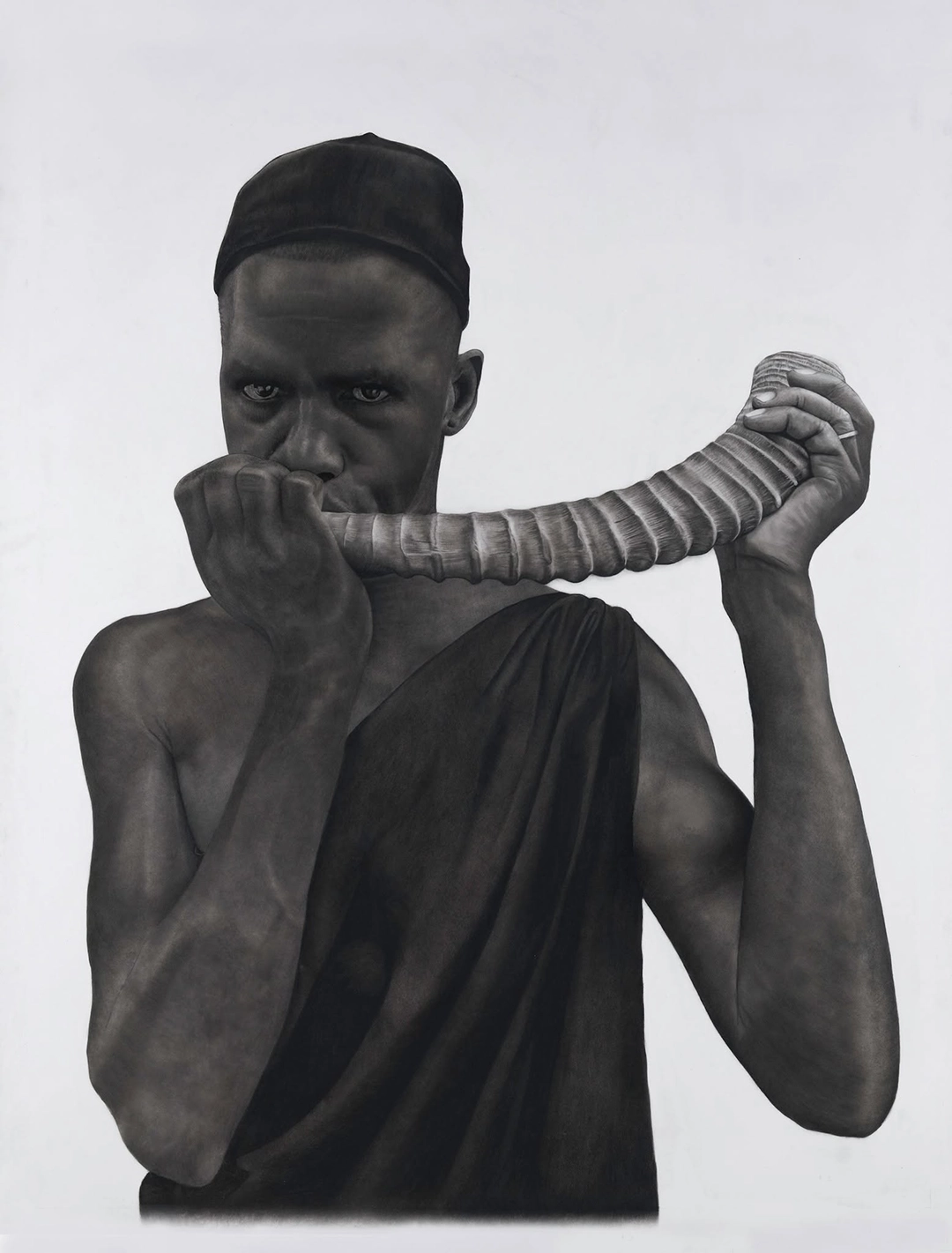
Prince Amadou, 2026 Charcoal and graphite pencil on paper | 60 x 48 inches. Image taken from the artist’s Instagram profile.
Chapter four of the exhibition introduces Freeman Little, the protagonist of the book. Freeman Little is a thirty-seven-year-old Black man from New Bern, North Carolina, a port city with direct historical ties to the transatlantic slave trade. Freeman suffers from a hereditary sleep disorder called Guent Bu Wa that brings on mystical, prophetic dreams. When his father lies dying in a hospital, Freeman falls asleep beside him and enters that dreamworld, where he wakes as his seven-year-old self. What the viewer travels through in chapter four is that dream.
Channeling autobiography through a fictional character works as a mechanism of amplification. Horton acknowledges this with notable honesty when he admits that early in his practice he tried to hide behind his subjects, and that the distance narrowed over time. Freeman Little lets him speak of his own history—the difficult relationship with his father, the childhood home in Kentucky, the mourning for his cousin murdered on the streets of Louisville—with a freedom that the direct exposure of the autobiographical does not always allow. Fiction, paradoxically, brings us closer than confession does. It gives the biographical material a structure that makes it communicable, that lifts it out of the merely personal and installs it in the territory of the shared.
The hereditary sleep disorder is also, read closely, a metaphor for the weight of history. Freeman's father suffers from it too but concealed it his whole life because he grew up in the South under Jim Crow, in a culture where Black men learned that showing vulnerability was dangerous. The gift and the curse are the same thing. The capacity to see, to dream, to receive visions. And that capacity is what the system tried to suppress, not only in Freeman's family but in entire generations.
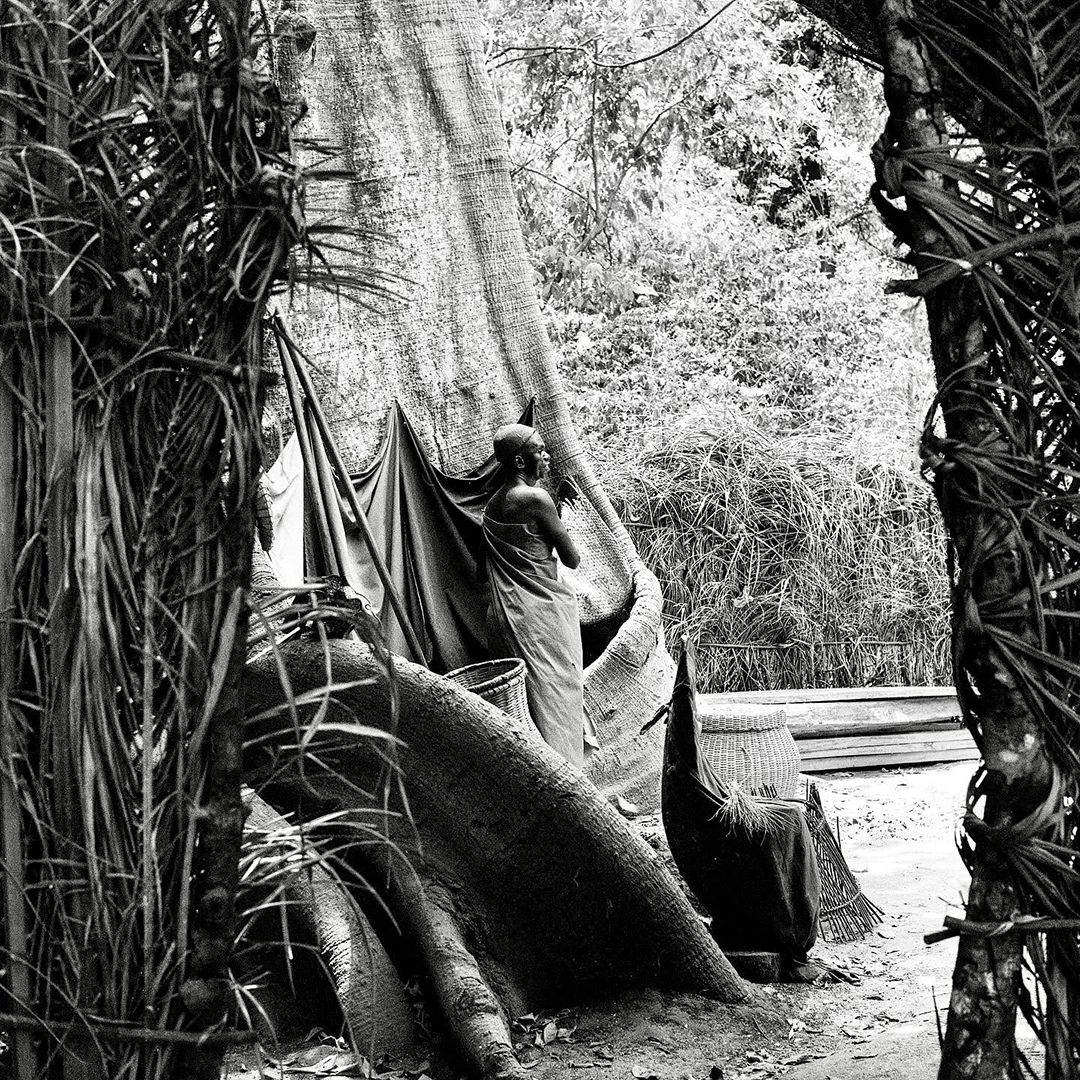
The book builds that universe with a precision that leaves nothing to chance. Guent Bu Wa has its own diagnostic classification number—IMNSD–NSD 7.4.3-B, Parasomnia Spectrum Disorder, Ancestral Lucidity Presentation—issued by a fictitious yet wholly plausible body, the International Manual of Neurocognitive Sleep Disorders, 12th Edition (Revised 2024). The document is printed in the book upside down, so that the reader has to turn the object over to read it. Several passages are underlined in red, as if Freeman had marked them before they reached our hands—"familial transmission patterns," "intensification during bereavement," "multigenerational documented, hereditary mechanisms unverified." The closing clinical note concedes that certain West African frameworks classify the phenomenon as ancestral cognitive transmission. It is the central tension of all Horton's work—what the system names as dysfunction, the community recognizes as a gift—materialized in an object that imitates the authority of medical diagnosis only to dismantle it from within.
The same tension is voiced by Ida, the old seer of the book, with a verbal economy that makes her unforgettable. "The Western world has a history of labeling what it can't understand."
The reconciliation between father and son that takes place in the dream—where the father appears decades younger, before history hardened him—is one of the most emotionally complex moments in the whole exhibition. The flatline of the heart monitor that wakes Freeman from the dream has the precise cruelty of reality interrupting desire.
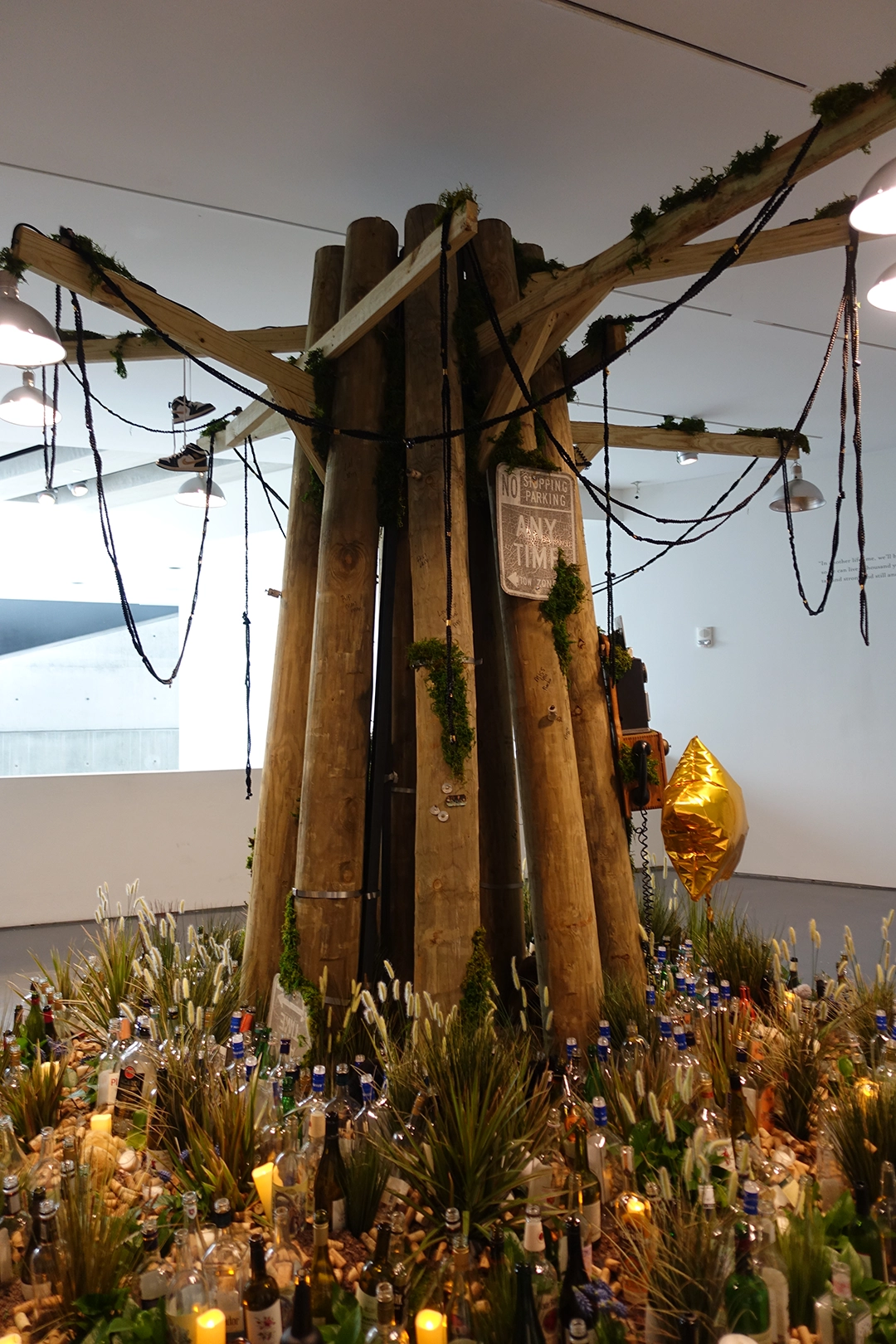
Baobab
Horton organizes his exhibition around three dimensions of mourning that overlap without blurring into one another. The personal mourning has a concrete face. His older cousin, photographed at seven, murdered at twenty-five in a gang fight in Cincinnati's West End. The place where he died became one of those street shrines that proliferate in the Black neighborhoods of American cities—liquor bottles, teddy bears, photographs, flowers. The Cincinnati Reds cap that appears in the installation is the one his cousin was wearing the day he died. The teddy bear was physically present at the shrine site. Horton brings them into the gallery as electric presences. The document informs. The presence confronts.
The collective mourning takes shape in the liquor bottles as a system of cultural meaning. For years Horton observed those improvised altars on the corners of the West End and recognized in them a form of funerary ritual that the community had invented in the absence of recognized formal ceremonies. The liquor bottles are, in that context, exactly what flowers or candles are in other traditions—markers of absence, claims of presence, refusals to let the dead vanish without a trace. To incorporate them physically into a work of art—the actual objects, present in the gallery—is a gesture of recognition toward a cultural practice that the institutional art world rarely takes seriously.
The ancestral mourning is the hardest to articulate and the one that runs deepest through chapter four. Freeman Little's dreamworld is peopled with figures from the world of the ancestors. The healer who reads the divination shells for him, the twins of the forest who speak to him of the baobab, the seven children of Ziguinchor to whom he must carry water. All of them come from that territory where the dead have not finished leaving and the living have not finished arriving. The reference to the door of no return—the door of the slave castles on the West African coast through which the enslaved passed toward the ships with no possibility of return—that appears at the start of Freeman's dream connects every form of mourning into a single historical arc. Freeman's dream, the cousin's death, the interrupted rites, the fragmented identity, all converge at that door.
The book gives that ancestral mourning a precise geography and a concrete mission. Freeman must deliver seven bags of water—Wata, in Wolof, simply water—to the Seven Boys of Ziguinchor before the sun sets, or the lineage will break forever. The mission is simple in its statement and abyssal in its implications. What is passed down from generation to generation is not wealth, not name, not land. It is water. The most basic element, the most egalitarian, the one no history can wholly take from anyone. When the seventh boy returns the last bag to Freeman saying "This one's not for us. It's for you," the mission reveals itself as what it always was, an initiation. Freeman did not go to Ziguinchor to save anyone, only to receive what was his.
The eight-foot-tall bed of the child Freeman, which the viewer encounters in the dreamworld, completes the circle with an admirable formal economy. A bed is a place of rest. A coffin is a place of rest. They share the same dimensions. Childhood and death share that geometry. And in that overlay, it is as exact as it is macabre.
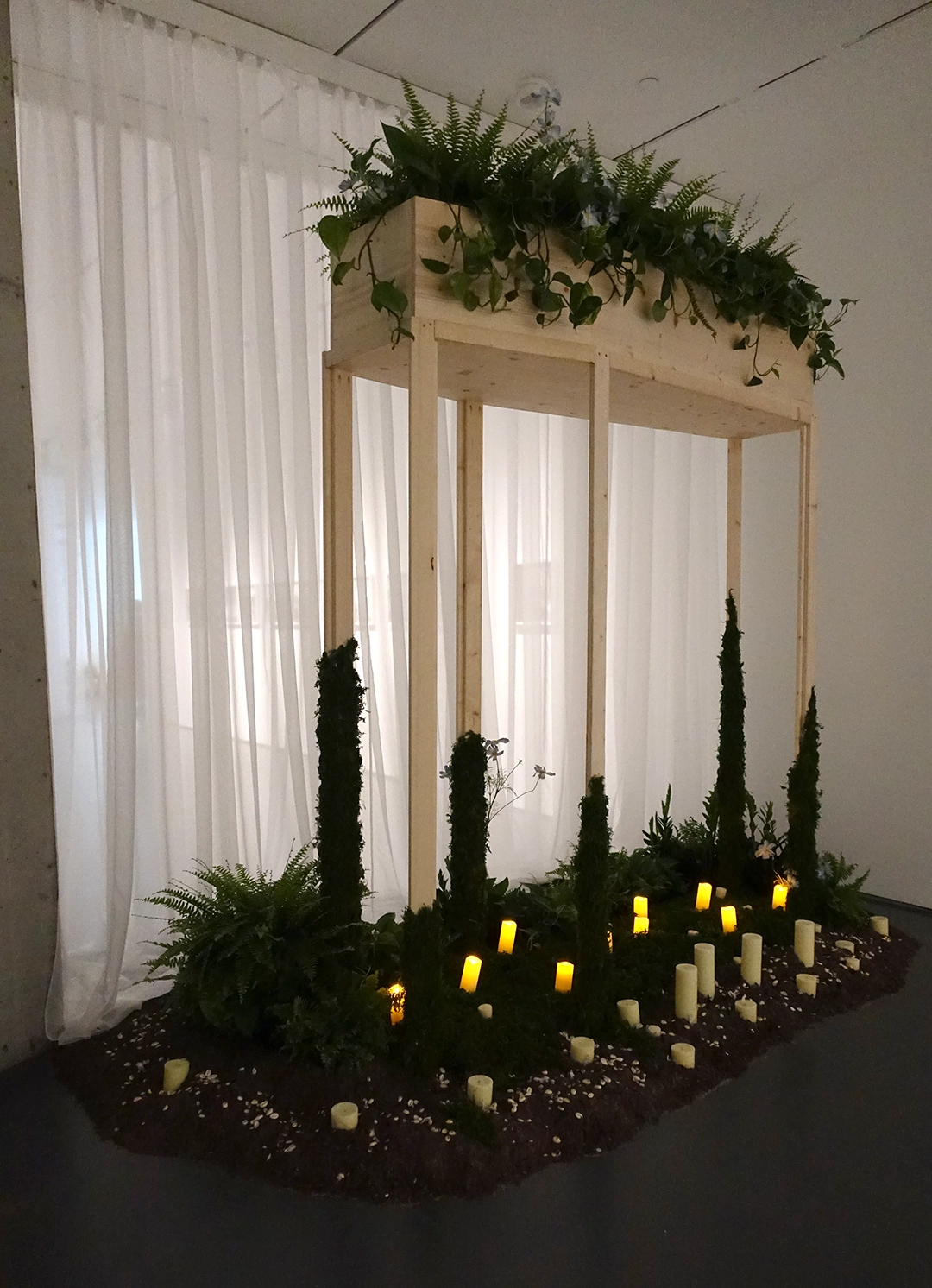
One of the most sophisticated dimensions of Horton's practice is his conception of the exhibition space as an extension of the conceptual argument. The show at the CAC unfolds a spatial distinction between exterior and interior that is philosophical in kind. Everything outside the central installation belongs, in the internal logic of the work, to the great outside, the hostile space, the space of history, the space where the uncontrollable things happen. Crossing the curtains into the interior of the installation, the viewer enters the grandmother's house, a space of warmth and safety that memory keeps as a refuge against precisely that exterior. The sofas acquired through Habitat for Humanity are emotional architecture.
The resource room at the end of the exhibition—where the viewer can sit, watch an interview with the artist, and process what they have just experienced—is another decision that reveals Horton's training as a social worker as much as any statement of intent. An exhibition that asks the viewer to immerse themselves in three simultaneous forms of mourning needs to offer a space of reintegration. The arrangement of the space is part of the ethics of the project, because the manner of exhibiting is already a taking of position.
The corridors that work as portals of entry and exit, marked with the blue that runs through the whole exhibition, are the last piece of this architecture. Blue as a narrative character—Horton's own term—marks the thresholds between the different states of the experience. Between the world of the living and the world of dreams. Between the mourning that paralyzes and the mourning that transforms. Between the hospital room where the father lies dying and the mystical forest where the father is young again.
To whom do you belong? Horton asks in his conversations with six Black male friends—to whom, in terms of family, legacy, and history. It is the central philosophical question of his entire practice. And it far exceeds the limits of the African American experience, though the African American experience gives it its most urgent and most historically specific form. We all belong to someone. We all carry the inheritance of those who lived before us, with their silences and their gifts, with their wounds and their music. The interruption of that chain of belonging—which for communities descended from slavery is a documented historical fact—produces a kind of existential disorientation that Horton has spent decades trying to articulate without simplifying.
His answer, built work by work and chapter by chapter, is practical. You belong to the seven-year-old you once were. You belong to the grandmother who still keeps her bells. You belong to the cousin who never reached twenty-six. You belong to the baobab that lives a thousand years. You belong to the door you do not cross and to everything that stayed on the other side. To the dream, the only form history has for speaking to you directly once the usual messengers have vanished.
Gee is a self-taught artist who began drawing in charcoal in 2019 and who, in less than a decade, has built one of the most ambitious and most coherent artistic projects of his generation in the United States. His first charcoal work was, at the same time, the first stone of a conceptual edifice whose architecture reveals itself fully only when one walks through it. Chapter 4: In Another Lifetime, at the Contemporary Arts Center in Cincinnati, is the invitation to take part in that passage. It begins before you enter the building. When someone places in your hands a book sewn with red thread and tells you there was a man who fell asleep beside his father and had the longest dream of his life. That dream, like the disorder that sets it off, is passed down by inheritance, and by the time you close the book the question that pursued that man, the question of whom we belong to, has become ours as well.
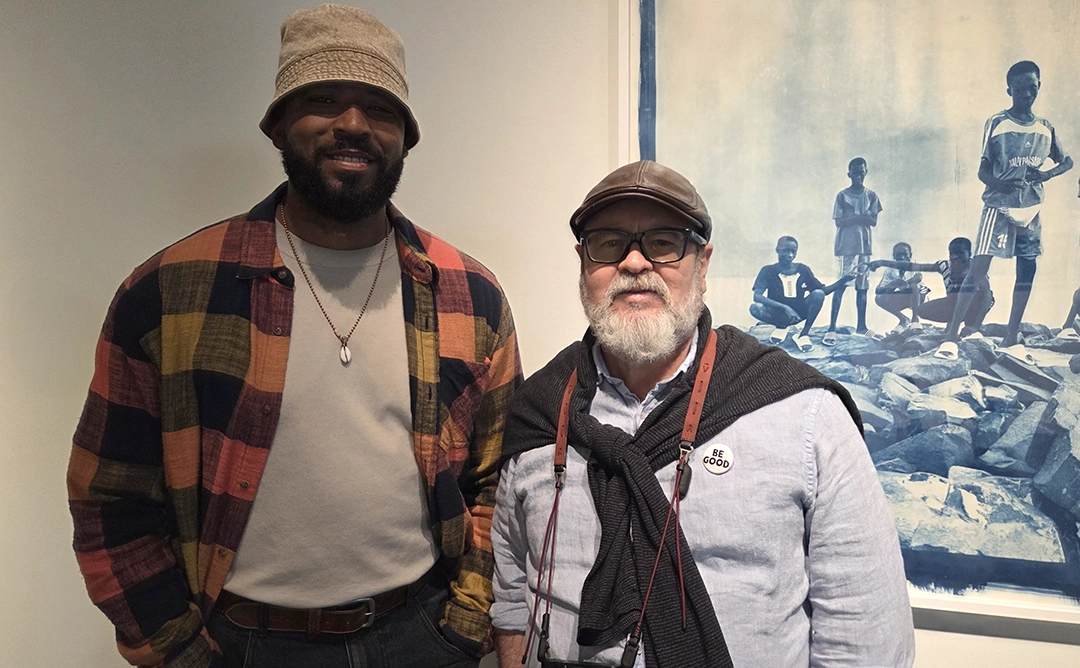
This article is based on an extensive conversation with the artist during the walkthrough of his exhibition at the CAC and on the analysis of the artist's book In Another Lifetime (Gee Horton & Freeman Little, Cincinnati, 2026).






If you’re a regular reader of this blog and enjoy its content, you might consider contributing to its upkeep. Any amount, no matter how small, will be warmly appreciated
Founded in 2021, Echoes (Notes of Visual Narrative) invites everyone to explore together the visual codes that shape our world—art, photography, design, and advertising in dialogue with society.

Copyright © 2026 r10studio.com. All Rights Reserved. Website Powered by r10studio.com
Cincinnati, Ohio


Comments powered by Talkyard.