
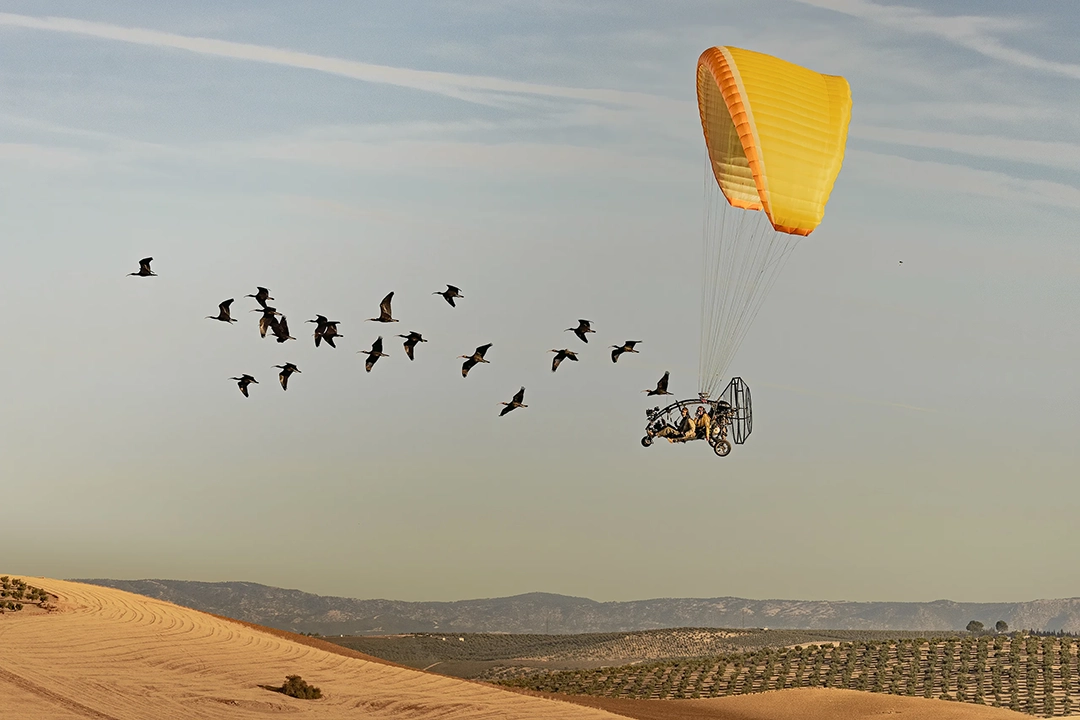
The hermit ibis (Geronticus eremita) is also known in Spanish as the northern bald ibis. Its scientific name points directly to the sparse, widely scattered feathers that protrude from its bald head and give it a lamentable appearance. This formal decrepitude can inspire a kind of compassionate affection, especially when the creature also has the face of an idiot, round eyes, and a stunned expression.
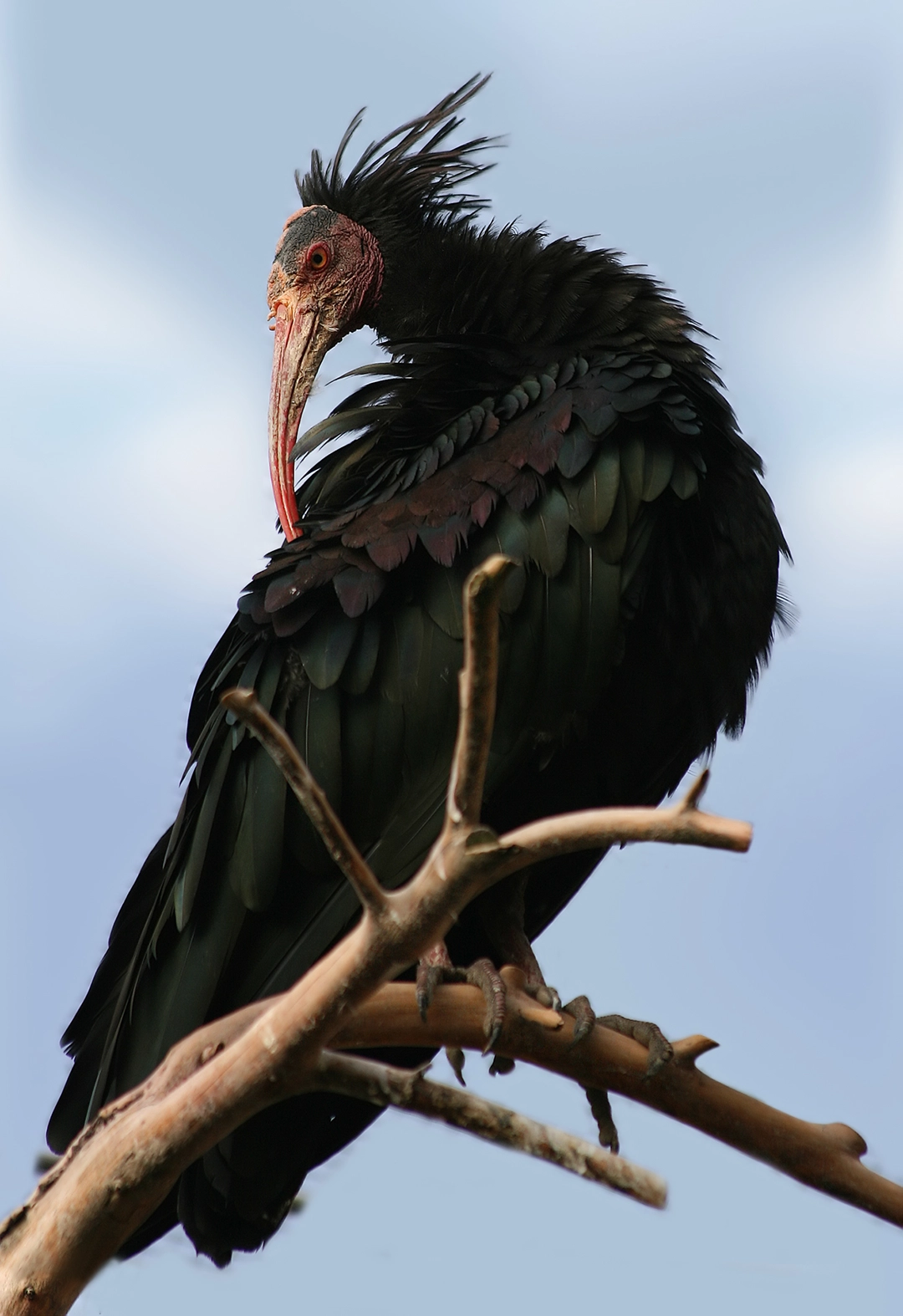
Geronticus eremita
An article in New Scientist claims that, some 400 years ago, poaching and climate change drove the species out of the northern foothills of the Alps. Such a span of time strikes me as excessive for taking unidirectional climatic variations too seriously. I do not buy the poaching part either, because even in books on witches there are no potions or recipes that call for these poor wretches.
This text is about a photograph. But the story far exceeds the excellence of the image.
In a very light flying contraption, Helena Wehner and Johannes Fritz take to the air. Both are part of an Austrian conservation group known as Waldrappteam. Its members are trying to reestablish a healthy population of the species in Europe. Waldrappteam is a compound German word in which Wald means forest, Rapp is associated with the raven or with animals of dark plumage or fur, and together they form Waldrapp, the bird’s name in its own language. Team is what two or more people do together in order to accomplish something.
Johannes is the pilot, and Helena, megaphone in hand, sings in German a set of elaborate ornithological romances, with the aim of guiding the birds toward their new winter homes. These inexplicable Germans raise them by hand, scratch the backs of their necks, and feed them earthworms. They manage to establish sincere bonds with them, and the birds follow them even when they are aboard an aircraft. As the ugly follow anyone who, for an instant, pays them attention.
Since its inception in 2004, the migration project has gathered followers and admirers of every kind in the communities along the birds’ route. Their journey covers approximately 2,800 kilometers in 50 days, from southeastern Germany to southwestern Spain.

Gunnar Hartmann by Baldur Hartmann
The photograph of this formation flying over the olive groves of Jaén, in southern Spain, was taken by student Gunnar Hartmann and earned him the overall prize in Nature’s Scientist at Work 2026 competition. Hartmann joined the conservation team as a volunteer in 2024, when he was a science student at the University of Koblenz, in Germany. Upon receiving the prize, Hartmann confessed that the photograph stirred intense emotions in him, that it made him smell the air of that morning and hear the birds’ racket. Youth, divine treasure.





If you’re a regular reader of this blog and enjoy its content, you might consider contributing to its upkeep. Any amount, no matter how small, will be warmly appreciated
Founded in 2021, Echoes (Notes of Visual Narrative) invites everyone to explore together the visual codes that shape our world—art, photography, design, and advertising in dialogue with society.

Copyright © 2026 r10studio.com. All Rights Reserved. Website Powered by r10studio.com
Cincinnati, Ohio


Comments powered by Talkyard.