
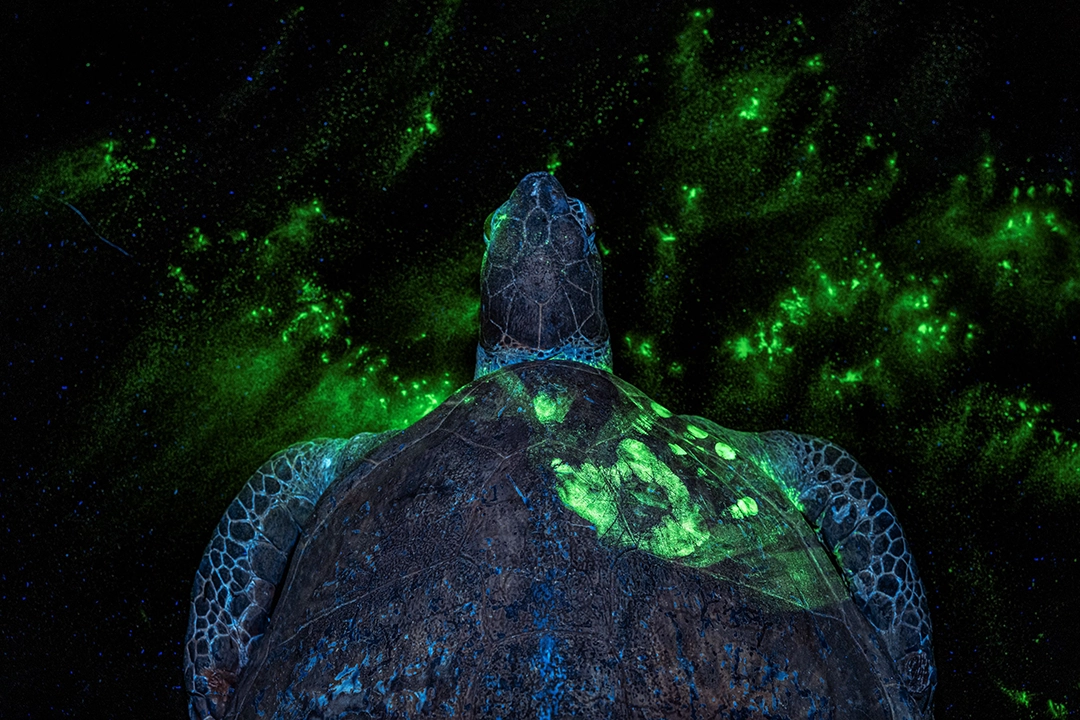
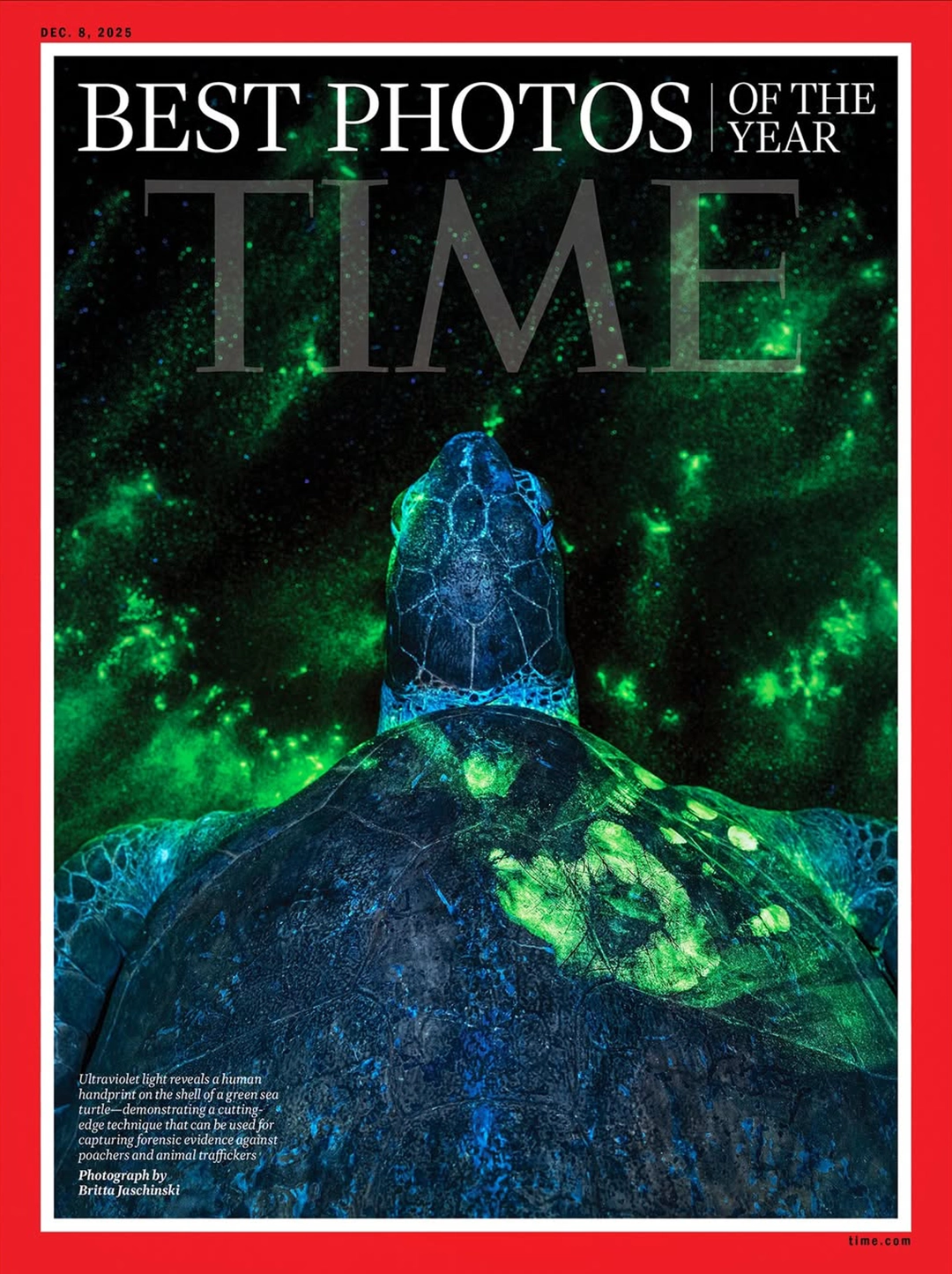
The winning photograph of the 2026 Environmental Photography Award shows a green sea turtle (Chelonia mydas) swimming underwater, enveloped in an unusual glow.
At first glance, the image presents itself under the sign of an almost hypnotic serenity: a spectral, totemic turtle rises within an indistinct yet vaguely familiar field. We notice, with a pale flicker of surprise, the imprint of a human hand inscribed upon its shell. Threads of light seem to stream from it. The colour and the iridescences suspended across the upper half of the photograph lead us to lift the scene out of the earthly realm and read it as a cosmic spectacle. A metaphor for animal life embarking on a healing journey into the depths of the galaxy.
The imprint is not a digital artifice. At the ZSL Wildlife Forensic Lab in London, Dr Alexandra Thomas and Dr Louise Gibson developed a procedure using fluorescent powders which, when exposed to ultraviolet light, reveal hand and finger marks, traces of blood and other bodily fluids, even gunshot residue. Police already use the technique to identify and apprehend poachers and wildlife traffickers.
Britta Jaschinski—the photograph’s author—arrived at that laboratory after decades spent documenting crimes against wildlife. She works with customs authorities, the police, and several conservation organisations. In 2018, she co-founded Photographers Against Wildlife Crime, and in 2023 she launched The Evidence Project. That work opened the doors of laboratories, storage rooms where evidence and confiscated material are kept, and the units investigating trafficking. Spaces to which a nature photographer rarely has access.
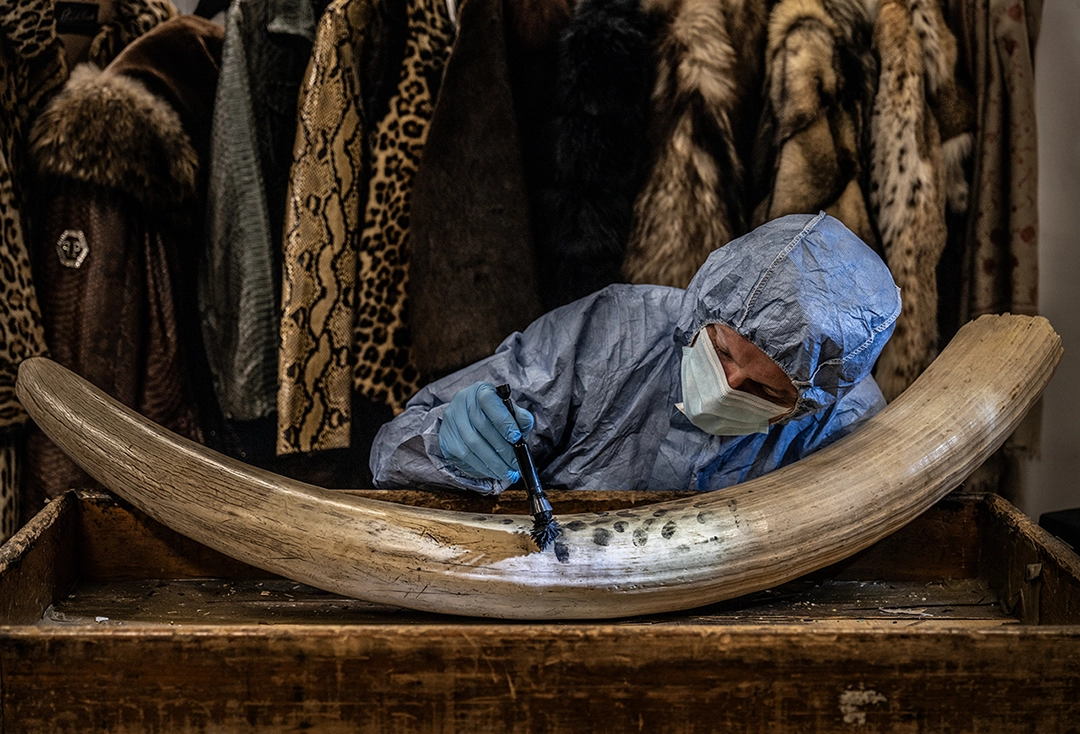
Success had smiled on her before. Her photograph Dusting for New Evidence won the Wildlife Photographer of the Year 2024 in the photojournalism category. It shows an investigator from London’s Metropolitan Police dusting a confiscated elephant tusk for latent fingerprints at CITES’ Border Department. For years, looking for human fingerprints on ivory was a futile task, because its porous surface absorbed them within a day. Recent ferromagnetic forensic powder has made it possible to recover them as many as twenty-eight days after someone touched the object. That same powder was probably used on the turtle.
This is perhaps the least obvious among the thousand ways of denouncing animal trafficking, its thousands of lost lives, the threat of extinction hanging over so many species. Most photographers would choose, of course, bloody, brutal, or melodramatic scenes. Scenes capable of producing an immediate impact. This photograph suffers from—or perhaps celebrates—a very delicate estrangement. Perhaps that is why it was awarded. Perhaps it is less legible, less categorical, yet unquestionably more poetic and more intriguing.
I think Britta Jaschinski took it with the competition more in mind than turtles. It is an ungenerous suspicion, certainly, yet morally unremarkable. Most of us care more about prizes than chelonians.
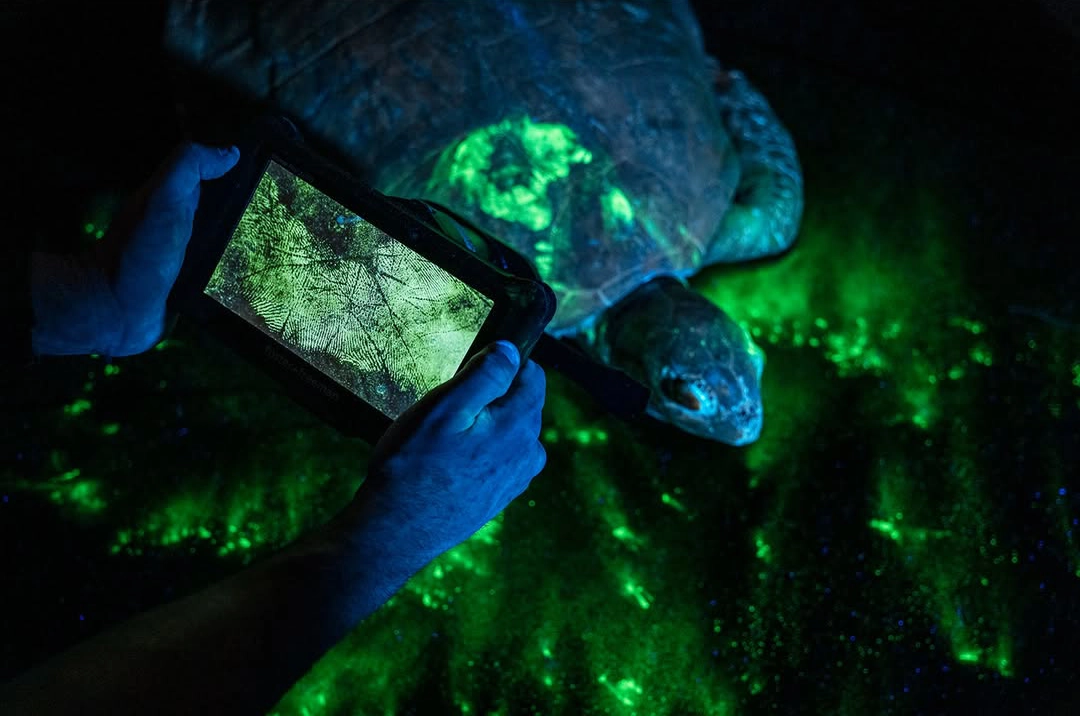
Six of the seven species of sea turtle live under threat from hunting, habitat destruction, and marine pollution. In this image, a human hand has left its mark on the animal. I sense that the turtle is safe. Science can now read that kind of mark, establish patterns, and confirm what it could once barely surmise.
The Environmental Photography Award is presented by the Prince Albert II of Monaco Foundation, and this year marked its sixth edition. An international jury of photographers and editors selected thirty-six images and awarded seven prizes. Five corresponded to the competition’s categories; the remaining two went to the public vote and the student vote. The Grand Prize, received by Jaschinski, was selected from among the five category winners.
The competition brings together photographs that inform and raise awareness about species loss, forests, the ocean, and polar regions. The selected images are on display along Monaco’s Larvotto promenade from May 28 to July 30, 2026. Afterwards, they will travel around the world. It is the familiar itinerary of awards of this kind. Skira Paris will bring them together in a book.
Behind all this stands a royal foundation and a financial prize. And behind both, many photographers. I am certain that many of them genuinely care about animals.





If you’re a regular reader of this blog and enjoy its content, you might consider contributing to its upkeep. Any amount, no matter how small, will be warmly appreciated
Founded in 2021, Echoes (Notes of Visual Narrative) invites everyone to explore together the visual codes that shape our world—art, photography, design, and advertising in dialogue with society.

Copyright © 2026 r10studio.com. All Rights Reserved. Website Powered by r10studio.com
Cincinnati, Ohio

Comments powered by Talkyard.