
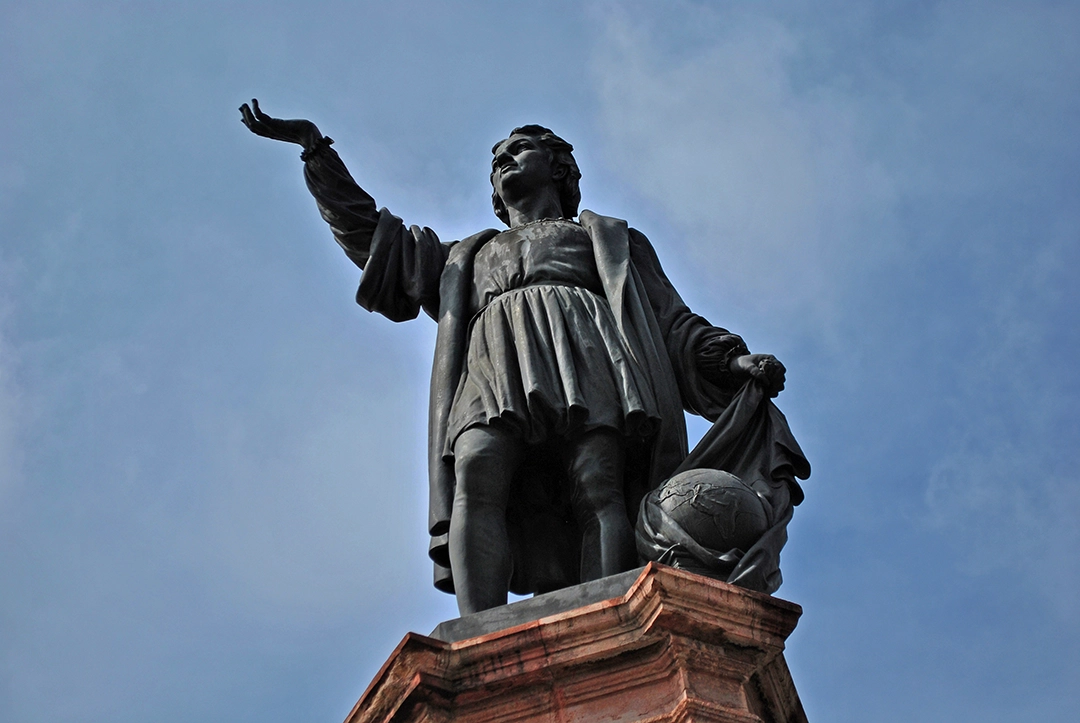
Columbus Monument, Paseo de la Reforma, Mexico City
Maximilian of Habsburg, the emperor whom the French Intervention installed on the throne, built the Paseo de la Emperatriz —modeled on the Parisian boulevards— to link Chapultepec Castle with the city center. Mexico's conservative quarters looked kindly upon it. When the empire fell, the republican governments renamed it Paseo de la Reforma. This Reforma is the Mexican liberal one, the laws driven by Benito Juárez that separated Church from State and consolidated the Republic.
In 1877, the city was barely urbanized. The avenue opened as a major artery from which the capital began to unfurl its circulatory network over the newborn neighborhoods. Its visual relief would rest in the hands of monuments conceived to tell the nation's founding story.
And back then, that story began with Columbus. His monument was financed by the businessman Antonio Escandón y Garmendia, one of the great railway concessionaires of the nineteenth century. He commissioned the statue from the French sculptor Charles Cordier. The year was 1872. It took three years to reach the capital, and arrived amid a political crisis: contested elections, the Tuxtepec rebellion, and Porfirio Díaz's rise to power.

When conditions finally allowed for its installation, they placed it somewhere other than the site Escandón had suggested, in front of the Buena Vista station. His idea had been that travelers would see it as they stepped off the train. Porfirio Díaz's Secretary of Development, Vicente Riva Palacio, decided otherwise. He installed it in 1877 at the first roundabout of the Paseo, overriding both the wishes of the man who had made it possible and a considerable share of public opinion.
At that moment Columbus was seen almost universally as a symbol of European civilization, of the dawn of the modern world, of scientific progress and the unstoppable expansion of knowledge. In nineteenth-century Spanish America, the new republics sought to insert themselves within these traditions.
The monumental ensemble also presents evangelization as an essential part of the birth of New Spain. A reading with an intense nineteenth-century aroma, as could hardly be otherwise. Discovery, evangelization, and civilization on the same plate. As a project, it inaugurates what today might be considered an open-air museum of what the Mexican State has been from its origins.
And yes, the disputes began from day one.
Some Mexican artists found the composition ugly, the proportions disproportionate, the fact that Columbus was not, in truth, as handsome as the high-resolution photographs of 1492 had shown, and, most important, nearly all of the guild's vexation came from the project being awarded to a vulgar Frenchman, when Mexico had sculptors falling out of its pockets.
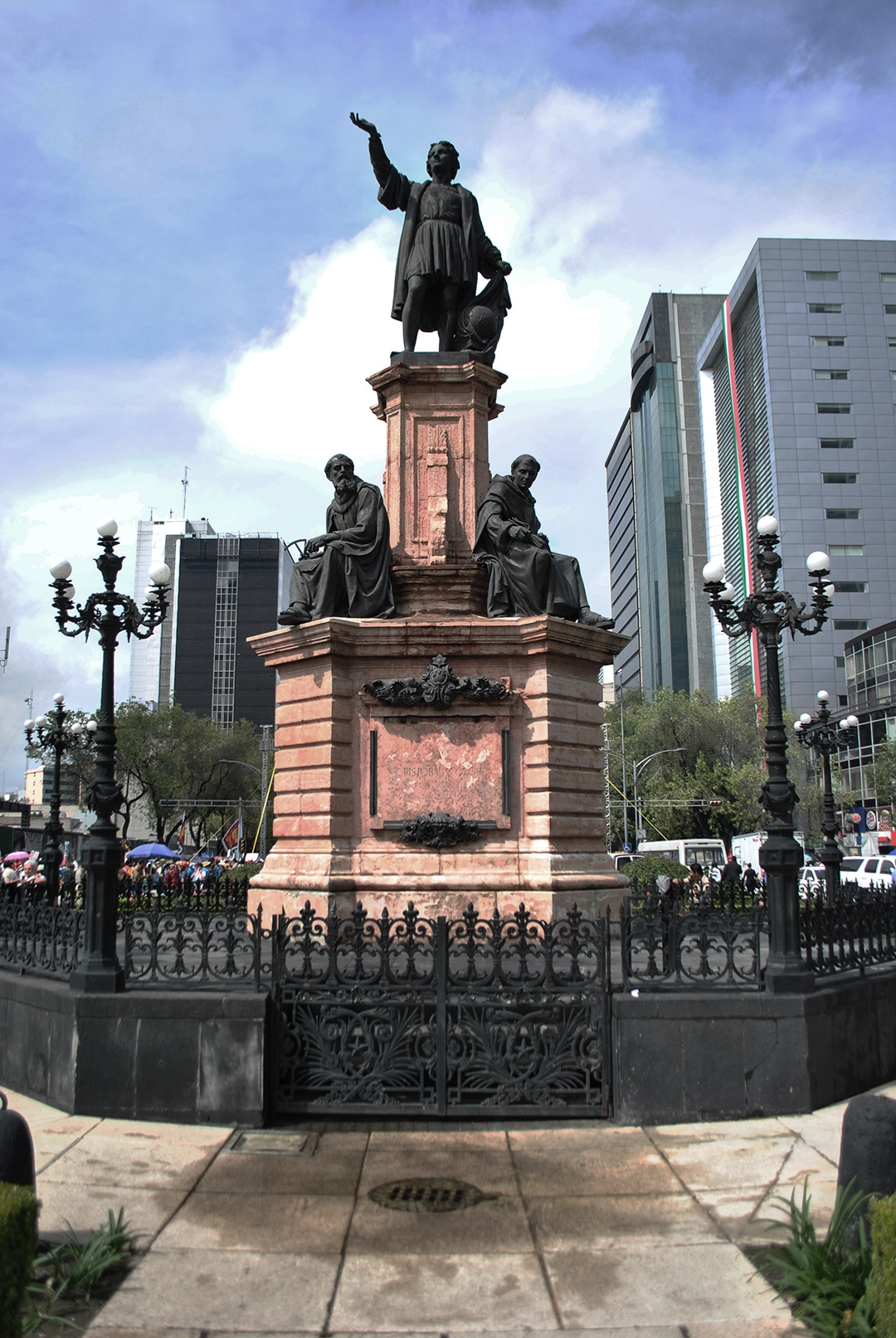
With this and other clamors in the background, there followed, in succession, the statue of Cuauhtémoc, the monuments to the heroes of the Reform, the statues of the liberals, and finally, the Column of Independence in 1910. As already noted, the avenue was becoming a walk through Mexico's official history, where each monument represented a chapter of the national narrative.
In 2020, the planet was profoundly indignant and everything bothered everyone. After the brutal murder of George Floyd, hundreds of anti-racist protests erupted, and numerous statues of colonizers, slavers, and conquistadors were razed.
In autumn, while nearly everyone slept, recovering from a long day of sustained indignation, in an operation coordinated by the authorities and the INAH, Columbus was lowered from his column in the cold dawn of October 10th. By the time the indignant stepped out for their revolutionary café con leche, Columbus had already escaped their righteous outrage.

Empty pedestal of the Christopher Columbus Monument on Paseo de la Reforma in Mexico City, following the statue’s removal in 2020.
The operation was presented as part of a restoration process. But the government decided Columbus would not return to his roundabout. It took up the political revision the collectives were demanding in the name of memory. Along with Columbus vanished Diego de Deza, Juan Pérez de Marchena, Pedro de Gante, and the ineffable Fray Bartolomé de las Casas. The last two only partly escape the condemnation of the irascible contemporary spirit thanks to their defense of the indigenous and their educational work. But they remain tied to the colonial evangelizing project. Into storage, without further ceremony.
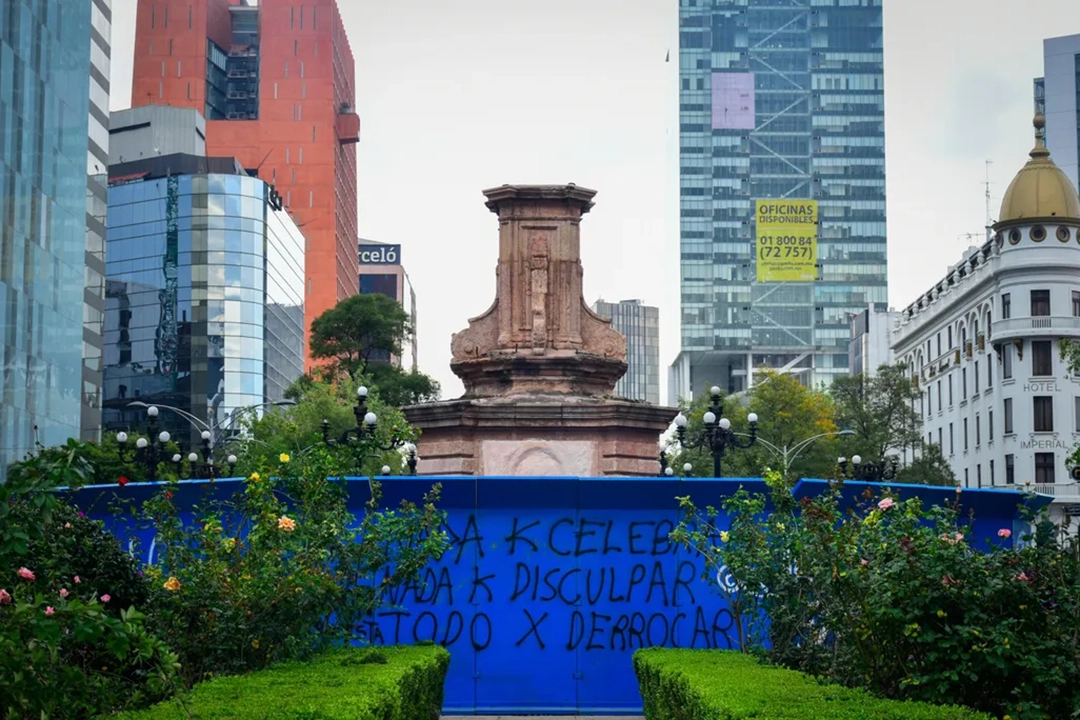
In October 2020, authorities in Mexico City set up metal fences (pictured here) to protect a statue of Christopher Columbus from protesters. Officials later removed the sculpture, ostensibly for restoration. Photo by Guillermo Gutiérrez / NurPhoto via Getty Images
Perfectly restored, with an impeccable haircut, the Admiral has remained since 2022 at the National Institute of Anthropology and History. And there he stays because, in spite of everything, he is catalogued as a historical monument. Any intervention —dismantling, relocation, vandalization, burning, melting down, stoning, or reinstallation— requires, by law, technical criteria and specialized oversight.

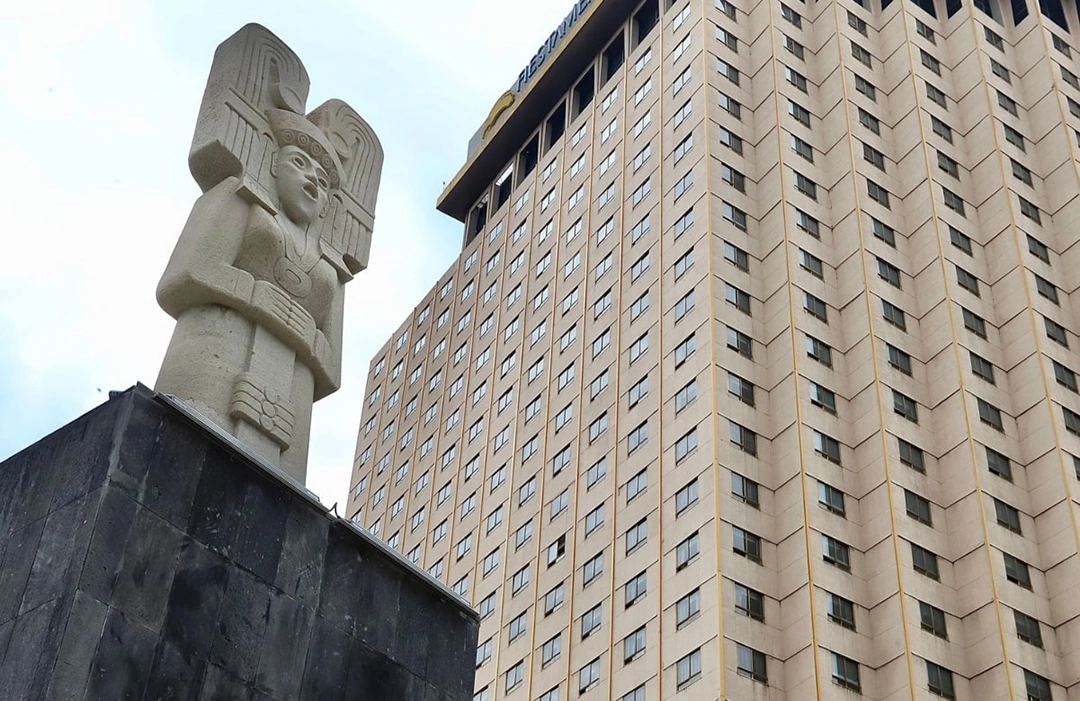
The Young Woman of Amajac, Paseo de la Reforma, Mexico City, 2023.
Installed on the former Columbus Roundabout, the monument was presented as a tribute to Indigenous women and a symbol of anti-colonial resistance. Its installation sparked controversy with feminist collectives, which had renamed the site the Roundabout of the Women Who Fight and sought to preserve the silhouette of a woman raising her clenched fist.
Spain has just won the football World Cup. Claudia Sheinbaum Pardo had Felipe VI, the king, right at her elbow, and — on Peacock TV at least — she looked cheerful, with little intention of demanding apologies for the mischief Hernán Cortés committed in the sixteenth century. I think today of Cristóbal Colón and his conjuring away from public view, not because I find him a very charming and dashing gentleman, but because he strikes me as an unsurpassable catalyst of the rancorous spirit of our days. At times his chronic ambient indignation exasperates me. A short jaunt through social media is enough to notice that atmosphere smelling of the end of the world, of the collapse of Western civilization.
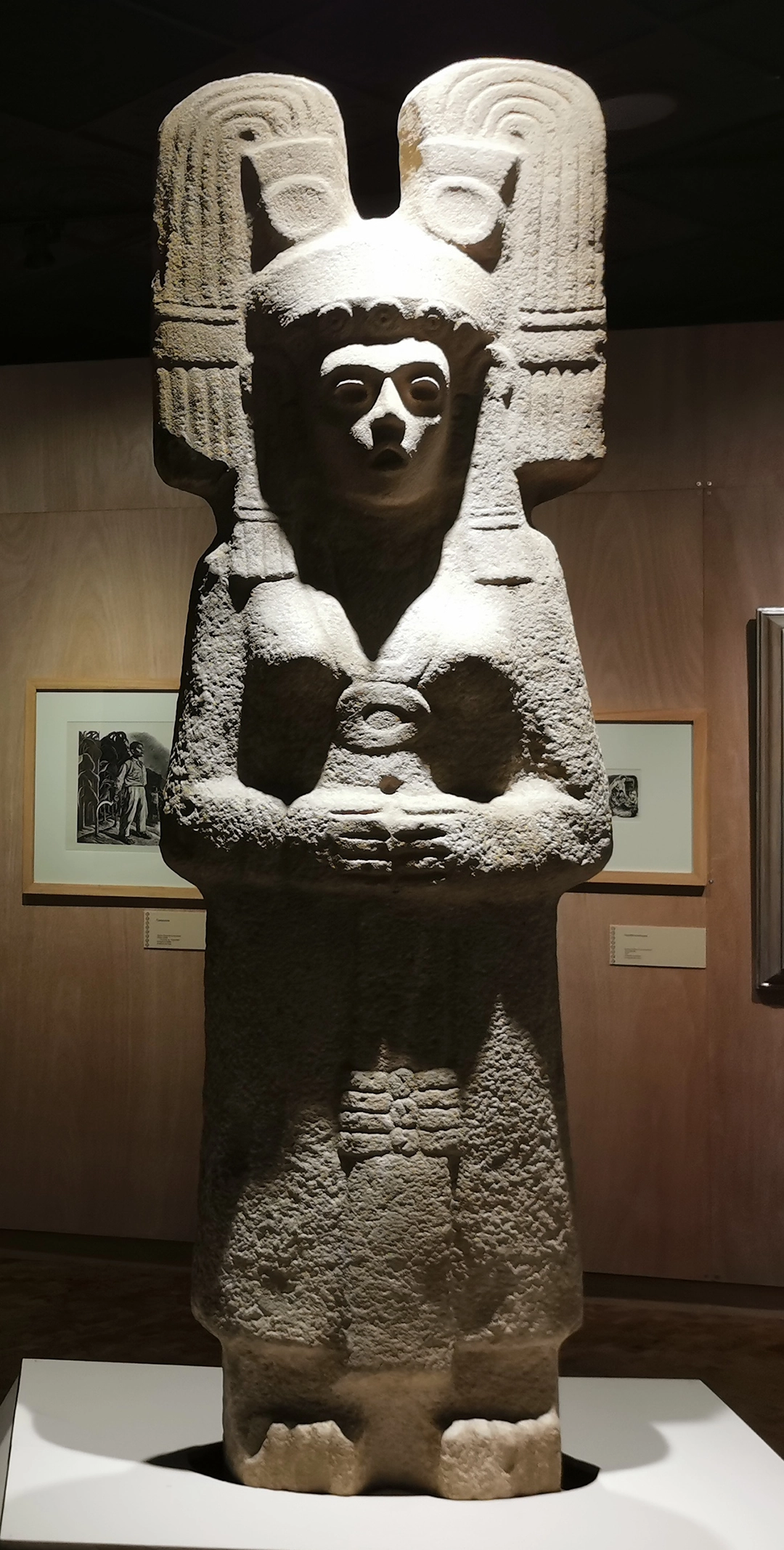
The Young Woman of Amajac, 1451–1521 CE
Limestone
Approximately 2 m (6.6 ft) high
Huastec culture, Postclassic period
Discovered in January 2021 in the Huasteca region of Veracruz, Mexico
Collection of the National Museum of Anthropology, Mexico City
This pre-Hispanic limestone monolith is believed to represent an elite Indigenous woman or female ruler. Its large almond-shaped eyes, elaborate headdress, and commanding scale suggest that the figure occupied a position of considerable political, ceremonial, or social importance within her community. The sculpture has consequently been interpreted as significant evidence of women’s leadership in the Huasteca region during the Late Postclassic period. The original is housed at the National Museum of Anthropology in Mexico City, while replicas have been proposed for installation in public spaces.
From where Columbus kept his balance —branded by the contemporary hordes as an antimonument— for more than a century, we are now watched by the Young Woman of Amajac, a replica of an original found by accident practically yesterday, in January 2022, in a citrus grove in Hidalgo Amajac, Veracruz. This is, to this day, an archaeological object, eroded and without inscription. Nobody knows who she is! Whether she really was a young woman, whether she represents a fertility deity, a Huastec noblewoman, or a ruler. Hoisting her up there in haste only makes sense as a deeply populist and anesthetizing political act.
It is desolating to sustain so traumatic a relationship with one's own history. I don't recall in the Cuba I left behind heated debates or intellectual lynchings over figures as reprobate as Pánfilo de Narváez, the Count of Valmaseda, or Valeriano Weyler y Nicolau. Even Francisco de Arango y Parreño, Miguel de Aldama y Alfonso, and Julián de Zulueta, all tied to the slave trade, still keep streets in their names. The revolutionary government chose the United States as its principal enemy; Mexico, it seems, opted for a less contentious one, the late Hernán Cortés. What the Cuban government did do was dismantle every statue on what had once been the Avenue of the Presidents. It replaced them with ridiculous, rustic monuments, all stone and hardly any metal, which look more like little tin soldiers than statesmen.
Are the original statues somewhere, restored, waiting for better times? Like hell they are! The Cuban Revolution has been to Cuba what Vesuvius was to Pompeii. Not only for its material heritage. In 2026 there are "patriots", of the couch and the little bag of chips, taking issue with the hemoglobin of Luis Manuel Otero Alcántara.







If you’re a regular reader of this blog and enjoy its content, you might consider contributing to its upkeep. Any amount, no matter how small, will be warmly appreciated
Founded in 2021, Echoes (Notes of Visual Narrative) invites everyone to explore together the visual codes that shape our world—art, photography, design, and advertising in dialogue with society.

Copyright © 2026 r10studio.com. All Rights Reserved. Website Powered by r10studio.com
Cincinnati, Ohio


Comments powered by Talkyard.