
Three days after turning twenty-nine, on Wednesday, January 21, 1998, I carried out my first subversive act against Cuba’s communist system. I went to wait for Pope John Paul II. I went with tremendous enthusiasm. Probably with Gilma, my wife at the time. We positioned ourselves on the right-hand sidewalk of Paseo, between 7th and 5th Streets, in Havana’s Vedado district. We waited for about an hour and a half. When he passed in front of us, we felt the blow of the rûaḥ —the breath, the spirit of God— upon our faces, powerful and strangely gentle. Overcome by feelings entirely new to us, we were astonished to see, for the first time in our lives, so many people with tears in their eyes.
A sentence hung in the air describing what everyone felt at that instant. Like letters leaping, swaying, invisible, yet legible to us all: Karol Józef Wojtyła, the Pole, John Paul II, was a thousand times greater and more powerful than the entire tribe of the Central Committee, including the three Mercedes. We later went to the Mass he celebrated in Revolution Square on January 25. Sheltered by the supernatural quality of the moment, thousands of people sang, for the first time and in tears, songs that had nothing whatsoever to do with the revolution, songs that practically denied it and tenderly shattered the ankles of the Communist Internationale.
John Paul II represented the moment of greatest international projection for contemporary Polish Catholicism. He carried enormous weight in the Catholic identity of his country and, above all, in the moral opposition to the communist regime. Elected pope in 1978, he remained on the throne of Peter until his death in 2005. He was the first non-Italian pope in more than four centuries.
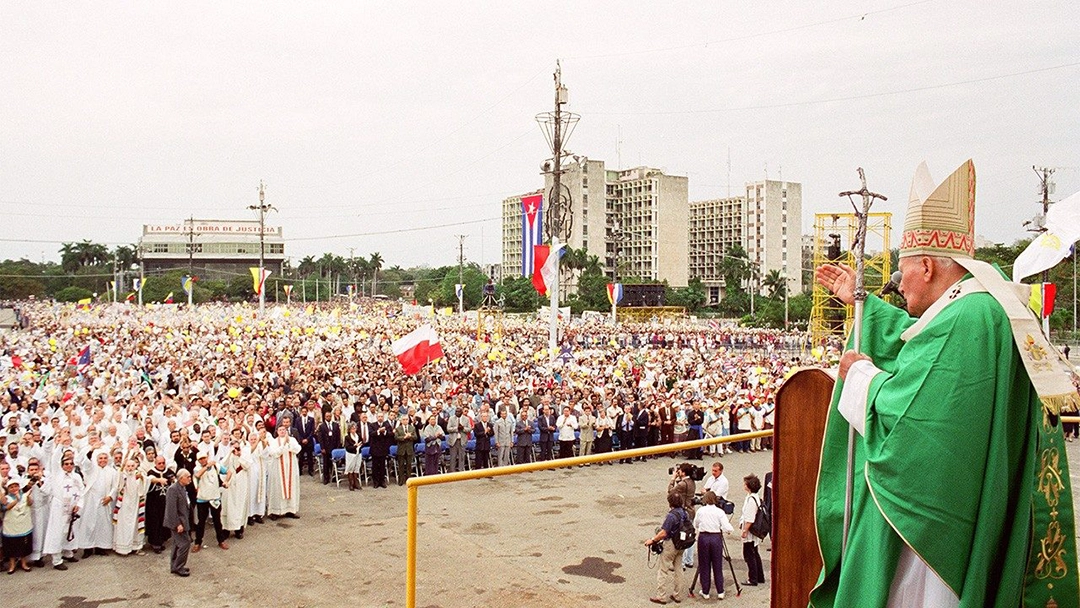
That visit to the island left behind a powerful sentence he pronounced upon arrival and which later dissolved, much like the dignity of almost all Cubans: May Cuba open itself to the world, and may the world open itself to Cuba.
Since then, the world has been steadily secularizing. What did you expect?
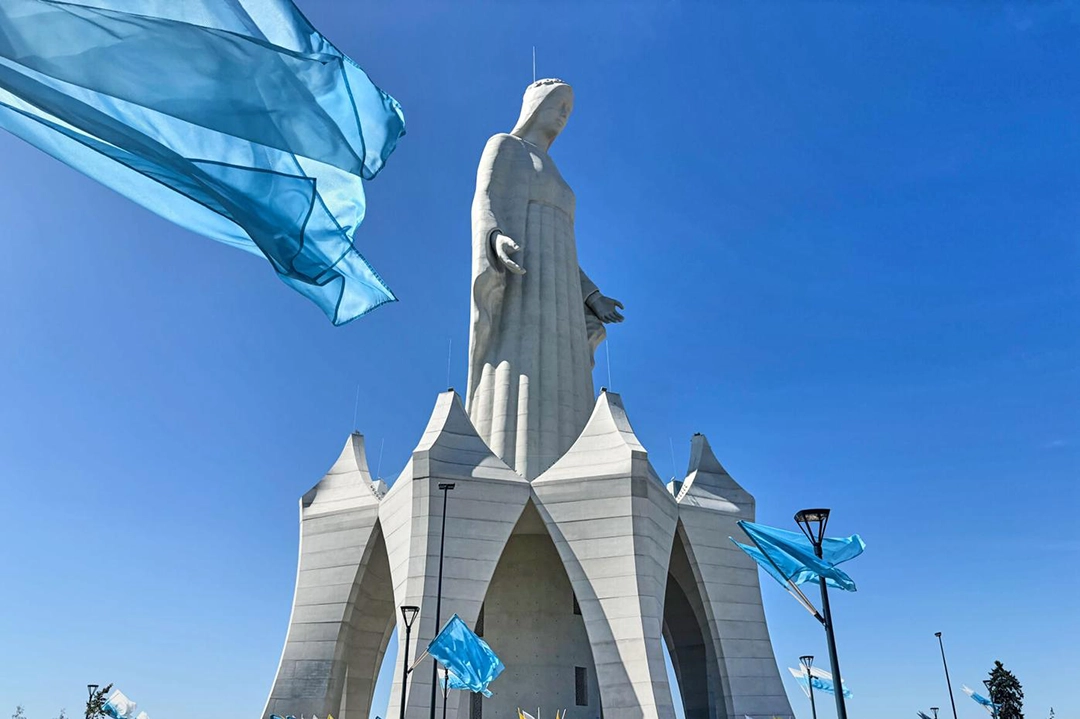
That is why I was surprised by a photograph I found in the latest issue of The Guardian Weekly. It showed a statue of the Virgin Mary inaugurated this past August 15. In Poland, of course, in Konotopie, a small town near Toruń. It is interesting for several reasons. One is its height: 55.6 meters —40.6 meters for the figure itself and another 15 for a pedestal conceived as an enormous crown and fitted with a viewing platform—. As of today, it is the tallest in Europe. Suffice it to say that it surpasses the 38-meter Christ the Redeemer in Rio de Janeiro, as well as the gigantic Christ the King in Świebodzin, in Poland itself. It is not the largest Marian image in the world. The Mother of All Asia, in the Philippines, reaches approximately 98 meters. That hardly diminishes its appeal.
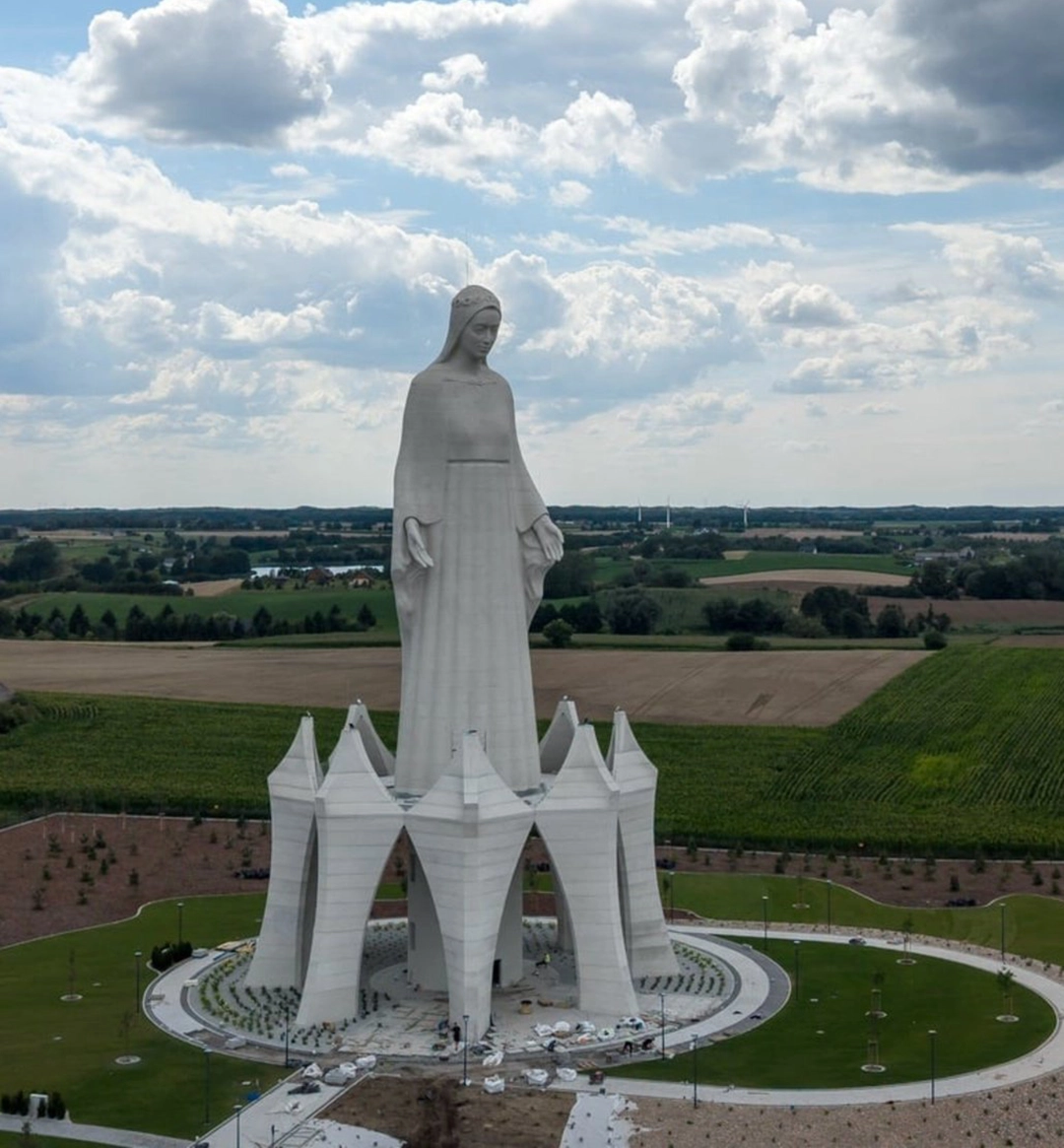
What amuses me somewhat is that it was financed by a pair of Polish businesspeople, Roman and Grażyna Karkosik. Roman is one of the country’s major industrialists and billionaires. The monument stands very near their residence and, according to them, was raised as an act of thanksgiving to God. It seems to me they wanted something beautiful to look at when they got up in the morning. Something that would also remind them how charming and fabulously rich they are. It did not cost them as much as one might imagine. About €23 million. Real Madrid paid RB Leipzig €125 million for Yan Diomandé, with another €15 million in add-ons that seem reasonably easy to trigger. A million if he brushes his teeth at least once a week, another if he wears deodorant. Something along those lines. For a nineteen-year-old boy. Considerably smaller than the Virgin.
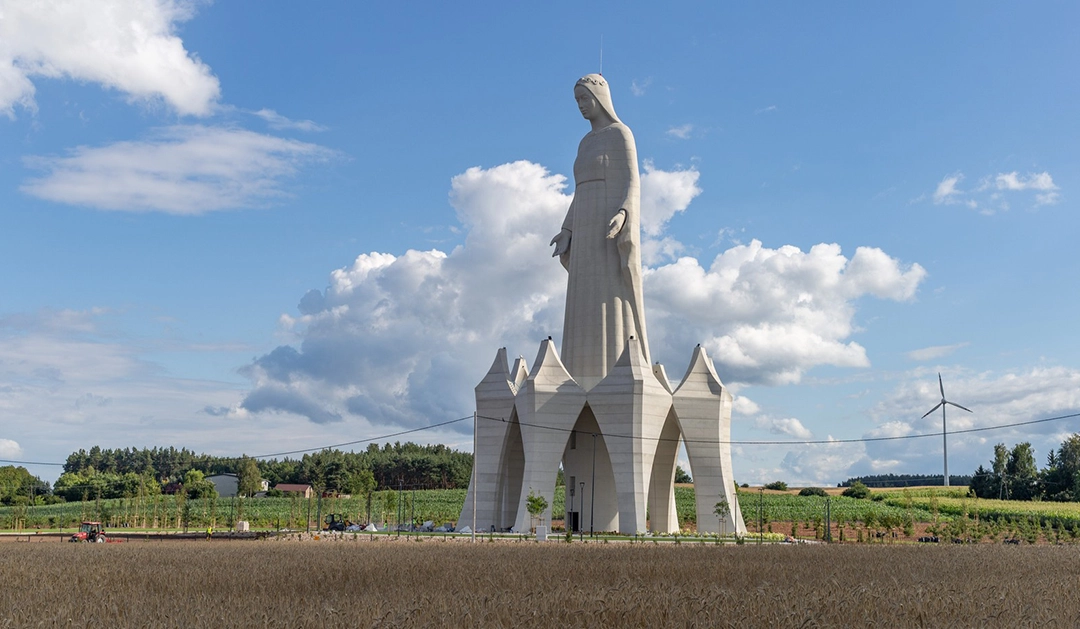
Poland inhabits that same secularizing world. Which makes it somewhat unexpected that, as faith loses adherents everywhere —particularly among the young and among city dwellers— a monument of this magnitude should suddenly appear. It stands planted in a rural landscape and, of course, everyone expects the village to fill with pilgrims. The inauguration, at least, drew hundreds of people and even included Lech Wałęsa.
When everyone has gone home, certain coordinates will remain fixed.
The statue is going to reconfigure the entire area, visually and symbolically. White, monumental, and solitary, it will somehow bless the landscape, the soil, the fruits, everything that prospers beneath its gaze. The apples will be holier, the grapes more devout, the wine more spiritual than spirituous. Its scale points, above all, to the economic power of those who made it possible, who from this summer onward will presumably be forgiven almost anything. The faith that will spring from its height like a silent fountain is going to materialize an infrastructure of its own. Reproductions in every size will be sold, along with holy cards and little medals. The devout will arrive, spend the night in saintly inns, and fornicate quietly with some residual fear of God, never quite enough to outmaneuver their sturdy lusts. It will become a point of reference: to the right of the Virgin, just past the Virgin, almost upon reaching her.
For all the disbelief it provokes in me, I feel a tired sort of joy. And I celebrate it, because I would rather have a Virgin than a TikTok influencer shaking her transition node. Why not?
The world today is overflowing with atheists. I suspect that in no small number of them, their dissent from God reprises a much earlier conflict with primordial forms of authority. People who never quite finished accepting the basic rules of upbringing, maternal or paternal severity, and who, long past the proper age for it, still practice a vague, disoriented, and rather visceral resistance, incidentally, to anyone or anything —above or below— telling them what may or may not be done.





If you’re a regular reader of this blog and enjoy its content, you might consider contributing to its upkeep. Any amount, no matter how small, will be warmly appreciated
Founded in 2021, Echoes (Notes of Visual Narrative) invites everyone to explore together the visual codes that shape our world—art, photography, design, and advertising in dialogue with society.

Copyright © 2026 r10studio.com. All Rights Reserved. Website Powered by r10studio.com
Cincinnati, Ohio
Comments powered by Talkyard.