
Part One
The Cuban troubadour Silvio Rodríguez recorded “Testamento” in 1979 for his album Rabo de nube. It is the last of nine, and you would have to be a fool to move it from the closing position. He wrote it in 1976, probably in Angola, with the possibility of being struck by a stray bullet before him.
Told that way, it is a beautiful, heroic story. Still, I do not rule out the possibility that as he wrote it—practically wept it—he was trying to quiet the certainty that he would need many lifetimes to make all the songs he had ever imagined. He would have been about twenty-nine when he composed it, thirty-two or thirty-three when he recorded it.
With the added disadvantage that I start everything too late, and setting aside the distances between us, with no intention whatsoever of joining him on any stage, I recognize myself in the weight of knowing that many pages will remain promises, germs suspended in possibility. That is why I want to write about a few music videos, which I have always wanted to examine for their visual narrativity, for their ability to sustain a complex iconographic system almost apart from the music they accompany.
A song burns with a different intensity when it finds its body in the visual universe. It happens less often than the industry would like and more often than musicians are willing to admit. When it does, the video tends to run far ahead in the race to inscribe a cultural product in the collective imagination. In memory, ordinary songs, when they are remembered at all, attach themselves to a particular setting or moment, always bound to its context. The video, however, endures there with a different texture. There are cases—few, but they exist—in which an artist’s entire public image is redefined by a particular visual narrative. In the public’s memory, the artist’s name becomes bound to what people saw on screen, while the person behind the voice recedes into the background.
Consider Sia Furler, her sudden turn toward invisibility, and the video for her song “Chandelier.” Then we will talk about her performer, Maddie Ziegler.
The Sia fable tends to be oversimplified. Her decision to “disappear” came before this video. In 2013, after a decade of writing hits for other singers, she published a manifesto against fame and posed for a Billboard cover with a paper bag over her head. She removed her face from her covers and all her promotional material. Naturally, that was bound to have consequences. How could she be present and absent at once? How could she remain recognizable, how could she replace a face with something capable of emulating it? Do you remember when Prince changed his name to a symbol no human being has ever been able to pronounce? Do you remember when they started calling him “the Artist Formerly Known as Prince”?
Sia was still Sia, and her name was enough to identify her. Yet by withdrawing her face from the public gaze, she interrupted the most immediate link between identity and recognition, depriving her hallowed image of what turns a proper name into a visually identifiable presence.
She needed some colorful, mischievous putty to fill that gap. She found it on May 6, 2014, in a video less than four minutes long, shot in an empty apartment and starring an eleven-year-old girl to whom she handed her wig. “Chandelier” was her first single as a lead artist to enter the Hot 100, where it reached No. 8. In her television performances, she sang with her back to the audience or facing a wall while dancers and actresses recreated the worlds of her videos onstage. From then on, her name would be bound to a platinum-blonde wig and a pair of deceptively fragile-looking legs.
Sia has at least three cult videos. This one, “Chandelier”; the first video version of “Cheap Thrills,” from 2016; and “Unstoppable,” filmed during the Nostalgic for the Present tour, also in 2016, and released as an official video in September 2021. She and Daniel Askill directed all three, and Ryan Heffington choreographed them. I want to focus on videos whose visual experience pushes the song that gave rise to them into the background and, in a way, turns it into a soundtrack.
The child figure who gave the Sia phenomenon its densely charged face was Madison Nicole Ziegler, born in Pittsburgh in 2002. Sia saw her on Dance Moms, Lifetime’s reality show, which spent five years filming the students of the Abby Lee Dance Company and, above all, their mothers. She wrote to her on Twitter. Maddie was eleven when she filmed the video. It was YouTube’s seventh most-viewed video of 2014. Today it has more than 2.9 billion views.
The choreographer contributed more than his fair share. Ryan Heffington was born in Yuba City, California, in the early seventies. No dance school stood behind him, no conventional path of training. He moved to Los Angeles at eighteen, set up two companies, named Hysterica and Fingered—two choices as unusual as they are hard to decipher—and opened a studio in Silver Lake, The Sweat Spot, where people came to sweat even though they had never imagined dancing in public in their lives. His visual arguments emerge from his clients’ gestures. Those who know their image interests almost no one. From what they do when no one is watching, he draws his visual vocabulary; he exaggerates their facial flourishes, breaks them into tics, and stretches them into controlled spasmodic grimaces. “Chandelier” won him MTV’s Best Choreography award and a Grammy nomination; Time wrote that it might be the best dance routine of the year. Best or not, it resembles nothing else.
It has been a good while since the makers of visual products—music videos, in this case—realized that if they wanted to be taken seriously, they had to switch their products off. Desaturate them, that is. For almost a century we have been assaulted by advertising shrieking from garish palettes. We are fed up, our eyes are burning, so the sensible thing is to dispense with colors that impose themselves as a statement in their own right. If anything, let a couple of drops of one or another fall into the spaghetti-like visual tangle, that amalgam of signs, as decoration, as an accent.

The clip opens with a tour through a vacant, dirty apartment, with low ceilings and walls whose paint has lifted in the damp. A hallway cuts through the middle of a space whose time has already been consumed. Through the window, the architecture around the location flashes past, the former Los Angeles Herald Examiner building in downtown Los Angeles, California. It lets in a little light, insolent and useless.
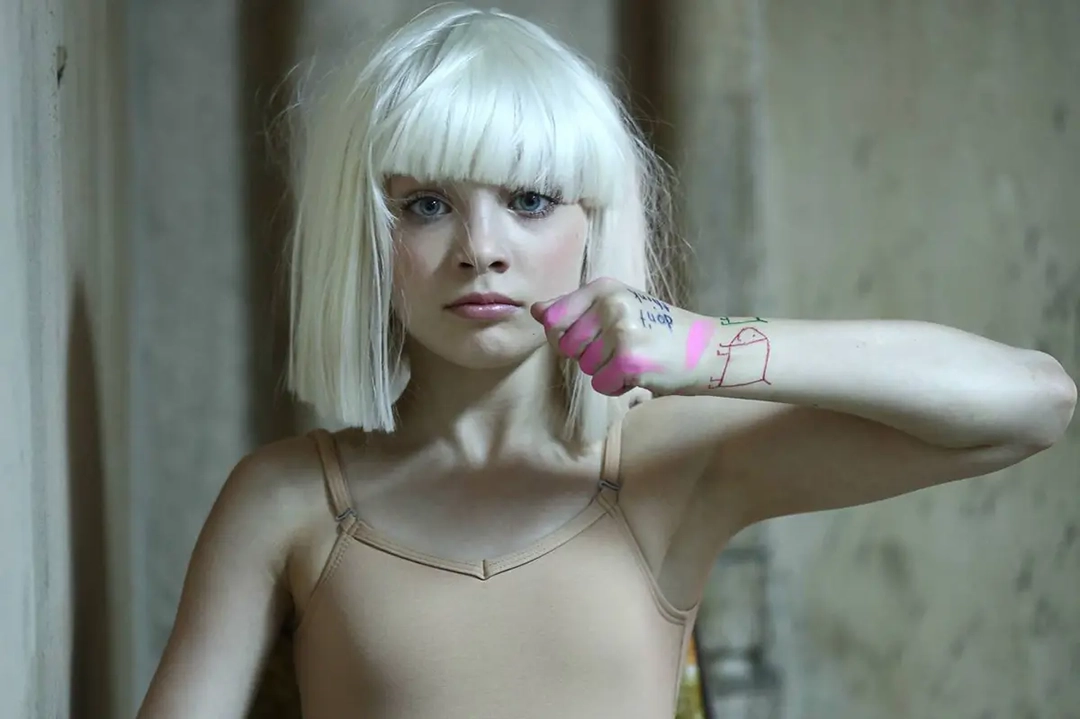
A girl I cannot classify, describe, remember, or ignore stands at the doorway, holding on to its frame. From then on she will be the center of that domestic universe, the sun around which battered furniture, lamps, and cheap pictures orbit, remnants of an abandoned world. She also wears a shoulder-length blonde wig, the same one Sia was using at the time to promote her album. She wears a leotard close to her skin tone, designed to command no more than a second of our attention, so that we see only the movement, the legs, the wig, and, above all, the face she wants to wear, the face of someone who does not want one.
The room is arranged so that her body seems even smaller and more vulnerable. Her movements, however, overflow it. She occupies the whole space without the slightest hesitation, with the insolence—and grace—of someone putting a candy too large for her mouth into it.
The choreographer, brilliant as it happens, asks the girl to do something far more exacting than dance. He asks her to condense the last six or seven years of her life into four minutes and, in one single gesture, dancer, child, almost adolescent, to relive her joys, her tantrums, to display the full repertoire of gestures and expressions with which she has challenged a world ruled by “the grown-ups”: parents, teachers, society, all those who have made her learn and obey the rules.
And the golden angel runs, lets herself fall, rolls, springs back up, and executes the classical leaps she has mastered with exactly the impatience required to make them imperfect.
Almost the whole choreography seems accidental, driven by the demons’ hunger. Look closely and you will see the turns left unfinished; each movement that brushes against virtuosity is followed by a childish, capricious, irreverent gesture, which in turn is immediately purified by another, as exquisite as the one before it. And so the intensity rises in crescendo. We climb aboard an emotional roller coaster, hand in hers. She builds and dismantles an identity, undoing it each time we take it for granted. She changes direction at dizzying speed while the camera follows as best it can.
The camera cannot afford to blink. If it does, it loses her, because the girl crawls and runs through the space as if she had lived an entire life there. Perhaps that is why the apartment serves as her dance partner. She dances with it, with the furniture, throws herself onto the beds, turns every corner into the setting for some mischief. I seem to remember Heffington emphasizing the child’s appropriation of the space, which looks abandoned until the girl brings it back to life.
All this movement, beyond the song itself, forms an autonomous piece that breaks with the traditional choreographic sequence through clumsiness, pats on the belly, pouts, childishness in general. It tends toward chaos and at moments offers pirouettes we would assume beyond the reach of any child. I am sure many things went wrong during the shoot, and stayed that way. Not everything can be choreographed. The height of the leaps, the flexibility, and the imprecision visible in every movement are also products of an inexact body, still developing, changing, a body that yesterday was smaller and weaker than the one that arrived on set.
The meaning will rest, in large part, on the smallest details. The camera does not move in on her face very often. When it does, we climb to more precise levels of signification. At around 1:37, we get a close-up in which we can read several pages of a preadolescent girl’s diary. She wears a badly drawn animal—possibly a dog—on her left wrist; her fingers are stained a silly pink, like chewing gum. She mimics the act of brushing her teeth, and the feeling of being thoroughly fed up with having to do it. She scratches the wall, opens her mouth in a grimace of feline hostility, launches the silent threat of a cornered cat. We cannot tell whether she is playing or possessed.
At 2:56, she places her face between the curtains of one of the windows and lifts her eyelid with a finger of her right hand, also stained pink. It is a moment of utmost vulnerability. In those two seconds, she condenses everything difficult about being a girl moving through the exhausting imperative of adolescence.
Have you seen her hands? They dance as much as her feet.
I once wrote, apropos of butoh, about bodies acted upon by anxious spirits, invisible presences that make memory flesh. There is no reason to assume Heffington ever looked to Hijikata. But the girl moves as if some unnatural force were shaking her, and that impression comes, I suspect, from the constant materialization of the inexact. An adult, trained body would have done the same thing more cleanly. And would have done nothing new.
To be continued





If you’re a regular reader of this blog and enjoy its content, you might consider contributing to its upkeep. Any amount, no matter how small, will be warmly appreciated
Founded in 2021, Echoes (Notes of Visual Narrative) invites everyone to explore together the visual codes that shape our world—art, photography, design, and advertising in dialogue with society.

Copyright © 2026 r10studio.com. All Rights Reserved. Website Powered by r10studio.com
Cincinnati, Ohio



Comments powered by Talkyard.