I exaggerate, of course, but when I read this news item, I once again had the vague impression that I was witnessing the gradual disintegration of the world my parents had bequeathed to me. The world that shaped my experience and my life up to this point. Perhaps, too, because whenever I write about roses, I am enveloped by the bittersweet haze of the past, above all, of what has fallen prey to oblivion.
Roses—seen in this light—have sculpted my entire life, emotionally and professionally. In the late 1980s, I was captivated by Umberto Eco’s Il nome della rosa, even more so by its Apostille. I discovered semiotics and the tremendous power of symbols. I resolved to devote myself to it in a future as distant as the galaxy where Luke Skywalker rescued Princess Leia and joined the Rebellion. Those were beautiful days, when countless pages still lay ahead to be read. I spent hour after hour in that monastery, lit by a dying sun that went out with the manuscript’s final verse: stat rosa pristina nomine, nomina nuda tenemus. A verse by the Benedictine Bernard of Morlaix: “Of the rose of yesteryear, only the name remains; we keep names, stripped bare.”
Not long afterward, I read Jorge Luis Borges’s poem “What Can I Hold You With?” in Páginas escogidas, published by the Cuban publishing house Casa de las Américas and translated from the English by Retamar. Its line “I offer you the memory of a yellow rose seen at sunset, years before you were born” left a deep impression on me, for its dramatic beauty.
For a brief while, that yellow rose opened a door to an abyssal, golden, unforeseen life, so intoxicating that it made me take a step back. Through divine intervention—or through monumental stupidity—the door closed at once, as definitively as the marble of The Farewell, by the same artist.
By this I mean that roses are everywhere.
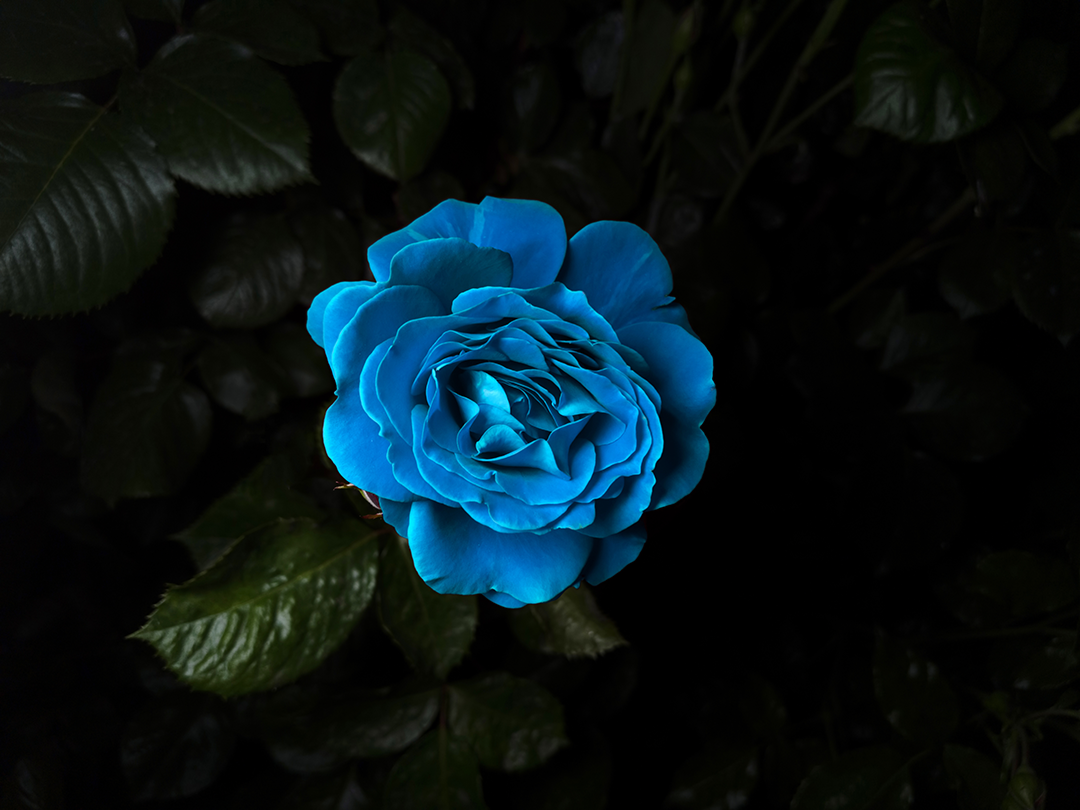
The news item in question reports that researchers at the Suntory Global Innovation Center in Kyoto, Japan, have developed violet-blue roses through genetic engineering. Along with the gene that enables the production of the blue pigment delphinidin, they introduced genes from other flowers that produce auxiliary molecules capable of intensifying the color. Strictly speaking, according to a precise color chart, the flowers are actually more violet than blue. What is certain is that the bushes produced blue flowers for seven years in greenhouse trials in Japan and for three years in open fields in Colombia. The team will continue working to intensify the blue hue that, for centuries, existed only in the imagination of poets.
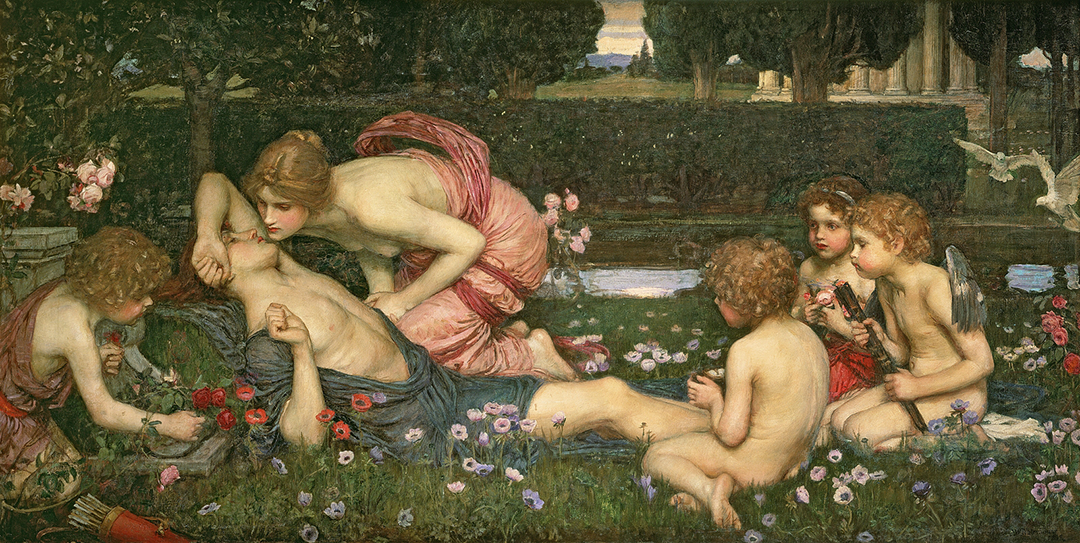
John William Waterhouse
The Awakening of Adonis, 1899
Oil on canvas, 95.9 × 188 cm
Private collection, Andrew Lloyd Webber Collection
Exhibited at the Royal Academy, London, 1900.
The rose’s potential as a symbol was recognized in the Greek dawn. They immediately associated it with Aphrodite and linked its birth to her. The story of its redness comes from there. According to Pausanias, the rose turned red with the blood Aphrodite shed when she cut herself on its thorns as she ran toward the dying Adonis.
The Romans inherited from the Greeks their devotion to the rose and its bond with the goddess—Venus in their pantheon. They also gave it the sense of secrecy, sub rosa, which literally means “under the rose.” Today the expression refers to something confidential or private. Perhaps this is because Cupid gave a rose to Harpocrates, god of silence, so that he would keep Venus’s love affairs secret.
The symbolism of the rose grew from there in every direction, almost always red, sometimes pink, sometimes yellow. That was how Juan Ramón Jiménez found it perfect: “Touch it no more, for that is how the rose is.”
So, knead it and see what comes of it.
The researchers are not starting from nothing. In fact, the Science News article flirts with the most repeated children’s rhyme in the English language, “Roses are red, violets are blue.” Generations of schoolchildren have copied it into their Valentine’s Day cards. Its immaculate simplicity has lent itself to endless parodies. Spenser had already paired red roses with blue violets in The Faerie Queene (1590), in the passage where the maiden Chrysogone bathes in a forest spring surrounded by flowers. The rhyme in the form we know today is documented in a London collection from 1784. For more than four centuries, no one questioned the distribution of colors between these two flowers.
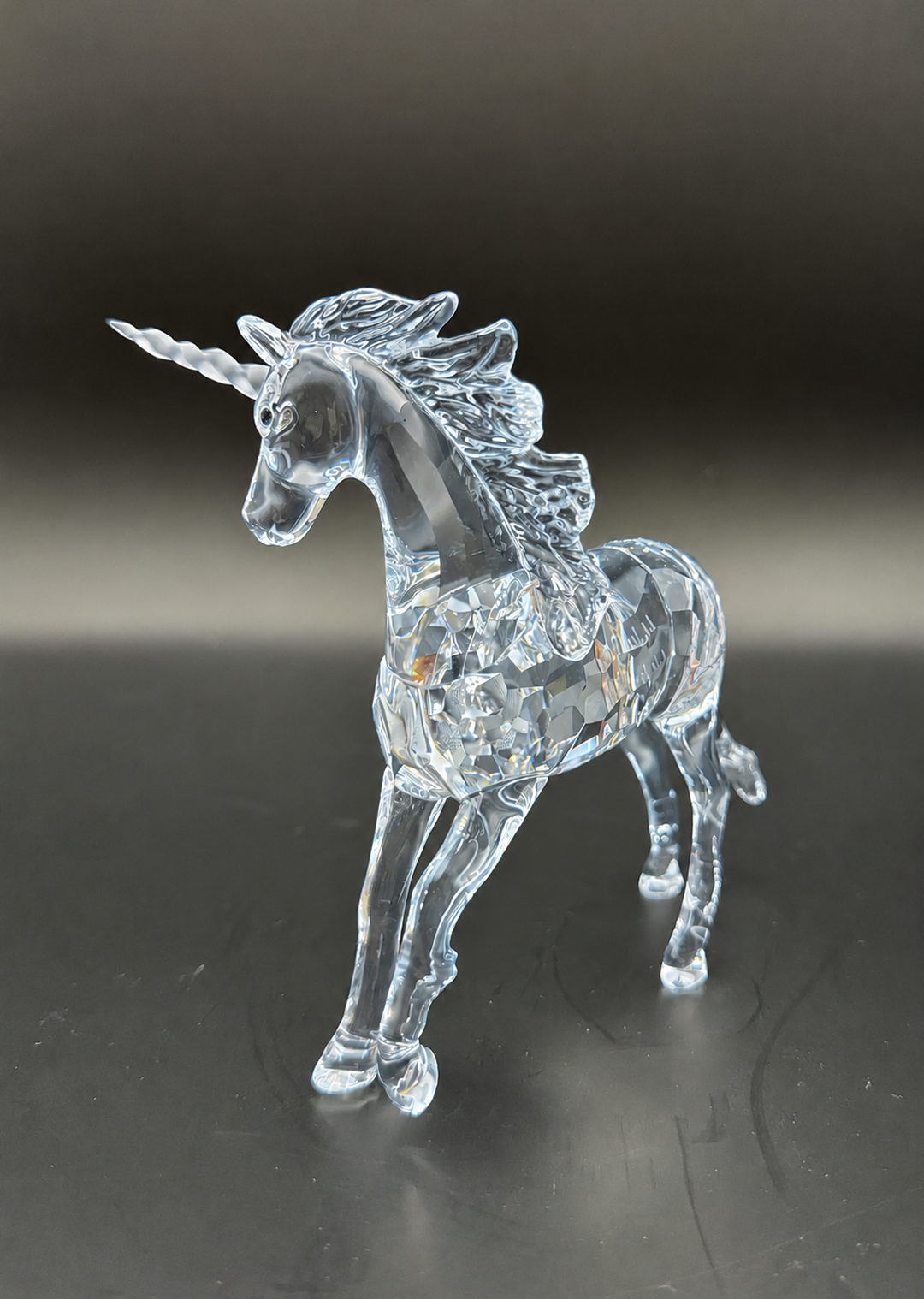
The most captivating blue rose is the one Tennessee Williams cultivates in his 1944 play The Glass Menagerie.
Laura Wingfield, a shy young woman with a slight limp, who lived sheltered by her collection of glass figurines, missed a term at school because of pleurisy. When her classmate Jim asked what had happened to her, he misunderstood the word pleurosis and thought he heard “blue roses.” He remembered her that way from then on. Years later, he reappears at the Wingfields’ home as the suitor Laura’s mother had so long hoped for. In the final scene, Jim tells Laura that she is as rare as a blue rose; he kisses her and, immediately afterward, confesses that he is engaged to someone else. Dancing that night, they accidentally break the horn of her favorite unicorn. The little glass animal becomes an ordinary horse. In the play, the blue of the blue rose stands for what is singular and fragile, what has no place in the world. Williams took his sister Rose as the model for Laura. She had undergone a lobotomy while he was writing the play. We see, then, that his blue rose blooms for only one night.
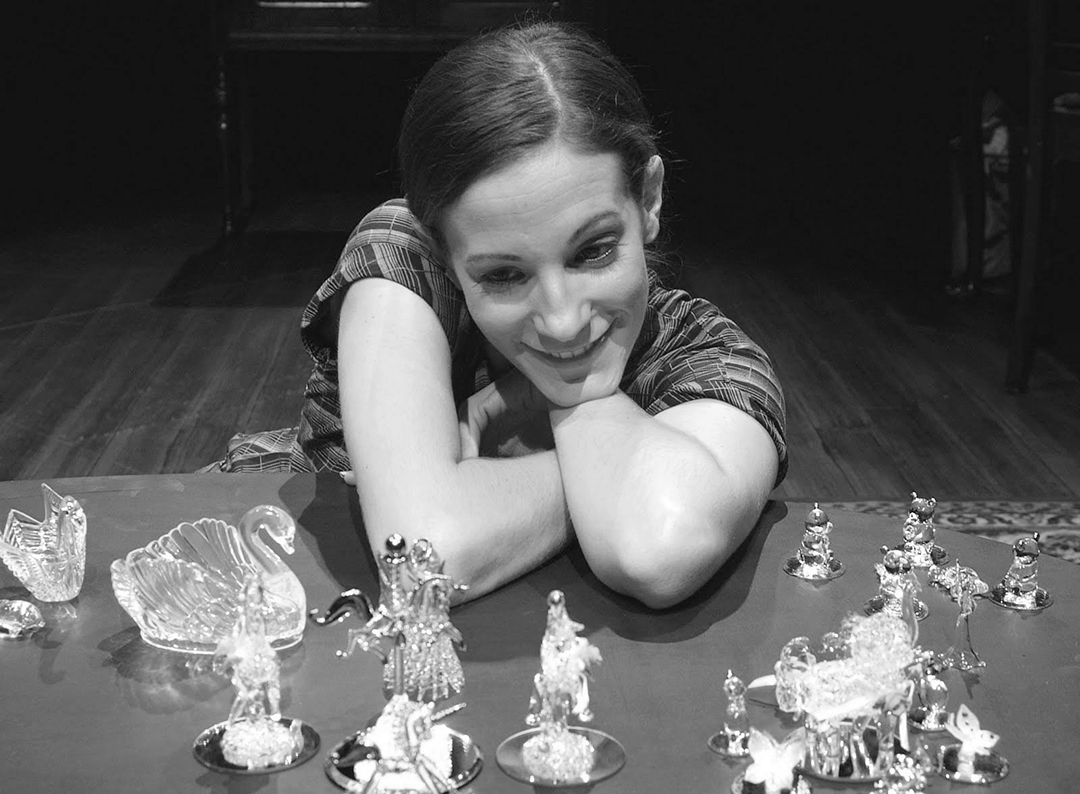
Laura
What lies behind this pursuit, as old as it is futile, of tinting the rose? What secret obstinacy drives us to dress it in a color nature has invariably denied it? For centuries, blue roses have stood as emblems of the unattainable. If we find them everywhere, what will remain of their power as symbols, of their poetry? Suntory Global spent 36 years trying, until it succeeded. But it succeeded by twisting the rose’s genome.
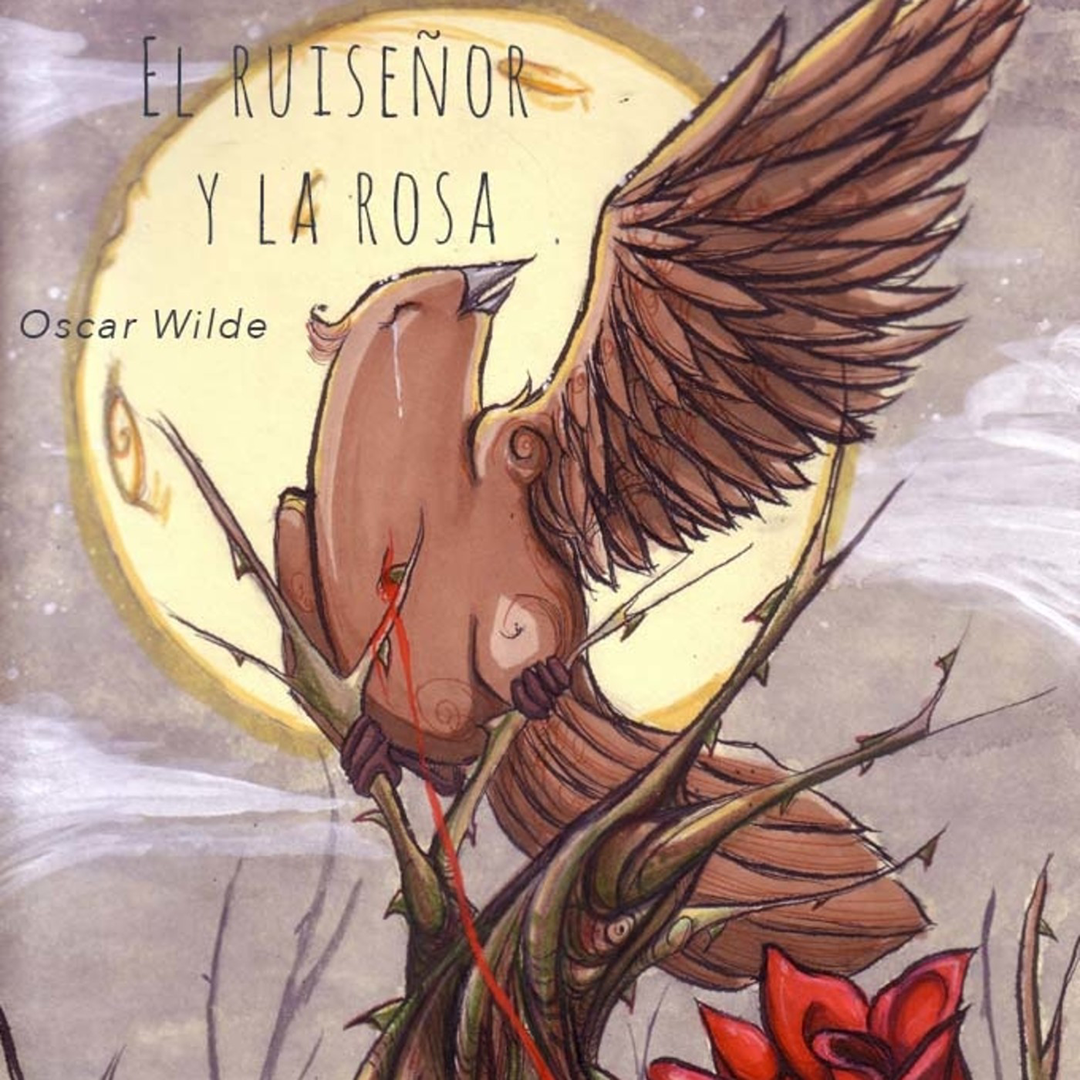
Oscar Wilde gave it a beautiful color through poetry. In “The Nightingale and the Rose,” he has a nightingale stain a rose red with the blood of its own heart, so that a student can offer it to the girl he loves. She rejects it, and the rose ends up in the street, beneath a cartwheel. A deeply painful scene for anyone who has known the madness of sterile, misguided efforts.






If you’re a regular reader of this blog and enjoy its content, you might consider contributing to its upkeep. Any amount, no matter how small, will be warmly appreciated
Founded in 2021, Echoes (Notes of Visual Narrative) invites everyone to explore together the visual codes that shape our world—art, photography, design, and advertising in dialogue with society.

Copyright © 2026 r10studio.com. All Rights Reserved. Website Powered by r10studio.com
Cincinnati, Ohio