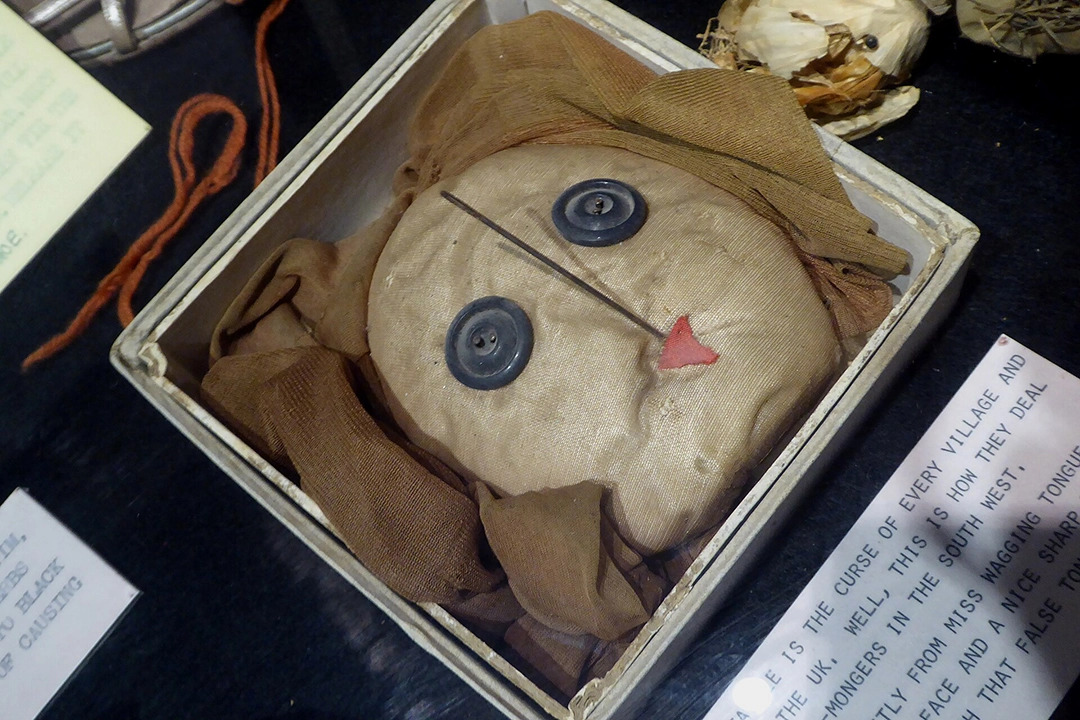
Cloth doll with button eyes and a needle piercing its felt tongue; according to the label, a remedy for the village’s malicious tongues.
Museum of Witchcraft and Magic, Boscastle, Cornwall.
Photo: Ethan Doyle White, Wikimedia Commons, CC BY-SA 4.0.
The November 19, 2026 issue of Science, Vol. 394, No. 6826, devotes two pages to an essay that, despite appearing in the books section, says nothing about a book. It begins with a confession somewhat unusual for a science journal. K. Paige Harden, a psychologist at the University of Texas at Austin, recalls that on Thanksgiving Day 2018, recently separated and without her children, she had dinner in New Orleans in front of a chalkboard announcing the soup of the day: Vodka. Her companion, noticing how low she was, suggested they visit one of the voodoo shops in the French Quarter and buy one of those dolls people stick pins into. She wanted to make a particular “someone” pay for the misery he had caused her.
She never went into the shop or bought anything. She is ninety-nine percent convinced that magic is a tall tale, but because she was raised in an evangelical family—with demons milling about everywhere—that remaining one percent gave her a slight unease. Trying to torture someone from a distance by sticking needles into a doll that, in some perverse way, invoked them seemed to her like flirting with forces she could not quite gauge, and had no intention of unleashing under any circumstances. I know the feeling. I probably would have done the same.
Eight years later, that scruple strikes her as rather innocent. That person, she herself, you and I—each of us has a “doll” that represents us.
Harden calls them “digital doubles.” They are electronic entities gradually shaped by our interactions with networks. Every click we make adds a hair. They acquire substance with every purchase we make in an online store, every step they record, and every second we linger over a particular image. They are manufactured by companies we don’t know exist. We ourselves—with considerable enthusiasm, as it happens—hand them another piece of our psychological puzzle every time we enter data or accept cookies.
Even those who have not yet been born have one waiting for them. An in vitro fertilization procedure often leaves five or six embryos in the lab, and some clinics offer an additional service. A few cells are taken from each embryo, its DNA is read, and a score is calculated for everything one might fear or desire—diabetes, heart attack, schizophrenia, height—by adding up the blurred effect of thousands of genetic variants. The parents receive a table with one column for each embryo. Number 3 may be spared diabetes but be more asthmatic than Number 1, while Number 5 may turn out tall but nervous. They use the data to choose which one to implant. For some parents, the first encounter with their child will be a numerical matrix. They will try to make the child as much like their mathematical projection as possible.
And, as in magic of the old kind, the doll need not be an exact likeness to work. It helps determine the credit we are denied, the job we are not offered, and the partner selected for us. All without anyone ever having seen our face.
In March, to take a recent example, I wrote here that Facebook had started sending me dozens of photos of Ana de Armas with one leg raised and her foot pointed toward the sky. I could not understand why. I mean, I like Ana de Armas, but I have no particular preference for a single raised leg. Perhaps in some refrigerated server lives a little figure bearing my name, one that seems to feel a devotion to pointed feet I had never suspected in myself. It is she—not me—whom the bombardment is aimed at.
As a psychological portrait, it is rather mediocre. I have been drawn with delusions and phobias I do not recognize, and would have denied if anyone had asked me. They have not taken a single line from life, yet assume the resemblance with confidence. A fairground caricaturist would have taken greater care. But there is nothing to be done. That figure is much more me than I am, and whoever questions it in order to sell me something, lend me money, or deny it to me has not the slightest curiosity about the flesh-and-blood version.
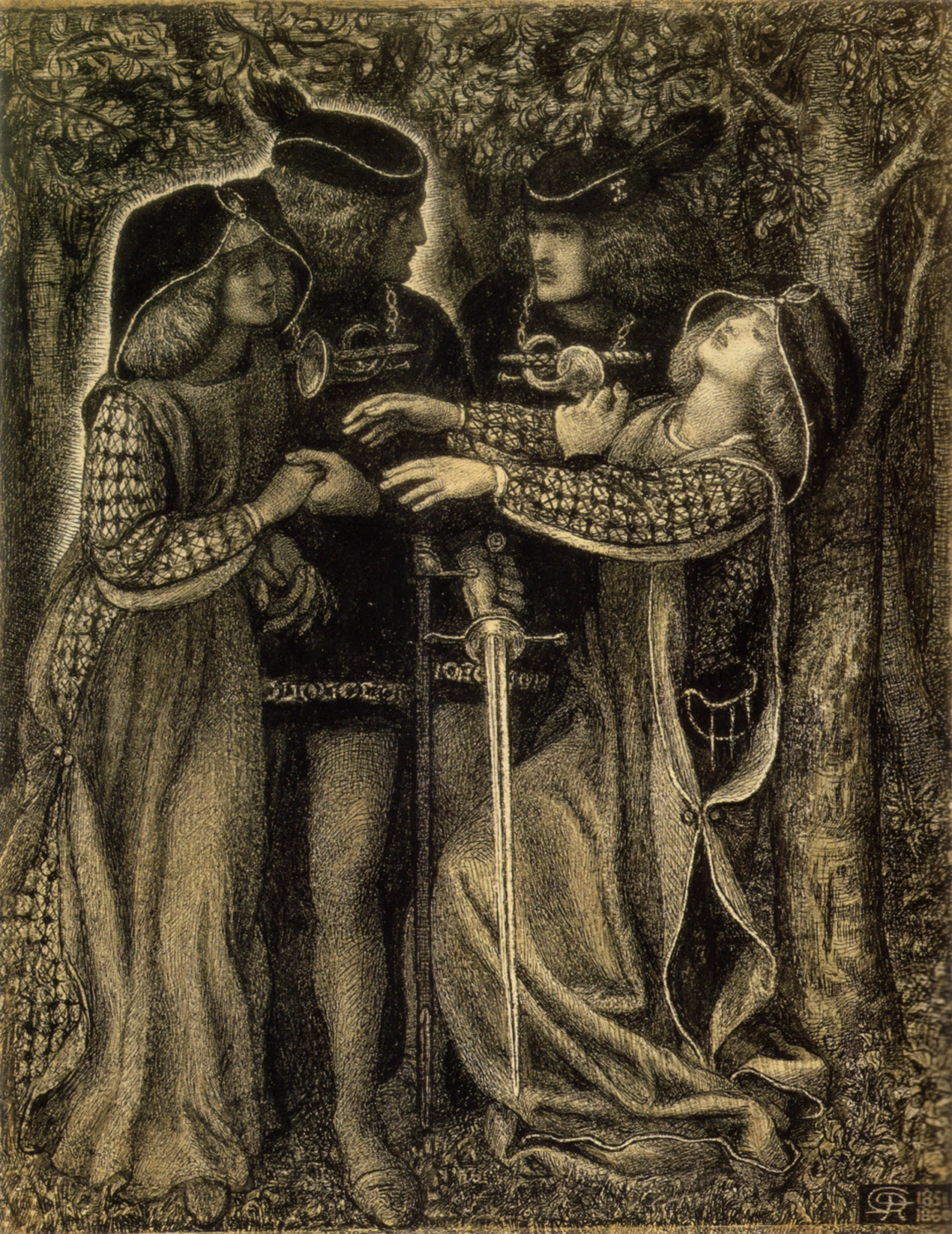
Dante Gabriel Rossetti, How They Met Themselves, 1851–1860. Pen, ink, and wash. Fitzwilliam Museum, Cambridge.
Wikimedia Commons, public domain.
These substitutions of one person for another have accompanied humanity since it was crawling. I remember a drawing by Dante Gabriel Rossetti, How They Met Themselves, which the painter himself called his “Bogie drawing,” something like the drawing of the bogeyman—the one Viggo Tarasov said only John Wick could eliminate. Two lovers stumble in the thick of a forest upon a couple identical to themselves, outlined by an implausible glow. The original has drawn his sword—resting it on the ground—while his companion fades away, arms outstretched toward the double, who regards her with calm disdain. In the lower-right corner appear two dates, 1851 and 1860. According to the Fitzwilliam Museum in Cambridge catalogue raisonné, Rossetti completed the version in its collection during his own honeymoon in Paris. As you can see, everyone celebrates as they please. Legend has it that whoever meets their double has only a few days left.
In Edmund Spenser’s poem The Faerie Queene (1590–1596), Florimell is the fairest lady. Every knight pursues her. A witch’s son falls in love with her and falls ill when she flees. To console him, his mother makes a copy. She fashions its body from wax and snow, with two little lamps for eyes; its hair is made of golden thread, and an evil spirit speaks for it, bringing it to life. It is the duplicate who travels through the poem from beginning to end. The knights compete for her, preferring her to the real Florimell a thousand times over. The real one is being held prisoner by Proteus at the bottom of the sea, bored out of her mind. In the end, the two are placed side by side, and the false one melts, evaporates, and lets her belt fall to the floor with an awkward metallic clatter. In this case, as we can see, we have evolved toward a copy palpable to the touch and visible, and although people say the original always comes off worse, I am not so sure that is true here.
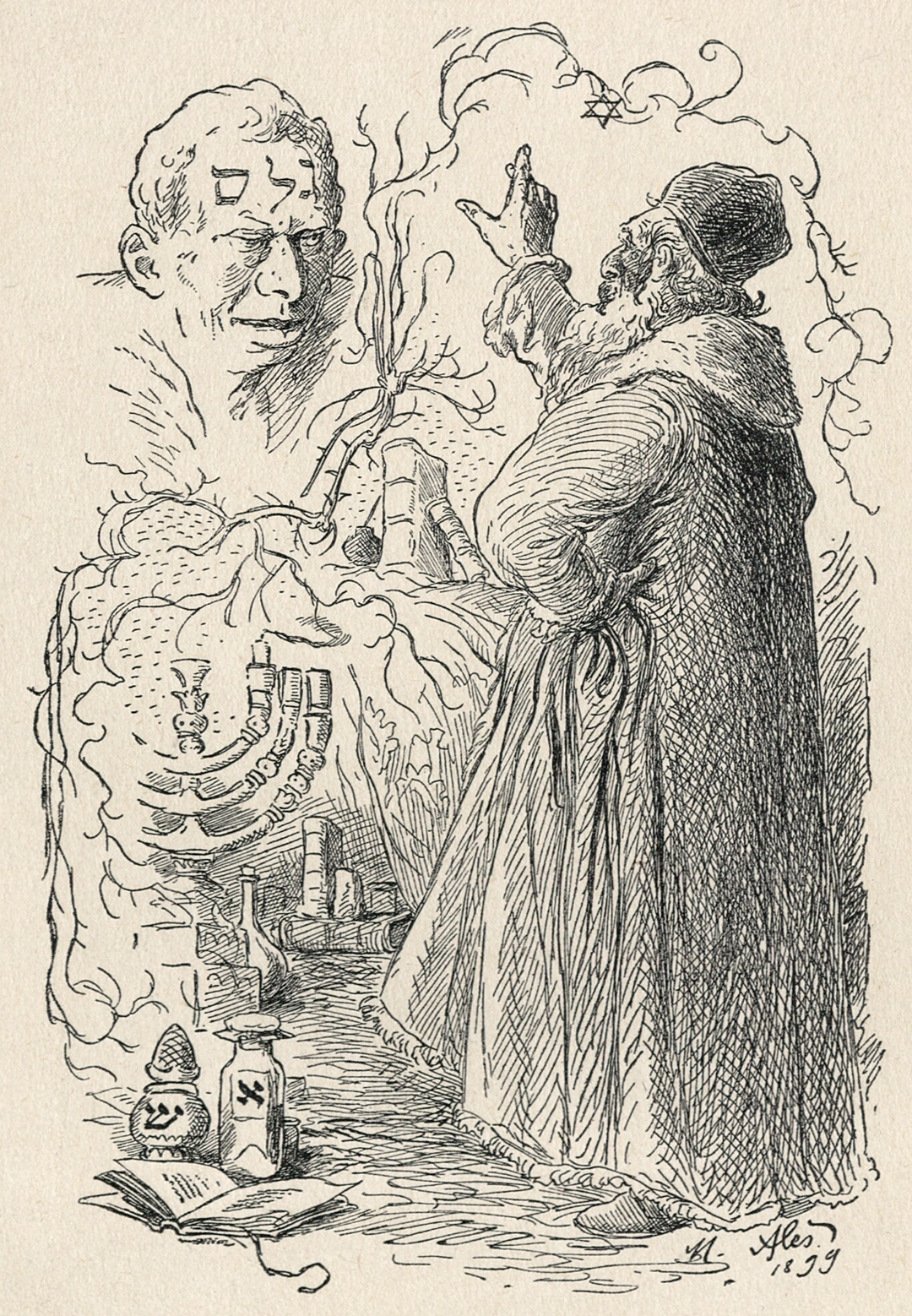
Mikoláš Aleš, The Maharal of Prague and the Golem, 1899.
Wikimedia Commons, public domain.
The next replica is the collective one. Language models—ChatGPT, Claude, and the rest—copy the species’ entire system of communication. They also seem quite autonomous. Harden compares them to the golem, the creature that, according to legend, Rabbi Judah Loew created in sixteenth-century Prague from inert matter—clay brought to life by sacred formulas—to defend the Jews of the ghetto. The golem embodies a living question. What happens when a creation meant to serve and protect acquires a power its creator cannot control?
I want to believe it is still controllable for now. I have been paying for several AIs since they came out, and I use them all the time. My opinion is grounded in the clay I have in my hands.
Will this or another doll replace us? Of my nearly three thousand Facebook friends, very few really know me, and fewer still have spoken with me in person. Right now, in a general sense, am I more replica than reality? The replica answers emails, translates from several languages. Is it still unmistakably distinguishable? Is it more intelligent, does it have a better memory, does it never tire? Are we in the midst of a process of fusion, after which no one will have any idea where I begin and end? Not even me? Are we better if we integrate ourselves into payment systems?
Some answers may come from Rome. In his encyclical Magnifica Humanitas, signed on May 15, 2026, Leo XIV devotes eighty-two pages to artificial intelligence and argues that we are made in the image of God because we were “created for relationship.” For centuries, the Church located that resemblance in reason and memory. With a sure instinct, the pope has moved it elsewhere precisely when both of those faculties have begun migrating into virtual ecosystems. Harden finds the same idea, without God, in anthropology and developmental psychology. We are born so helpless that our brains grew large in the effort to remember the face of whoever fed us. What makes us human, then, would be dependence: needing to be cared for and, when the time comes, caring for others.
The tech companies have read the same thing and reached the opposite conclusions. In November 2025, Nucleus Genomics plastered the New York subway with “Have Your Best Baby,” where “best” naturally means the one who gives us the least trouble. Artisan, a San Francisco startup, spent two million dollars on billboards proposing “Stop Hiring Humans,” because humans need to eat and sleep, get sick, laugh, and become distracted during work hours. Two years later, the company had to take the ads down and apologize. It had no choice but to keep working with people. For now.
Harden ends her essay by quoting the poet and farmer Wendell Berry, who refused to buy a computer and announced a quarter-century ago that the world would divide between those who want to live as creatures and those who want to live as machines. She sides with the creatures, but holds on to her machine, her Instagram account, and her Anthropic subscription—the same company that sent one of its founders to speak for seven minutes at the Vatican presentation of the encyclical. I don’t hold it against her. I am sitting in the same chair and receiving the same bills.
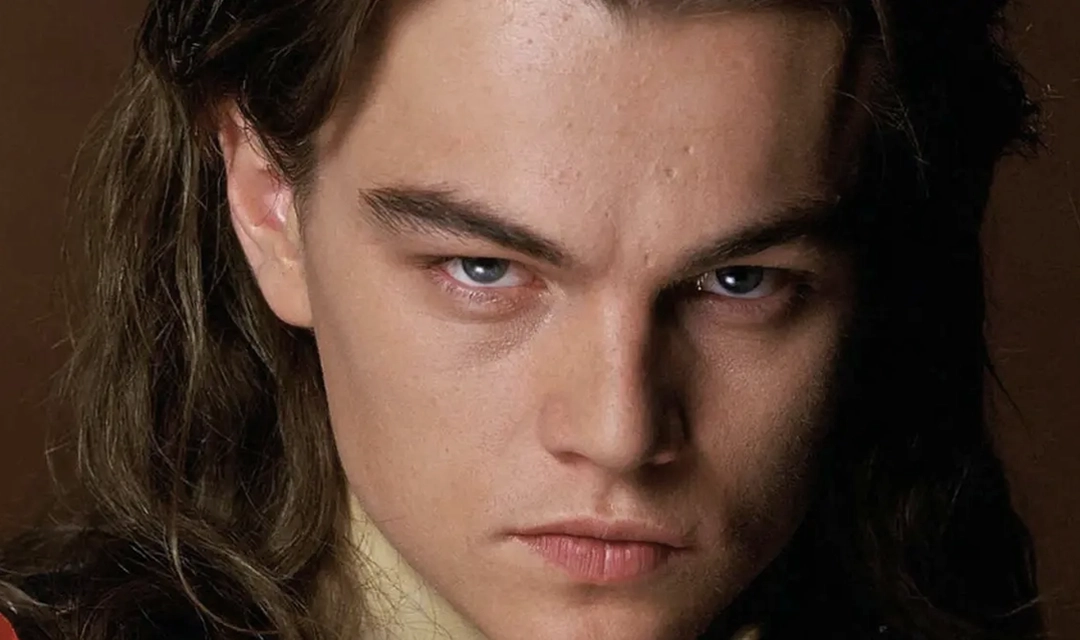
One detail the magazine does not mention is that Harden co-directs the Texas Twin Project at her university, a registry of twins. She has spent half her life studying people who came into the world with a replica and who, as far as she has been able to tell, get along quite well with it. In The Man in the Iron Mask—the DiCaprio film—the twins cannot both fit in the same palace, and the plot’s only question is which of them will keep the mask and which the crown. The Texas twins, who may share the occasional lightweight mask and almost certainly no crown, get by with taking turns using the car and, in their fantasies, the girlfriends. I no longer get photographs of Ana de Armas with her foot pointing toward the ceiling. And let the record show, I like her very much. Now I’m getting Anya Taylor-Joy, all demure and tucked in. What’s going on, little doll… what are you up to?
Note
The title of this article is taken from I Am the Walrus by John Lennon
The Beatles, Magical Mystery Tour (1967)
Release date: 24 November 1967
I am he
As you are he
As you are me
And we are all together




If you’re a regular reader of this blog and enjoy its content, you might consider contributing to its upkeep. Any amount, no matter how small, will be warmly appreciated
Founded in 2021, Echoes (Notes of Visual Narrative) invites everyone to explore together the visual codes that shape our world—art, photography, design, and advertising in dialogue with society.

Copyright © 2026 r10studio.com. All Rights Reserved. Website Powered by r10studio.com
Cincinnati, Ohio