March | 2026
Cursor introduced Composer 2 as “frontier-level coding intelligence” without initially saying that the model began with Kimi K2.5, an open-source system from China’s Moonshot AI. A user found traces of Kimi in the code, and Cursor later acknowledged the base. The company said only about a quarter of the compute behind the final model came from that foundation, with the rest devoted to continued training and reinforcement learning. It also said the commercial use was authorized through Fireworks AI.
The omission mattered because model releases are staged as declarations of independent invention. A new name, benchmark chart, and product launch can make a layered technical artifact look like a singular achievement. Open-source development works differently: capability travels, is modified, and returns under another brand. Cursor’s mistake was therefore less about borrowing than about hiding the genealogy until outsiders reconstructed it. The episode also disturbed the familiar story of an AI race divided neatly between the United States and China. The supposed rivals already inhabit one another’s products. Composer 2 is not simply American or Chinese, original or copied. It is a commercial model assembled from shared research, private compute, licensing agreements, and a disclosure that arrived only after the borrowed foundation spoke through the code.
Cursor presentó Composer 2 como una inteligencia de programación de frontera sin mencionar inicialmente que el modelo partía de Kimi K2.5, un sistema de código abierto creado por la empresa china Moonshot AI. Un usuario encontró rastros de Kimi en el código y Cursor terminó reconociendo esa base. La compañía afirmó que solo una cuarta parte del cómputo del modelo final procedía de ese fundamento y que el resto se dedicó a entrenamiento adicional y aprendizaje por refuerzo. También aseguró que el uso comercial estaba autorizado mediante Fireworks AI.
La omisión importó porque los lanzamientos de modelos suelen escenificarse como declaraciones de invención independiente. Un nombre nuevo, una tabla de resultados y una campaña de producto pueden convertir un objeto técnico compuesto por capas en un logro aparentemente singular. El código abierto funciona de otra manera: la capacidad circula, se modifica y reaparece bajo otra marca. El error de Cursor no fue tanto tomar prestado como ocultar la genealogía hasta que terceros la reconstruyeron. El episodio también altera el relato de una carrera de IA dividida limpiamente entre Estados Unidos y China. Los supuestos rivales ya viven dentro de los productos del otro. Composer 2 reúne investigación compartida, cómputo privado, licencias y una revelación que solo llegó cuando la base prestada habló a través del código.

Hachette Book Group withdrew the horror novel “Shy Girl” before its planned U.S. release and discontinued the edition already available in Britain after concerns that artificial intelligence had generated its prose. Readers and reviewers had noticed patterns they associated with machine writing. The author, Mia Ballard, denied using AI herself and said an acquaintance hired to edit an earlier self-published version was responsible. A novel moved from manuscript to product, then became evidence in a dispute about who had actually written it.
The withdrawal gives publishers a new role that extends beyond judging quality or checking plagiarism. They must now establish a chain of authorship for language that can look fluent while hiding its production history. Yet the case also exposes how uncertain that judgment remains. Suspicion can begin with repetitive phrasing, an improbable image, or simply the atmosphere around a book, then spread faster than any forensic proof. The machine does not need to be listed as an author to reshape the fate of the human name on the cover. In this new editorial economy, provenance becomes part of the work itself, and a writer may be asked to prove that a book is theirs and that every stage of its transformation remained human.
Hachette Book Group retiró la novela de terror “Shy Girl” antes de su lanzamiento previsto en Estados Unidos y suspendió la edición ya disponible en el Reino Unido por sospechas de que su prosa había sido generada con inteligencia artificial. Lectores y críticos habían detectado patrones que asociaban con escritura automática. La autora, Mia Ballard, negó haber usado IA y atribuyó el problema a una persona contratada para editar una versión autopublicada anterior. La novela pasó de manuscrito a producto y luego a prueba dentro de una disputa sobre quién la había escrito realmente.
La retirada asigna a las editoriales una función nueva que va más allá de evaluar calidad o comprobar plagios. Ahora deben reconstruir la cadena de autoría de un lenguaje que puede parecer fluido mientras oculta su proceso de producción. El caso también revela lo incierto de ese juicio. La sospecha puede empezar con una frase repetitiva, una imagen improbable o el ambiente que rodea al libro, y extenderse antes de que exista una prueba técnica. La máquina no necesita figurar como autora para alterar el destino del nombre humano impreso en la portada. En esta economía editorial, la procedencia pasa a formar parte de la obra, y el escritor debe demostrar que el libro es suyo y que cada etapa de su transformación siguió siendo humana.
Microsoft says it will reduce Copilot entry points in Photos, Widgets, Notepad, and Snipping Tool as part of a broader effort to improve Windows quality. The retreat follows years of adding AI buttons and features across the operating system, including the delayed Recall function that raised persistent privacy concerns. The company now describes restraint as a better way to integrate assistance.
A removed button is a small admission that software can become hostile through excess. Each shortcut promised help, but each also changed the shape of a familiar tool and asked users to understand a new layer of behavior. Copilot entered applications that had once performed narrow tasks without requiring a conversation with a model. Its withdrawal gives users back some negative space, the unoccupied area where a tool can remain predictable. Microsoft is responding to feedback, yet the reversal also reveals how product strategy was set. AI was first treated as a presence that every surface needed; now quality requires deciding where it should stay out. The operating system improves when the assistant stops interrupting the work it was supposed to support.
Microsoft afirma que reducirá los accesos a Copilot en Fotos, Widgets, Notepad y Snipping Tool como parte de un esfuerzo más amplio por mejorar la calidad de Windows. El repliegue llega después de años de añadir botones y funciones de IA al sistema operativo, incluida la función Recall, retrasada por problemas persistentes de privacidad. La empresa presenta ahora la contención como una forma mejor de integrar la asistencia.
Un botón retirado es una pequeña admisión de que el software puede volverse hostil por exceso. Cada acceso prometía ayuda, pero también alteraba una herramienta familiar y obligaba al usuario a entender una nueva capa de comportamiento. Copilot entró en aplicaciones que antes cumplían tareas concretas sin exigir una conversación con un modelo. Su retirada devuelve algo de espacio negativo, esa zona libre donde una herramienta puede seguir siendo predecible. Microsoft responde a las quejas, pero la reversión también muestra cómo se fijó la estrategia de producto. Primero se trató la IA como una presencia necesaria en cada superficie; ahora la calidad exige decidir dónde debe quedarse fuera. El sistema mejora cuando el asistente deja de interrumpir el trabajo que debía apoyar.
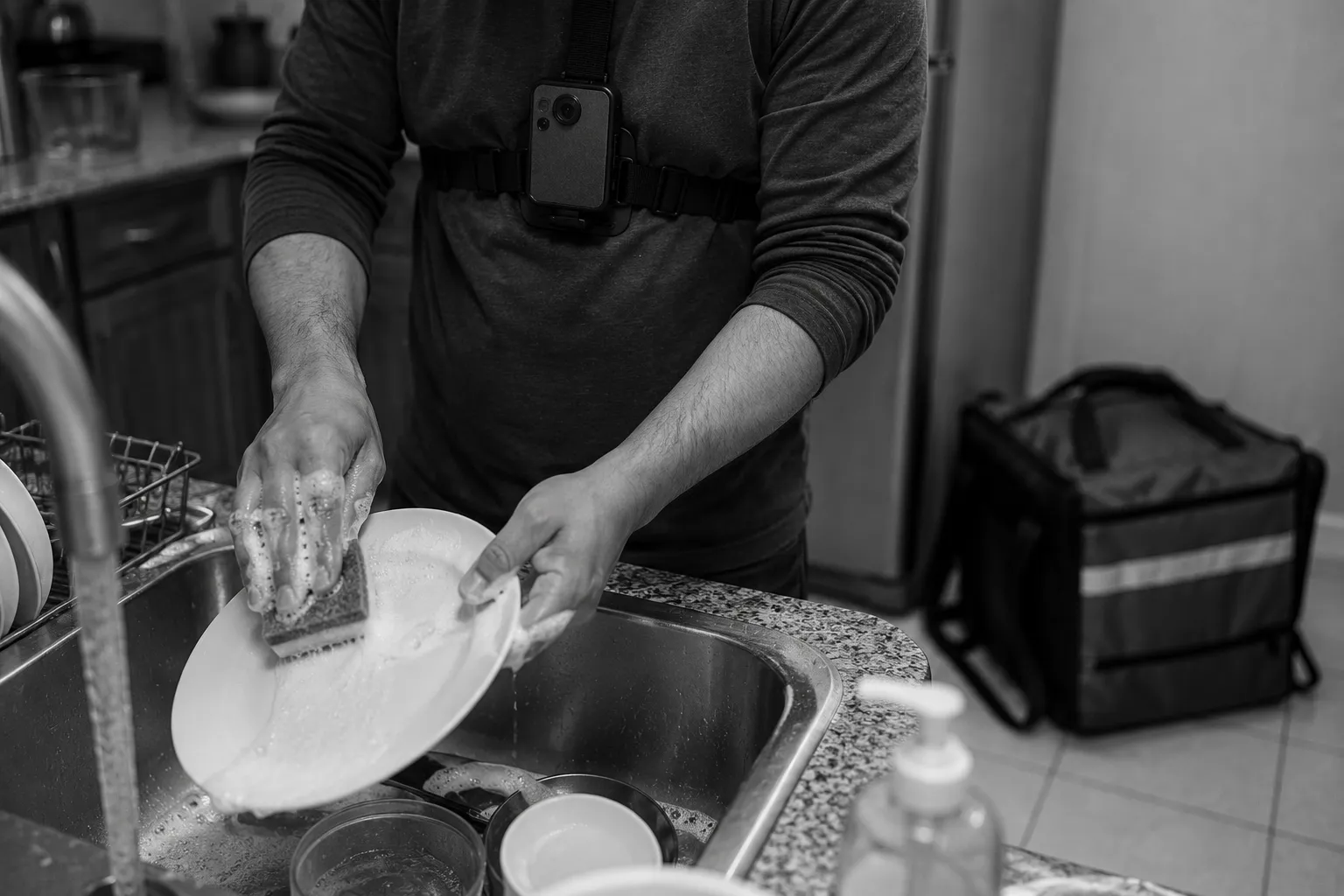
DoorDash is launching Tasks, an app that pays delivery couriers to film ordinary activities and record speech for AI and robotics training. One assignment asks a worker wearing a body camera to film washing dishes, holding each clean plate in view. The courier’s route through the city becomes a route through the physical world, collecting gestures that models cannot learn from polished demonstrations alone.
The arrangement extends platform labor into data production. A worker who already supplies location, timing, and delivery evidence can now sell images of hands, kitchens, entrances, and accents. DoorDash calls this flexible income, and the payment is shown before the assignment begins. The language of choice is real, but the bargaining position remains shaped by a platform that decides which tasks exist and what they are worth. Ordinary labor becomes training material through a short contract and a phone camera. The future robot may learn to wash a plate from footage made by someone paid to deliver food, while the worker’s own body remains outside the story of the machine being taught.
DoorDash lanza Tasks, una aplicación que paga a los repartidores por filmar actividades cotidianas y grabar voces para entrenar sistemas de IA y robótica. Una de las tareas pide a un trabajador con cámara corporal que grabe cómo lava platos y mantenga cada plato limpio dentro del encuadre. La ruta del repartidor por la ciudad se convierte también en una ruta por el mundo físico, recogiendo gestos que los modelos no pueden aprender de demostraciones pulidas.
El acuerdo extiende el trabajo de plataforma hacia la producción de datos. Un trabajador que ya entrega ubicación, horarios y pruebas de reparto puede vender imágenes de manos, cocinas, entradas y acentos. DoorDash lo llama ingreso flexible y muestra el pago antes de empezar. La posibilidad de elegir es real, pero la posición de negociación sigue marcada por una plataforma que decide qué tareas existen y cuánto valen. El trabajo cotidiano se transforma en material de entrenamiento mediante un contrato breve y la cámara del teléfono. El robot del futuro puede aprender a lavar un plato con imágenes grabadas por alguien contratado para repartir comida, mientras el cuerpo de ese trabajador queda fuera de la historia de la máquina que está aprendiendo.
Nothing CEO Carl Pei says smartphone apps will eventually disappear as AI agents learn a user’s intentions and carry out tasks across services. Instead of opening messages, maps, ride-hailing, and calendars to arrange coffee, the user would state an intention and let the device coordinate the steps. The proposal sounds convenient because it removes the visible sequence that currently makes a phone legible.
That sequence also provides a record of agency. An app shows which company received a request, which price was offered, and which permission was used. An agent that moves through private interfaces on a user’s behalf compresses those decisions into an answer that may look effortless. The phone becomes less like a collection of rooms and more like a concierge with access to every door. For the system to act without mimicking human taps, companies will need interfaces designed for agents, along with rules for identity, consent, and liability. The app may disappear from view while its contracts remain active underneath. Convenience will be measured in fewer screens, but responsibility will have to travel through the hidden steps.
Carl Pei, director ejecutivo de Nothing, afirma que las aplicaciones del teléfono desaparecerán con el tiempo a medida que los agentes aprendan las intenciones del usuario y ejecuten tareas entre servicios. En vez de abrir mensajería, mapas, transporte y calendario para organizar un café, la persona expresaría una intención y dejaría que el dispositivo coordinara los pasos. La propuesta parece cómoda porque elimina la secuencia visible que hoy vuelve legible al teléfono.
Esa secuencia también ofrece un registro de la agencia. Una aplicación muestra qué empresa recibió la solicitud, qué precio ofreció y qué permiso utilizó. Un agente que atraviesa interfaces privadas en nombre del usuario comprime esas decisiones en una respuesta que parece effortless. El teléfono se parece menos a una colección de habitaciones y más a un conserje con acceso a todas las puertas. Para actuar sin imitar los toques humanos, las empresas necesitarán interfaces diseñadas para agentes y reglas sobre identidad, consentimiento y responsabilidad. La aplicación puede desaparecer de la vista mientras sus contratos siguen activos debajo. La comodidad se medirá en menos pantallas, pero la responsabilidad tendrá que circular por los pasos ocultos.
Kagi is bringing its Small Web collection to mobile devices, offering access to more than 30,000 personal blogs, webcomics, independent videos, and other non-commercial sites it describes as human-authored. The project responds to a web where search results increasingly mix personal writing with material produced or polished by machines. Discovery becomes an act of choosing which kind of voice deserves to appear.
The gesture is attractive because it reverses the usual logic of scale. Instead of asking an index to contain everything, Kagi curates a smaller field and sends the user from one site to another, recalling StumbleUpon and the informal pleasures of the early web. Curation also creates a new authority. Someone must decide whether a site is independent, recent, and human enough to enter the collection. RSS requirements already exclude pages that do not publish regularly, and users have found entries that sound suspiciously synthetic. The human web therefore needs procedures for recognizing humans, a paradox that turns authorship into a property administered by an index. The personal page survives, but first it must pass through a directory.
Kagi lleva su colección Small Web a los móviles, con acceso a más de 30.000 blogs personales, cómics web, videos independientes y otros sitios no comerciales que describe como escritos por personas. El proyecto responde a una web donde los resultados de búsqueda mezclan cada vez más la escritura personal con materiales producidos o retocados por máquinas. Descubrir contenido se convierte en decidir qué tipo de voz merece aparecer.
El gesto resulta atractivo porque invierte la lógica habitual de la escala. En vez de pedirle a un índice que contenga todo, Kagi selecciona un campo pequeño y lleva al usuario de un sitio a otro, como StumbleUpon y los placeres informales de la primera web. La selección también crea una nueva autoridad. Alguien debe decidir si una página es independiente, reciente y suficientemente humana para entrar en la colección. Los requisitos de RSS ya excluyen sitios que no publican con regularidad, y algunos usuarios han encontrado entradas que parecen sintéticas. La web humana necesita así procedimientos para reconocer a los humanos, una paradoja que convierte la autoría en una propiedad administrada por un índice. La página personal sobrevive, pero primero debe pasar por un directorio.
Encyclopedia Britannica and Merriam-Webster are suing OpenAI over nearly 100,000 online articles they say were scraped for training. The complaint also points to verbatim reproductions, retrieval systems that substitute for publisher pages, and fabricated answers attributed to the institutions. A dictionary and an encyclopedia are defending their names at the moment when language software uses names as shortcuts for authority.
The dispute places a strange object in court: knowledge that has been copied, compressed, and returned without its original address. Britannica’s articles were written to answer questions under editorial responsibility. ChatGPT can deliver a fluent answer while depriving the page of the visit that supports its staff, archives, and future revisions. When the answer is wrong, the institution may still be blamed because its name has been attached to the invention. The lawsuit asks who owns the words, but it also asks who remains visible when a machine has learned to sound informed. A definition can be reproduced in a second. The institution that maintains it takes years to build, and the browser window may never show where the sentence began.
Encyclopedia Britannica y Merriam-Webster demandaron a OpenAI por casi 100.000 artículos en línea que, según afirman, fueron extraídos para entrenar modelos. La demanda también señala reproducciones literales, sistemas de recuperación que sustituyen las páginas de los editores y respuestas inventadas atribuidas a esas instituciones. Un diccionario y una enciclopedia defienden sus nombres justo cuando el software lingüístico los utiliza como atajos de autoridad.
El conflicto lleva al tribunal un objeto extraño: conocimiento copiado, comprimido y devuelto sin su dirección original. Los artículos de Britannica se escribieron para responder preguntas bajo responsabilidad editorial. ChatGPT puede ofrecer una respuesta fluida y privar a la página de la visita que sostiene a sus redactores, archivos y futuras revisiones. Cuando la respuesta falla, la institución puede seguir siendo culpada porque su nombre quedó unido a la invención. La demanda pregunta quién posee las palabras, pero también quién permanece visible cuando una máquina aprende a sonar informada. Una definición puede reproducirse en un segundo. La institución que la mantiene tarda años en construirse, y la ventana del navegador quizá nunca muestre dónde comenzó la frase.
Google and Accel reviewed more than 4,000 applications for an India-focused AI accelerator and said roughly 70 percent of rejected ideas were “wrappers,” products that placed a chatbot on existing software without redesigning the workflow. The word has become an investor’s shortcut for a company thought to be too dependent on the model underneath it.
A wrapper is also a judgment about originality. It treats the interface as suspect when the infrastructure belongs to someone else, even though every technology business depends on layers built elsewhere. The selected companies work in science, ERP systems, call centers, entertainment, and industrial automation, areas where the model is tied to a specific institution or task. Their distinction lies in the work around the model, not in claiming ownership of intelligence itself. The accelerator turns that distinction into a gate. Founders must prove that they have changed a procedure, gathered a hard-to-replace dataset, or entered a physical industry before capital considers the product durable. A thin layer can still be useful, but it will have to survive the next feature released by the model maker.
Google y Accel revisaron más de 4.000 solicitudes para un acelerador de IA centrado en India y dijeron que cerca del 70% de las ideas rechazadas eran “wrappers”, productos que colocaban un chatbot sobre software existente sin rediseñar el flujo de trabajo. La palabra se ha convertido en un atajo de los inversores para señalar una empresa demasiado dependiente del modelo que tiene debajo.
Wrapper también es un juicio sobre la originalidad. Considera sospechosa la interfaz cuando la infraestructura pertenece a otro, aunque todo negocio tecnológico dependa de capas construidas en otro lugar. Las empresas elegidas trabajan en ciencia, sistemas ERP, centros de llamadas, entretenimiento y automatización industrial, ámbitos donde el modelo queda ligado a una institución o tarea concreta. Su diferencia está en el trabajo alrededor del modelo, no en reclamar la propiedad de la inteligencia. El acelerador convierte esa diferencia en una puerta de entrada. Los fundadores deben demostrar que han cambiado un procedimiento, reunido datos difíciles de sustituir o entrado en una industria física antes de que el capital considere duradero el producto. Una capa fina puede ser útil, pero tendrá que sobrevivir a la próxima función del fabricante del modelo.
The U.S. Army signed a ten-year contract with Anduril worth up to $20 billion, consolidating more than 120 procurement actions into one enterprise agreement. The package includes hardware, software, infrastructure, and services. The language of the deal is administrative, but its object is a military whose battlefield is increasingly organized through commercial code and autonomous machines.
Consolidation changes the political shape of technological power. A company that once sold a few systems now receives a broad channel into the institution that defines security priorities, while the state gains speed by reducing the number of separate purchases it must manage. The contract joins the culture of venture-backed disruption to the older rituals of defense procurement. Palmer Luckey’s consumer-electronics past, Anduril’s theatrical brand, and the Army’s need for deployable software meet inside one long commitment. A future fighter, drone, or surveillance tool may arrive as a product update rather than a public decision. The contract does not merely buy equipment. It gives one company room to define what military readiness looks like in code.
El Ejército estadounidense firmó con Anduril un contrato de diez años y hasta 20.000 millones de dólares, agrupando más de 120 procesos de compra en un solo acuerdo empresarial. El paquete incluye hardware, software, infraestructura y servicios. El lenguaje del contrato es administrativo, pero su objeto es un ejército cuyo campo de batalla se organiza cada vez más mediante código comercial y máquinas autónomas.
La concentración cambia la forma política del poder tecnológico. Una empresa que antes vendía sistemas concretos obtiene un canal amplio hacia la institución que define las prioridades de seguridad, mientras el Estado gana velocidad al reducir el número de compras separadas que debe gestionar. El contrato une la cultura de la disrupción financiada por capital riesgo con los antiguos rituales de la adquisición militar. El pasado de Palmer Luckey en la electrónica de consumo, la marca teatral de Anduril y la necesidad de software desplegable se encuentran dentro de un compromiso prolongado. Un futuro avión, dron o sistema de vigilancia puede llegar como actualización de producto y no como decisión pública. El contrato compra equipos y concede a una empresa espacio para definir la preparación militar en código.