The Restless Archive
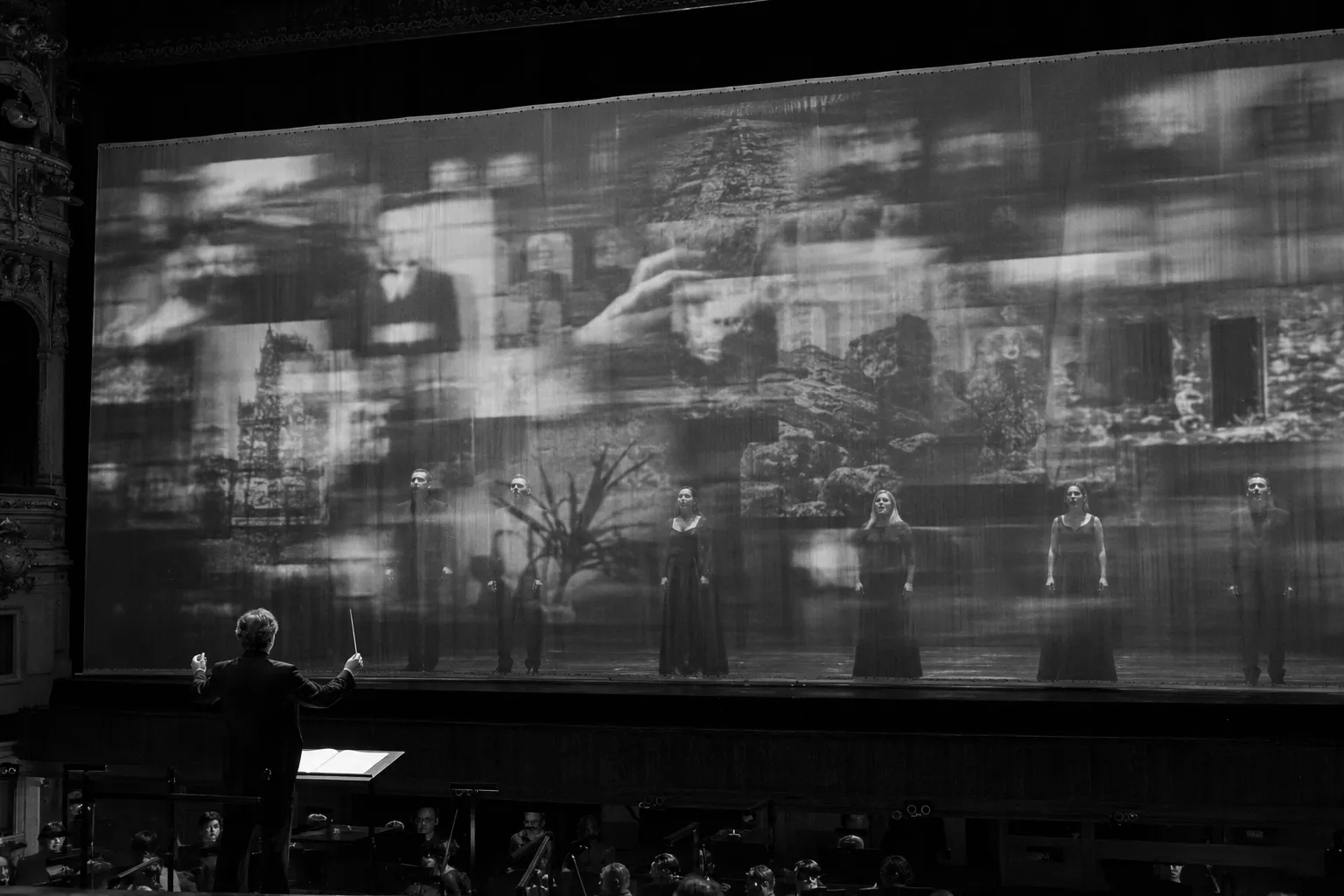
For Bayreuth’s 150th anniversary, a creative team led by Marcus Lobbes called Wagner’s four-opera Ring of the Nibelungen a “curated” production. A screen filled the proscenium while real-time projections drew on Bayreuth’s archive of Ring stagings and a chronology of events. AP independently reported that Lobbes’s team preselected images, that the collage included Helmut Kohl, the World Trade Center after September 11, and a German-reunification stamp, and, citing dpa, that boos and whistles met the team after Götterdämmerung. The Guardian’s Flora Willson supplied the harsher judgments, calling the rapid association “mindless scrolling” and visual bric-a-brac. Those terms identify Willson’s critical response.
Each scene began with material from the 1876 premiere, after which the system determined the sequence during performance. Faces blurred and hands acquired surplus fingers. Rocks changed into bodies while historical images passed among abandoned rooms and scrap metal. The screen’s placement established a physical hierarchy. It occupied the proscenium’s full width and height; singers performed behind it, mostly stationary, with murders reduced to exits and erotic climaxes to clasped hands. Willson observed that even the silence conductor Christian Thielemann left in Wotan’s monologue could not arrest the projections. Their continuous motion dispersed the dramatic tension she heard in the music, because each image morphed before a gesture could gather force. During Thielemann’s silence, the screen kept moving in front of the singer.
El archivo inquieto
Para el 150 aniversario de Bayreuth, el equipo creativo dirigido por Marcus Lobbes llamó “curada” a su producción de El anillo del nibelungo. Una pantalla ocupaba el proscenio. Las proyecciones en tiempo real recurrían al archivo de montajes del Anillo en Bayreuth y a una cronología pública. AP informó que el equipo preseleccionó imágenes de Helmut Kohl, las Torres Gemelas tras el 11-S y un sello de la reunificación alemana. Citando a dpa, consignó abucheos y silbidos al equipo tras El ocaso de los dioses. En su reseña, Flora Willson, de The Guardian, describió la sucesión como imágenes sin sentido y revoltijo visual.
Cada escena partía de material del estreno de 1876. Durante la función, el sistema determinaba el resto de la secuencia. Los rostros se desenfocaban y aparecían manos con dedos sobrantes. Las rocas se volvían cuerpos entre imágenes históricas, habitaciones abandonadas y chatarra. La pantalla imponía una jerarquía física. Cubría todo el ancho y alto del proscenio; detrás actuaban los cantantes, casi inmóviles, con asesinatos reducidos a salidas y clímax eróticos a manos enlazadas. Willson observó que el silencio de Christian Thielemann en el monólogo de Wotan tampoco detenía las proyecciones. El movimiento disipaba la tensión que percibía en la música, pues cada imagen se transformaba antes de que un gesto cobrara fuerza. Durante aquel silencio, la pantalla siguió moviéndose delante del cantante.









