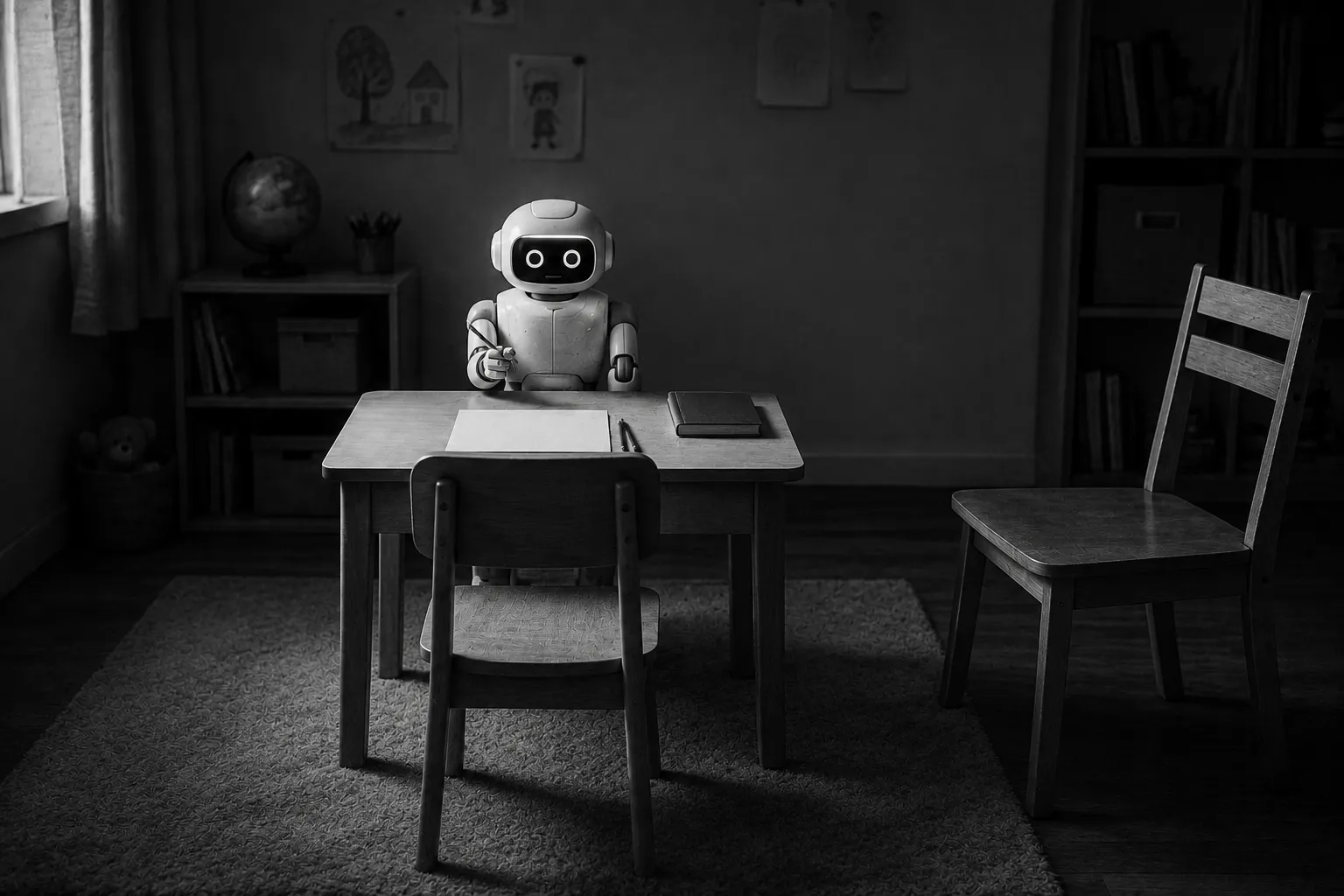
The Mechanical Tutor
At a White House summit on educational technology, Melania Trump appeared beside a Figure AI humanoid and asked the audience to imagine a robot educator called Plato. The proposed tutor would bring literature, science, art, mathematics, history, and philosophy into the home while adapting to each child and remaining permanently patient. The demonstration was aspirational rather than a description of current robotics, but it joined a growing political and commercial enthusiasm for schools where AI handles more instruction.
The mechanical tutor is compelling because it promises to remove the limits that make education difficult: fatigue, uneven access, scarce specialists, and the fixed pace of a classroom. Those limits are also where teaching becomes a relationship. Patience has meaning when another person chooses to offer it; adaptation involves judgment about a child’s silence, confidence, family, and needs. A robot can present the entire archive while knowing none of the life into which that archive must enter. The image of Plato at home therefore shifts education from a public institution toward a private service delivered by hardware and maintained by a company. Whether machines can explain algebra is secondary to who defines the lesson, observes the child, stores the interaction, and remains accountable when the always-available teacher is wrong.
El tutor mecánico
Durante una cumbre de tecnología educativa en la Casa Blanca, Melania Trump apareció junto a un humanoide de Figure AI y pidió imaginar un robot educador llamado Platón. El tutor propuesto llevaría literatura, ciencia, arte, matemáticas, historia y filosofía al hogar, adaptándose a cada niño y manteniéndose siempre paciente. La demostración era una aspiración y no una descripción de la robótica actual, pero se sumó al creciente entusiasmo político y comercial por escuelas donde la IA asume una parte mayor de la enseñanza.
El tutor mecánico resulta atractivo porque promete eliminar los límites que dificultan la educación: cansancio, acceso desigual, escasez de especialistas y el ritmo fijo del aula. Esos límites también son el lugar donde enseñar se convierte en una relación. La paciencia tiene significado cuando otra persona decide ofrecerla; la adaptación exige interpretar el silencio, la confianza, la familia y las necesidades de un niño. Un robot puede presentar el archivo completo sin conocer la vida en la que debe entrar ese archivo. La imagen de Platón en casa desplaza así la educación desde una institución pública hacia un servicio privado entregado por una máquina y mantenido por una empresa. La pregunta no es si puede explicar álgebra, sino quién define la lección, observa al menor, almacena la interacción y responde cuando el maestro siempre disponible se equivoca.









