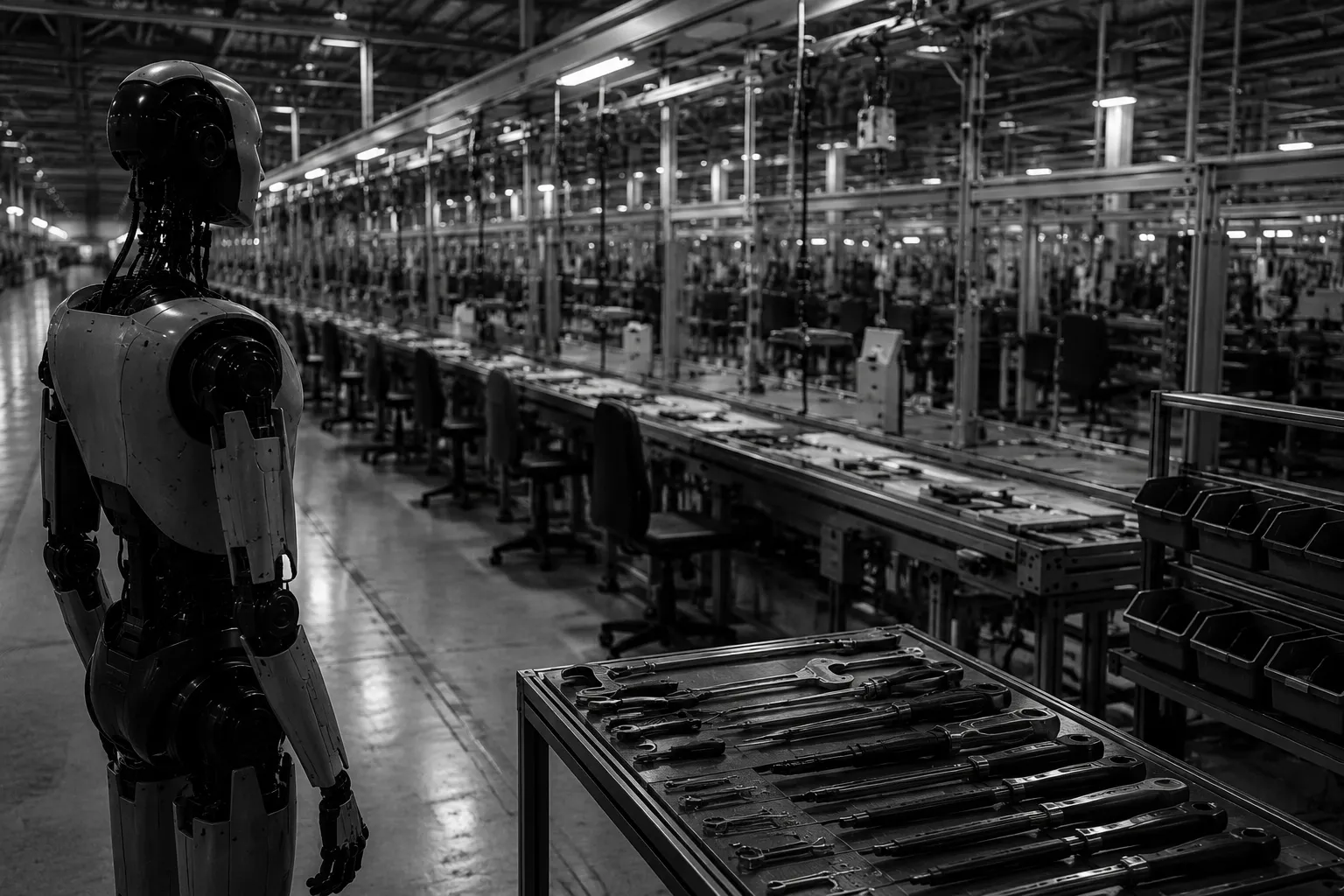
The Factory Human
Chinese humanoid robot companies are shipping units and iterating faster than their U.S. competitors, helped by a manufacturing base built around electric vehicles, sensors, batteries, and industrial automation. Unitree reportedly shipped roughly 36 times as many robots last year as U.S. rivals Figure and Tesla. The early market is moving from televised demonstrations toward warehouses, factories, retail, and rehabilitation, TechCrunch reported on February 28th.
The robot's public image begins with spectacle. At China's Spring Festival Gala, humanoids performed kung fu flips before returning to the less cinematic work of moving goods and repeating physical tasks. The speed advantage comes from compressing research, supply chains, manufacturing, and deployment into one industrial loop. Machines can enter a workplace, fail, collect new data, and return in a revised form before a distant competitor has finished its demonstration. The body is already ahead of the software in some respects, while autonomy remains limited by scarce real-world training data and safety problems. The humanoid becomes ordinary when it occupies a station for a long shift. The performance ends when the robot is expected to keep working after the cameras leave.
El humano de fábrica
Las empresas chinas de robots humanoides están enviando unidades y repitiendo diseños más rápido que sus competidores estadounidenses, apoyadas por una base manufacturera construida alrededor de los vehículos eléctricos, los sensores, las baterías y la automatización industrial. Unitree habría enviado el año pasado unas 36 veces más robots que sus rivales estadounidenses Figure y Tesla. El mercado inicial está pasando de las demostraciones televisadas a los almacenes, las fábricas, el comercio minorista y la rehabilitación, informó TechCrunch el 28 de febrero.
La imagen pública del robot comienza con el espectáculo. En la Gala del Festival de Primavera de China, los humanoides hicieron volteretas de kung fu antes de regresar al trabajo menos cinematográfico de mover mercancías y repetir tareas físicas. La ventaja de velocidad procede de comprimir la investigación, las cadenas de suministro, la fabricación y el despliegue dentro de un mismo circuito industrial. Las máquinas pueden entrar en un lugar de trabajo, fallar, recoger datos nuevos y regresar en una versión revisada antes de que un competidor lejano termine su demostración. El cuerpo ya está por delante del software en algunos aspectos, mientras la autonomía sigue limitada por la escasez de datos reales y los problemas de seguridad. El humanoide se vuelve ordinario cuando ocupa un puesto durante un turno largo. La actuación termina cuando el robot debe seguir trabajando después de que se van las cámaras.









